Exercise 12.7
Genetic similarity — similarities in inherited features, which scientists study in detail using DNA. These features help in understanding the similarities and differences among organisms. Similar features in organisms suggest that they have evolved from common ancestors.
Not cross-checked
NCERT prints no numerical answer for this exercise, so this working has not been cross-checked against the book.
This item's stored text is a long mis-extracted block of body text. The chapter's Pause and Ponder $\displaystyle 7$ (page $\displaystyle 248$) asks whether 'biodiversity' means only the variety of organisms, or something wider.
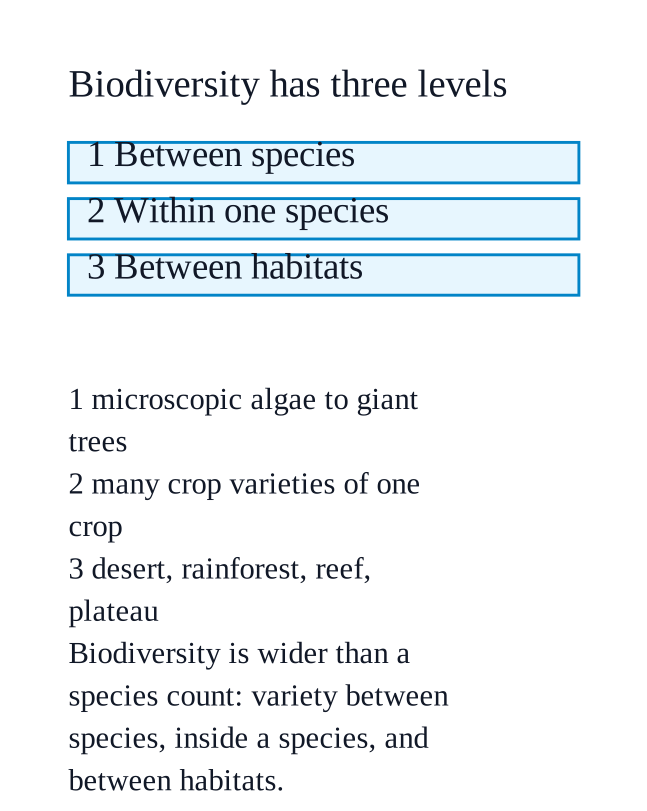
It is wider than a species count — biodiversity covers variety at three levels, all of which the chapter uses.
Variety between species. The plain meaning: the immense variety of living organisms, from microscopic algae to giant trees, from glowing jellyfish to soaring eagles.
Variety within a single species. Farmers conserved diverse crop varieties of the same crop — some drought-tolerant, some pest-resistant, some able to grow in nutrient-poor soils. That is inherited variation inside one species, and it is why diversity reduces the risk of crop failure.
Variety of habitats and ecosystems. Mountains, desert, rainforest, plateaus, coastlines, coral reefs — each with its own soil and climate. The chapter even classifies the floating phumdis of Loktak Lake as one of the world's unique habitats.
The interconnections themselves. Algae releasing oxygen, fungi and bacteria decomposing litter, bees and bats pollinating — these links keep ecosystems working and are part of what is lost when biodiversity falls.
Practical proof it is more than a list of names: a region counts as a biodiversity hotspot only if it has many endemic species and has suffered significant habitat loss — habitat is built into the idea.
