Exercise 12.6
How does the diversity of organisms contribute to the balance and stability of an ecosystem?
Not cross-checked
NCERT prints no numerical answer for this exercise, so this working has not been cross-checked against the book.
Because every organism performs a job that some other organism depends on — diversity keeps all the jobs filled.
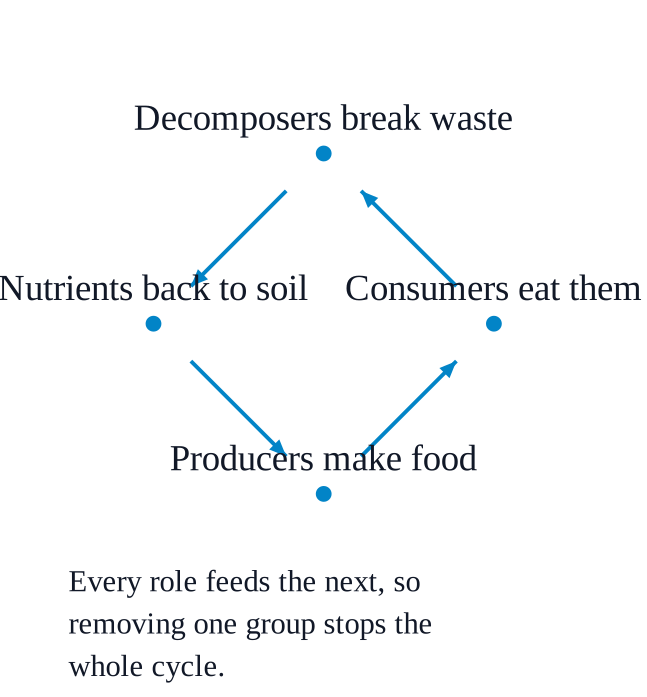
The ecological roles are shared out. Producers capture sunlight and make food, consumers feed on them, and decomposers return the material to the soil. Remove any one role and the cycle stops.
Oxygen and food supply. Microscopic algae in the oceans release most of the oxygen we breathe; plants form the base of most food chains.
Nutrient recycling. Fungi and bacteria decompose fallen leaves and waste into manure, making the soil fertile. Without fungi, decay would be greatly reduced and soil fertility and ecological balance would suffer.
Reproduction of plants depends on animals. Birds, bees and bats pollinate flowers; animals, birds, wind and water disperse seeds.
Diversity is insurance against failure. The chapter's farming example makes it general: diversity reduces the risk of crop failure. In a diverse ecosystem, the loss of one species is less likely to bring everything down.
Losses cascade the other way too. When one species disappears, others that depend on it decline and may disappear as well — which is why a low-diversity system is fragile.
Diversity buffers real disasters. Villages with more mangroves suffered less destruction in the \(\displaystyle 1999\) Odisha super cyclone; forest diversity in the Western Ghats acts as a biological barrier against Kyasanur Forest Disease; diverse soil microorganisms break down pollutants and mangrove soils trap heavy metals.