Exercise 12.1
If many organisms share common features, could they also share a common ancestry?
Not cross-checked
NCERT prints no numerical answer for this exercise, so this working has not been cross-checked against the book.
Yes — shared features are the main clue to shared ancestry. The chapter says it directly: similar features in organisms suggest that they have evolved from common ancestors.
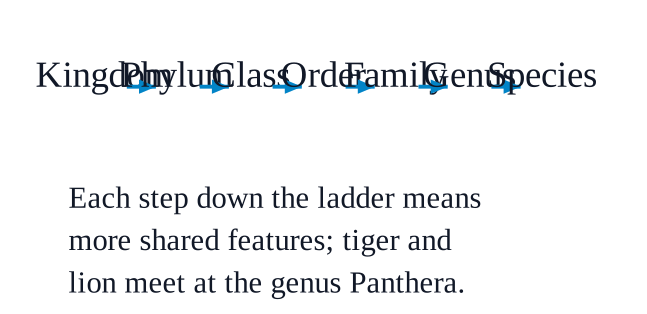
The more features two organisms share, the closer the ancestry. That is why classification is a ladder — Kingdom → Phylum → Class → Order → Family → Genus → Species — and at each lower level organisms share more common features.
Example from the chapter: tiger (Panthera tigris) and lion (Panthera leo) sit in the same genus Panthera because both can roar and have a similar skull structure.
But the kind of feature matters. Easily visible outside features can mislead — Aristotle grouped animals by habitat (land, water, air) and that system had to be abandoned. Scientists therefore also compare internal structure, cell structure and reproduction.
The strongest evidence is genetic: DNA carries the instructions for growth and function, and organisms with similar DNA are taken to have a common ancestry. This is how Carl Woese proposed the three domains in \(\displaystyle 1977\).