SolveItClass 9 · NCERT

NCERT Solutions · Class 9 Science Patterns in Life: Diversity and Classification

25 questions · 25 still being checked

Pause and Ponder 12.9–12.10 (part 13 of 14)

  1. Exercise 12.9

    Why do genetic studies provide deep information about living beings?

    Not cross-checked

    NCERT prints no numerical answer for this exercise, so this working has not been cross-checked against the book.

    Because DNA is the cause of the features, not just another feature. Every living cell contains genetic material that carries the instructions for its growth and function, so comparing DNA compares organisms at the level where their similarities and differences actually originate.
    It reveals ancestry directly. Organisms with similar DNA are taken to have a common ancestry — a relationship you can only guess at from outward appearance.
    It corrects mistakes made from looks alone. Aristotle's habitat-based grouping failed because it relied on easily observable external characteristics. Genetic data does not depend on how an organism happens to look or where it lives.
    It works where the microscope runs out. Microscopic organisms look alike but are not alike. Genetic study showed that microscopic life is far more diverse than anyone had believed.
    It has already rewritten classification. On genetic data, Carl Woese proposed the three domain system in \(\displaystyle 1977\) — Bacteria, Archaea, Eukarya — splitting two groups of prokaryotes that a microscope could not tell apart.
    This is why 'genetic similarity' appears in the chapter's list of classification criteria alongside external features, internal structure and cell structure.
  2. Exercise 12.10

    How can changes in climate affect the biodiversity? wet soil

    Not cross-checked

    NCERT prints no numerical answer for this exercise, so this working has not been cross-checked against the book.

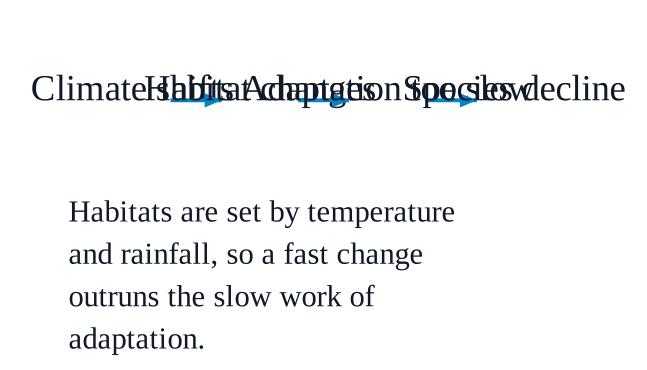
    Climate change reduces biodiversity, mainly by changing habitats faster than species can adapt to them. The chapter lists it beside pollution, deforestation and the overuse of resources as a cause of biodiversity loss.
    NCERT_Solution_Class9_Science_Ch12_PP_Q12-10
    Habitats are defined by climate. Each Indian region — Himalaya, western desert, north-eastern rainforest, southern plateau, coastline — has its own temperature and rainfall, and it is these conditions that decide which species live there. Shift the temperature and rainfall and the habitat itself changes.
    Species survive by adaptation, and adaptation is slow. Diversity arose from small differences accumulating over many generations. A rapid change in conditions does not leave enough generations for that to happen, so the organisms that cannot cope simply decline.
    Endemic species are hit hardest. Nilgiri tahr, lion-tailed macaque, Nepenthes khasiana and Neelakurinji are found naturally nowhere else — if their one region becomes unsuitable, they have nowhere to move to.
    Losses spread through the food web. When one species disappears, others that depend on it decline and may disappear too — pollinators lose their flowers, hornbills lose their fruiting trees.
    Special features become liabilities. Thick fur in polar bears and fat storage in camels suit particular extremes; a change in those extremes turns a survival feature into a burden.
    Habitat loss is the mechanism to name in an answer. The chapter's own example is the phumdis of Loktak Lake degenerating and putting the endemic Sangai deer on the IUCN Red Data list.