Exercise 8.8
Magnesium is essential for many biological processes, including muscle contraction. For an atom of magnesium with a mass number of and atomic number , determine the number of (i) protons, (ii) neutrons, (iii) electrons, and also illustrate the arrangement of electrons in a magnesium atom.
NCERT’s answer
(i)
Protons $\displaystyle 12$ (ii) Neutrons $\displaystyle 12$ (iii) Electrons $\displaystyle 12$; Electronic configuration $\displaystyle 2$, $\displaystyle 8$, $\displaystyle 2$
(i) protons \(\displaystyle = 12\) (ii) neutrons \(\displaystyle = 12\) (iii) electrons \(\displaystyle = 12\)
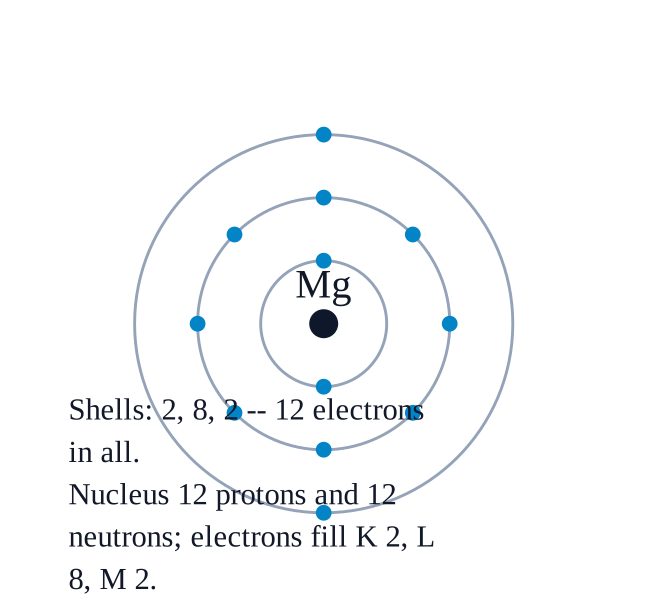
(i) Atomic number \(\displaystyle Z = 12\), and \(\displaystyle Z\) is the number of protons → $\displaystyle 12$ protons.
(ii) \(\displaystyle \text{neutrons} = A - Z = 24 - 12 = 12\) → $\displaystyle 12$ neutrons.
(iii) A magnesium atom is electrically neutral, so electrons \(\displaystyle =\) protons \(\displaystyle = \) $\displaystyle 12$ electrons.
Electronic configuration: fill K first (maximum \(\displaystyle 2\times1^{2} = 2\)), then L (maximum \(\displaystyle 2\times2^{2} = 8\)), and the $\displaystyle 2$ left over go into M → $\displaystyle 2$, $\displaystyle 8$, $\displaystyle 2$.
What your drawing must contain:
a small circle at the centre for the nucleus, labelled inside with "$\displaystyle 12$ p, $\displaystyle 12$ n";
three concentric circles drawn around it, labelled K (n = $\displaystyle 1$), L (n = $\displaystyle 2$) and M (n = $\displaystyle 3$), with K nearest the nucleus;
$\displaystyle 2$ dots on the K circle, $\displaystyle 8$ dots on the L circle, $\displaystyle 2$ dots on the M circle — check that \(\displaystyle 2 + 8 + 2 = 12\);
the $\displaystyle 2$ electrons on the outermost M shell marked as the valence electrons;
a title, "Magnesium, \(\displaystyle ^{24}_{12}\text{Mg}\)".
