SolveItClass 9 · NCERT

NCERT Solutions · Class 9 Science Journey Inside the Atom

33 questions · 19 still being checked

Pause and Ponder 8.7–8.8 (part 13 of 23)

  1. Exercise 8.7

    Assertion (A): Rutherford concluded that most of the mass of an atom is concentrated in a small region at the centre called the nucleus. Reason (R): According to Thomson’s model, electrons are embedded in a uniformly distributed positive charge sphere. Choose the correct option: (i) Both A and R are true, and R is the correct explanation of A. (ii) Both A and R are true, but R is not the correct explanation of A. (iii) A is true, but R is false. (iv) A is false, but R is true.

    Not cross-checked

    NCERT prints no numerical answer for this exercise, so this working has not been cross-checked against the book.

    NCERT’s answer
    (ii)
    (ii) Both A and R are true, but R is not the correct explanation of A.
    NCERT_Solution_Class9_Science_Ch8_PP_Q8-7
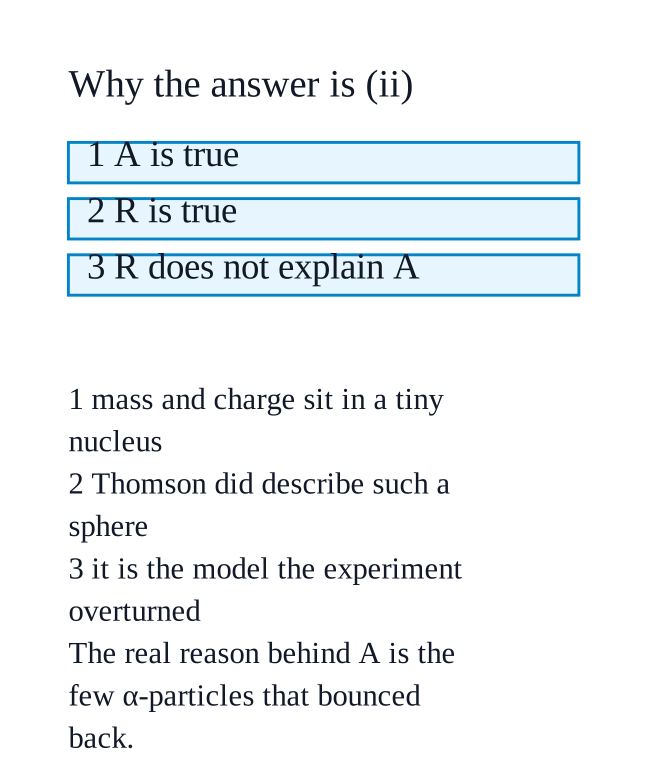
    A is true: from the gold foil experiment Rutherford concluded that the positive charge and most of the mass are concentrated in a tiny central region, the nucleus.
    R is also true: Thomson's model really does describe electrons embedded in a uniformly distributed sphere of positive charge.
    But R describes the older model that this experiment overturned. It gives no reason at all for Rutherford's conclusion.
    The real reason behind A is the observation that a few α-particles were deflected through large angles and a few bounced back.
    So both statements stand on their own, but R does not explain A — which is option (ii).
  2. Exercise 8.8

    Imagine you are a scientist who has discovered a new element. Name this element after yourself and justify that the symbol you have chosen follows the IUPAC rules.

    Not cross-checked

    NCERT prints no numerical answer for this exercise, so this working has not been cross-checked against the book.

    Worked example: a student named Anaya discovers an element, names it anayium, and chooses the symbol An.
    NCERT_Solution_Class9_Science_Ch8_PP_Q8-8
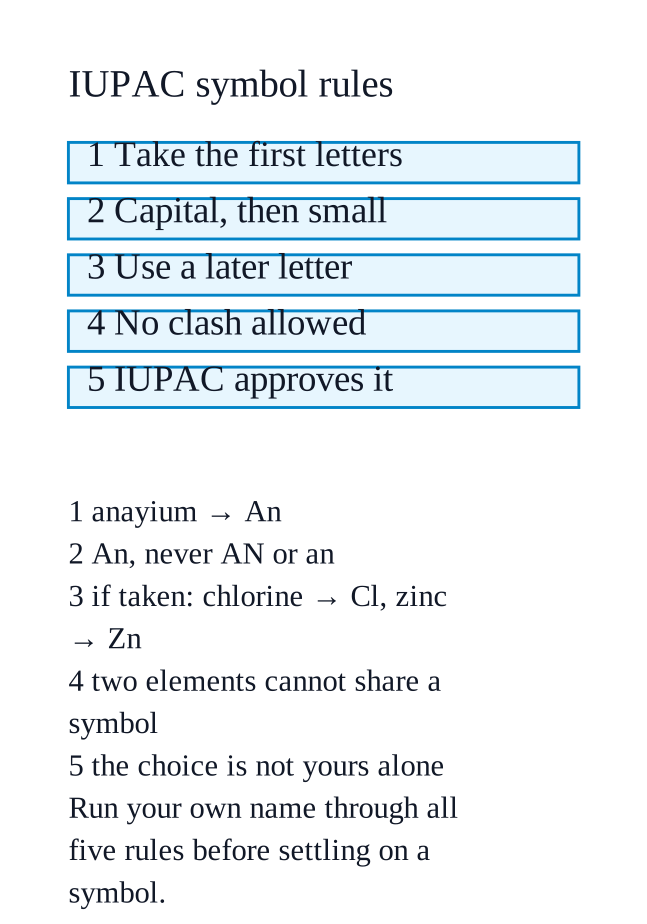
    Rule $\displaystyle 1$ — the symbol is taken from the first letters of the name: Anayium gives An. ✓
    Rule $\displaystyle 2$ — the first letter is a capital and the second is small: An, never AN or an (just as cobalt is Co, not CO). ✓
    Rule $\displaystyle 3$ — if those first two letters are already in use, take the first letter with a later letter of the name instead, the way chlorine gives Cl and zinc gives Zn; so "Ay" or "Ai" would be the fallback here. Not "Am" — that is already americium. ✓
    Rule $\displaystyle 4$ — the symbol must not clash with an existing element's symbol, or the same two letters would stand for two elements at once. ✓
    Rule $\displaystyle 5$ — the choice is not yours alone to make final: IUPAC approves the names and symbols of all elements internationally.
    Now repeat this with your own name and check your symbol against the same five points.