Exercise 8.7
Assertion (A): The discovery of subatomic particles helped in understanding the atomic structure. Reason (R): The number of electrons is equal to the number of protons in an atom. Choose the correct option: (i) Both A and R are true, and R is the correct explanation of A. (ii) Both A and R are true, but R is not the correct explanation of A. (iii) A is true, but R is false. (iv) A is false, but R is true.
Not cross-checked
NCERT prints no numerical answer for this exercise, so this working has not been cross-checked against the book.
NCERT’s answer
(ii)
(ii) Both A and R are true, but R is not the correct explanation of A.
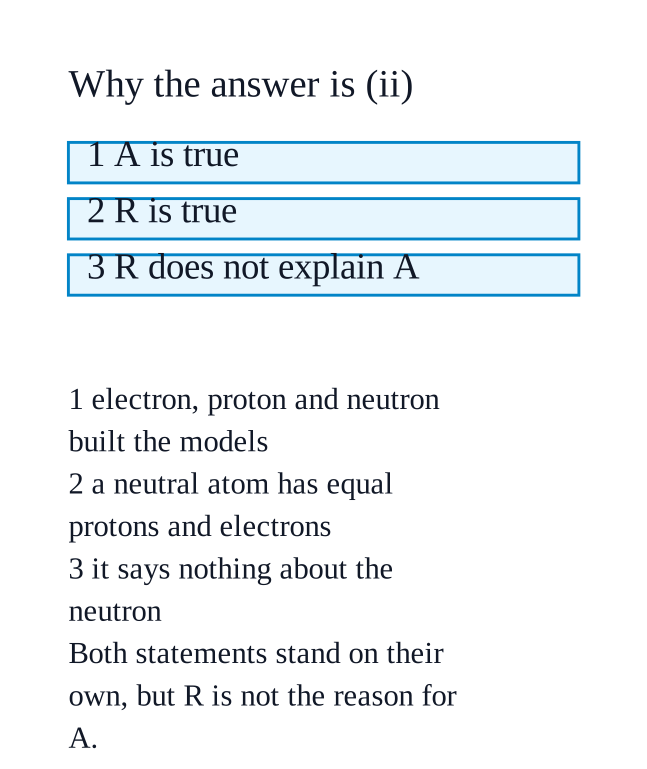
A is true — the electron (Thomson, $\displaystyle 1897$), the proton (Rutherford) and the neutron (Chadwick, $\displaystyle 1932$) are exactly the particles out of which atomic structure is built. Each discovery forced a better model.
R is true as well — in a neutral atom the number of electrons equals the number of protons: helium has $\displaystyle 2$ and $\displaystyle 2$, sodium has $\displaystyle 11$ and 11.
But R is only one particular fact about two of those particles. It does not say why discovering subatomic particles advanced our understanding of atomic structure.
Indeed R cannot explain A, because the neutron — one of the three discoveries — has nothing to do with the electron-proton balance at all.
Both statements true, R not the explanation → option (ii).