Exercise 8.3
The composition of the nuclei of three atomic species X, Y, and Z are given as follows. Number of protons Number of neutrons Explain the relation between the following: (i) Y and Z (ii) Z and X
Not cross-checked
NCERT prints no numerical answer for this exercise, so this working has not been cross-checked against the book.
NCERT’s answer
(i)
Isotopes (ii) Isobars
(i) Y and Z are isotopes. (ii) Z and X are isobars.
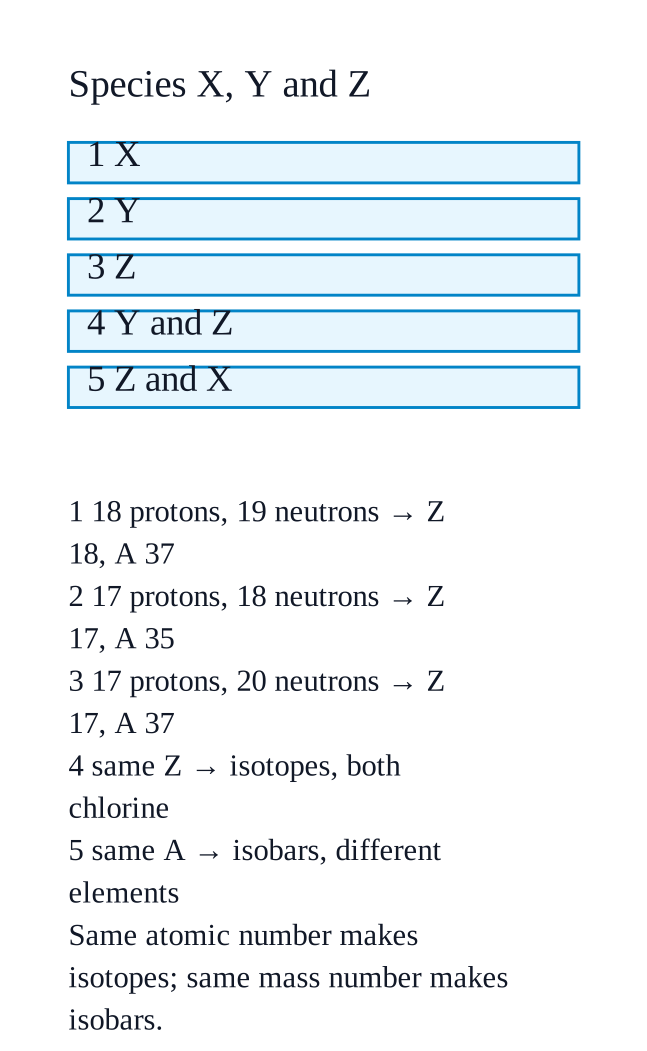
First work out the atomic number and mass number of each species, using \(\displaystyle Z = \text{protons}\) and \(\displaystyle A = \text{protons} + \text{neutrons}\):
X: atomic number \(\displaystyle = 18\), mass number \(\displaystyle = 18 + 19 = 37\)
Y: atomic number \(\displaystyle = 17\), mass number \(\displaystyle = 17 + 18 = 35\)
Z: atomic number \(\displaystyle = 17\), mass number \(\displaystyle = 17 + 20 = 37\)
(i) Y and Z both have $\displaystyle 17$ protons, so the same atomic number, but mass numbers $\displaystyle 35$ and 37. Same \(\displaystyle Z\), different \(\displaystyle A\) → isotopes. They are the same element (chlorine), with the same electronic configuration and so the same chemical properties.
(ii) Z and X both have mass number $\displaystyle 37$, but atomic numbers $\displaystyle 17$ and 18. Same \(\displaystyle A\), different \(\displaystyle Z\) → isobars. Because the atomic number differs, these are different elements.