SolveItClass 9 · NCERT

NCERT Solutions · Class 9 Science Journey Inside the Atom

33 questions · 19 still being checked

Revise, Reflect, Refine 8.1–8.2 (part 2 of 23)

  1. Exercise 8.1

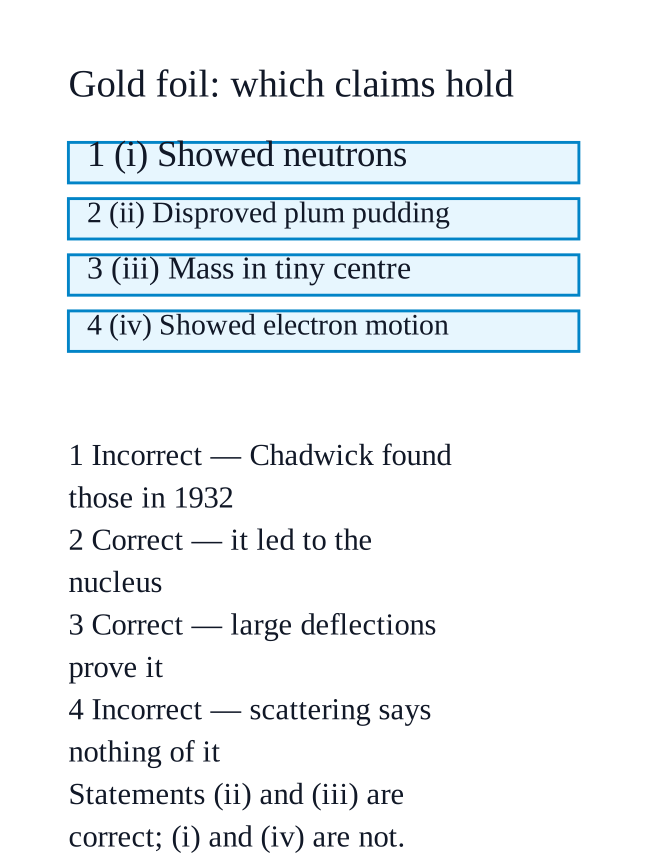
    Choose the correct options and explain the reason for the correct and incorrect options in the context of Ernest Rutherford’s gold foil experiment: (i) The experiment clearly showed the existence of neutrons in the nucleus. (ii) The results disproved the plum pudding model and led to the idea of a nucleus at the centre of the atom. (iii) The large deflection of a few alpha particles indicated that most of the mass of the atom and positive charge are packed into a tiny centre. (iv) The way alpha particles were deflected showed that electrons move around the nucleus.

    Not cross-checked

    NCERT prints no numerical answer for this exercise, so this working has not been cross-checked against the book.

    NCERT’s answer
    (ii)
    , (iii) are correct
    Correct: (ii) and (iii). Incorrect: (i) and (iv).
    NCERT_Solution_Class9_Science_Ch8_RRR_Q8-1
    (ii) Correct — Thomson's evenly spread positive charge predicted that every α-particle would pass through or be deflected only slightly. Large deflections and bounce-backs contradicted that prediction outright, and forced the idea of a nucleus at the centre.
    (iii) Correct — only a very small region carrying a large positive charge and most of the atom's mass can turn a fast α-particle through a large angle. That such deflections were rare shows how tiny that centre is.
    (i) Incorrect — the experiment revealed nothing about neutrons. The neutron was discovered by James Chadwick in $\displaystyle 1932$, twenty-one years later; being uncharged, it could not have repelled α-particles at all.
    (iv) Incorrect — the scattering only recorded what happens to positive particles near the positive centre. Electrons are far too light to deflect an α-particle noticeably, so the experiment gave no evidence about how electrons move. The orbiting-electron picture was a proposal Rutherford added to his model, not something the deflections showed — and it was in fact the part his model could not defend, since it failed to explain atomic stability.
  2. Exercise 8.2

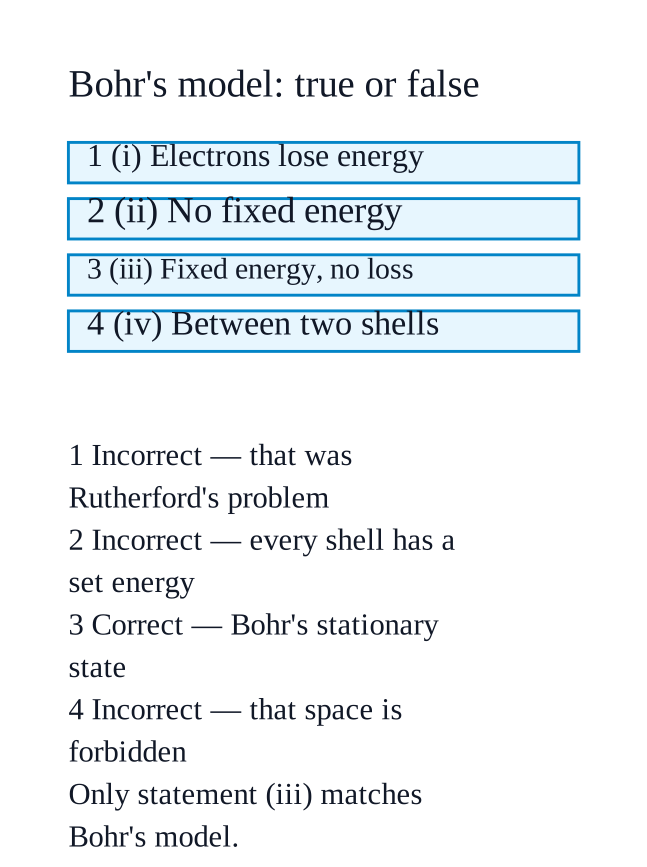
    Which of the following statements are correct or incorrect according to the Bohr’s atomic model? Give a reason for each statement. (i) Electrons lose energy while moving in fixed orbits and slowly fall into the nucleus. (ii) Electrons can exist anywhere around the nucleus with no fixed energy. (iii) Electrons revolve around the nucleus in orbits of fixed energy without losing energy. (iv) Electrons can be found between energy levels as they move around the nucleus.

    Not cross-checked

    NCERT prints no numerical answer for this exercise, so this working has not been cross-checked against the book.

    NCERT’s answer
    (iii)
    is correct
    Only (iii) is correct. (i), (ii) and (iv) are all incorrect.
    NCERT_Solution_Class9_Science_Ch8_RRR_Q8-2
    (i) Incorrect — Bohr's model says the opposite. In a fixed orbit, a stationary state, the electron's energy stays constant and it does not lose energy, so it never spirals in. The spiralling problem belonged to Rutherford's model, and Bohr's model exists precisely to remove it.
    (ii) Incorrect — electrons cannot exist just anywhere. Each shell (K, L, M, N ... or \(\displaystyle n = 1, 2, 3, 4 ...\)) has a definite energy, and an electron must occupy one of them.
    (iii) Correct — this is Bohr's stationary-state postulate exactly: electrons revolve in orbits of fixed energy without losing energy. It is what explains why atoms are stable and do not collapse.
    (iv) Incorrect — the space between two shells is forbidden. An electron changes shell only by absorbing or releasing a fixed amount of energy equal to the difference between the two levels; it is never found in between.