Exercise 8.2
Could an orange or a lemon, which also contain seeds inside soft pulp, be a good comparison? In what ways does it match Thomson’s idea and where does it fall short?
Not cross-checked
NCERT prints no numerical answer for this exercise, so this working has not been cross-checked against the book.
Yes, it works as a rough comparison, but it is a weaker one than the watermelon the chapter uses.
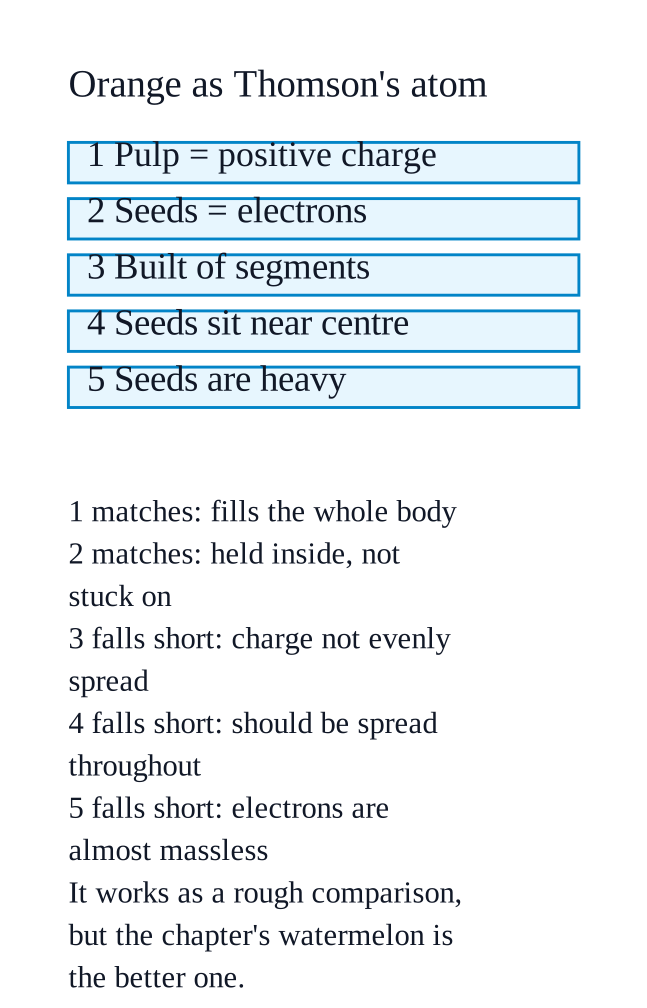
Where it matches: the soft pulp plays the part of the positively charged matter that fills the whole atom.
Where it matches: the seeds play the part of the electrons, held inside that matter rather than stuck on the outside.
Where it matches: the fruit is a single round body, like Thomson's single sphere.
Where it falls short: an orange is built of segments, so its pulp is not the smooth, evenly spread positive charge Thomson imagined.
Where it falls short: the seeds sit in a few fixed places near the centre, whereas Thomson's electrons are spread throughout the sphere.
Where it falls short: the seeds are heavy compared with the pulp, while an electron's mass is almost negligible compared with the atom.
Where it falls short: no part of a fruit is charged at all, so it cannot show the balance of positive against negative charge — which is the entire point of the model.