Exercise 8.4
What do you think would happen if α-particles were replaced with negatively charged particles in Rutherford’s gold foil experiment?
Not cross-checked
NCERT prints no numerical answer for this exercise, so this working has not been cross-checked against the book.
The deflections would reverse in direction: negative particles would be pulled towards the nucleus instead of being pushed away from it.
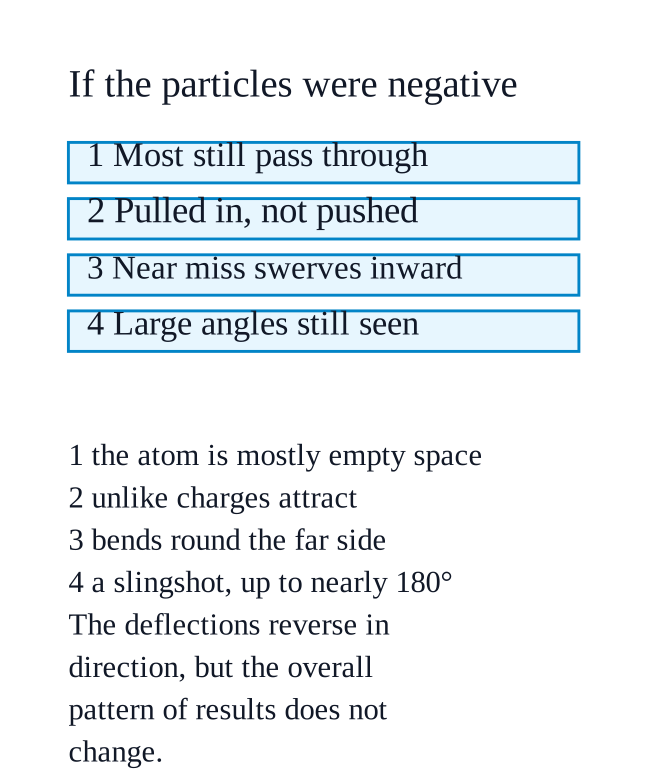
The nucleus is positively charged. It repels a positive α-particle, but unlike charges attract, so it would attract a negative particle.
Most particles would still pass straight through, because the atom is mostly empty space — that part of the result would not change at all.
The few that came close to a nucleus would swerve inward, bending round the far side of it, instead of being pushed outward from the near side.
Large-angle scattering, right up to nearly \(\displaystyle 180^\circ\), would still be seen. A particle aimed almost straight at the nucleus is whipped tightly around it and comes back out roughly the way it came — a slingshot, the way a comet swinging past the Sun is turned right around by attraction.
For the same off-centre aim, an attracting nucleus turns a particle through the same angle as a repelling one; only the side it passes on differs. So the experiment would still show a tiny, dense, charged nucleus in a mostly empty atom.
The atom's electrons would repel them slightly, but electrons have far too little mass to deflect a fast particle by much.