Exercise 8.5
Explain and arrange the following statements in the correct chronological order to show how atomic models have evolved over time. (i) Bohr’s model proposed that electrons move in fixed orbits around the nucleus, each with a definite energy. (ii) Thomson’s model depicted the atom as a ʻplum puddingʼ with electrons embedded in a sphere of positive charge. (iii) Rutherford’s model proposed that atoms have a dense central nucleus. (iv) Dalton’s model described atoms as indivisible particles.
Not cross-checked
NCERT prints no numerical answer for this exercise, so this working has not been cross-checked against the book.
Correct chronological order: (iv) → (ii) → (iii) → (i).
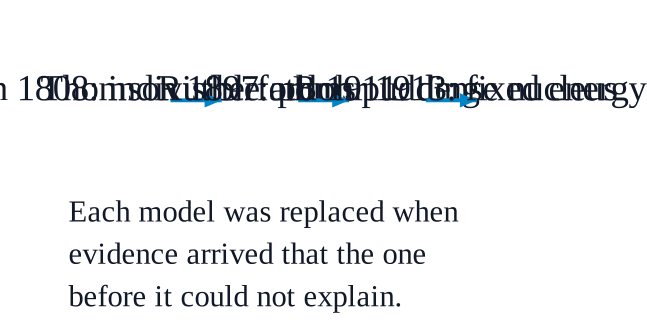
(iv) Dalton, $\displaystyle 1808$ — all matter is made of indivisible particles called atoms, the fundamental building blocks that cannot be broken down. The first scientific description of matter, and the starting point for everything after it.
(ii) Thomson, after his $\displaystyle 1897$ discovery of the electron — cathode-ray work showed atoms contain smaller negative particles, so atoms are not indivisible. To keep the atom neutral he placed electrons inside a sphere of positive charge: the plum pudding model.
(iii) Rutherford, $\displaystyle 1911$ — the gold foil experiment showed most α-particles pass straight through while a few are thrown sharply back. The positive charge and most of the mass must therefore sit in a dense central nucleus, with the rest of the atom empty.
(i) Bohr, $\displaystyle 1913$ — Rutherford's orbiting electrons should have lost energy and spiralled in. Bohr fixed this by allowing only certain shells of definite energy, in which an electron moves without losing energy — which explains why atoms are stable.
Each step was forced by the failure of the one before it: this is how the chapter shows science moving forward, keeping what works and repairing what does not.