Exercise 8.4
What conclusion did Rutherford draw about the position and characteristics of the atom’s positively charged part based on the few alpha particles that bounced back or were deflected at large angles in the gold foil experiment?
Not cross-checked
NCERT prints no numerical answer for this exercise, so this working has not been cross-checked against the book.
Rutherford concluded that the positive charge is not spread through the atom at all, but packed into a tiny, dense centre he called the nucleus.
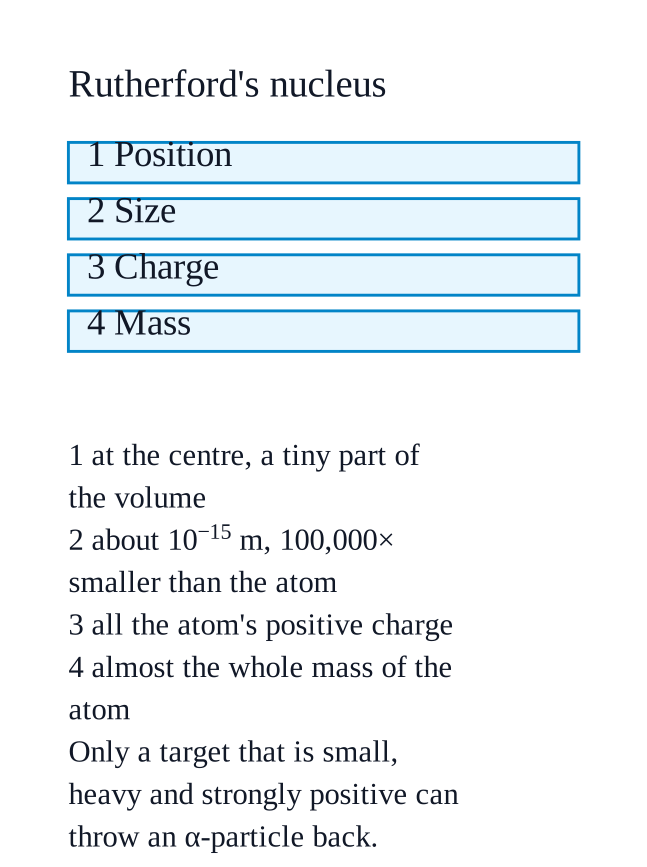
Position — at the centre of the atom, occupying an extremely small part of its volume.
Size — diameter about \(\displaystyle 10^{-15}\ \text{m}\), against an atom's \(\displaystyle 10^{-10}\ \text{m}\); that is roughly \(\displaystyle 10^{5}\) times smaller than the atom itself.
Charge — it carries all the positive charge of the atom, concentrated enough to repel an approaching α-particle violently.
Mass — it is dense, holding almost the entire mass of the atom.
Why the bounce-backs prove this: an α-particle is itself positive, fast and heavy, so only a near head-on approach to a small region of large positive charge and large mass can push it straight back the way it came.
Why so few bounced back: such a target is a very small mark to hit. Most α-particles missed it completely and went straight through, which is what shows that the rest of the atom is empty space.