Exercise 13.5
How are mountain and valley breezes formed? Suppose there are two mountains, one covered with grass and another covered with barren rocks; would the temperature of the two mountain breezes be different? If so, how?
Not cross-checked
NCERT prints no numerical answer for this exercise, so this working has not been cross-checked against the book.
Valley breeze (daytime, air flows up the slope): the Sun-facing mountain slopes heat up faster than the valley floor, so the air above them becomes warm and rises, creating a low pressure region; cooler air from the valley then moves up the slopes to replace it.
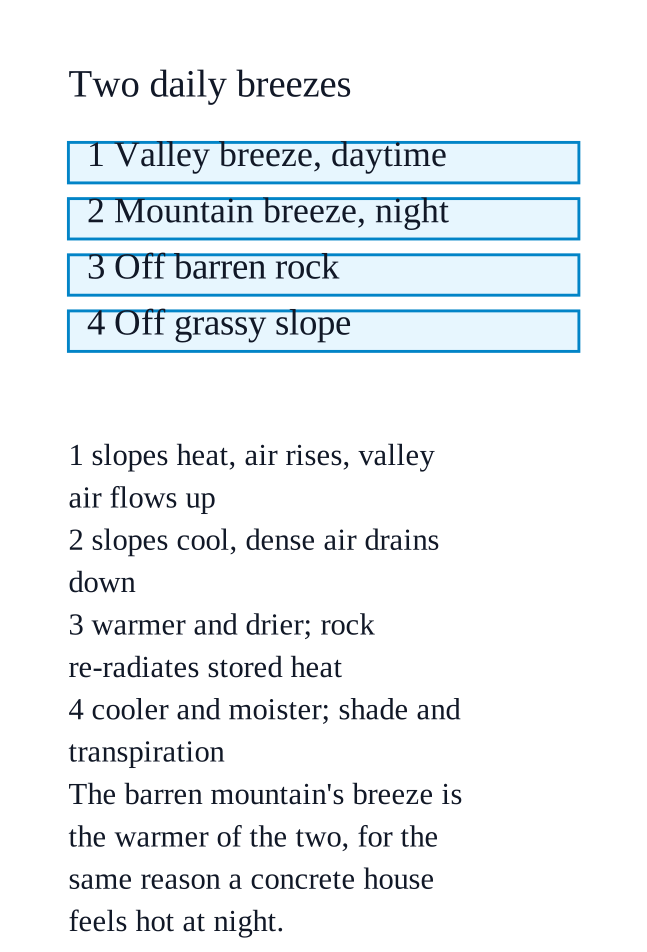
Mountain breeze (after sunset, air flows down into the valley): the slopes lose heat faster and become cooler while the valley floor stays relatively warmer; the air over the slopes becomes cool and dense and flows down into the valley.
Such daily reversals of wind direction are common in hilly regions like Shimla, Dehradun and other Himalayan valleys.
Yes — the two mountain breezes would differ in temperature. The breeze off the barren rocky mountain would be comparatively warmer (and drier).
Bare rock has a low albedo (crushed rock reflects only \(\displaystyle 0.25-0.30 \)), so during the day it absorbs a large amount of solar radiation and stores heat.
At night the rock re-radiates that stored heat into the air above it — exactly the reason a concrete house feels hot at night while a thick mud-and-wood house stays cool — so the air draining off the rocky slope is warmer.
The grass-covered mountain stays cooler through the day by shade and transpiration and stores less heat, so the air sinking off it at night is cooler; the transpired water vapour also makes that breeze more moist.