SolveItClass 9 · NCERT

NCERT Solutions · Class 9 Science Earth as a System: Energy, Matter, and Life

23 questions · 23 still being checked

Revise, Reflect, Refine 13.7–13.16 (part 11 of 11)

  1. Exercise 13.7

    Explain the processes involved in the nitrogen cycle. How would life on Earth be affected if nitrogen were not cycled?

    Not cross-checked

    NCERT prints no numerical answer for this exercise, so this working has not been cross-checked against the book.

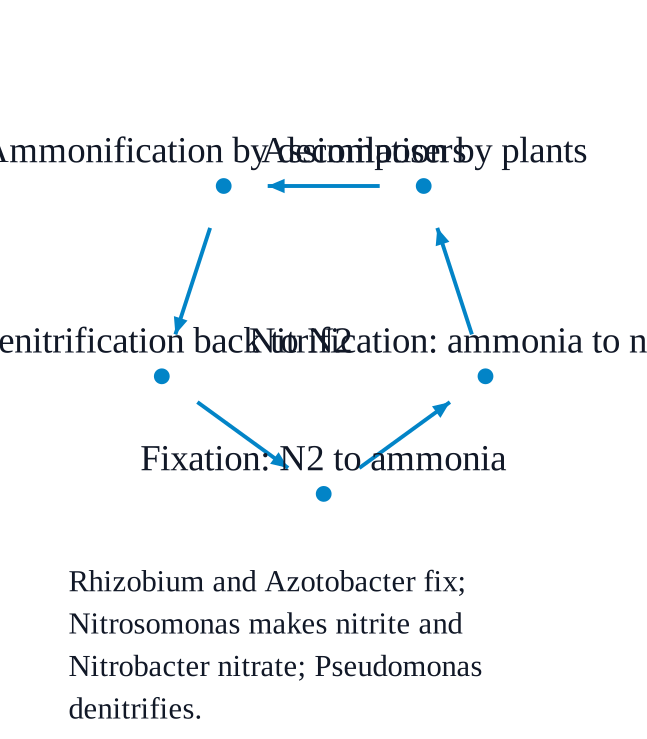
    The nitrogen cycle is the overall movement of nitrogen between air, soil, water and organisms; atmospheric \(\displaystyle N_{2} \) is the largest reservoir but is non-reactive, so it must first be converted into soluble compounds.
    NCERT_Solution_Class9_Science_Ch13_RRR_Q13-7
    Nitrogen fixation — nitrogen-fixing bacteria such as Rhizobium in the root nodules of legumes and Azotobacter in the soil convert atmospheric \(\displaystyle N_{2} \) into ammonia (\(\displaystyle NH_{3} \)). Lightning fixes a tiny amount as nitrogen oxides, and industrially the Haber–Bosch process does most of it today.
    NitrificationNitrosomonas converts ammonia into nitrite (\(\displaystyle NO_{2}^{-} \)), and Nitrobacter converts nitrite into nitrate (\(\displaystyle NO_{3}^{-} \)).
    Assimilation — plants take up these nitrogen compounds from the soil; animals obtain their nitrogen by eating plants or other animals.
    Ammonification — when plants and animals die or produce waste, decomposers such as bacteria and fungi break down the organic matter and return ammonia to the soil.
    Denitrification — denitrifying bacteria such as Pseudomonas convert some nitrates back into nitrogen gas, returning it to the atmosphere and completing the cycle.
    If nitrogen were not cycled: the huge atmospheric store would stay useless, because \(\displaystyle N_{2} \) cannot be absorbed directly by plants or animals.
    No nitrate or ammonia in the soil means plants cannot synthesise proteins and nucleic acids, so growth, seed formation and crop yields would fail.
    Animals, which get all their nitrogen from plants, would be starved of protein, and food chains would collapse.
    Nitrogen locked up in dead bodies and waste would never be released back to the soil, so ecosystems could not recover or maintain their balance.
  2. Exercise 13.8

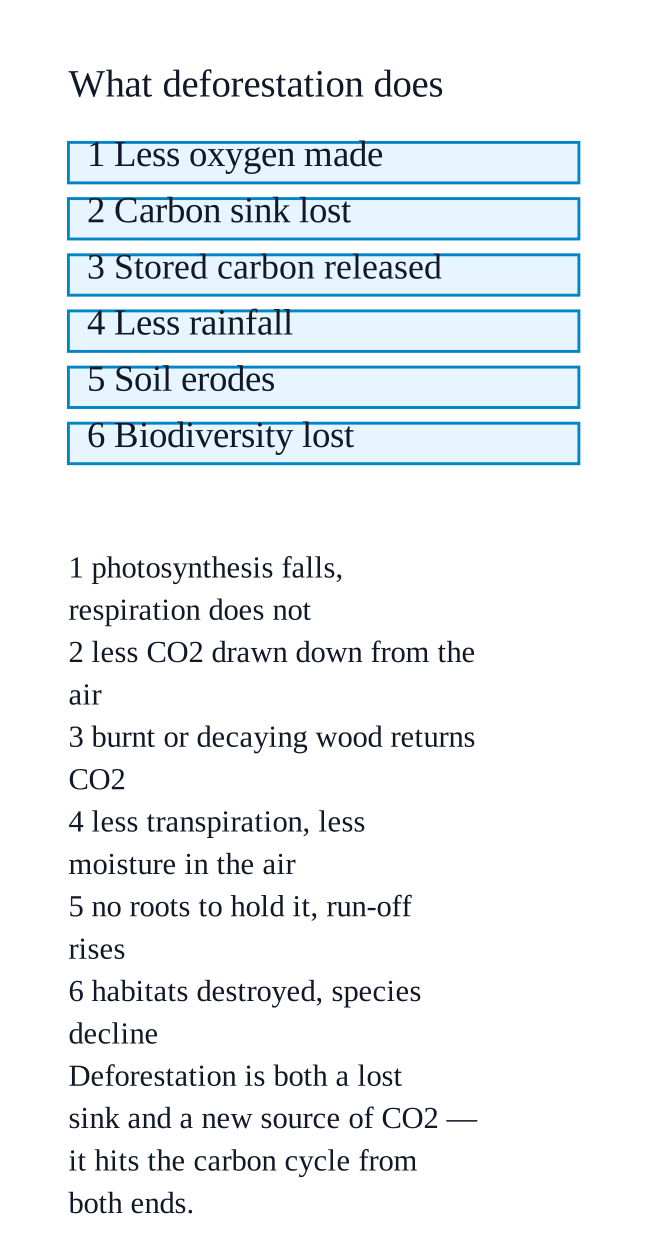
    What are the impacts of deforestation on the Earth’s oxygen and carbon cycles? What are the other consequences of deforestation?

    Not cross-checked

    NCERT prints no numerical answer for this exercise, so this working has not been cross-checked against the book.

    Oxygen cycle: fewer trees means less photosynthesis, so less \(\displaystyle O_{2} \) is returned to the atmosphere, while respiration and the combustion of fuels keep on consuming it — the production side of the balance is weakened.
    NCERT_Solution_Class9_Science_Ch13_RRR_Q13-8
    Carbon cycle (uptake): forests are natural carbon sinks; clearing them means less atmospheric \(\displaystyle CO_{2} \) is drawn down by photosynthesis, and the remaining sinks become saturated.
    Carbon cycle (release): the carbon stored in the wood is returned to the air as \(\displaystyle CO_{2} \) when the trees are burnt or decay, so deforestation is a source of \(\displaystyle CO_{2} \) as well as a loss of sink.
    Net effect: atmospheric \(\displaystyle CO_{2} \) rises, intensifying the greenhouse effect and global warming — deforestation, along with fossil-fuel burning, is one of the two causes the chapter names for the \(\displaystyle 35\% \) rise since 1960.
    Less rainfall: reduced transpiration puts less moisture into the air, which can cause a decline in local rainfall.
    Altered albedo: removing forest cover changes the fraction of sunlight the surface reflects, changing local heating.
    Soil erosion: without tree roots to hold the soil together, erosion increases; run-off rises and infiltration falls.
    Loss of biodiversity: habitats are destroyed over time, and many species decline as they lose their natural homes.
  3. Exercise 13.9

    Explain with suitable diagram the path that carbon takes to go back to the atmosphere. You may start from plants using CO2\displaystyle CO_{2} from the atmosphere.

    Not cross-checked

    NCERT prints no numerical answer for this exercise, so this working has not been cross-checked against the book.

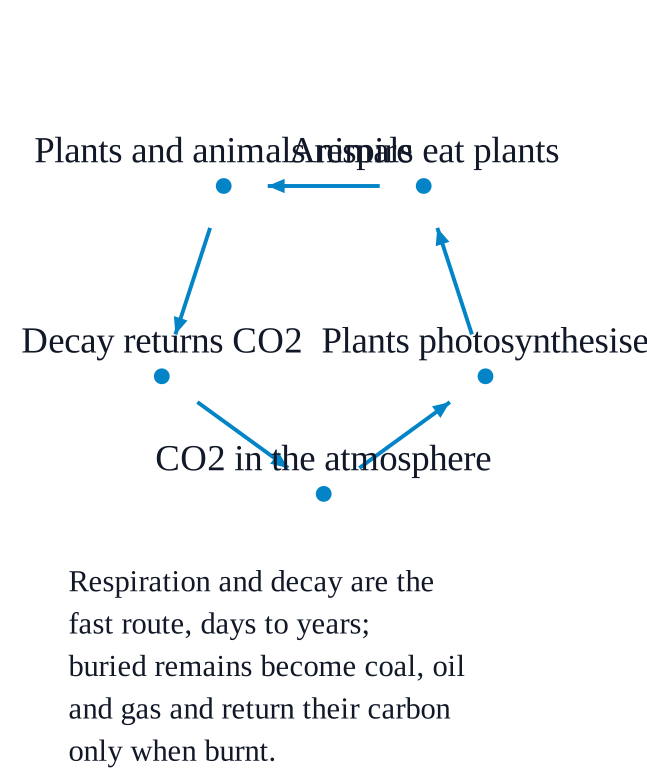
    Carbon starts in the air as \(\displaystyle CO_{2} \), is fixed by plants, and returns to the air by four routes: respiration, decomposition, combustion of fossil fuels, and exchange with ocean water.
    NCERT_Solution_Class9_Science_Ch13_RRR_Q13-9
    Step $\displaystyle 1$ — Photosynthesis: plants take \(\displaystyle CO_{2} \) from the atmosphere and, using sunlight, convert it into glucose.
    Step $\displaystyle 2$ — Respiration (fast route, days to years): plants themselves respire and release some \(\displaystyle CO_{2} \) straight back; animals that eat plants or other animals respire and release \(\displaystyle CO_{2} \) too.
    Step $\displaystyle 3$ — Decomposition: when plants and animals die, decomposers break down the organic matter and \(\displaystyle CO_{2} \) returns to the air.
    Step $\displaystyle 4$ — Combustion of fossil fuels (slow route, millions of years): buried dead plants and animals are converted over millions of years into coal, oil and gas; burning these for heating, cooking, transport and industry releases that carbon as \(\displaystyle CO_{2} \) on a very short time scale.
    Step $\displaystyle 5$ — Ocean exchange: the atmosphere and ocean water continuously exchange \(\displaystyle CO_{2} \); dissolved \(\displaystyle CO_{2} \) becomes carbonate and bicarbonate ions used by phytoplankton and by shell-forming organisms, and when they die and sink, carbon is stored on the ocean floor for long periods.
    What your diagram must show
    Draw a closed loop. Put a box at the top labelled "\(\displaystyle CO_{2} \) in the atmosphere".
    A downward arrow from that box to a box "Plants", labelled Photosynthesis.
    An arrow from "Plants" to a box "Animals", labelled "feeding".
    Two upward arrows back to the \(\displaystyle CO_{2} \) box — one from "Plants" and one from "Animals" — each labelled Respiration.
    Arrows from "Plants" and "Animals" down to a box "Dead plants and animals", then an upward arrow from it to the \(\displaystyle CO_{2} \) box labelled Decomposition.
    A branch from "Dead plants and animals" down to a box "Fossil fuels — coal, oil, gas", labelled "burial over millions of years", and an upward arrow from that box to the \(\displaystyle CO_{2} \) box labelled Combustion of fossil fuels.
    To one side, a box "\(\displaystyle CO_{2} \) dissolved in ocean water — plankton and shells" joined to the \(\displaystyle CO_{2} \) box by a double-headed arrow labelled Absorption / release.
    Mark the respiration and decomposition arrows as the fast cycle (days to years) and the fossil-fuel branch as the slow cycle (millions of years).
  4. Exercise 13.10

    Why is an excess of CO2\displaystyle CO_{2} in the atmosphere considered undesirable even though it is required by plants?

    Not cross-checked

    NCERT prints no numerical answer for this exercise, so this working has not been cross-checked against the book.

    \(\displaystyle CO_{2} \) is genuinely needed — plants use it for photosynthesis and it keeps the Earth warm enough to sustain life — but the balance is critical, and an excess breaks it.
    NCERT_Solution_Class9_Science_Ch13_RRR_Q13-10
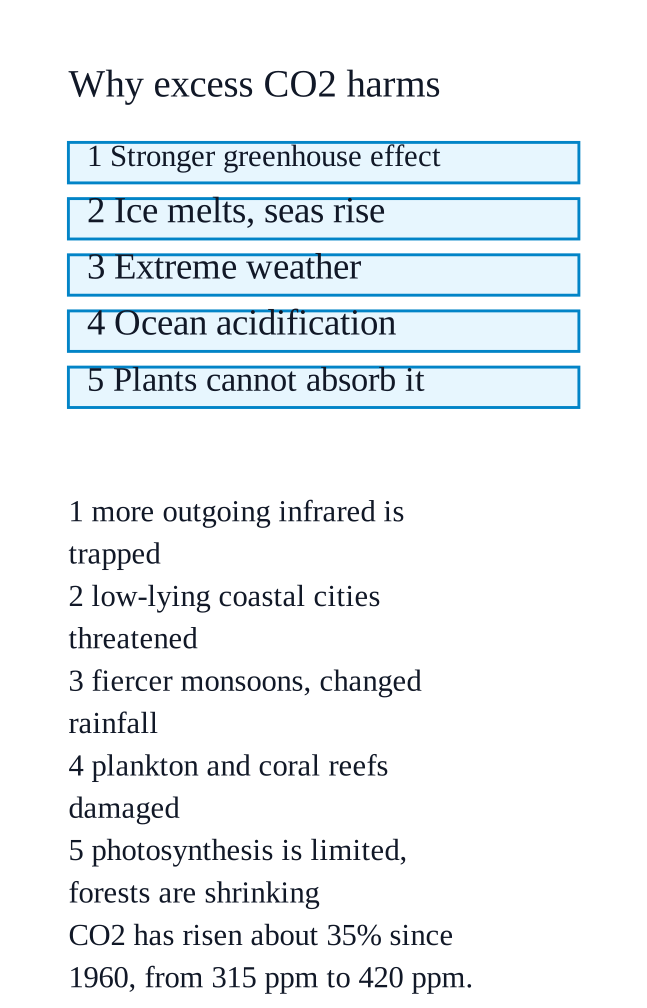
    Enhanced greenhouse effect: extra \(\displaystyle CO_{2} \) traps more of the outgoing infrared radiated by the Earth's surface, causing global warming.
    Melting ice and rising seas: glaciers and Arctic sea ice melt, sea level rises, and low-lying coastal cities are threatened.
    Extreme weather: in India this may mean more intense monsoons (warmer air holds more moisture) and changed rainfall patterns that threaten agriculture.
    Ocean acidification: the ocean absorbs the excess \(\displaystyle CO_{2} \) and sea water becomes more acidic, threatening plankton and coral reefs and disrupting marine ecosystems.
    Plants cannot simply mop it up: photosynthesis is limited by water, light, nutrients and available forest area, and deforestation is shrinking that sink even as emissions grow.
    Scale of the problem: \(\displaystyle CO_{2} \) has risen by about \(\displaystyle 35\% \) since $\displaystyle 1960$, from \(\displaystyle 315 \) ppm to \(\displaystyle 420 \) ppm — a rise unprecedented in the history of human civilisation.
  5. Exercise 13.11

    How is heat lost from the surface of the Earth? What is its significance?

    Not cross-checked

    NCERT prints no numerical answer for this exercise, so this working has not been cross-checked against the book.

    The Earth's surface loses heat mainly by re-radiating it as infrared radiation into the atmosphere and space.
    NCERT_Solution_Class9_Science_Ch13_RRR_Q13-11
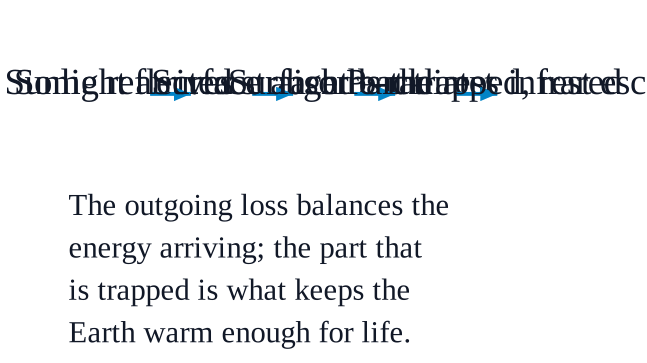
    By day the surface absorbs incoming solar radiation (UV, visible and infrared), warms up, and then radiates that energy back at longer, infrared wavelengths — because all objects radiate heat.
    Part of this outgoing infrared is absorbed by the greenhouse gases \(\displaystyle CO_{2} \), \(\displaystyle CH_{4} \) and water vapour and sent back down; the rest escapes into space.
    A further part of the incoming radiation never heats the surface at all — it is reflected straight back by the surface (its albedo) and by clouds and the atmosphere.
    Significance — energy balance: this outgoing loss balances the energy arriving from the Sun. If heat were not lost, the Earth would go on getting hotter without limit.
    Significance — habitable temperature: the partial trapping of the outgoing heat is what keeps the planet warm enough for life; without the atmosphere the Earth would be too cold to live on.
    Everyday evidence: a concrete house feels hot at night because the concrete re-radiates the heat it absorbed during the day, while a thick mud-and-wood house stays cool because it re-radiates less.
  6. Exercise 13.12

    If the Earth were a flat disc instead of a sphere, how would the patterns of solar radiation and temperature be different?

    Not cross-checked

    NCERT prints no numerical answer for this exercise, so this working has not been cross-checked against the book.

    On a flat disc facing the Sun, every point would receive the rays at the same angle, so insolation — and therefore temperature — would be nearly the same all over the lit face.
    NCERT_Solution_Class9_Science_Ch13_RRR_Q13-12
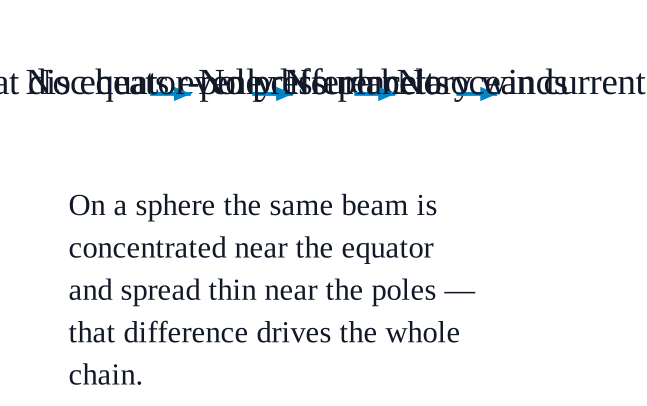
    On the actual spherical Earth, the rays strike different latitudes at different angles: near the equator the beam is concentrated over a small area, while near the poles the same beam is spread over a much larger area.
    That is exactly why equatorial regions stay relatively warm all year and polar regions stay much colder — the equator-to-pole temperature difference.
    On a disc that difference would vanish: no hot equator, no cold poles, and no distinct climate zones by latitude.
    With uniform heating there would be no equatorial low, sub-tropical high, sub-polar low or polar high pressure belts, so the planetary winds would not form.
    With no planetary winds dragging the surface water, the wind-driven ocean currents and gyres would not form either, and heat would not be carried from equator to poles.
    Some uneven heating would remain — land heats faster than water, and dark low-albedo surfaces heat faster than bright ones — but only as local effects, not the global circulation the chapter describes.
    (This assumes the disc's flat face is turned towards the Sun. If it were tilted, the whole face would simply be heated less, uniformly, rather than being heated unevenly by latitude.)
  7. Exercise 13.13

    Suppose there is a rise in atmospheric temperature on Earth. How would this affect the cryosphere, hydrosphere and biosphere?

    Not cross-checked

    NCERT prints no numerical answer for this exercise, so this working has not been cross-checked against the book.

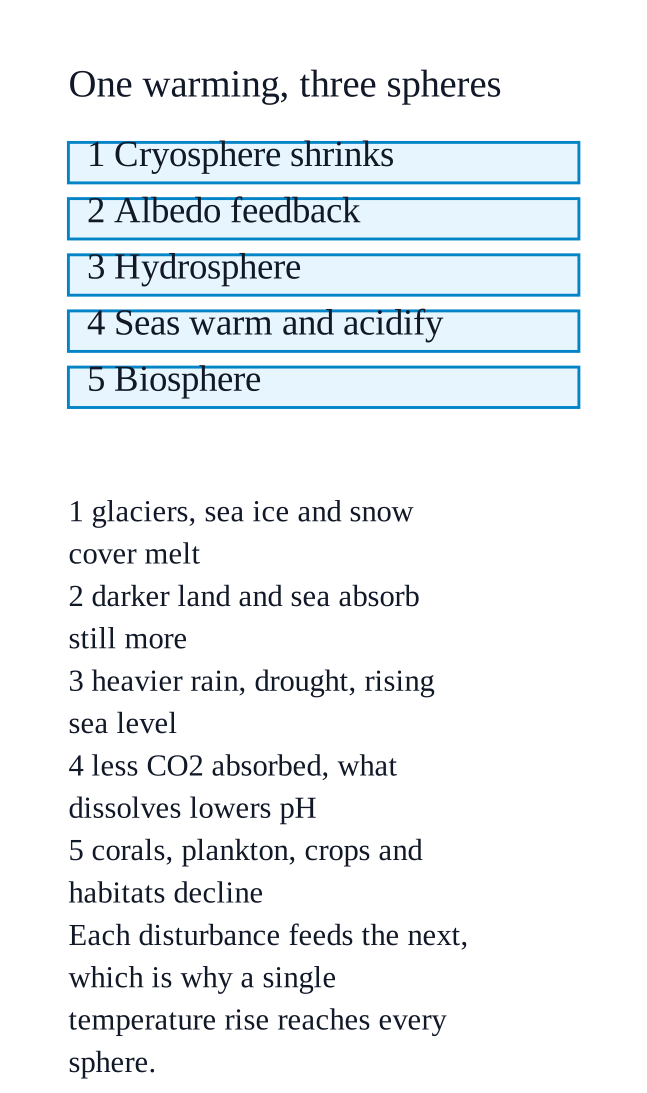
    A rise in atmospheric temperature disturbs all three spheres, and each disturbance feeds the next.
    NCERT_Solution_Class9_Science_Ch13_RRR_Q13-13
    Cryosphere — it shrinks. Glaciers, Arctic sea ice and polar ice caps melt faster and snow cover is reduced.
    Bright ice and snow have a high albedo (\(\displaystyle 0.50-0.90 \)); as they melt, darker land and sea water are exposed, which absorb more radiation and warm the region further.
    Hydrosphere — more water, moved about more violently. A warmer atmosphere holds more moisture, so evaporation increases, giving heavier rain in some regions and drought in others.
    Meltwater adds to rivers and, in the long run, raises sea level, flooding low-lying regions and threatening coastal cities such as Mumbai and Chennai.
    Warmer sea water absorbs less \(\displaystyle CO_{2} \), weakening the ocean as a carbon sink, while the \(\displaystyle CO_{2} \) it does take up makes it more acidic.
    Biosphere — habitat loss and falling biodiversity. Acidic, warmer seas threaten plankton and coral reefs, damaging the base of marine food chains and coastal fisheries.
    On land, changed rainfall patterns and intensified monsoons hurt agriculture, and species that cannot move or adapt to the new temperature lose their habitats and decline.
  8. Exercise 13.14

    Explain how the Earth’s atmosphere helps in maintaining a suitable temperature for life to survive on the Earth.

    Not cross-checked

    NCERT prints no numerical answer for this exercise, so this working has not been cross-checked against the book.

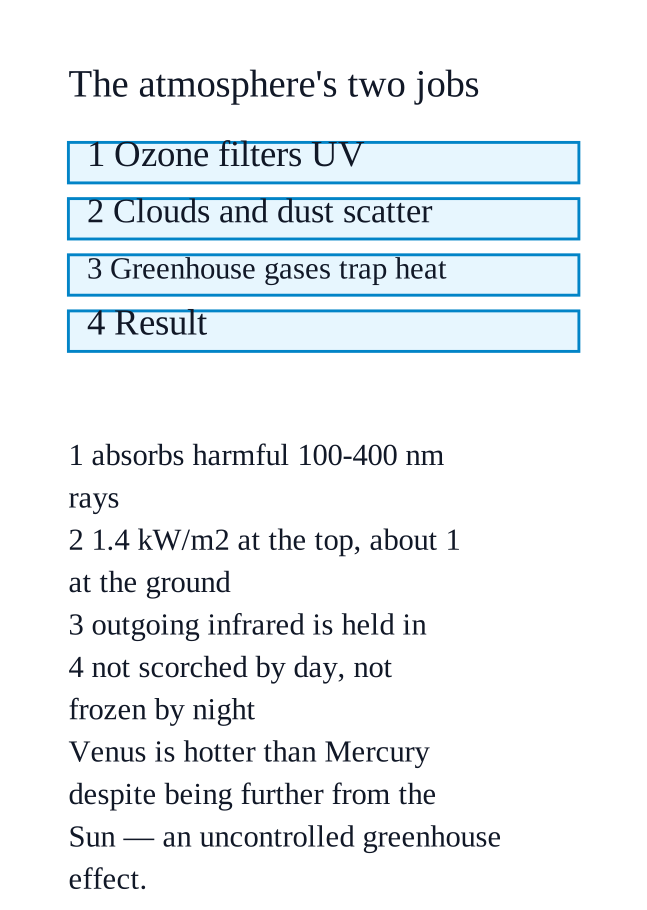
    The atmosphere keeps the Earth's temperature suitable for life by playing two roles at once — it filters what comes in, and it traps part of what goes out.
    NCERT_Solution_Class9_Science_Ch13_RRR_Q13-14
    Role $\displaystyle 1$, absorbing incoming radiation: the ozone layer in the stratosphere absorbs the harmful short-wavelength UV rays (\(\displaystyle 100 \) nm to \(\displaystyle 400 \) nm), and clouds, gases and dust particles absorb or scatter some sunlight before it reaches the ground, so the surface is not scorched.
    Because of this, the maximum insolation reaching the surface is only about \(\displaystyle 1\ kWm^{-2} \), lower than the solar constant of about \(\displaystyle 1.4\ kWm^{-2} \) at the top of the atmosphere.
    Role $\displaystyle 2$, trapping outgoing heat: the surface absorbs sunlight and re-radiates it in the infrared, and the greenhouse gases \(\displaystyle CO_{2} \), \(\displaystyle CH_{4} \) and water vapour absorb this heat, preventing it from escaping straight into space — the greenhouse effect.
    Together these two roles keep both daytime heating and night-time cooling within the range that life can survive; without the atmosphere the Earth would be too cold for life.
    The balance is delicate. Venus is hotter than Mercury even though Mercury is nearer the Sun, because Venus has an atmosphere with an uncontrolled greenhouse effect.
    Excess \(\displaystyle CO_{2} \) from human activities enhances the greenhouse effect and causes global warming, which if left unchecked could make the Earth uninhabitable.
  9. Exercise 13.15

    Describe the interrelationship between different spheres of the Earth. Illustrate with example how these spheres function in a delicate balance. y Consider two hypothetical Earth-sized planets that have an atmosphere. Assume that one planet is entirely covered by oceans and the other is entirely by land. Knowing that the Sun heats the equator more than the poles, how would the wind patterns on these planets compare with the wind systems we observe on Earth, with its combination of land and sea? y Choose any one meal you ate recently (it could be anything, for example, roti and dal, rice and sambar, idli and chutney, and so on). For each main item in the meal, find out and explain: (i) how the carbon in it originally came from carbon dioxide in the air through photosynthesis, and (ii) how the nitrogen in it likely came from the atmosphere into the soil (for example, by bacteria or through the Haber-Bosch process and fertilisers) and then into the plant. Further, list other human activities involved in producing or cooking this meal that add extra carbon dioxide or nitrogen to the environment. y Using data from the India Meteorological Department (IMD, https://mausam.imd.gov.in/) or newspaper records, find the average monsoon rainfall (June - September, or the local season) for your city or district for 5\displaystyle 5 years during two decades, such as the 1980s and 2020s. Note any trend you may find (increasing or decreasing, or the total number of days) with heavy rain (>50\displaystyle 50 mm). How can this be connected to the warmer Arabian Sea temperatures or changes in land use (forests to farms to cities) as discussed in the chapter? The Quest Continues ... New tools are allowing scientists to observe the planet in real time and uncover hidden connections between climate, ecosystems, and human activity. What new discoveries will these tools reveal about the changing Earth, and how will they improve our understanding of global warming and climate change?

    Not cross-checked

    NCERT prints no numerical answer for this exercise, so this working has not been cross-checked against the book.

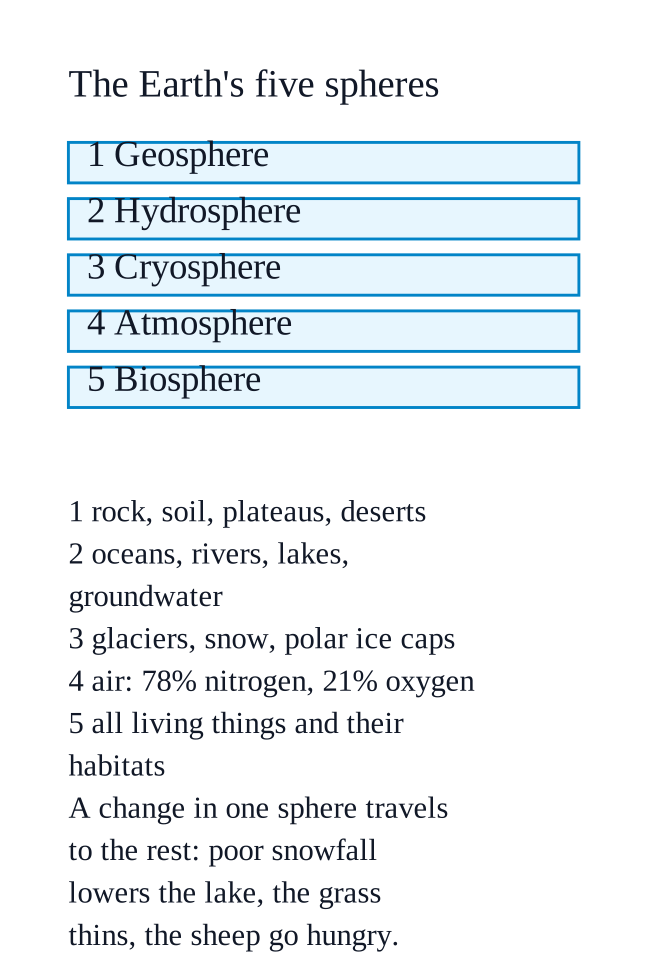
    The Earth's five spheres are joined by continuous flows of energy and matter, so a disturbance in any one sphere produces changes in all the others.
    NCERT_Solution_Class9_Science_Ch13_RRR_Q13-15
    Geosphere — solid rock, soil, landforms such as the Deccan plateau and the Thar desert, and the Earth's interior.
    Hydrosphere — liquid water: oceans, rivers such as the Ganga–Brahmaputra system, lakes and groundwater.
    Cryosphere — water as ice and snow: Himalayan glaciers, snow in Ladakh, polar ice caps.
    Atmosphere — the layer of air held by the Earth's gravity, \(\displaystyle 78\% \) nitrogen and \(\displaystyle 21\% \) oxygen with argon, \(\displaystyle CO_{2} \) and water vapour.
    Biosphere — all living organisms and their habitats: mangroves, forests, farms, ocean plankton and coral reefs.
    Example $\displaystyle 1$ — snow, lake and grass (Activity $\displaystyle 13.1$): snow (cryosphere) melts and feeds a lake (hydrosphere); the lake waters the grass (biosphere) that sheep graze. A few winters of poor snowfall lower the lake in summer, so less water reaches the grass and the sheep have less to eat — one small change travels through three spheres.
    Example $\displaystyle 2$ — the monsoon: a warmer atmosphere heats the Arabian Sea (hydrosphere), causing more evaporation and fluctuations in the southwest monsoon; the result is floods in some parts of India and drought in others. The same warming melts glaciers and polar ice (cryosphere), and rising sea level threatens coastal cities and destroys habitats (biosphere).
    Example $\displaystyle 3$ — deforestation: clearing trees (biosphere) reduces transpiration, so local rainfall declines (atmosphere and hydrosphere); without roots the soil erodes (geosphere); and with less photosynthesis, more \(\displaystyle CO_{2} \) stays in the air, warming the planet further.
    Why the balance is delicate: the connecting flows are cyclic — water, carbon, nitrogen and oxygen must keep returning through the biogeochemical cycles. A break anywhere in a cycle does not stay local; it propagates across every sphere.
  10. Exercise 13.16

    (i)
    66\displaystyle 66 cm 11\displaystyle 11 cm s (iii) 900\displaystyle 900 Chapter 5\displaystyle 5

    Not cross-checked

    NCERT prints no numerical answer for this exercise, so this working has not been cross-checked against the book.

    No solution exists for this item — it is not a question.
    Chapter $\displaystyle 13$'s Revise, Reflect, Refine exercises run from $\displaystyle 1$ to $\displaystyle 15$ only, ending with question $\displaystyle 15$ on the interrelationship between the Earth's spheres.
    The text captured under this number is stray OCR from the Answer Key at the back of the book.
    Specifically, "(i) $\displaystyle 66$ cm (ii) $\displaystyle 14$ cm (iii) \(\displaystyle \tfrac{11}{900} \) cm \(\displaystyle s^{-1} \) (iv) \(\displaystyle \tfrac{7}{2700} \) cm \(\displaystyle s^{-1} \)" is the printed answer to Chapter $\displaystyle 4$, Revise, Reflect, Refine question $\displaystyle 16$ — a motion problem, not an Earth-system one — and "Chapter $\displaystyle 5$" is simply the next heading in the key.
    Recommended action: delete this entry rather than attempt an answer.