Exercise 13.5
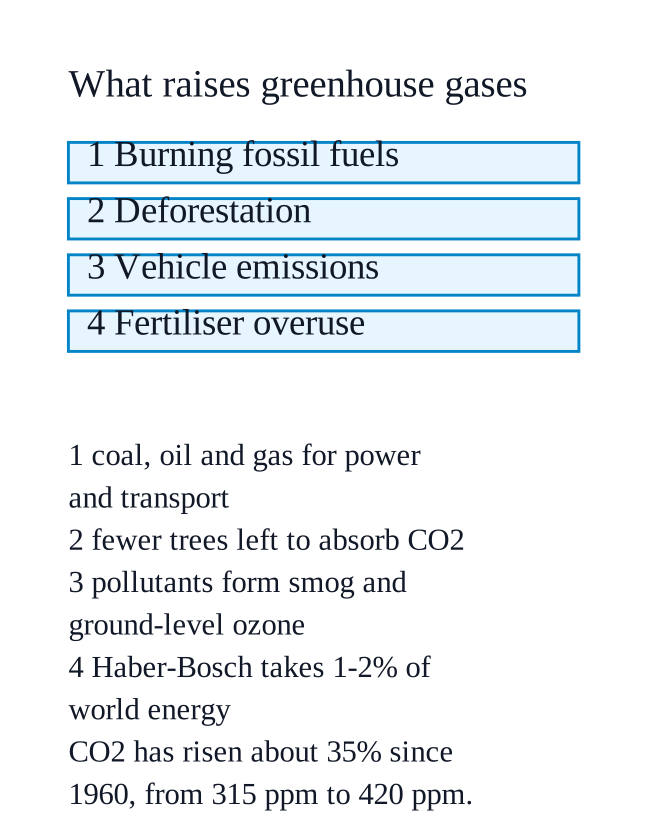
What would happen to plants and animals on Earth if the biogeochemical cycles were disrupted and stopped? Explain by giving a few examples. Burning of fossil fuels and deforestation saturate natural carbon sinks The overuse of fertilisers in agriculture adds excessive
Not cross-checked
NCERT prints no numerical answer for this exercise, so this working has not been cross-checked against the book.
Life would collapse, because the biogeochemical cycles are what keep returning nutrients to living organisms; if they stopped, each nutrient would be locked in a form no organism could use.
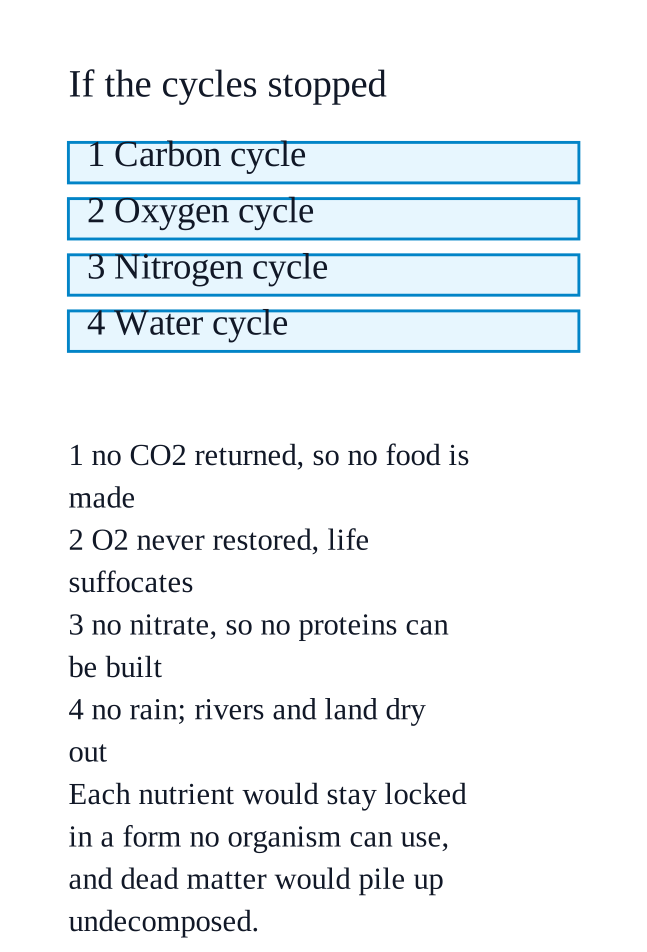
Carbon cycle stops — respiration, decomposition and combustion no longer return \(\displaystyle CO_{2} \) to the air, so plants run out of raw material for photosynthesis and no food is made for any organism.
Oxygen cycle stops — the \(\displaystyle O_{2} \) used up by respiration and combustion is not restored by photosynthesis, so plants and animals eventually suffocate.
Nitrogen cycle stops — atmospheric \(\displaystyle N_{2} \) is non-reactive and cannot be used directly; with no ammonia or nitrate in the soil, plants cannot build proteins and nucleic acids, and animals that eat them are starved of nitrogen too.
Water cycle stops — no evaporation, no clouds, no precipitation; rivers, lakes and groundwater are never refilled, and terrestrial life dries out.
Dead bodies and waste would pile up undecomposed, permanently trapping the nutrients they contain instead of returning them to the soil.