Exercise 13.6
You have witnessed weather phenomena, such as winds, storms, rainfall, etc. Which atmospheric layer is mainly responsible for such phenomena and what is the primary reason for its occurrence?
Not cross-checked
NCERT prints no numerical answer for this exercise, so this working has not been cross-checked against the book.
The troposphere — the lowest layer of the atmosphere, of average height about \(\displaystyle 12 \) km — is responsible for winds, storms and rainfall.
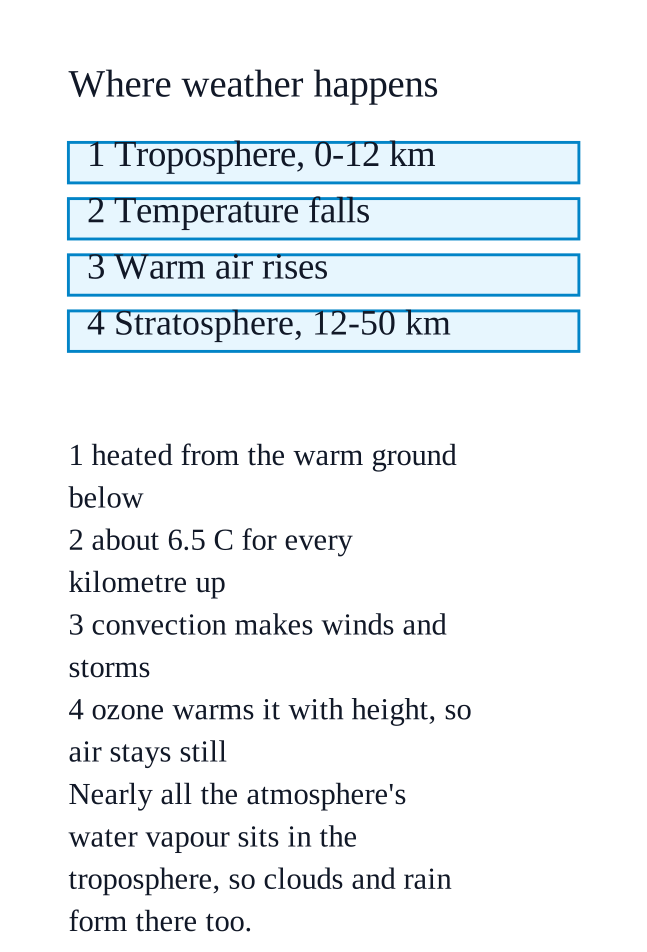
Primary reason: it is heated from the Earth's surface below, not directly by the Sun. The ground absorbs solar radiation and warms the air touching it, so temperature in this layer decreases with height at about \(\displaystyle 6.5\ ^{\circ}\mathrm{C} \) per km.
Warm air near the ground is lighter and rises; cooler air moves in to replace it. This convection is what generates winds and storms.
Nearly all the atmosphere's water vapour is in this layer, so evaporation, condensation and precipitation take place here.
Above it, the stratosphere (\(\displaystyle 12-50 \) km) behaves oppositely: the ozone layer absorbs UV, so temperature rises with height. This calms the layer, prevents vertical mixing of air, and keeps weather confined to the troposphere.
The troposphere's height is greatest above the equator and least above the poles, which is why equatorial regions have the most vigorous weather.