Exercise 13.4
The dissolved in the ocean is disturbed when the global temperature increases. What will happen to marine life?
Not cross-checked
NCERT prints no numerical answer for this exercise, so this working has not been cross-checked against the book.
Marine life is hit from two sides: warm sea water absorbs less \(\displaystyle CO_{2} \), and the \(\displaystyle CO_{2} \) that does dissolve makes the water more acidic.
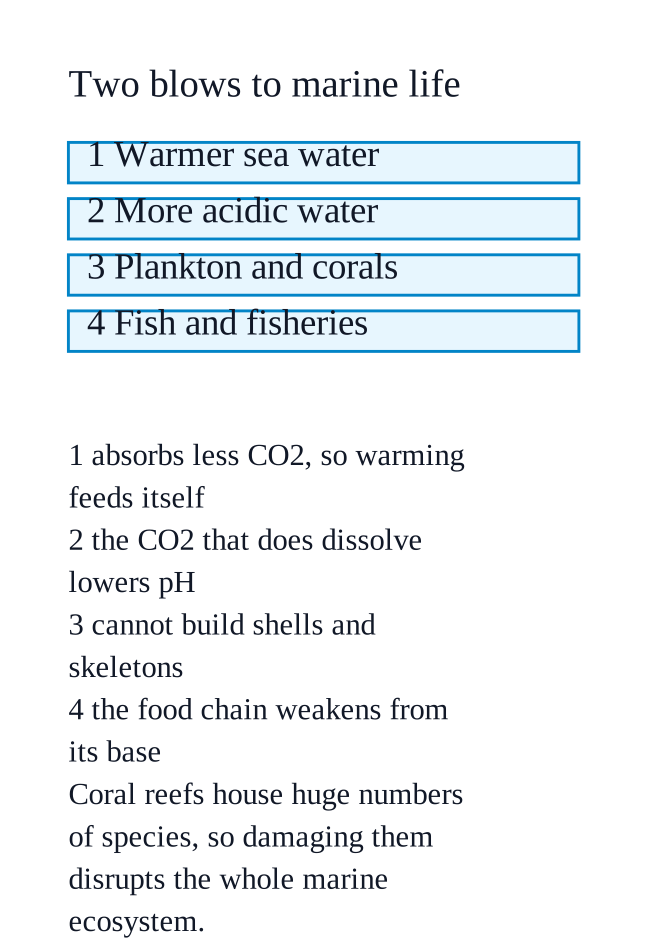
Warmer ocean water reduces the ocean's capacity to act as a carbon sink, so more \(\displaystyle CO_{2} \) stays in the atmosphere and the warming feeds on itself.
The excess atmospheric \(\displaystyle CO_{2} \) that is absorbed makes sea water more acidic; this threatens tiny plankton and coral reefs, which need carbonate to build shells and skeletons.
Phytoplankton use the dissolved carbonate and bicarbonate ions for photosynthesis; disturbing this weakens the very base of the marine food chain, so fish and larger animals decline too.
Coral reefs are habitats for a huge number of species — damaging them destroys those habitats and disrupts the whole marine ecosystem.
Coastal fisheries, and the people who depend on them, are affected in turn.