SolveItClass 9 · NCERT

NCERT Solutions · Class 9 Science Earth as a System: Energy, Matter, and Life

23 questions · 23 still being checked

Revise, Reflect, Refine 13.3–13.4 (part 5 of 11)

  1. Exercise 13.3

    Explain how climate change affects the water cycle. Illustrate with examples.

    Not cross-checked

    NCERT prints no numerical answer for this exercise, so this working has not been cross-checked against the book.

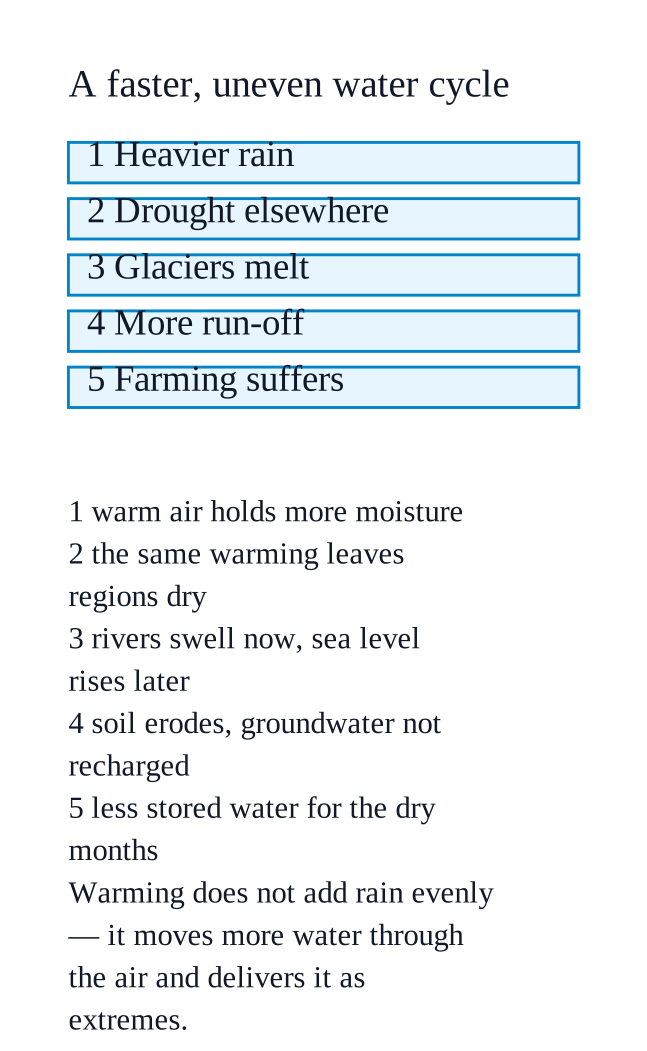
    Climate change speeds up the water cycle and makes it uneven — more moisture moves through the air, but it is delivered as extremes rather than steady rain.
    NCERT_Solution_Class9_Science_Ch13_RRR_Q13-3
    Heavier rain in some places, drought in others: a warmer atmosphere holds more moisture, so monsoons intensify over some regions while others are left dry.
    Melting glaciers: extra meltwater swells rivers now, and in the long run raises sea level, threatening coastal cities such as Mumbai and Chennai.
    More run-off, less infiltration: sudden bursts of intense rainfall run off the surface instead of soaking in — this erodes soil and reduces the recharge of groundwater.
    Agriculture suffers: with less groundwater stored, sustaining crops through the dry months becomes difficult.
    All spheres are linked by it: the disturbed water cycle connects the cryosphere (glaciers), hydrosphere (rivers and oceans), atmosphere (moisture), geosphere (soil erosion and poor infiltration) and biosphere (crops and fisheries).
  2. Exercise 13.4

    Describe how albedo affects the Earth’s surface temperature and its climate.

    Not cross-checked

    NCERT prints no numerical answer for this exercise, so this working has not been cross-checked against the book.

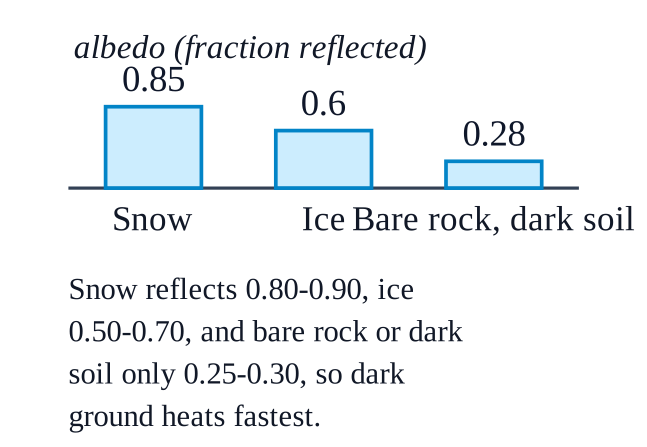
    Albedo is the fraction of solar radiation that a surface reflects — the higher the albedo, the less radiation is absorbed and the cooler the surface stays.
    NCERT_Solution_Class9_Science_Ch13_RRR_Q13-4
    High albedo keeps a region cold: snow reflects \(\displaystyle 0.80-0.90 \) and ice \(\displaystyle 0.50-0.70 \) of the incoming radiation, which is a major reason the polar regions are so cold.
    Low albedo makes a region warm: black soil, ocean water and crushed rock (\(\displaystyle 0.25-0.30 \)) reflect little and absorb much, so they heat up quickly — the same reason a dark road becomes hotter than a light-coloured surface, and dark clothes feel hotter than white ones.
    Climate effect: these differences in absorption create the uneven heating of the Earth's surface, and that uneven heating is what drives winds and ocean currents.
    Feedback effect: warming melts bright snow and ice and exposes darker land and sea beneath; the lowered albedo means still more absorption, which warms the region further.
    Human land use changes albedo too: cities of dark concrete and asphalt absorb and re-radiate heat, giving the urban heat island effect, and clearing forests also alters the surface albedo.