Exercise 13.3
What happens to the warm surface of water from the equator as it travels toward the poles? What impact does this movement have on the area? India’s Scientific Contributions Scientists at the Indian Institute of Tropical Meteorology (IITM), Pune, run advanced computer models that couple the energy flows we discussed in this chapter, between atmosphere, oceans, land and ice to simulate the Indian monsoon. These models use data from satellites, buoys in the Indian Ocean, and even stations in Antarctica to improve seasonal forecasts and to study how global warming may change monsoon rainfall patterns across India.
Not cross-checked
NCERT prints no numerical answer for this exercise, so this working has not been cross-checked against the book.
The warm equatorial surface water cools as it travels poleward, becomes denser and sinks, then flows back towards the equator through the deeper levels of the ocean.
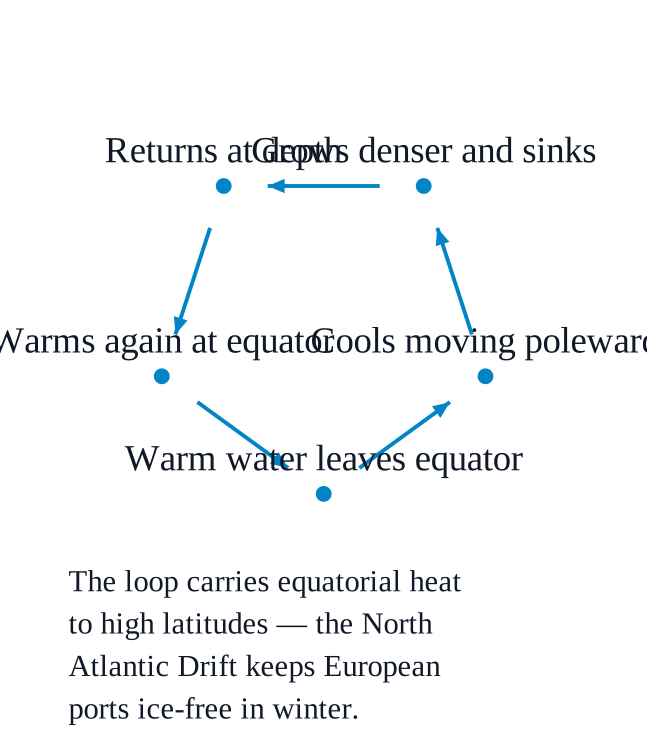
The Earth's rotation deflects these moving water masses, so the flow curves into large circular patterns called gyres — clockwise in the Northern Hemisphere, counter clockwise in the Southern Hemisphere.
Impact on the area it reaches: the current carries heat from the equator towards the poles, so the temperature difference across the planet is reduced and high-latitude coasts are made much milder than their latitude would suggest.
Example: the North Atlantic Drift, an extension of the Gulf Stream, flows to the north-western coast of Europe and keeps many ports ice-free during winter even at high latitudes.
This moderating influence also supports human activities such as trade and commerce.
The same currents transport nutrients along their path, supporting massive marine ecosystems.