Exercise 9.3
You want to design a new ionic compound, where the total positive charge is + and the total negative charge is -. Which of the following combinations gives the correct number of ions? (i) and Cl (ii) and (iii) and (iv) and
Not cross-checked
NCERT prints no numerical answer for this exercise, so this working has not been cross-checked against the book.
NCERT’s answer
(iii)
(iii) $\displaystyle 2$ \(\displaystyle Fe^{3+}\) and $\displaystyle 3$ \(\displaystyle O^{2-}\).
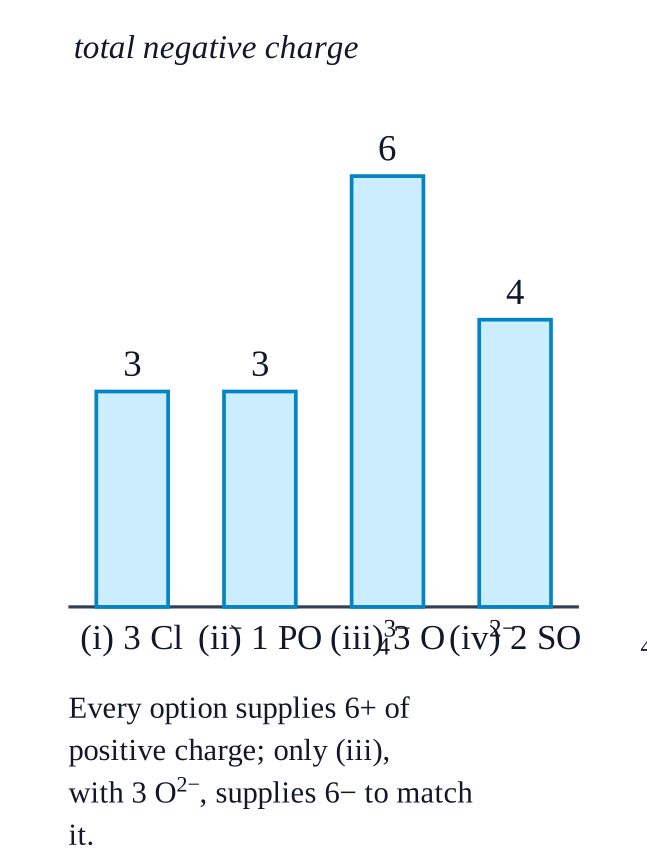
Positive charge: \(\displaystyle 2 \times (3+) = 6+\). Negative charge: \(\displaystyle 3 \times (2-) = 6-\). They balance exactly.
(i) fails: $\displaystyle 2$ \(\displaystyle Al^{3+}\) gives \(\displaystyle 6+\), but $\displaystyle 3$ \(\displaystyle Cl^-\) gives only \(\displaystyle 3-\).
(ii) fails: $\displaystyle 3$ \(\displaystyle Mg^{2+}\) gives \(\displaystyle 6+\), but $\displaystyle 1$ \(\displaystyle PO_4^{3-}\) gives only \(\displaystyle 3-\).
(iv) fails: $\displaystyle 3$ \(\displaystyle Ca^{2+}\) gives \(\displaystyle 6+\), but $\displaystyle 2$ \(\displaystyle SO_4^{2-}\) gives only \(\displaystyle 4-\).
The compound in (iii) is ferric oxide, \(\displaystyle Fe_2O_3\) — the simplest whole-number ratio of the same two ions.