SolveItClass 9 · NCERT

NCERT Solutions · Class 9 Science Atomic Foundations of Matter

39 questions · 21 still being checked

Pause and Ponder 9.4–9.5 (part 6 of 22)

  1. Exercise 9.4

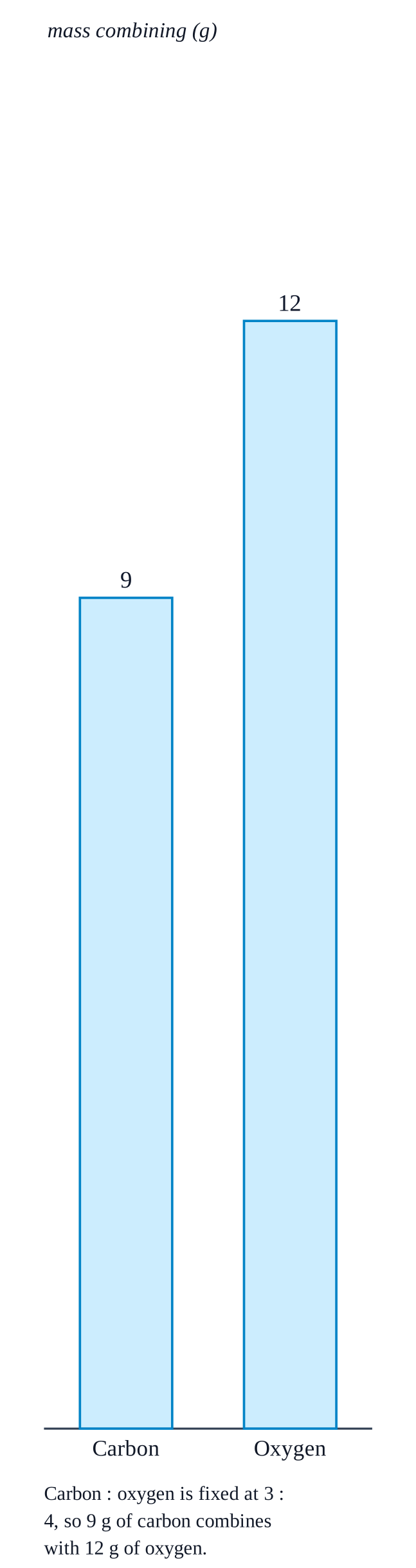
    Carbon monoxide (CO) contains carbon and oxygen in the mass ratio of 3\displaystyle 3:4. How much oxygen will combine with 9\displaystyle 9 g of carbon to form carbon monoxide?
    NCERT’s answer
    $\displaystyle 12$ g
    Oxygen required = $\displaystyle 12$ g.
    NCERT_Solution_Class9_Science_Ch9_PP_Q9-4
    In carbon monoxide the mass ratio carbon : oxygen is fixed at \(\displaystyle 3 : 4\).
    Mass of oxygen \(\displaystyle = \dfrac{4}{3} \times 9 = 12\) g.
    So \(\displaystyle 9 + 12 = 21\) g of carbon monoxide is formed.
  2. Exercise 9.5

    The Law of Definite Proportions holds true for compounds but not for mixtures. Give reason.

    Not cross-checked

    NCERT prints no numerical answer for this exercise, so this working has not been cross-checked against the book.

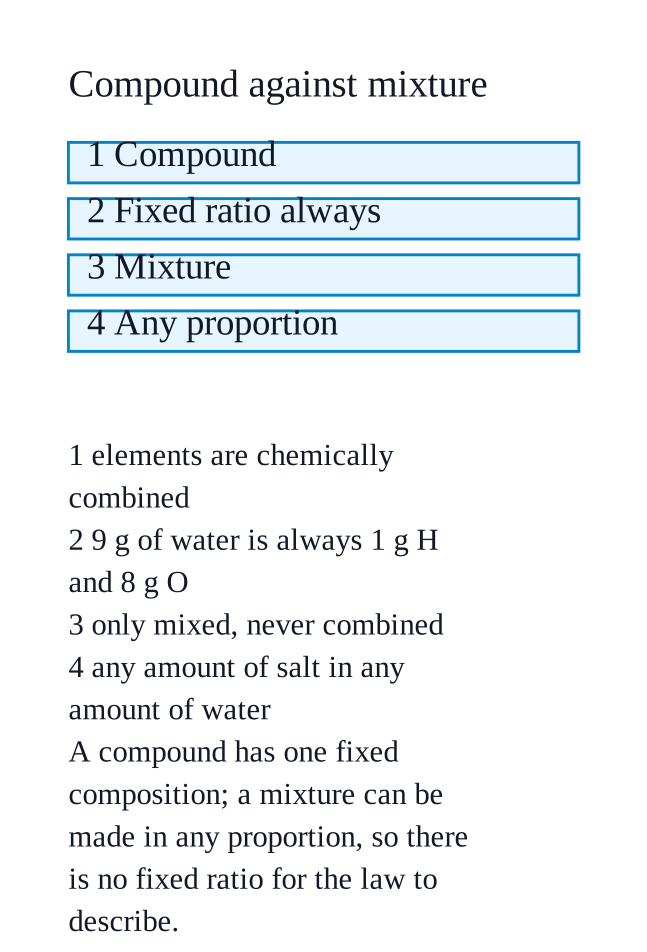
    Because a compound has a fixed composition, while a mixture does not.
    NCERT_Solution_Class9_Science_Ch9_PP_Q9-5
    In a compound the elements are chemically combined in a definite ratio by mass — $\displaystyle 9$ g of pure water always gives $\displaystyle 1$ g hydrogen and $\displaystyle 8$ g oxygen, whether it came from a river, a borewell or the ocean.
    In a mixture the substances are only mixed, not chemically combined, so they can be taken in any proportion — any amount of salt can be stirred into any amount of water (Activity $\displaystyle 9.1$).
    A mixture also keeps the separate properties of its components, so there is no fixed combining ratio for the law to describe.