SolveItClass 9 · NCERT

NCERT Solutions · Class 9 Science Atomic Foundations of Matter

39 questions · 21 still being checked

Revise, Reflect, Refine 9.1–9.10 (part 4 of 5)

  1. Exercise 9.1

    A particular element (A) has one electron in its third shell. There is another element (B) with six electrons in its second shell. (i) How many electrons does A tend to give or take to become stable? (ii) What kind of ion would it form? (iii) How many electrons does B tend to give or take to become stable? (iv) What kind of ion would it form? (v) If A and B were to combine, what kind of bond would be formed? (vi) What would be the formula for the compound thus formed?
    NCERT’s answer
    (i)
    tends to give $\displaystyle 1$ electron (ii) Cation (\(\displaystyle A^{+}\)) (iii) tends to take $\displaystyle 2$ electrons (iv) Anion (\(\displaystyle B^{2-}\)) (v) Ionic (vi) \(\displaystyle A_{2}\)B
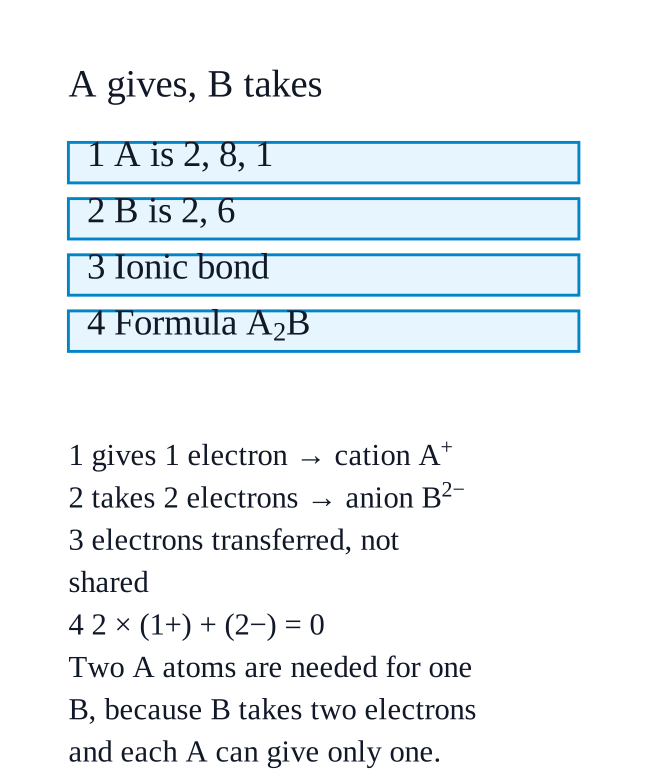
    (i) A tends to give $\displaystyle 1$ electron.
    NCERT_Solution_Class9_Science_Ch9_RRR_Q9-1
    (ii) It forms a cation, \(\displaystyle A^+\).
    (iii) B tends to take $\displaystyle 2$ electrons.
    (iv) It forms an anion, \(\displaystyle B^{2-}\).
    (v) An ionic bond — electrons are transferred from A to B, not shared.
    (vi) \(\displaystyle A_2B\).
    Working: "one electron in the third shell" fixes A's configuration as $\displaystyle 2$, $\displaystyle 8$, $\displaystyle 1$. Its valence shell has fewer than $\displaystyle 4$ electrons, so it donates its single electron and is left with the stable $\displaystyle 2$, 8.
    "Six electrons in the second shell" fixes B as $\displaystyle 2$, $\displaystyle 6$. With more than $\displaystyle 4$ valence electrons it accepts $\displaystyle 2$ to complete its octet.
    Two \(\displaystyle A^+\) ions are needed for each \(\displaystyle B^{2-}\) so the charges cancel: \(\displaystyle 2 \times (1+) + (2-) = 0\), giving \(\displaystyle A_2B\).
  2. Exercise 9.2

    An element X has six electrons in its outer shell and forms a diatomic molecule. (i) Why would that be so? (ii) What kind of bond would it form? (iii) Draw the structure of the molecule it would form. (iv) A certain other element Y has two electrons in its second shell. Draw the structure of the molecule that X would form with Y.

    Not cross-checked

    NCERT prints no numerical answer for this exercise, so this working has not been cross-checked against the book.

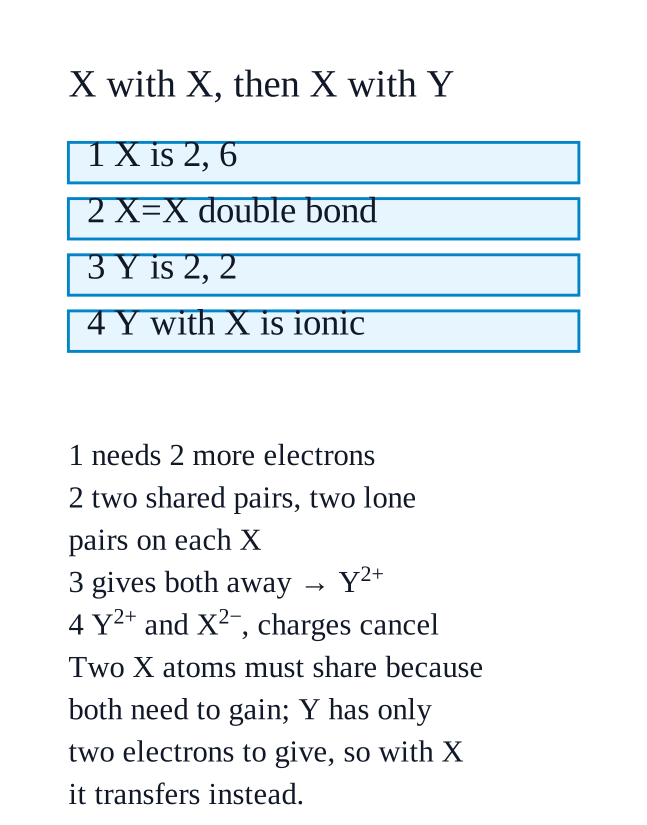
    (i) Because X has six valence electrons and needs two more to complete its octet, and no single X atom can supply them to itself. Two X atoms each share two of their electrons, so both reach $\displaystyle 8$ — hence the element exists as \(\displaystyle X_2\).
    NCERT_Solution_Class9_Science_Ch9_RRR_Q9-2
    (ii) A covalent bond, and because two pairs are shared it is a double bond.
    (iii) The drawing must show: two atoms labelled X side by side, each with its $\displaystyle 6$ valence electrons marked (dots on one atom, crosses on the other); two shared pairs — $\displaystyle 4$ electrons — in the overlap between them; two lone pairs left on each X; each X counting $\displaystyle 8$ electrons in all; and the line formula X=X written alongside, the two lines standing for the two shared pairs.
    (iv) Y is $\displaystyle 2$, $\displaystyle 2$ — two valence electrons, fewer than four, so it donates both rather than sharing. Y becomes \(\displaystyle Y^{2+}\) (left with a complete duplet, $\displaystyle 2$) and X becomes \(\displaystyle X^{2-}\) $\displaystyle (2, 8)$, joined by an ionic bond in the ratio $\displaystyle 1$ : $\displaystyle 1$ → YX.
    The drawing for (iv) must show: Y with shells $\displaystyle 2$, $\displaystyle 2$ on the left and X with shells $\displaystyle 2$, $\displaystyle 6$ on the right; two curved arrows labelled \(\displaystyle 2e^-\) running from Y's outer shell to X's outer shell; the products drawn as \(\displaystyle [2]^{2+}\) labelled \(\displaystyle Y^{2+}\) and \(\displaystyle [2,8]^{2-}\) labelled \(\displaystyle X^{2-}\), each in square brackets with its charge outside; the label ionic bond between them; and the formula YX written below.
  3. Exercise 9.3

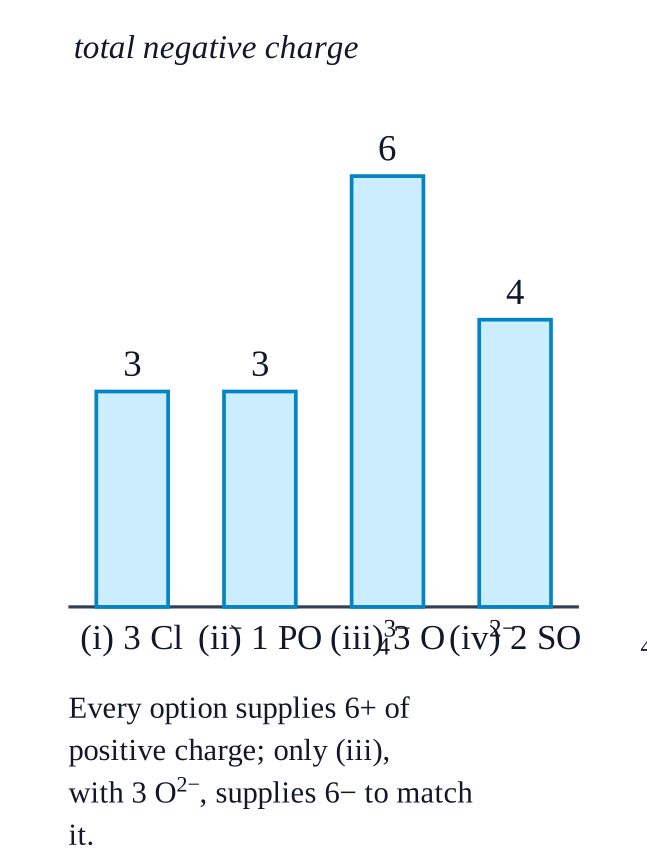
    You want to design a new ionic compound, where the total positive charge is 6\displaystyle 6+ and the total negative charge is 6\displaystyle 6 -. Which of the following combinations gives the correct number of ions? (i) 2\displaystyle 2 Al3+\displaystyle Al^{3+} and 3\displaystyle 3 Cl (ii) 3\displaystyle 3 Mg2+\displaystyle Mg^{2+} and 1\displaystyle 1 PO4\displaystyle PO_{4} (iii) 2\displaystyle 2 Fe3+\displaystyle Fe^{3+} and 3\displaystyle 3 O2\displaystyle O^{2-} (iv) 3\displaystyle 3 Ca2+\displaystyle Ca^{2+} and 2\displaystyle 2 SO4\displaystyle SO_{4}

    Not cross-checked

    NCERT prints no numerical answer for this exercise, so this working has not been cross-checked against the book.

    NCERT’s answer
    (iii)
    (iii) $\displaystyle 2$ \(\displaystyle Fe^{3+}\) and $\displaystyle 3$ \(\displaystyle O^{2-}\).
    NCERT_Solution_Class9_Science_Ch9_RRR_Q9-3
    Positive charge: \(\displaystyle 2 \times (3+) = 6+\). Negative charge: \(\displaystyle 3 \times (2-) = 6-\). They balance exactly.
    (i) fails: $\displaystyle 2$ \(\displaystyle Al^{3+}\) gives \(\displaystyle 6+\), but $\displaystyle 3$ \(\displaystyle Cl^-\) gives only \(\displaystyle 3-\).
    (ii) fails: $\displaystyle 3$ \(\displaystyle Mg^{2+}\) gives \(\displaystyle 6+\), but $\displaystyle 1$ \(\displaystyle PO_4^{3-}\) gives only \(\displaystyle 3-\).
    (iv) fails: $\displaystyle 3$ \(\displaystyle Ca^{2+}\) gives \(\displaystyle 6+\), but $\displaystyle 2$ \(\displaystyle SO_4^{2-}\) gives only \(\displaystyle 4-\).
    The compound in (iii) is ferric oxide, \(\displaystyle Fe_2O_3\) — the simplest whole-number ratio of the same two ions.
  4. Exercise 9.4

    Choose the correct statement(s) and correct the false statement(s). (i) Elements are made up of molecules and compounds are made up of atoms. (ii) The molecule of a compound is always made up of two or more atoms of the same kind. (iii) One molecule of nitrogen gas contains three nitrogen atoms. (iv) Water is made of two hydrogen atoms, covalently bonded with one oxygen atom.

    Not cross-checked

    NCERT prints no numerical answer for this exercise, so this working has not been cross-checked against the book.

    NCERT’s answer
    (iv)
    Only (iv) is correct; (i), (ii) and (iii) are false.
    (i) False. Corrected: elements are made up of atoms of one kind (which may join together as molecules of that element, such as \(\displaystyle O_2\)), and compounds are made up of atoms of two or more different kinds, combined as molecules or as ions.
    (ii) False. Corrected: the molecule of a compound is made up of two or more atoms of different kinds — it is a molecule of an element that contains atoms of the same kind.
    (iii) False. Corrected: one molecule of nitrogen gas contains two nitrogen atoms, \(\displaystyle N_2\), joined by a triple bond.
    (iv) True. Oxygen needs $\displaystyle 2$ electrons and each hydrogen needs $\displaystyle 1$, so two hydrogen atoms each share one electron with one oxygen atom — two covalent bonds, giving \(\displaystyle H_2O\).
  5. Exercise 9.5

    Write the chemical formulae for the following compounds. (i) Aluminium nitrate (ii) Calcium oxide (iii) Ferric oxide
    NCERT’s answer
    (i)
    Al(\(\displaystyle NO_{3}\))$\displaystyle 3$ (ii) CaO (iii) \(\displaystyle Fe_{2}\)\(\displaystyle O_{3}\)
    (i) Aluminium nitrate — \(\displaystyle Al(NO_3)_3\): \(\displaystyle Al^{3+}\) with \(\displaystyle NO_3^-\); criss-cross $\displaystyle 3$ and $\displaystyle 1$ to get one Al to three nitrate ions, and use brackets because more than one polyatomic ion is present.
    (ii) Calcium oxide — CaO: \(\displaystyle Ca^{2+}\) with \(\displaystyle O^{2-}\); criss-crossing gives \(\displaystyle Ca_2O_2\), which is divided by the common factor 2.
    (iii) Ferric oxide — \(\displaystyle Fe_2O_3\): ferric is \(\displaystyle Fe^{3+}\) and oxide is \(\displaystyle O^{2-}\); criss-cross $\displaystyle 3$ and $\displaystyle 2$, with no common factor to remove.
  6. Exercise 9.6

    Write the formulae of the compounds formed from the following pairs of ions. (i) Ca2+\displaystyle Ca^{2+} and Br (ii) Al3+\displaystyle Al^{3+} and CO3\displaystyle CO_{3} (iii) K+\displaystyle K^{+} and SO4\displaystyle SO_{4} (iv) NH4\displaystyle NH_{4} + and Cl
    NCERT’s answer
    (i)
    \(\displaystyle CaBr_{2}\) (ii) \(\displaystyle Al_{2}\)(\(\displaystyle CO_{3}\))$\displaystyle 3$ (iii) \(\displaystyle K_{2}\)\(\displaystyle SO_{4}\) (iv) \(\displaystyle NH_{4}\)Cl
    (i) \(\displaystyle Ca^{2+}\) and \(\displaystyle Br^-\) → \(\displaystyle CaBr_2\) — criss-cross $\displaystyle 2$ and $\displaystyle 1$; \(\displaystyle (2+) + 2 \times (1-) = 0\).
    (ii) \(\displaystyle Al^{3+}\) and \(\displaystyle CO_3^{2-}\) → \(\displaystyle Al_2(CO_3)_3\) — criss-cross $\displaystyle 3$ and $\displaystyle 2$; brackets because three carbonate ions are present.
    (iii) \(\displaystyle K^+\) and \(\displaystyle SO_4^{2-}\) → \(\displaystyle K_2SO_4\) — criss-cross $\displaystyle 1$ and $\displaystyle 2$; only one sulfate ion, so no brackets.
    (iv) \(\displaystyle NH_4^+\) and \(\displaystyle Cl^-\) → \(\displaystyle NH_4Cl\) — both valency $\displaystyle 1$, so one of each and no brackets.
  7. Exercise 9.7

    Which of the following, in Fig. 9.18\displaystyle 9.18, correctly represents Cl number of chlorine = 17\displaystyle 17). (i)NCERT_Question_Class9_Science_Ch9_RRR_Q9-7

    Not cross-checked

    NCERT prints no numerical answer for this exercise, so this working has not been cross-checked against the book.

    NCERT’s answer
    (ii)
    (ii) is the correct representation of the \(\displaystyle Cl^{-}\) ion.
    Chlorine has atomic number $\displaystyle 17$, so a neutral chlorine atom has $\displaystyle 17$ protons and $\displaystyle 17$ electrons, filling as $\displaystyle 2$, $\displaystyle 8$, $\displaystyle 7$.
    A \(\displaystyle Cl^{-}\) ion is chlorine that has gained one electron, so it still has $\displaystyle 17$ protons but now $\displaystyle 18$ electrons: \(\displaystyle 2 + 8 + 8 = 18\), i.e. the shells fill as $\displaystyle 2$, $\displaystyle 8$, $\displaystyle 8$.
    Counting the electrons drawn on each of the four diagrams in Fig. $\displaystyle 9.18$:
    (i) $\displaystyle 2$, $\displaystyle 7$, $\displaystyle 8$ — seventeen electrons in total, which is the right number for a neutral atom, but the shells are filled out of order: the second shell holds up to eight and must be completed before the third begins.
    (ii) $\displaystyle 2$, $\displaystyle 8$, $\displaystyle 8$ — eighteen electrons, one more than the seventeen protons, which is exactly a chloride ion. This is the answer.
    (iii) $\displaystyle 2$, $\displaystyle 8$, $\displaystyle 9$ — nineteen electrons, two more than the protons; the outermost shell also exceeds the eight that this shell can hold.
    (iv) $\displaystyle 2$, $\displaystyle 8$, $\displaystyle 7$ — the neutral chlorine atom, not the ion, and the commonest wrong choice here.
    The distinction being tested is that gaining an electron changes the electron count and the outermost shell, never the number of protons — the nucleus is untouched, which is why the ion is still chlorine.
  8. Exercise 9.8

    Determine the formula unit mass of the following substances. (i) Ammonium nitrate (NH4\displaystyle NH_{4}NO3\displaystyle NO_{3}), used as a nitrogen fertiliser, which is essential for plant growth. (ii) Phosphoric acid (H3\displaystyle H_{3}PO4\displaystyle PO_{4}), used to make phosphate fertiliser and detergents. (iii) Sodium hydrogencarbonate (NaHCO3\displaystyle NaHCO_{3}), used to relieve acidity and helps in digestion.
    NCERT’s answer
    (i)
    $\displaystyle 80$ u (ii) $\displaystyle 98$ u (iii) $\displaystyle 84$ u
    (i) Ammonium nitrate, \(\displaystyle NH_4NO_3\) = $\displaystyle 80$ u
    $\displaystyle 2$ N, $\displaystyle 4$ H, $\displaystyle 3$ O: \(\displaystyle (14 \times 2) + (1 \times 4) + (16 \times 3) = 28 + 4 + 48 = 80\) u.
    (ii) Phosphoric acid, \(\displaystyle H_3PO_4\) = $\displaystyle 98$ u
    $\displaystyle 3$ H, $\displaystyle 1$ P, $\displaystyle 4$ O: \(\displaystyle (1 \times 3) + (31 \times 1) + (16 \times 4) = 3 + 31 + 64 = 98\) u.
    (iii) Sodium hydrogencarbonate, \(\displaystyle NaHCO_3\) = $\displaystyle 84$ u
    $\displaystyle 1$ Na, $\displaystyle 1$ H, $\displaystyle 1$ C, $\displaystyle 3$ O: \(\displaystyle 23 + 1 + 12 + (16 \times 3) = 23 + 1 + 12 + 48 = 84\) u.
    Atomic masses used: H = $\displaystyle 1$ u, C = $\displaystyle 12$ u, N = $\displaystyle 14$ u, O = $\displaystyle 16$ u, Na = $\displaystyle 23$ u, P = $\displaystyle 31$ u.
  9. Exercise 9.9

    Write the formulae for the compounds formed by the reaction of: (i) Magnesium and nitrogen (ii) Lithium and nitrogen (iii) Sodium and sulfur (iv) Aluminium and oxygen
    NCERT’s answer
    (i)
    \(\displaystyle Mg_{3}\)\(\displaystyle N_{2}\) (ii) \(\displaystyle Li_{3}\)N (iii) \(\displaystyle Na_{2}\)S (iv) \(\displaystyle Al_{2}\)\(\displaystyle O_{3}\)
    (i) Magnesium and nitrogen → \(\displaystyle Mg_3N_2\) — \(\displaystyle Mg^{2+}\) with \(\displaystyle N^{3-}\); criss-cross $\displaystyle 2$ and $\displaystyle 3$, and \(\displaystyle 3 \times (2+) + 2 \times (3-) = 0\).
    (ii) Lithium and nitrogen → \(\displaystyle Li_3N\) — \(\displaystyle Li^+\) with \(\displaystyle N^{3-}\); three lithium ions balance one nitride ion.
    (iii) Sodium and sulfur → \(\displaystyle Na_2S\) — \(\displaystyle Na^+\) with \(\displaystyle S^{2-}\); two sodium ions balance one sulfide ion.
    (iv) Aluminium and oxygen → \(\displaystyle Al_2O_3\) — \(\displaystyle Al^{3+}\) with \(\displaystyle O^{2-}\); criss-cross $\displaystyle 3$ and 2.
    Nitrogen is not in Table $\displaystyle 9.1$: it has $\displaystyle 5$ valence electrons and, having more than $\displaystyle 4$, gains $\displaystyle 3$ to complete its octet, giving the nitride ion \(\displaystyle N^{3-}\).
  10. Exercise 9.10

    Complete the Table 9.3\displaystyle 9.3 by writing the formulae of the compounds formed by the cations on the left and the anions at the top. LiNO3\displaystyle LiNO_{3} is given as an example. NH4\displaystyle NH_{4} + Li+\displaystyle Li^{+} Al3+\displaystyle Al^{3+} Cu2+\displaystyle Cu^{2+}

    Disagrees with the book

    This working does not reach the answer printed in NCERT. One of the two is wrong and it has not yet been settled which — check it before you rely on it.

    NCERT’s answer
    \(\displaystyle NO_{3}\) \(\displaystyle SO_{4}\) \(\displaystyle PO_{4}\) $\displaystyle 2$− $\displaystyle 3$− + \(\displaystyle NH_{4}\) \(\displaystyle NH_{4}\)\(\displaystyle NO_{3}\) (\(\displaystyle NH_{4}\))\(\displaystyle 2SO_{4}\) (\(\displaystyle NH_{4}\))\(\displaystyle 3PO_{4}\) \(\displaystyle Li^{+}\) \(\displaystyle LiNO_{3}\) \(\displaystyle Li_{2}\)\(\displaystyle SO_{4}\) \(\displaystyle Li_{3}\)\(\displaystyle PO_{4}\) \(\displaystyle Al^{3+}\) Al(\(\displaystyle NO_{3}\))$\displaystyle 3$ \(\displaystyle Al_{2}\)(\(\displaystyle SO_{4}\))$\displaystyle 3$ \(\displaystyle AlPO_{4}\) \(\displaystyle Cu^{2+}\) Cu(\(\displaystyle NO_{3}\))$\displaystyle 2$ \(\displaystyle CuSO_{4}\) \(\displaystyle Cu_{3}\)(\(\displaystyle PO_{4}\))$\displaystyle 2$ $\displaystyle 272$ Textbook of Science for Grade $\displaystyle 9$
    The completed table:
    Cation\(\displaystyle NO_3^-\)\(\displaystyle SO_4^{2-}\)\(\displaystyle PO_4^{3-}\)
    \(\displaystyle NH_4^+\)\(\displaystyle NH_4NO_3\)\(\displaystyle (NH_4)_2SO_4\)\(\displaystyle (NH_4)_3PO_4\)
    \(\displaystyle Li^+\)\(\displaystyle LiNO_3\) (given)\(\displaystyle Li_2SO_4\)\(\displaystyle Li_3PO_4\)
    \(\displaystyle Al^{3+}\)\(\displaystyle Al(NO_3)_3\)\(\displaystyle Al_2(SO_4)_3\)\(\displaystyle AlPO_4\)
    \(\displaystyle Cu^{2+}\)\(\displaystyle Cu(NO_3)_2\)\(\displaystyle CuSO_4\)\(\displaystyle Cu_3(PO_4)_2\)
    Method for every cell: criss-cross the charge numbers, then divide the subscripts by a common factor if there is one.
    \(\displaystyle Al^{3+}\) with \(\displaystyle PO_4^{3-}\) gives \(\displaystyle Al_3(PO_4)_3\), which reduces to \(\displaystyle AlPO_4\); \(\displaystyle Cu^{2+}\) with \(\displaystyle SO_4^{2-}\) gives \(\displaystyle Cu_2(SO_4)_2\), which reduces to \(\displaystyle CuSO_4\).
    Brackets are written only where two or more of the same polyatomic ion appear — so \(\displaystyle Al(NO_3)_3\) and \(\displaystyle (NH_4)_2SO_4\) take them, while \(\displaystyle NH_4NO_3\) and \(\displaystyle AlPO_4\) do not.