SolveItClass 9 · NCERT

NCERT Solutions · Class 9 Science Atomic Foundations of Matter

39 questions · 21 still being checked

Revise, Reflect, Refine 9.11–9.15 (part 5 of 5)

  1. Exercise 9.11

    5.3\displaystyle 3 g of sodium carbonate and 6.0\displaystyle 6.0 g of acetic acid react to produce 2.2\displaystyle 2.2 g of carbon dioxide, 0.9\displaystyle 0.9 g of water, and 8.2\displaystyle 8.2 g of sodium acetate. Verify whether the law of conservation of mass is valid.

    Not cross-checked

    NCERT prints no numerical answer for this exercise, so this working has not been cross-checked against the book.

    The Law of Conservation of Mass is valid — the total mass is $\displaystyle 11.3$ g both before and after.
    NCERT_Solution_Class9_Science_Ch9_RRR_Q9-11
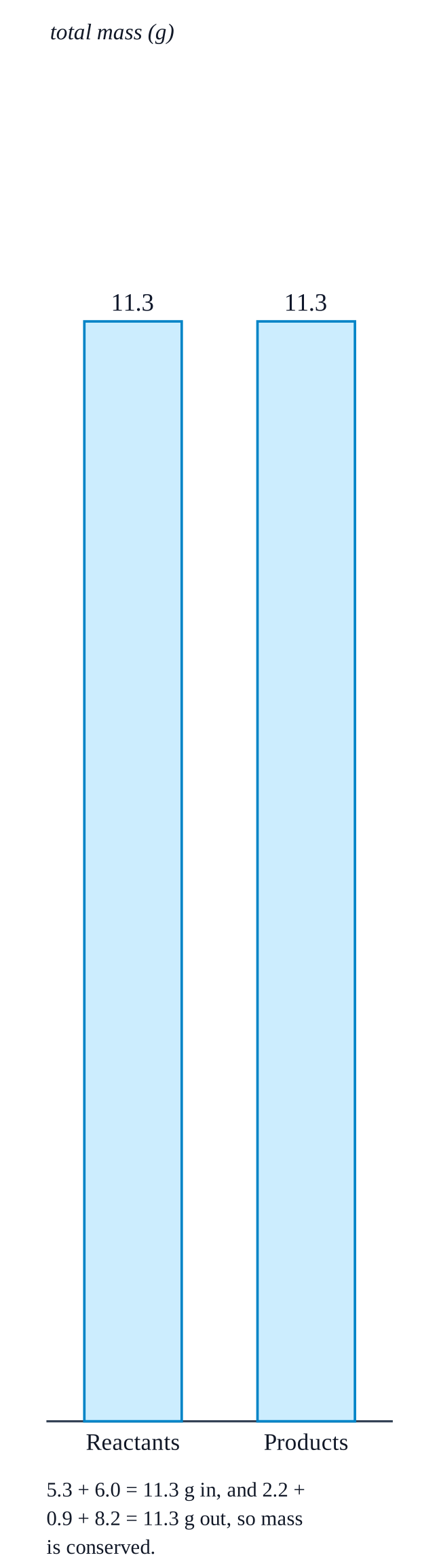
    Total mass of reactants \(\displaystyle = 5.3 + 6.0 = 11.3\) g.
    Total mass of products \(\displaystyle = 2.2 + 0.9 + 8.2 = 11.3\) g.
    Mass of reactants = mass of products, so no matter was created or destroyed — the atoms have only rearranged.
    Note that carbon dioxide gas is released here, so the reaction must be carried out in a closed container; in an open one the escaping gas would make the final reading $\displaystyle 2.2$ g short, exactly as in Activity $\displaystyle 9.2$, set-up 1.
  2. Exercise 9.12

    If a species has 11\displaystyle 11 protons, 12\displaystyle 12 neutrons and 10\displaystyle 10 electrons then (i) what is its atomic number and mass number? (ii) is it neutral, a cation or an anion? Explain. (iii) write its electronic configuration. (iv) name the species.
    NCERT’s answer
    (i)
    Z = $\displaystyle 11$; A = $\displaystyle 23$ (ii) Cation (iii) Electronic configuration $\displaystyle 2$, $\displaystyle 8$ (iv) Sodium cation (\(\displaystyle Na^{+}\))
    (i) Atomic number \(\displaystyle Z = 11\) (the number of protons); mass number \(\displaystyle A = 11 + 12 = 23\).
    NCERT_Solution_Class9_Science_Ch9_RRR_Q9-12
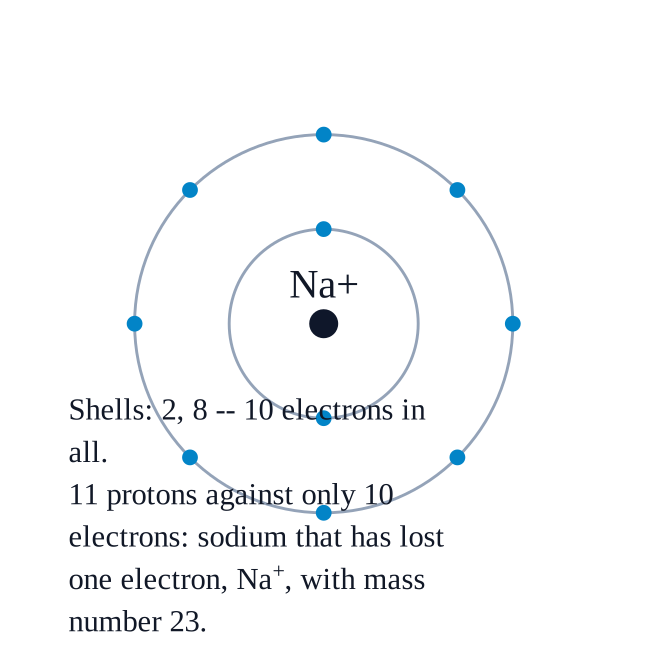
    (ii) A cation. There are $\displaystyle 11$ positive protons against only $\displaystyle 10$ electrons, so one negative charge is missing and the species carries a net charge of $\displaystyle 1$+ — it has lost one electron.
    (iii) Electronic configuration $\displaystyle 2$, $\displaystyle 8$ — the $\displaystyle 10$ electrons fill the K shell ($\displaystyle 2$) and the L shell ($\displaystyle 8$), which is why losing that electron made it stable.
    (iv) The sodium cation, \(\displaystyle Na^+\): \(\displaystyle Z = 11\) identifies the element as sodium, and the $\displaystyle 1$+ charge makes it the cation.
  3. Exercise 9.13

    Two elements, A and B, have the following configurations — A: 2\displaystyle 2, 8\displaystyle 8, 5\displaystyle 5 (i) Which element is more reactive? (ii) Will A and B form ionic or covalent bonds when they combine? Explain using electron transfer or sharing. (iii) Predict the formula of the compound they would form.
    NCERT’s answer
    (i)
    Element B (ii) Covalent (iii) \(\displaystyle AB_{3}\)
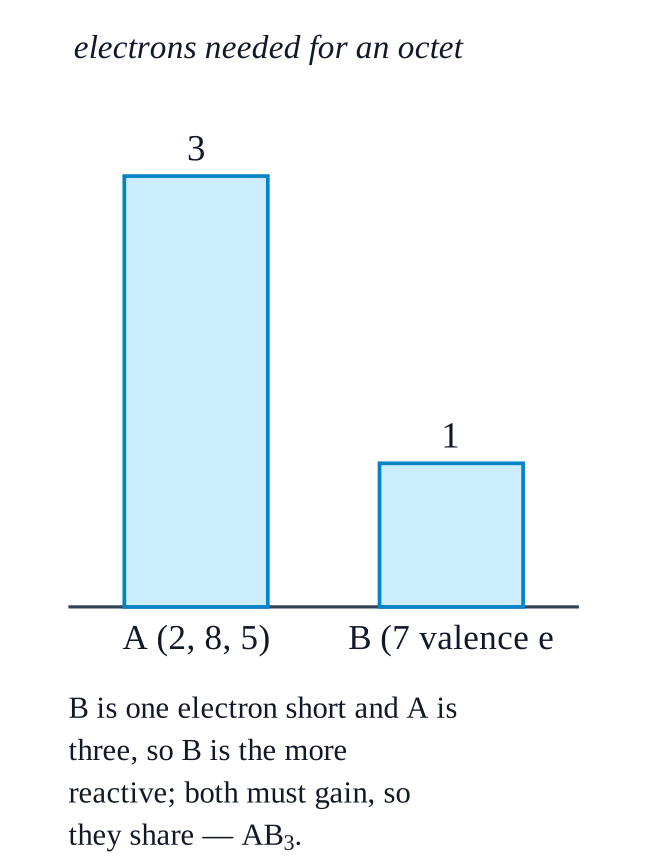
    (i) Element B is the more reactive. It needs only one electron to complete its octet ($\displaystyle 7$ valence electrons), while A needs three ($\displaystyle 5$ valence electrons) — the smaller the gap, the more readily the atom reacts.
    NCERT_Solution_Class9_Science_Ch9_RRR_Q9-13
    (ii) A covalent bond, formed by sharing. Both A and B have more than $\displaystyle 4$ valence electrons, so both need to gain and neither will donate; the only way both can reach an octet is to share electron pairs.
    (iii) \(\displaystyle AB_3\). A must gain a share in $\displaystyle 3$ electrons and each B can offer a share in only $\displaystyle 1$, so one A atom shares one electron pair with each of three B atoms.
    After bonding, A counts \(\displaystyle 5 + 3 = 8\) electrons and each B counts \(\displaystyle 7 + 1 = 8\) — every atom has its octet.
  4. Exercise 9.14

    Assertion (A): Copper sulfate conducts electricity in the molten state but not in the solid state. Reason (R): Copper and sulfate ions are fixed in the lattice in molten state, while in solid state they can move freely. Choose the correct option: (i) Both A and R are true, and R is the correct explanation of A. (ii) Both A and R are true, but R is not the correct explanation of A. (iii) A is true, but R is false. (iv) A is false, but R is true.

    Not cross-checked

    NCERT prints no numerical answer for this exercise, so this working has not been cross-checked against the book.

    NCERT’s answer
    (iii)
    (iii) A is true, but R is false.
    NCERT_Solution_Class9_Science_Ch9_RRR_Q9-14
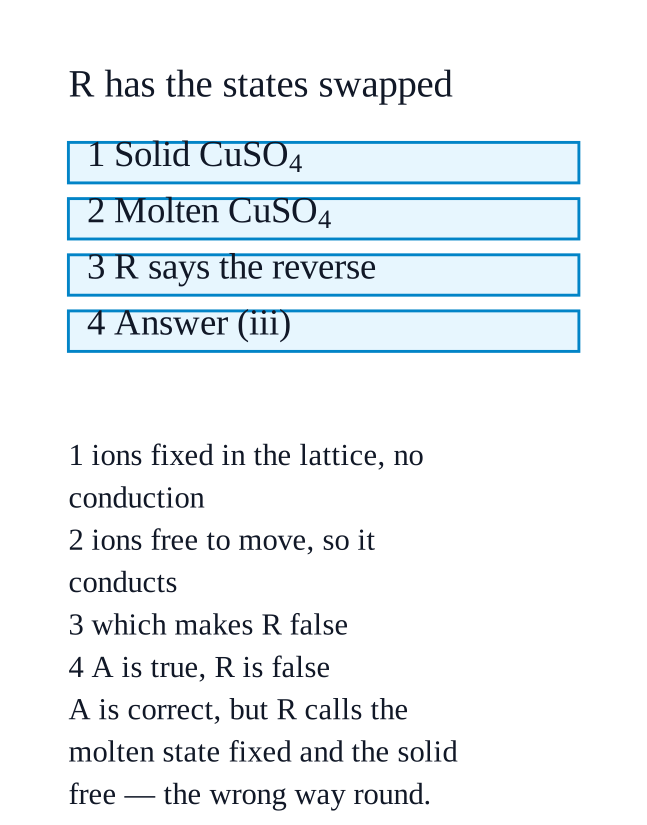
    A is true. Copper sulfate is ionic; it does not conduct as a solid but does conduct once molten.
    R is false because it has the two states the wrong way round. The ions are held in fixed positions in the solid lattice, and they become free to move in the molten state.
    The chapter's rule is that ions must be free to move for a compound to conduct — which is why solid \(\displaystyle CuSO_4\) does not conduct, while its melt (and its solution in water) does.
    Since R is false, it cannot explain A, and options (i), (ii) and (iv) are all ruled out.
  5. Exercise 9.15

    The species 27Al, 80Br How many electrons and neutrons do they have? y Design and perform an experiment to show and compare that water always contains hydrogen and oxygen in the same ratio, regardless of its source. y Compare atoms and ions of any three elements. Show the number of electrons before and after ion formation using bar graphs. y Make a card game with cations and anions. Possible ideas may include — Š Pick cards from the pile or from open cards and match them with cards in your hand to form compounds. You may discard any unwanted cards. Š Ask other players for cards and form compounds using the cards they already have. y To learn more about molecules you can explore the link given below — Š https://phet.colorado.edu/sims/html/build-a-molecule/latest/build-a-molecule_all.html The Quest Continues … Are there any chemical changes that do not obey the Law of Conservation of Mass?
    NCERT’s answer
    Electrons $\displaystyle 13$, Neutrons $\displaystyle 14$; Electrons $\displaystyle 36$, Neutrons $\displaystyle 45$; Electrons $\displaystyle 78$, Neutrons $\displaystyle 121$
    \(\displaystyle ^{27}Al\): $\displaystyle 13$ electrons and $\displaystyle 14$ neutrons.
    It is a neutral atom, so electrons = protons = $\displaystyle 13$; neutrons \(\displaystyle = 27 - 13 = 14\).
    \(\displaystyle ^{80}Br^-\): $\displaystyle 36$ electrons and $\displaystyle 45$ neutrons.
    The $\displaystyle 1$− charge means one extra electron: \(\displaystyle 35 + 1 = 36\); neutrons \(\displaystyle = 80 - 35 = 45\).
    \(\displaystyle ^{201}Hg^{2+}\): $\displaystyle 78$ electrons and $\displaystyle 121$ neutrons.
    The $\displaystyle 2$+ charge means two electrons lost: \(\displaystyle 80 - 2 = 78\); neutrons \(\displaystyle = 201 - 80 = 121\).
    In every case neutrons = mass number − number of protons, and the charge changes only the electron count — the nucleus is untouched when an ion forms.