SolveItClass 9 · NCERT

NCERT Solutions · Class 9 Science Atomic Foundations of Matter

39 questions · 21 still being checked

Pause and Ponder 9.1–9.10 (part 1 of 5)

  1. Exercise 9.1

    A student burns 10\displaystyle 10 g of ethanol in an open beaker. reaction, no residue is left in the beaker. Does this mean the Law of Conservation of Mass is violated? Explain.

    Not cross-checked

    NCERT prints no numerical answer for this exercise, so this working has not been cross-checked against the book.

    No — the Law of Conservation of Mass is not violated.
    NCERT_Solution_Class9_Science_Ch9_PP_Q9-1
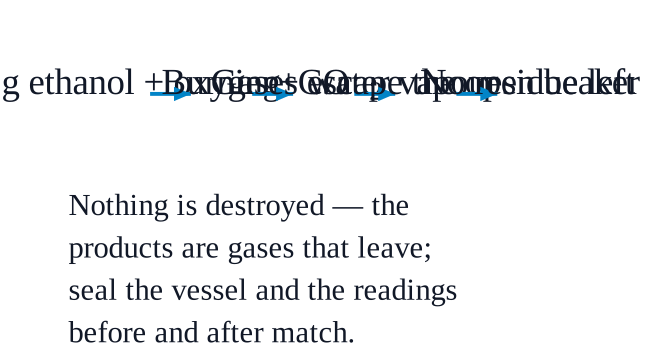
    Burning is a chemical reaction: ethanol + oxygen (from the air) → carbon dioxide + water vapour.
    Both products are gases, and the beaker is open, so they escape into the air — that is why no residue is left behind.
    Nothing was destroyed; the mass simply left the beaker. Mass of ethanol + mass of oxygen used = mass of carbon dioxide + mass of water vapour formed.
    This is Experimental set-up $\displaystyle 1$ of Activity $\displaystyle 9.2$ again: the balance read less only because the \(\displaystyle CO_2\) escaped. Sealing the system (set-up $\displaystyle 2$) made the initial and final readings match.
    To test it properly, burn the ethanol in a closed vessel and weigh the vessel with everything inside it, before and after.

  2. Exercise 9.2

    When 20\displaystyle 20 g of hydrogen reacts completely with 160\displaystyle 160 g of oxygen, how much water is formed according to the Law of Conservation Mass? 166\displaystyle 166 Exploration|Grade 9\displaystyle 9
    NCERT’s answer
    $\displaystyle 180$ g
    Water formed = $\displaystyle 180$ g.
    NCERT_Solution_Class9_Science_Ch9_PP_Q9-2
    Mass is neither created nor destroyed in a chemical reaction, so mass of product = total mass of reactants.
    \(\displaystyle 20 + 160 = 180\) g of water.
    The ratio agrees with the chapter too: \(\displaystyle 20 : 160 = 1 : 8\), which is the fixed hydrogen : oxygen mass ratio in water.
  3. Exercise 9.3

    A compound consists of 40\displaystyle 40% sulfur and 60\displaystyle 60% oxygen by mass. In a sample of the same compound containing 20\displaystyle 20 g of sulfur, what mass of oxygen must be present to satisfy the Law of Constant Proportions?
    NCERT’s answer
    $\displaystyle 30$ g
    Oxygen present = $\displaystyle 30$ g.
    NCERT_Solution_Class9_Science_Ch9_PP_Q9-3
    A compound has a fixed composition, so sulfur : oxygen \(\displaystyle = 40 : 60 = 2 : 3\) by mass in every sample of it.
    Mass of oxygen \(\displaystyle = \dfrac{60}{40} \times 20 = \dfrac{3}{2} \times 20 = 30\) g.
    Check: total sample \(\displaystyle = 20 + 30 = 50\) g, so sulfur is \(\displaystyle \dfrac{20}{50} \times 100 = 40\%\) and oxygen \(\displaystyle \dfrac{30}{50} \times 100 = 60\%\) — as stated.
  4. Exercise 9.4

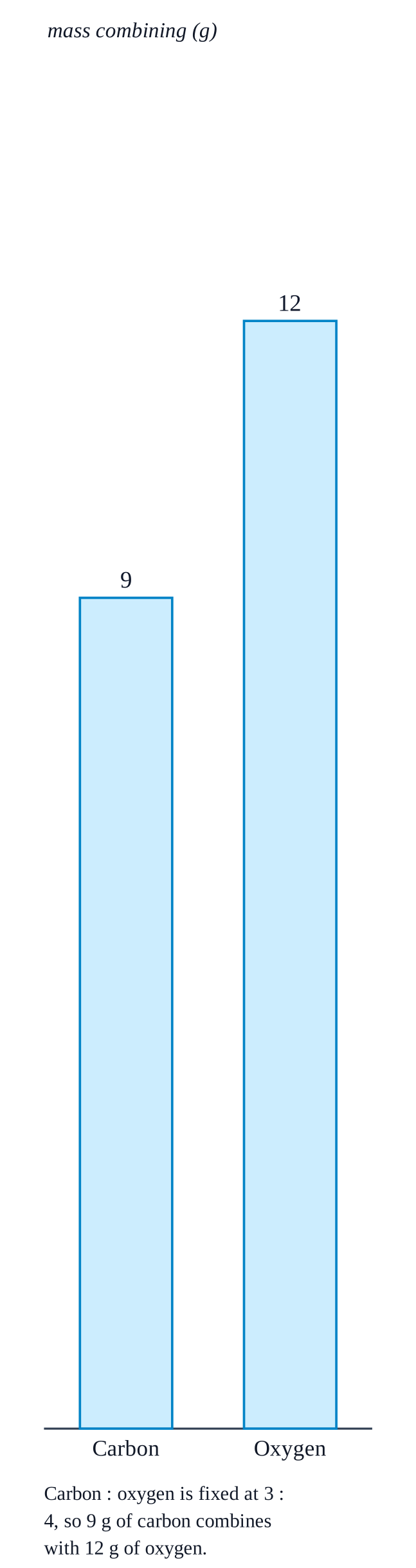
    Carbon monoxide (CO) contains carbon and oxygen in the mass ratio of 3\displaystyle 3:4. How much oxygen will combine with 9\displaystyle 9 g of carbon to form carbon monoxide?
    NCERT’s answer
    $\displaystyle 12$ g
    Oxygen required = $\displaystyle 12$ g.
    NCERT_Solution_Class9_Science_Ch9_PP_Q9-4
    In carbon monoxide the mass ratio carbon : oxygen is fixed at \(\displaystyle 3 : 4\).
    Mass of oxygen \(\displaystyle = \dfrac{4}{3} \times 9 = 12\) g.
    So \(\displaystyle 9 + 12 = 21\) g of carbon monoxide is formed.
  5. Exercise 9.5

    The Law of Definite Proportions holds true for compounds but not for mixtures. Give reason.

    Not cross-checked

    NCERT prints no numerical answer for this exercise, so this working has not been cross-checked against the book.

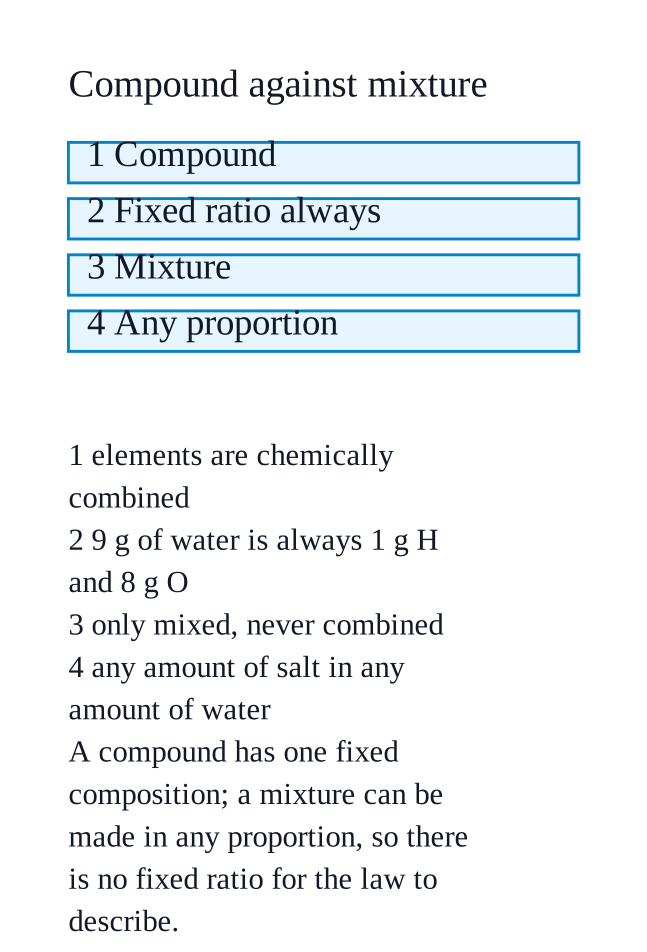
    Because a compound has a fixed composition, while a mixture does not.
    NCERT_Solution_Class9_Science_Ch9_PP_Q9-5
    In a compound the elements are chemically combined in a definite ratio by mass — $\displaystyle 9$ g of pure water always gives $\displaystyle 1$ g hydrogen and $\displaystyle 8$ g oxygen, whether it came from a river, a borewell or the ocean.
    In a mixture the substances are only mixed, not chemically combined, so they can be taken in any proportion — any amount of salt can be stirred into any amount of water (Activity $\displaystyle 9.1$).
    A mixture also keeps the separate properties of its components, so there is no fixed combining ratio for the law to describe.
  6. Exercise 9.6

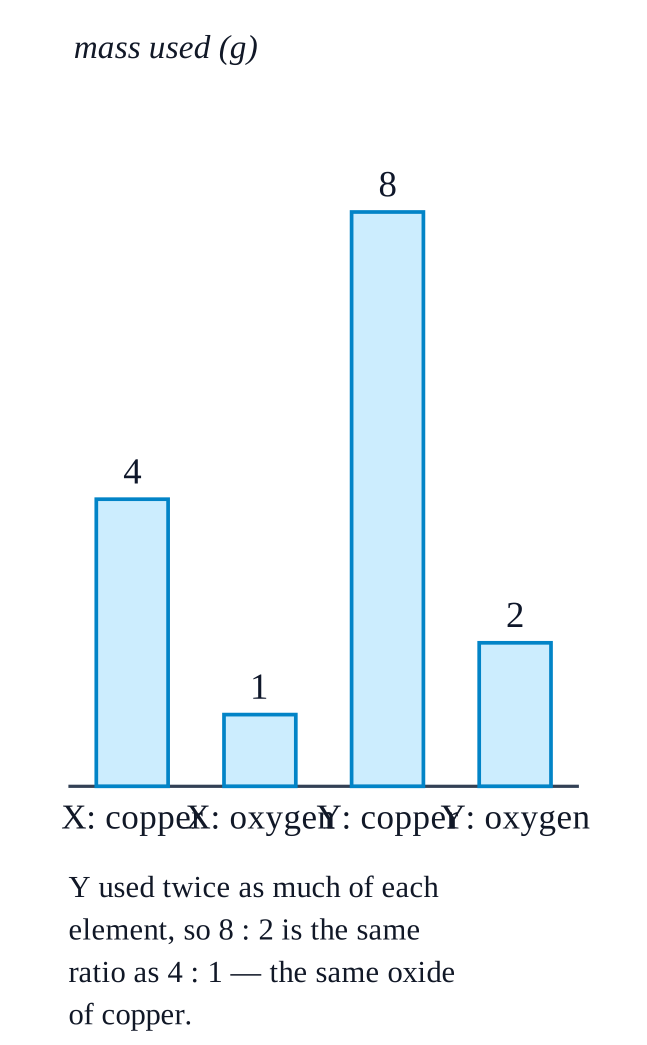
    Students X and Y, both prepared an oxide of copper by combining copper and oxygen in the ratios of 4\displaystyle 4:1\displaystyle 1 and 8\displaystyle 8:2\displaystyle 2, respectively. Do their results justify the Law of Constant Proportions? Explain.

    Not cross-checked

    NCERT prints no numerical answer for this exercise, so this working has not been cross-checked against the book.

    Yes — the results do justify the Law of Constant Proportions.
    NCERT_Solution_Class9_Science_Ch9_PP_Q9-6
    Student X obtained copper : oxygen \(\displaystyle = 4 : 1\).
    Student Y obtained \(\displaystyle 8 : 2\), which reduces to \(\displaystyle \dfrac{8}{2} : \dfrac{2}{2} = 4 : 1\).
    The two ratios are identical, so both students made the same oxide of copper — Y simply used twice as much of each element.
    That is exactly what the law says: however it is prepared, a compound contains its elements in the same fixed ratio by mass.
  7. Exercise 9.7

    Assertion (A): 2\displaystyle 2 g of hydrogen combines with 16\displaystyle 16 g of oxygen to form 18\displaystyle 18 g of water. Reason (R): According to Dalton’s Atomic Theory, atoms combine in a simple whole number ratio by mass to form compounds. Choose the correct option: (i) Both A and R are true, and R is the correct explanation of A. (ii) Both A and R are true, but R is not the correct explanation of A. (iii) A is true, but R is false. (iv) A is false, but R is true. Exploration|Grade 9\displaystyle 9

    Not cross-checked

    NCERT prints no numerical answer for this exercise, so this working has not been cross-checked against the book.

    NCERT’s answer
    (iii)
    -; one; two
    (iii) A is true, but R is false.
    NCERT_Solution_Class9_Science_Ch9_PP_Q9-7
    A is true. \(\displaystyle 2 + 16 = 18\) g, and \(\displaystyle 2 : 16 = 1 : 8\), the fixed hydrogen : oxygen mass ratio of water given in the chapter.
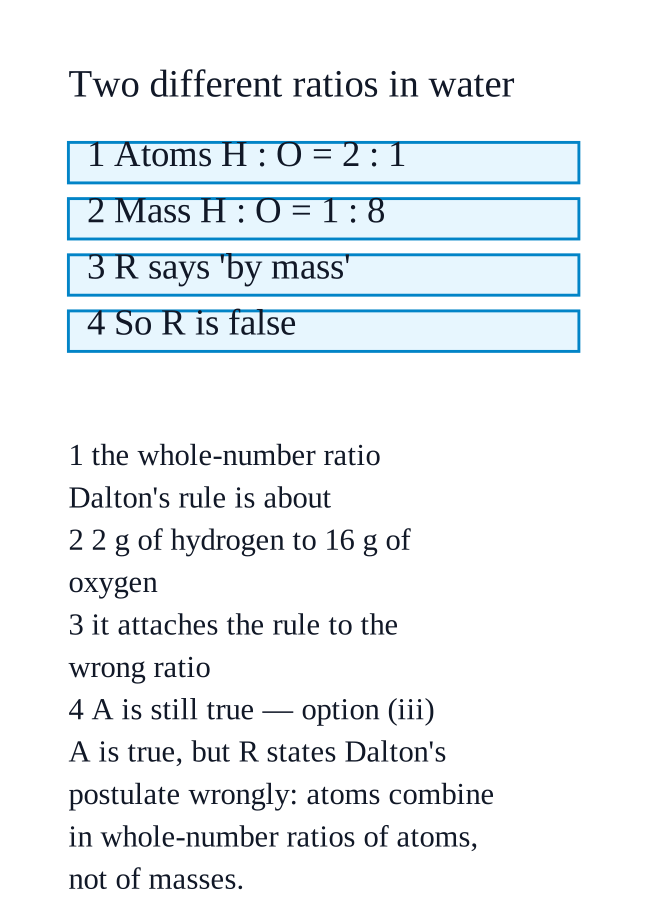
    R is false as worded. Dalton's postulate is that atoms combine in the ratio of simple whole numbers — that is a ratio of the numbers of atoms, not a ratio by mass.
    The two ratios are different quantities. In water the atoms combine as \(\displaystyle H : O = 2 : 1\) (the formula \(\displaystyle H_{2}O\) means two hydrogen atoms to one oxygen atom), while the masses combine as \(\displaystyle 1 : 8\). Dalton's whole-number rule speaks about the first, and R attaches it to the second.
    Nor is a mass ratio obliged to be whole numbers at all — sodium chloride combines in the mass ratio \(\displaystyle 23 : 35.5\).
    So R states the postulate wrongly and cannot explain A.
  8. Exercise 9.8

    Nitrogen has five valence electrons. Draw the structure of the nitrogen molecule (N2\displaystyle N_{2}).

    Not cross-checked

    NCERT prints no numerical answer for this exercise, so this working has not been cross-checked against the book.

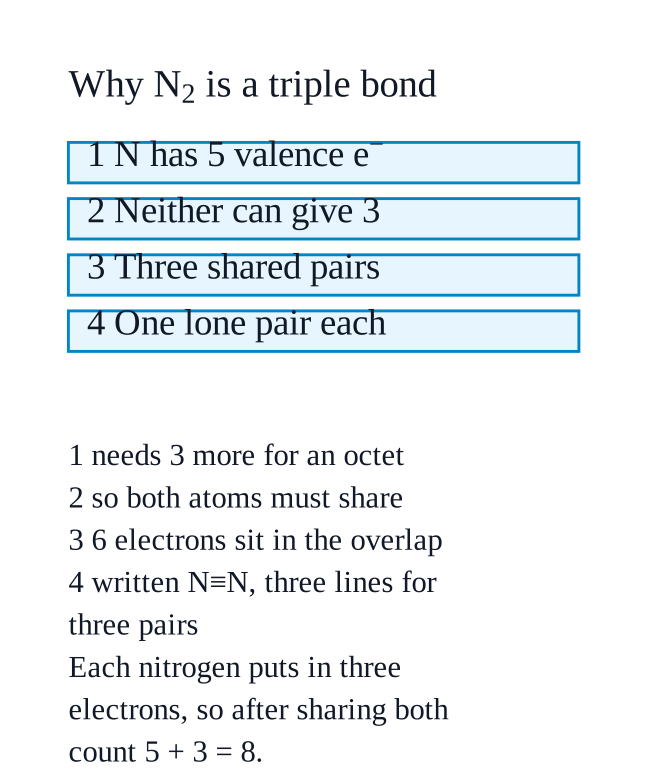
    Two nitrogen atoms share three pairs of electrons, giving a triple bond: \(\displaystyle N \equiv N\).
    NCERT_Solution_Class9_Science_Ch9_PP_Q9-8
    Nitrogen has $\displaystyle 5$ valence electrons and needs $\displaystyle 3$ more for an octet; neither atom can take $\displaystyle 3$ from the other, so each contributes $\displaystyle 3$ electrons to be shared.
    After sharing, each nitrogen counts \(\displaystyle 5 + 3 = 8\) valence electrons — a complete octet, so \(\displaystyle N_2\) is stable.
    The drawing must contain:
    two atoms labelled N, side by side, each starting with its $\displaystyle 5$ valence electrons marked round it;
    dots for one atom's electrons and crosses for the other's, so the reader can see which electron came from where;
    three shared pairs ($\displaystyle 6$ electrons) drawn in the overlap between the two symbols;
    one lone pair left on each nitrogen, drawn on its outer side;
    the line formula N≡N written alongside, the three lines standing for the three shared pairs.
  9. Exercise 9.9

    The atomic number of fluorine is 9. Explain the formation of the fluorine molecule (F2\displaystyle F_{2}). Just as atoms share electrons to form covalent bonds, we too, can share and care to build strong relationships with people around us. This sharing brings unity and stability, laying the foundation for a stronger community, and ultimately, a strong nation. 170\displaystyle 170 Exploration|Grade 9\displaystyle 9

    Not cross-checked

    NCERT prints no numerical answer for this exercise, so this working has not been cross-checked against the book.

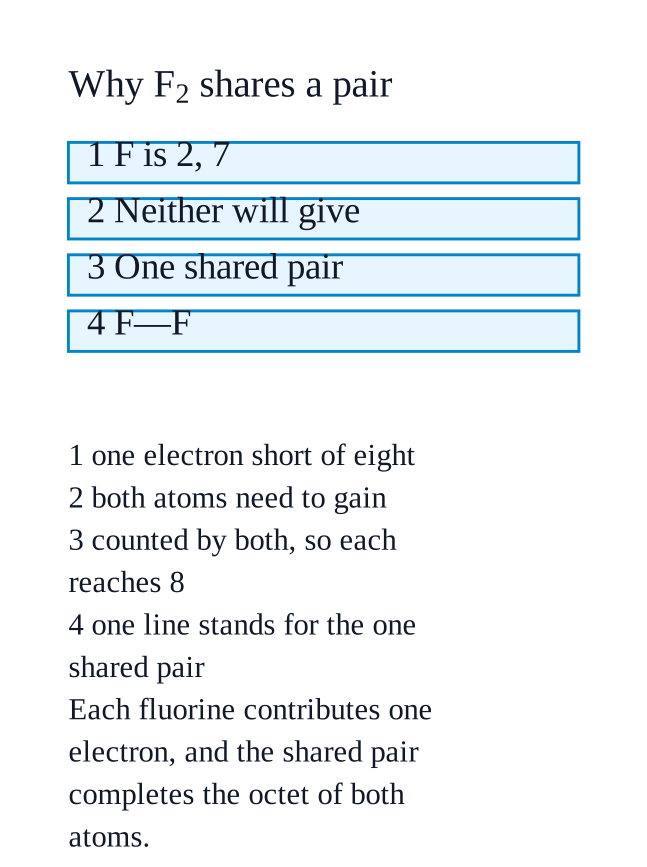
    Two fluorine atoms share one pair of electrons, forming a single covalent bond: F—F.
    NCERT_Solution_Class9_Science_Ch9_PP_Q9-9
    Fluorine (\(\displaystyle Z = 9\)) has the configuration $\displaystyle 2$, $\displaystyle 7$ — seven valence electrons, one short of an octet.
    Both atoms need to gain an electron, so neither will donate one; the only way for both to become stable is to share.
    Each atom puts in one electron, and the shared pair is counted by both atoms, so each fluorine now has $\displaystyle 8$ valence electrons.
    The shared pair attracts both nuclei and holds the atoms together; each atom also keeps three lone pairs.
    The molecule is written \(\displaystyle F_2\), or F—F, one line for the one shared pair.
  10. Exercise 9.10

    Show the formation of the following molecules: (i) Carbon dioxide (CO2\displaystyle CO_{2}) (ii) Hydrogen sulfide (H2\displaystyle H_{2}S) (iii) Ammonia (NH3\displaystyle NH_{3})

    Not cross-checked

    NCERT prints no numerical answer for this exercise, so this working has not been cross-checked against the book.

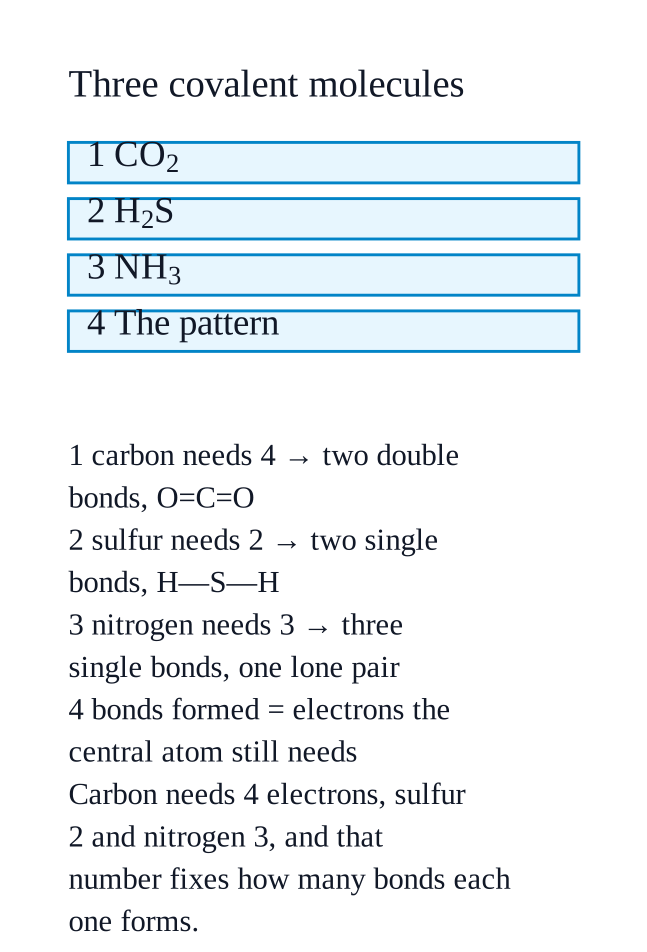
    (i) \(\displaystyle CO_2\) — carbon $\displaystyle (2, 4)$ has $\displaystyle 4$ valence electrons and needs $\displaystyle 4$ more; each oxygen $\displaystyle (2, 6)$ needs 2. Carbon shares two electrons with each oxygen, making two double bonds: O=C=O.
    NCERT_Solution_Class9_Science_Ch9_PP_Q9-10
    (ii) \(\displaystyle H_2S\) — sulfur ($\displaystyle 2$, $\displaystyle 8$, $\displaystyle 6$) needs $\displaystyle 2$ electrons and each hydrogen needs $\displaystyle 1$, so two hydrogen atoms each share one electron with sulfur: two single bonds, H—S—H.
    (iii) \(\displaystyle NH_3\) — nitrogen $\displaystyle (2, 5)$ needs $\displaystyle 3$ electrons, so three hydrogen atoms each share one with it: three single bonds, with one lone pair left on nitrogen.
    Each diagram must show:
    \(\displaystyle CO_2\): C in the middle, an O on each side; $\displaystyle 4$ electrons ($\displaystyle 2$ shared pairs) between C and each O; $\displaystyle 2$ lone pairs left on each O; C ends with $\displaystyle 8$ electrons and each O with $\displaystyle 8$; the line form O=C=O beside it.
    \(\displaystyle H_2S\): S in the middle with an H on each side; $\displaystyle 2$ electrons ($\displaystyle 1$ shared pair) between S and each H; $\displaystyle 2$ lone pairs left on S; each H reaches its duplet of $\displaystyle 2$ and S its octet of $\displaystyle 8$; the line form H—S—H.
    \(\displaystyle NH_3\): N in the middle with three H atoms round it; $\displaystyle 1$ shared pair between N and each H; $\displaystyle 1$ lone pair left on N; N reaches $\displaystyle 8$ and each H reaches 2.
    In all three, use dots for one element's electrons and crosses for the other's, and label every atom with its symbol.