SolveItClass 9 · NCERT

NCERT Solutions · Class 9 Science Atomic Foundations of Matter

39 questions · 21 still being checked

Pause and Ponder 9.11–9.20 (part 2 of 5)

  1. Exercise 9.11

    Neon (atomic number 10\displaystyle 10) neither transfers nor shares its valence electrons. Explain.

    Not cross-checked

    NCERT prints no numerical answer for this exercise, so this working has not been cross-checked against the book.

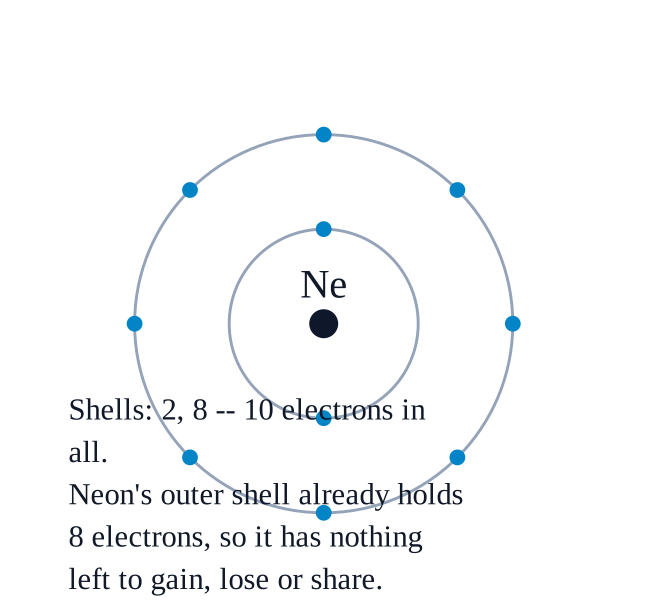
    Because neon's valence shell is already complete — its configuration is $\displaystyle 2$, $\displaystyle 8$, a full octet.
    NCERT_Solution_Class9_Science_Ch9_PP_Q9-11
    Atoms lose, gain or share electrons only in order to complete their valence shell and become stable; neon has nothing left to complete.
    Its energy is already low, so combining with another atom would not lower it further and would bring no gain in stability.
    Neon therefore stays as single atoms, forms no molecules and is chemically unreactive.
  2. Exercise 9.12

    What kind of ion will oxygen (O) form?
    NCERT’s answer
    Anion (\(\displaystyle O^{2-}\))
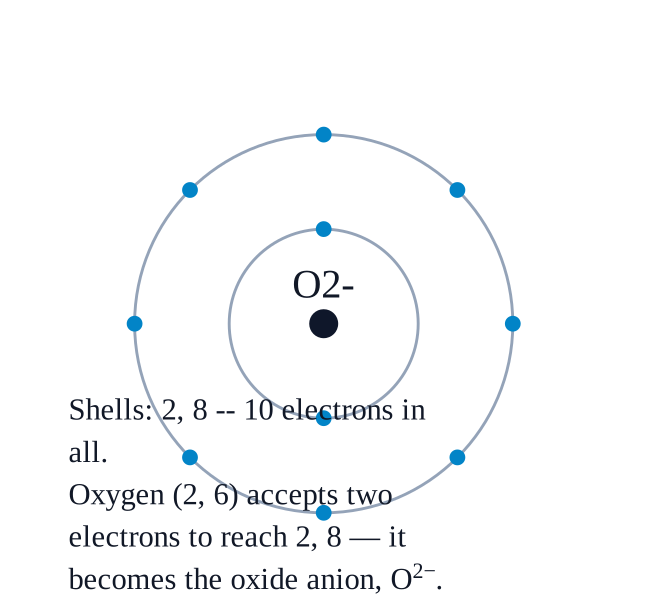
    Oxygen forms an anion — the oxide ion, \(\displaystyle O^{2-}\).
    NCERT_Solution_Class9_Science_Ch9_PP_Q9-12
    Oxygen (\(\displaystyle Z = 8\)) has the configuration $\displaystyle 2$, $\displaystyle 6$: six valence electrons, two short of an octet.
    An atom with more than $\displaystyle 4$ valence electrons gains electrons rather than losing them, so oxygen accepts $\displaystyle 2$.
    It then has $\displaystyle 8$ protons but $\displaystyle 10$ electrons, a net charge of $\displaystyle 2$−, and the stable arrangement $\displaystyle 2$, 8.
  3. Exercise 9.13

    Fill in the blanks. Among magnesium and chlorine, magnesium atom can give two electrons to become Mg2+\displaystyle Mg^{2+}. However, chlorine can take only one electron to become ____________. Now, __________ ion of magnesium and __________ ions of chlorine combine to give magnesium chloride.

    Not cross-checked

    NCERT prints no numerical answer for this exercise, so this working has not been cross-checked against the book.

    NCERT’s answer
    Cl
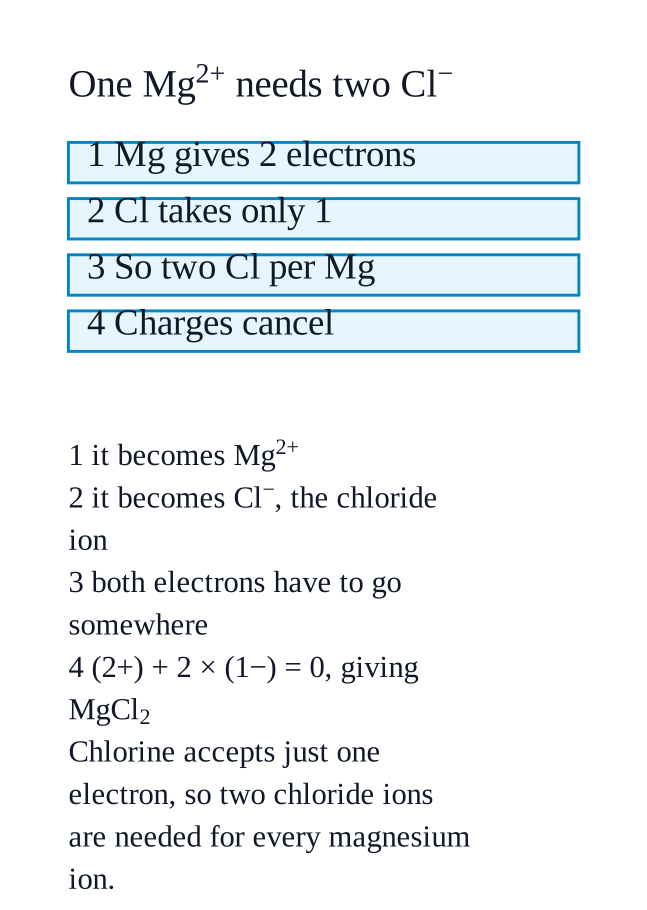
    Blank $\displaystyle 1$ = \(\displaystyle Cl^-\) (the chloride ion); blank $\displaystyle 2$ = one; blank $\displaystyle 3$ = two.
    NCERT_Solution_Class9_Science_Ch9_PP_Q9-13
    Chlorine is $\displaystyle 2$, $\displaystyle 8$, $\displaystyle 7$ — one electron short of an octet — so it accepts exactly one electron and becomes \(\displaystyle Cl^-\).
    Magnesium gives away $\displaystyle 2$ electrons, but each chlorine atom can take only $\displaystyle 1$, so two chlorine atoms are needed for every magnesium atom.
    The charges must cancel: \(\displaystyle (2+) + 2 \times (1-) = 0\).
    One \(\displaystyle Mg^{2+}\) ion and two \(\displaystyle Cl^-\) ions therefore combine to give magnesium chloride, \(\displaystyle MgCl_2\).
  4. Exercise 9.14

    Show the formation of cations of potassium (K) and calcium (Ca) atoms, and the formation of their corresponding chlorides using diagrams.

    Not cross-checked

    NCERT prints no numerical answer for this exercise, so this working has not been cross-checked against the book.

    Potassium forms \(\displaystyle K^+\) and calcium forms \(\displaystyle Ca^{2+}\); their chlorides are KCl and \(\displaystyle CaCl_2\).
    NCERT_Solution_Class9_Science_Ch9_PP_Q9-14
    Potassium (\(\displaystyle Z = 19\)) is $\displaystyle 2$, $\displaystyle 8$, $\displaystyle 8$, $\displaystyle 1$. Losing its single valence electron leaves $\displaystyle 19$ protons and $\displaystyle 18$ electrons → \(\displaystyle K^+\), with the stable arrangement $\displaystyle 2$, $\displaystyle 8$, 8.
    Calcium (\(\displaystyle Z = 20\)) is $\displaystyle 2$, $\displaystyle 8$, $\displaystyle 8$, $\displaystyle 2$. Losing both valence electrons leaves $\displaystyle 20$ protons and $\displaystyle 18$ electrons → \(\displaystyle Ca^{2+}\), also $\displaystyle 2$, $\displaystyle 8$, 8.
    KCl: the one electron potassium loses is taken by one chlorine atom ($\displaystyle 2$, $\displaystyle 8$, $\displaystyle 7$ → $\displaystyle 2$, $\displaystyle 8$, $\displaystyle 8$); \(\displaystyle K^+\) and \(\displaystyle Cl^-\) are then held by electrostatic attraction → KCl.
    \(\displaystyle CaCl_2\): calcium gives one electron to each of two chlorine atoms, since each chlorine can take only one → \(\displaystyle Ca^{2+}\) and two \(\displaystyle Cl^-\) → \(\displaystyle CaCl_2\).
    The four diagrams must show:
    K → \(\displaystyle K^+\): concentric shells holding $\displaystyle 2$, $\displaystyle 8$, $\displaystyle 8$, $\displaystyle 1$ electrons round a nucleus labelled $\displaystyle 19$ p; a curved arrow out of the outermost shell labelled \(\displaystyle e^-\); the product drawn as shells $\displaystyle 2$, $\displaystyle 8$, $\displaystyle 8$ inside square brackets with + outside, labelled "Potassium cation \(\displaystyle K^+\)".
    Ca → \(\displaystyle Ca^{2+}\): shells $\displaystyle 2$, $\displaystyle 8$, $\displaystyle 8$, $\displaystyle 2$ round a nucleus labelled $\displaystyle 20$ p; two arrows labelled \(\displaystyle 2e^-\); the product as $\displaystyle 2$, $\displaystyle 8$, $\displaystyle 8$ in square brackets with $\displaystyle 2$+ outside, labelled "Calcium cation \(\displaystyle Ca^{2+}\)".
    KCl: K ($\displaystyle 2$, $\displaystyle 8$, $\displaystyle 8$, $\displaystyle 1$) beside Cl ($\displaystyle 2$, $\displaystyle 8$, $\displaystyle 7$), one arrow from K's valence shell to Cl's valence shell; the products \(\displaystyle [2,8,8]^+\) and \(\displaystyle [2,8,8]^-\) labelled \(\displaystyle K^+\) and \(\displaystyle Cl^-\); the gap between them labelled ionic bond; the formula KCl written below.
    \(\displaystyle CaCl_2\): Ca in the middle with a Cl on either side; one arrow from Ca to each Cl; the products \(\displaystyle Ca^{2+}\) and two \(\displaystyle Cl^-\), each in square brackets with its charge; the formula \(\displaystyle CaCl_2\) written below.
  5. Exercise 9.15

    Illustrate how sodium sulfide (Na2\displaystyle Na_{2}S) is formed. Name of ion Sodium Lithium Potassium Silver Calcium Barium Iron (Ferrous) Iron (Ferric) Copper (Cuprous) Copper (Cupric) Magnesium Zinc Aluminium Fluoride Chloride Bromide Iodide Oxide Sulfide

    Not cross-checked

    NCERT prints no numerical answer for this exercise, so this working has not been cross-checked against the book.

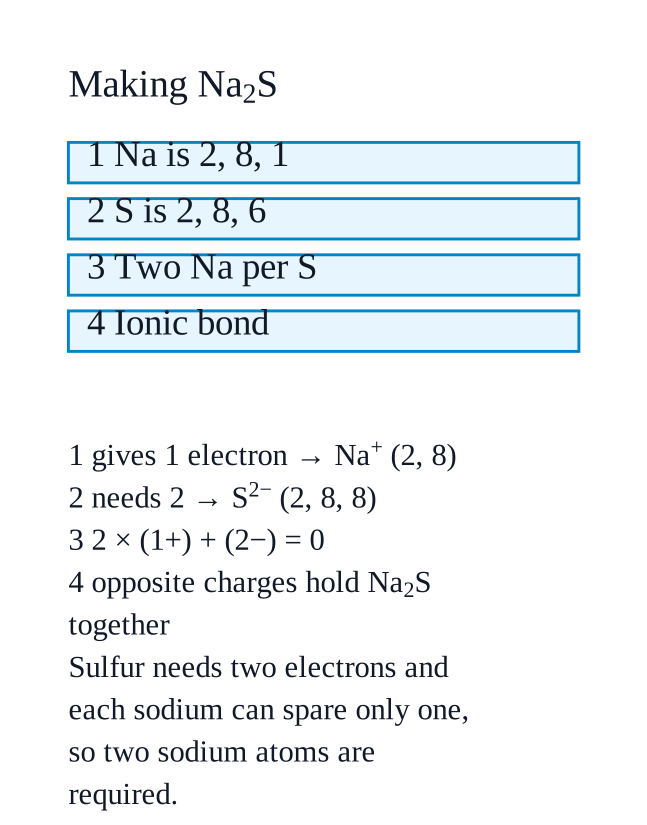
    \(\displaystyle Na_2S\) is formed when each of two sodium atoms transfers one electron to a single sulfur atom.
    NCERT_Solution_Class9_Science_Ch9_PP_Q9-15
    Sodium is $\displaystyle 2$, $\displaystyle 8$, $\displaystyle 1$ — one valence electron to give away; sulfur is $\displaystyle 2$, $\displaystyle 8$, $\displaystyle 6$ — two electrons short of an octet.
    Each Na loses $\displaystyle 1$ electron → \(\displaystyle Na^+\) $\displaystyle (2, 8)$; sulfur accepts both → \(\displaystyle S^{2-}\) ($\displaystyle 2$, $\displaystyle 8$, $\displaystyle 8$).
    Two sodium ions are needed for one sulfide ion so that the charges cancel: \(\displaystyle 2 \times (1+) + (2-) = 0\).
    The oppositely charged ions are held together by the electrostatic force of attraction — an ionic bond — giving \(\displaystyle Na_2S\), sodium sulfide.
    The illustration must show: two sodium atoms (shells $\displaystyle 2$, $\displaystyle 8$, $\displaystyle 1$) on the left and one sulfur atom ($\displaystyle 2$, $\displaystyle 8$, $\displaystyle 6$) on the right; one curved arrow labelled \(\displaystyle e^-\) from each sodium's valence shell to the sulfur's valence shell; the products drawn as \(\displaystyle [2,8]^+\) twice, labelled \(\displaystyle Na^+\), and \(\displaystyle [2,8,8]^{2-}\), labelled \(\displaystyle S^{2-}\); the label ionic bond between them; and the formula \(\displaystyle Na_2S\) written underneath.
  6. Exercise 9.16

    Name the following: (i) CO2\displaystyle CO_{2} _______________________________ (ii) NO2\displaystyle NO_{2} _______________________________ (iii) SF6\displaystyle SF_{6} (iv) PCl3 _______________________________

    Not cross-checked

    NCERT prints no numerical answer for this exercise, so this working has not been cross-checked against the book.

    NCERT’s answer
    (i)
    Carbon dioxide (ii) Nitrogen dioxide (iii) Sulfur hexafluoride (iv) Phosphorous trichloride
    (i) \(\displaystyle CO_2\) — carbon dioxide
    NCERT_Solution_Class9_Science_Ch9_PP_Q9-16
    (ii) \(\displaystyle NO_2\) — nitrogen dioxide
    (iii) \(\displaystyle SF_6\) — sulfur hexafluoride
    (iv) \(\displaystyle PCl_3\) — phosphorus trichloride
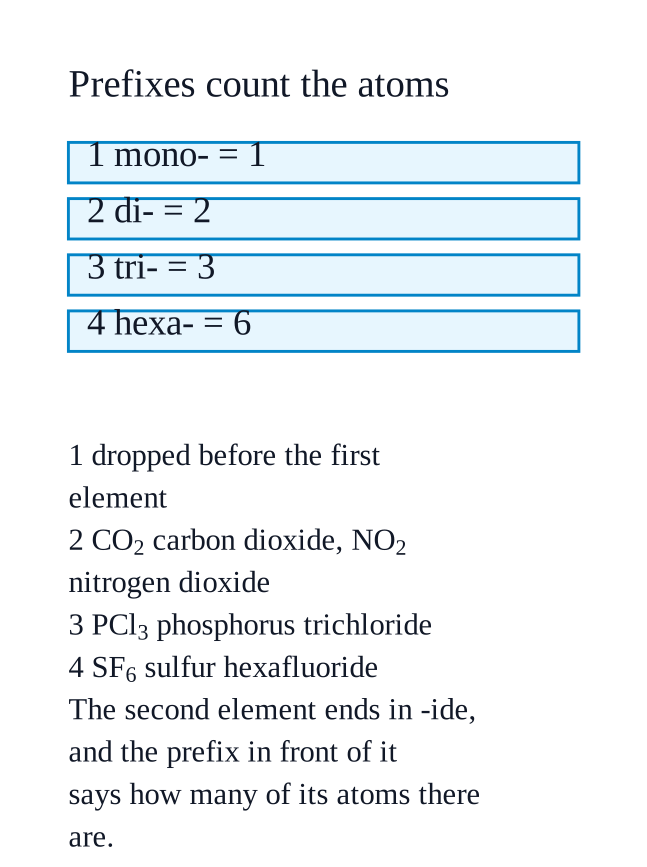
    Rule used: the first element keeps its ordinary name, the second element ends in -ide, and the prefixes mono- ($\displaystyle 1$), di- ($\displaystyle 2$), tri- ($\displaystyle 3$), tetra- ($\displaystyle 4$), penta- ($\displaystyle 5$), hexa- ($\displaystyle 6$) count the atoms.
    mono- is dropped before the first element, which is why \(\displaystyle CO_2\) is carbon dioxide and not "monocarbon dioxide", and why \(\displaystyle NO_2\) is nitrogen dioxide.
  7. Exercise 9.17

    Write the formula for the following: (i) Sodium hydrogencarbonate _____________________ (ii) Sulfur dioxide (iii) Ferric chloride ___________________________________ (iv) Cuprous oxide ___________________________________
    NCERT’s answer
    (i)
    \(\displaystyle NaHCO_{3}\) (ii) \(\displaystyle SO_{2}\) (iii) \(\displaystyle FeCl_{3}\) (iv) \(\displaystyle Cu_{2}\)O
    (i) Sodium hydrogencarbonate — \(\displaystyle NaHCO_3\): \(\displaystyle Na^+\) with \(\displaystyle HCO_3^-\), both of valency $\displaystyle 1$, so one of each.
    (ii) Sulfur dioxide — \(\displaystyle SO_2\): the prefix di- fixes two oxygen atoms to one sulfur.
    (iii) Ferric chloride — \(\displaystyle FeCl_3\): ferric is \(\displaystyle Fe^{3+}\) and chloride is \(\displaystyle Cl^-\); criss-crossing $\displaystyle 3$ and $\displaystyle 1$ gives one Fe to three Cl.
    (iv) Cuprous oxide — \(\displaystyle Cu_2O\): cuprous is \(\displaystyle Cu^+\) and oxide is \(\displaystyle O^{2-}\); criss-crossing $\displaystyle 1$ and $\displaystyle 2$ gives two Cu to one O.
  8. Exercise 9.18

    Write the formulae for the compounds formed from the following pairs of ions: (i) Fe3+\displaystyle Fe^{3+} and OH\displaystyle OH^{‒} 9.6\displaystyle 9.6 Properties of the Ionic and the Covalent Compounds Activity 9.4\displaystyle 9.4: Let us experiment 1. Collect the samples of some compounds, such as camphor, sodium chloride, copper sulfate, sugar and naphthalene. (A) Solubility in (i) water, (ii) kerosene, and (iii) petrol 2. Try dissolving each sample separately in the water, kerosene and petrol. 3. Record your observations in Table 9.2. (B) Electrical conductivity in the water Safety first: Do not touch the electrodes when they are connected to the battery but use a low-voltage battery to avoid the risk of shock. Petrol and kerosene are flammable liquids, so be careful while working with them.
    NCERT’s answer
    (i)
    Fe(OH)$\displaystyle 3$ (ii) \(\displaystyle K_{2}\)\(\displaystyle CO_{3}\)
    (i) \(\displaystyle Fe^{3+}\) and \(\displaystyle OH^-\) → \(\displaystyle Fe(OH)_3\)
    Criss-cross the charge numbers $\displaystyle 3$ and $\displaystyle 1$: one \(\displaystyle Fe^{3+}\) to three \(\displaystyle OH^-\), and \(\displaystyle 3+ \;+\; 3 \times (1-) = 0\).
    Brackets are needed because three of the same polyatomic ion are present — it is \(\displaystyle Fe(OH)_3\), not \(\displaystyle FeOH_3\).
    (ii) \(\displaystyle K^+\) and \(\displaystyle CO_3^{2-}\) → \(\displaystyle K_2CO_3\)
    Criss-cross $\displaystyle 1$ and $\displaystyle 2$: two \(\displaystyle K^+\) to one \(\displaystyle CO_3^{2-}\), and \(\displaystyle 2 \times (1+) + (2-) = 0\).
    Only one carbonate ion is present, so no brackets are used.
  9. Exercise 9.19

    What type of chemical bond is present in a solid compound that does not conduct electricity in the solid state but conducts electricity when dissolved in water?

    Not cross-checked

    NCERT prints no numerical answer for this exercise, so this working has not been cross-checked against the book.

    An ionic bond.
    NCERT_Solution_Class9_Science_Ch9_PP_Q9-19
    In the solid state the ions are locked in fixed positions in the crystal lattice by strong forces, so no charge can move and the compound cannot conduct.
    On dissolving in water the ions become free to move, and moving ions carry the current — so the solution conducts.
    A covalent compound would fail one test or the other: sugar dissolves but releases no ions, and camphor and naphthalene do not conduct at all.
  10. Exercise 9.20

    Metal M, with two electrons in its valence shell (M shell), reacts with oxygen to form a compound that is slightly soluble in water. Predict its: (i) formula (ii) type of bond (iii) electrical conductivity of its aqueous solution. You have learnt in section 9.4.2\displaystyle 9.4.2 that in ionic compounds, the ions form

    Not cross-checked

    NCERT prints no numerical answer for this exercise, so this working has not been cross-checked against the book.

    NCERT’s answer
    (i)
    MO (ii) Ionic (iii) Conducts electricity in aqueous solution
    (i) Formula: MO
    NCERT_Solution_Class9_Science_Ch9_PP_Q9-20
    (ii) Type of bond: ionic
    (iii) Its aqueous solution conducts electricity
    M's valence shell is the M shell holding $\displaystyle 2$ electrons, so M is $\displaystyle 2$, $\displaystyle 8$, $\displaystyle 2$ — a metal with fewer than $\displaystyle 4$ valence electrons, which donates them → \(\displaystyle M^{2+}\).
    Oxygen has $\displaystyle 6$ valence electrons and gains $\displaystyle 2$ → \(\displaystyle O^{2-}\).
    Criss-crossing the charges gives \(\displaystyle M_2O_2\), and dividing both subscripts by the common factor $\displaystyle 2$ gives MO.
    Metal + non-metal joined by the transfer of electrons is an ionic bond.
    The compound is only slightly soluble, but whatever does dissolve releases free \(\displaystyle M^{2+}\) and \(\displaystyle O^{2-}\) ions into the water, and free ions conduct — so the bulb would glow, if weakly.