Exercise 1
Show that the function given by has maximum at .
Not cross-checked
This solution has not been cross-checked against the answer printed in NCERT.
The domain is \(\displaystyle x>0\), since \(\displaystyle \log x\) is defined only there.By the quotient rule,
\[f'(x)=\frac{x\cdot\dfrac{1}{x}-\log x\cdot 1}{x^{2}}=\frac{1-\log x}{x^{2}}. \]Stationary points: \(\displaystyle x^{2}\neq 0\) on the domain, so \(\displaystyle f'(x)=0\) only when \(\displaystyle 1-\log x=0\), i.e. \(\displaystyle \log x=1\), i.e. \(\displaystyle x=e\).Apply the second derivative test. Differentiating \(\displaystyle f'(x)=(1-\log x)x^{-2}\),
\[f''(x)=\frac{\left(-\dfrac{1}{x}\right)x^{2}-(1-\log x)(2x)}{x^{4}}=\frac{-1-2(1-\log x)}{x^{3}}=\frac{2\log x-3}{x^{3}}. \]
At \(\displaystyle x=e\), \(\displaystyle \log e=1\), so
\[f''(e)=\frac{2-3}{e^{3}}=-\frac{1}{e^{3}}<0. \]Since \(\displaystyle f''(e)<0\), \(\displaystyle f\) has a maximum at \(\displaystyle x=e\).This maximum is in fact the absolute maximum on \(\displaystyle (0,\infty)\): \(\displaystyle f'(x)>0\) for \(\displaystyle 0<x<e\) (there \(\displaystyle \log x<1\)) and \(\displaystyle f'(x)<0\) for \(\displaystyle x>e\).Hence \(\displaystyle f\) has its maximum at \(\displaystyle x=e\), the maximum value being \(\displaystyle f(e)=\dfrac{1}{e}\).
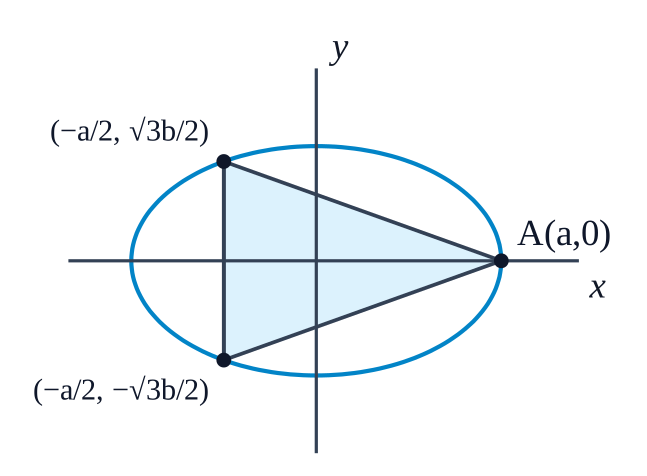 Take the vertex at the end \(\displaystyle A(a,0)\) of the major axis. By symmetry of the ellipse in the \(\displaystyle x\)-axis, the other two vertices of an isosceles triangle with this apex are \(\displaystyle (x,y)\) and \(\displaystyle (x,-y)\) with \(\displaystyle -a<x<a\) and
\[y=b\sqrt{1-\frac{x^{2}}{a^{2}}}=\frac{b}{a}\sqrt{a^{2}-x^{2}}. \]The base is the vertical chord of length \(\displaystyle 2y\) and the height is \(\displaystyle a-x\), so the area is
\[A(x)=\frac{1}{2}(2y)(a-x)=\frac{b}{a}(a-x)\sqrt{a^{2}-x^{2}}=\frac{b}{a}(a-x)^{3/2}(a+x)^{1/2}, \]
using \(\displaystyle a^{2}-x^{2}=(a-x)(a+x)\).Differentiate by the product rule:
\[A'(x)=\frac{b}{a}\left[-\frac{3}{2}(a-x)^{1/2}(a+x)^{1/2}+\frac{1}{2}(a-x)^{3/2}(a+x)^{-1/2}\right] \]
\[=\frac{b}{2a}\cdot\frac{(a-x)^{1/2}}{(a+x)^{1/2}}\Big[-3(a+x)+(a-x)\Big]=\frac{b}{2a}\cdot\frac{(a-x)^{1/2}}{(a+x)^{1/2}}\,(-2a-4x). \]For \(\displaystyle -a<x<a\) the factor \(\displaystyle \dfrac{(a-x)^{1/2}}{(a+x)^{1/2}}\) is positive, so
\[A'(x)=0\iff -2a-4x=0\iff x=-\frac{a}{2}. \]
Moreover \(\displaystyle -2a-4x>0\) for \(\displaystyle x<-\dfrac{a}{2}\) and \(\displaystyle <0\) for \(\displaystyle x>-\dfrac{a}{2}\), so \(\displaystyle A\) changes from increasing to decreasing: by the first derivative test \(\displaystyle x=-\dfrac{a}{2}\) gives a maximum.At \(\displaystyle x=-\dfrac{a}{2}\): \(\displaystyle a-x=\dfrac{3a}{2}\), \(\displaystyle a+x=\dfrac{a}{2}\), so
\[A=\frac{b}{a}\cdot\frac{3a}{2}\cdot\sqrt{\frac{3a}{2}\cdot\frac{a}{2}}=\frac{b}{a}\cdot\frac{3a}{2}\cdot\frac{a\sqrt{3}}{2}=\frac{3\sqrt{3}}{4}ab. \]The maximum area is \(\displaystyle \dfrac{3\sqrt{3}}{4}\,ab\) square units (attained when the base is the chord \(\displaystyle x=-\tfrac{a}{2}\)).
Take the vertex at the end \(\displaystyle A(a,0)\) of the major axis. By symmetry of the ellipse in the \(\displaystyle x\)-axis, the other two vertices of an isosceles triangle with this apex are \(\displaystyle (x,y)\) and \(\displaystyle (x,-y)\) with \(\displaystyle -a<x<a\) and
\[y=b\sqrt{1-\frac{x^{2}}{a^{2}}}=\frac{b}{a}\sqrt{a^{2}-x^{2}}. \]The base is the vertical chord of length \(\displaystyle 2y\) and the height is \(\displaystyle a-x\), so the area is
\[A(x)=\frac{1}{2}(2y)(a-x)=\frac{b}{a}(a-x)\sqrt{a^{2}-x^{2}}=\frac{b}{a}(a-x)^{3/2}(a+x)^{1/2}, \]
using \(\displaystyle a^{2}-x^{2}=(a-x)(a+x)\).Differentiate by the product rule:
\[A'(x)=\frac{b}{a}\left[-\frac{3}{2}(a-x)^{1/2}(a+x)^{1/2}+\frac{1}{2}(a-x)^{3/2}(a+x)^{-1/2}\right] \]
\[=\frac{b}{2a}\cdot\frac{(a-x)^{1/2}}{(a+x)^{1/2}}\Big[-3(a+x)+(a-x)\Big]=\frac{b}{2a}\cdot\frac{(a-x)^{1/2}}{(a+x)^{1/2}}\,(-2a-4x). \]For \(\displaystyle -a<x<a\) the factor \(\displaystyle \dfrac{(a-x)^{1/2}}{(a+x)^{1/2}}\) is positive, so
\[A'(x)=0\iff -2a-4x=0\iff x=-\frac{a}{2}. \]
Moreover \(\displaystyle -2a-4x>0\) for \(\displaystyle x<-\dfrac{a}{2}\) and \(\displaystyle <0\) for \(\displaystyle x>-\dfrac{a}{2}\), so \(\displaystyle A\) changes from increasing to decreasing: by the first derivative test \(\displaystyle x=-\dfrac{a}{2}\) gives a maximum.At \(\displaystyle x=-\dfrac{a}{2}\): \(\displaystyle a-x=\dfrac{3a}{2}\), \(\displaystyle a+x=\dfrac{a}{2}\), so
\[A=\frac{b}{a}\cdot\frac{3a}{2}\cdot\sqrt{\frac{3a}{2}\cdot\frac{a}{2}}=\frac{b}{a}\cdot\frac{3a}{2}\cdot\frac{a\sqrt{3}}{2}=\frac{3\sqrt{3}}{4}ab. \]The maximum area is \(\displaystyle \dfrac{3\sqrt{3}}{4}\,ab\) square units (attained when the base is the chord \(\displaystyle x=-\tfrac{a}{2}\)).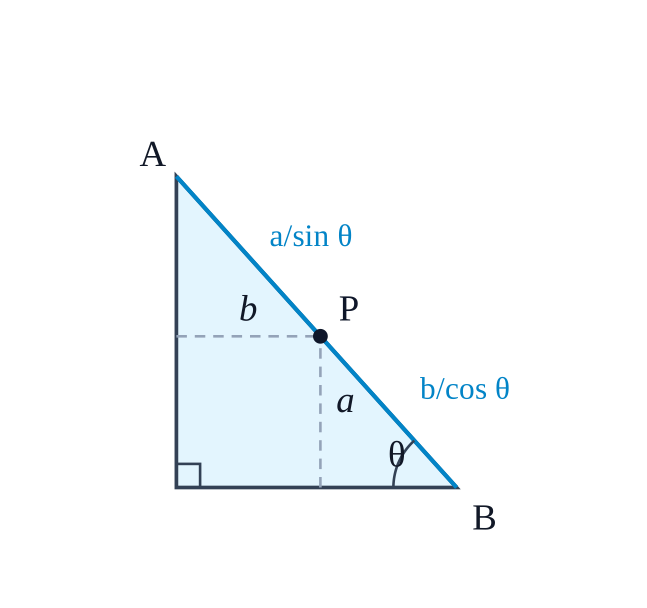 Place the right angle at the origin with the two legs along the axes, and let \(\displaystyle P\) be the given point on the hypotenuse, at distance \(\displaystyle a\) from one leg and \(\displaystyle b\) from the other. Let \(\displaystyle \theta\) be the acute angle the hypotenuse makes with the leg from which \(\displaystyle P\) is at distance \(\displaystyle a\), so \(\displaystyle \theta\in\left(0,\dfrac{\pi}{2}\right)\).\(\displaystyle P\) divides the hypotenuse into two pieces. In the right triangle formed by \(\displaystyle P\), its foot on the horizontal leg and the vertex \(\displaystyle A\), the side opposite \(\displaystyle \theta\) is \(\displaystyle a\), so that piece has length \(\displaystyle a/\sin\theta\). In the right triangle on the other side, the horizontal projection of the piece \(\displaystyle PB\) is \(\displaystyle b\) and it makes angle \(\displaystyle \theta\) with the horizontal, so that piece has length \(\displaystyle b/\cos\theta\). Hence the length of the hypotenuse is
\[L(\theta)=\frac{a}{\sin\theta}+\frac{b}{\cos\theta}=a\,\mathrm{cosec}\,\theta+b\sec\theta. \]Differentiate:
\[L'(\theta)=-a\,\mathrm{cosec}\,\theta\cot\theta+b\sec\theta\tan\theta=-\frac{a\cos\theta}{\sin^{2}\theta}+\frac{b\sin\theta}{\cos^{2}\theta}. \]
Setting \(\displaystyle L'(\theta)=0\) and multiplying by \(\displaystyle \dfrac{\sin^{2}\theta\cos^{2}\theta}{1}\):
\[b\sin^{3}\theta=a\cos^{3}\theta\ \Rightarrow\ \tan^{3}\theta=\frac{a}{b}\ \Rightarrow\ \tan\theta=\left(\frac{a}{b}\right)^{1/3}. \]This is the only stationary point in \(\displaystyle \left(0,\dfrac{\pi}{2}\right)\), and \(\displaystyle L(\theta)\to\infty\) as \(\displaystyle \theta\to 0^{+}\) and as \(\displaystyle \theta\to\dfrac{\pi}{2}^{-}\); also \(\displaystyle L'<0\) before it and \(\displaystyle L'>0\) after it (the factor \(\displaystyle b\sin^{3}\theta-a\cos^{3}\theta\) is increasing in \(\displaystyle \theta\)). So this value gives the minimum.From \(\displaystyle \tan\theta=a^{1/3}/b^{1/3}\), the right triangle with legs \(\displaystyle a^{1/3}\) and \(\displaystyle b^{1/3}\) has hypotenuse \(\displaystyle \sqrt{a^{2/3}+b^{2/3}}\), so
\[\sin\theta=\frac{a^{1/3}}{\sqrt{a^{2/3}+b^{2/3}}},\qquad \cos\theta=\frac{b^{1/3}}{\sqrt{a^{2/3}+b^{2/3}}}. \]
Therefore
\[L=\frac{a\sqrt{a^{2/3}+b^{2/3}}}{a^{1/3}}+\frac{b\sqrt{a^{2/3}+b^{2/3}}}{b^{1/3}}=\sqrt{a^{2/3}+b^{2/3}}\left(a^{2/3}+b^{2/3}\right)=\left(a^{2/3}+b^{2/3}\right)^{3/2}. \]Hence the minimum length of the hypotenuse is \(\displaystyle \left(a^{\frac{2}{3}}+b^{\frac{2}{3}}\right)^{\frac{3}{2}}\).
Place the right angle at the origin with the two legs along the axes, and let \(\displaystyle P\) be the given point on the hypotenuse, at distance \(\displaystyle a\) from one leg and \(\displaystyle b\) from the other. Let \(\displaystyle \theta\) be the acute angle the hypotenuse makes with the leg from which \(\displaystyle P\) is at distance \(\displaystyle a\), so \(\displaystyle \theta\in\left(0,\dfrac{\pi}{2}\right)\).\(\displaystyle P\) divides the hypotenuse into two pieces. In the right triangle formed by \(\displaystyle P\), its foot on the horizontal leg and the vertex \(\displaystyle A\), the side opposite \(\displaystyle \theta\) is \(\displaystyle a\), so that piece has length \(\displaystyle a/\sin\theta\). In the right triangle on the other side, the horizontal projection of the piece \(\displaystyle PB\) is \(\displaystyle b\) and it makes angle \(\displaystyle \theta\) with the horizontal, so that piece has length \(\displaystyle b/\cos\theta\). Hence the length of the hypotenuse is
\[L(\theta)=\frac{a}{\sin\theta}+\frac{b}{\cos\theta}=a\,\mathrm{cosec}\,\theta+b\sec\theta. \]Differentiate:
\[L'(\theta)=-a\,\mathrm{cosec}\,\theta\cot\theta+b\sec\theta\tan\theta=-\frac{a\cos\theta}{\sin^{2}\theta}+\frac{b\sin\theta}{\cos^{2}\theta}. \]
Setting \(\displaystyle L'(\theta)=0\) and multiplying by \(\displaystyle \dfrac{\sin^{2}\theta\cos^{2}\theta}{1}\):
\[b\sin^{3}\theta=a\cos^{3}\theta\ \Rightarrow\ \tan^{3}\theta=\frac{a}{b}\ \Rightarrow\ \tan\theta=\left(\frac{a}{b}\right)^{1/3}. \]This is the only stationary point in \(\displaystyle \left(0,\dfrac{\pi}{2}\right)\), and \(\displaystyle L(\theta)\to\infty\) as \(\displaystyle \theta\to 0^{+}\) and as \(\displaystyle \theta\to\dfrac{\pi}{2}^{-}\); also \(\displaystyle L'<0\) before it and \(\displaystyle L'>0\) after it (the factor \(\displaystyle b\sin^{3}\theta-a\cos^{3}\theta\) is increasing in \(\displaystyle \theta\)). So this value gives the minimum.From \(\displaystyle \tan\theta=a^{1/3}/b^{1/3}\), the right triangle with legs \(\displaystyle a^{1/3}\) and \(\displaystyle b^{1/3}\) has hypotenuse \(\displaystyle \sqrt{a^{2/3}+b^{2/3}}\), so
\[\sin\theta=\frac{a^{1/3}}{\sqrt{a^{2/3}+b^{2/3}}},\qquad \cos\theta=\frac{b^{1/3}}{\sqrt{a^{2/3}+b^{2/3}}}. \]
Therefore
\[L=\frac{a\sqrt{a^{2/3}+b^{2/3}}}{a^{1/3}}+\frac{b\sqrt{a^{2/3}+b^{2/3}}}{b^{1/3}}=\sqrt{a^{2/3}+b^{2/3}}\left(a^{2/3}+b^{2/3}\right)=\left(a^{2/3}+b^{2/3}\right)^{3/2}. \]Hence the minimum length of the hypotenuse is \(\displaystyle \left(a^{\frac{2}{3}}+b^{\frac{2}{3}}\right)^{\frac{3}{2}}\).