Exercise 11
Find the absolute maximum and minimum values of the function given by
Not cross-checked
This solution has not been cross-checked against the answer printed in NCERT.
NCERT’s answer
Absolute maximum \(\displaystyle =\frac{5}{4}\), Absolute minimum \(\displaystyle =1\)
\(\displaystyle f\) is continuous on the closed interval \(\displaystyle [0,\pi]\), so by the extreme value theorem the absolute extrema exist and occur either at an interior critical point or at an endpoint.\[f'(x)=2\cos x(-\sin x)+\cos x=\cos x\,(1-2\sin x). \]Set \(\displaystyle f'(x)=0\) on \(\displaystyle (0,\pi)\):
\[\cos x=0\Rightarrow x=\frac{\pi}{2};\qquad \sin x=\frac{1}{2}\Rightarrow x=\frac{\pi}{6}\ \text{or}\ x=\frac{5\pi}{6}. \]
(Both solutions of \(\displaystyle \sin x=\tfrac12\) lie in \(\displaystyle [0,\pi]\) — dropping \(\displaystyle \tfrac{5\pi}{6}\) is the usual slip.)Evaluate \(\displaystyle f\) at the critical points and endpoints, using \(\displaystyle \cos^{2}\dfrac{\pi}{6}=\cos^{2}\dfrac{5\pi}{6}=\dfrac{3}{4}\):
\[f(0)=1+0=1,\qquad f\!\left(\frac{\pi}{6}\right)=\frac{3}{4}+\frac{1}{2}=\frac{5}{4}, \]
\[f\!\left(\frac{\pi}{2}\right)=0+1=1,\qquad f\!\left(\frac{5\pi}{6}\right)=\frac{3}{4}+\frac{1}{2}=\frac{5}{4},\qquad f(\pi)=1+0=1. \]Absolute maximum value \(\displaystyle =\dfrac{5}{4}\), attained at \(\displaystyle x=\dfrac{\pi}{6}\) and \(\displaystyle x=\dfrac{5\pi}{6}\).Absolute minimum value \(\displaystyle =1\), attained at \(\displaystyle x=0,\ \dfrac{\pi}{2},\ \pi\).
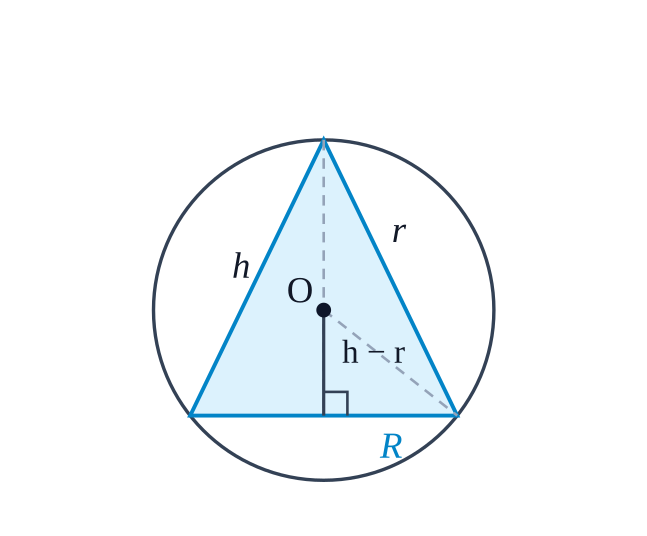 Let the cone have altitude \(\displaystyle h\) and base radius \(\displaystyle R\), inscribed in the sphere of radius \(\displaystyle r\) so that its axis passes through the centre \(\displaystyle O\) of the sphere (the apex must lie on the sphere, and the base circle must lie on the sphere).The distance from \(\displaystyle O\) to the plane of the base is \(\displaystyle h-r\), and the radius drawn to a point of the base circle gives, by Pythagoras,
\[R^{2}=r^{2}-(h-r)^{2}=r^{2}-h^{2}+2rh-r^{2}=2rh-h^{2}. \]
(This formula is also correct when the centre lies outside the cone, since only \(\displaystyle (h-r)^{2}\) enters.)Hence the volume, as a function of \(\displaystyle h\) alone, is
\[V(h)=\frac{1}{3}\pi R^{2}h=\frac{\pi}{3}\left(2rh^{2}-h^{3}\right),\qquad 0<h<2r. \]Differentiate:
\[V'(h)=\frac{\pi}{3}\left(4rh-3h^{2}\right)=\frac{\pi}{3}h(4r-3h). \]
Since \(\displaystyle h>0\), \(\displaystyle V'(h)=0\Rightarrow h=\dfrac{4r}{3}\) (which indeed satisfies \(\displaystyle 0<h<2r\)).Second derivative test:
\[V''(h)=\frac{\pi}{3}(4r-6h),\qquad V''\!\left(\frac{4r}{3}\right)=\frac{\pi}{3}\left(4r-8r\right)=-\frac{4\pi r}{3}<0. \]So the volume is maximum when \(\displaystyle h=\dfrac{4r}{3}\); that is, the altitude of the cone of maximum volume inscribed in a sphere of radius \(\displaystyle r\) is \(\displaystyle \dfrac{4r}{3}\).
Let the cone have altitude \(\displaystyle h\) and base radius \(\displaystyle R\), inscribed in the sphere of radius \(\displaystyle r\) so that its axis passes through the centre \(\displaystyle O\) of the sphere (the apex must lie on the sphere, and the base circle must lie on the sphere).The distance from \(\displaystyle O\) to the plane of the base is \(\displaystyle h-r\), and the radius drawn to a point of the base circle gives, by Pythagoras,
\[R^{2}=r^{2}-(h-r)^{2}=r^{2}-h^{2}+2rh-r^{2}=2rh-h^{2}. \]
(This formula is also correct when the centre lies outside the cone, since only \(\displaystyle (h-r)^{2}\) enters.)Hence the volume, as a function of \(\displaystyle h\) alone, is
\[V(h)=\frac{1}{3}\pi R^{2}h=\frac{\pi}{3}\left(2rh^{2}-h^{3}\right),\qquad 0<h<2r. \]Differentiate:
\[V'(h)=\frac{\pi}{3}\left(4rh-3h^{2}\right)=\frac{\pi}{3}h(4r-3h). \]
Since \(\displaystyle h>0\), \(\displaystyle V'(h)=0\Rightarrow h=\dfrac{4r}{3}\) (which indeed satisfies \(\displaystyle 0<h<2r\)).Second derivative test:
\[V''(h)=\frac{\pi}{3}(4r-6h),\qquad V''\!\left(\frac{4r}{3}\right)=\frac{\pi}{3}\left(4r-8r\right)=-\frac{4\pi r}{3}<0. \]So the volume is maximum when \(\displaystyle h=\dfrac{4r}{3}\); that is, the altitude of the cone of maximum volume inscribed in a sphere of radius \(\displaystyle r\) is \(\displaystyle \dfrac{4r}{3}\).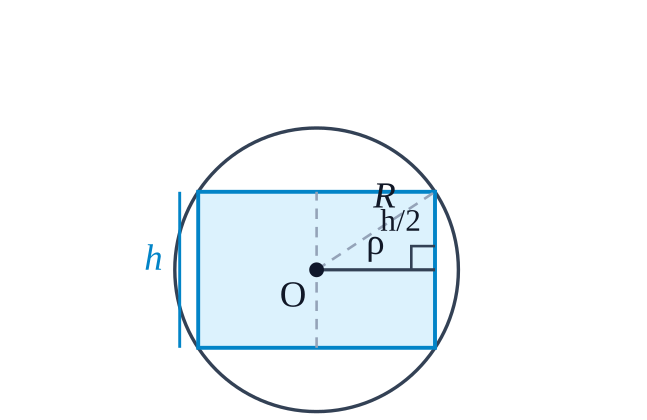 Let the inscribed cylinder have height \(\displaystyle h\) and base radius \(\displaystyle \rho\). Its axis passes through the centre of the sphere, so the centre is at height \(\displaystyle \dfrac{h}{2}\) above the plane of the lower base.The radius drawn from the centre to a point of the rim gives, by Pythagoras,
\[R^{2}=\rho^{2}+\left(\frac{h}{2}\right)^{2}\ \Rightarrow\ \rho^{2}=R^{2}-\frac{h^{2}}{4}. \]Hence the volume in terms of \(\displaystyle h\) alone is
\[V(h)=\pi\rho^{2}h=\pi\left(R^{2}h-\frac{h^{3}}{4}\right),\qquad 0<h<2R. \]Differentiate:
\[V'(h)=\pi\left(R^{2}-\frac{3h^{2}}{4}\right)=0\ \Rightarrow\ h^{2}=\frac{4R^{2}}{3}\ \Rightarrow\ h=\frac{2R}{\sqrt{3}} \]
(taking the positive root, since \(\displaystyle h\) is a length).Second derivative test:
\[V''(h)=-\frac{3\pi h}{2}<0\quad\text{for }h>0, \]
so the volume is maximum at \(\displaystyle h=\dfrac{2R}{\sqrt{3}}\), as required.Maximum volume: with \(\displaystyle h=\dfrac{2R}{\sqrt3}\), \(\displaystyle h^{3}=\dfrac{8R^{3}}{3\sqrt3}\), so
\[V=\pi\left(R^{2}\cdot\frac{2R}{\sqrt3}-\frac{1}{4}\cdot\frac{8R^{3}}{3\sqrt3}\right)=\pi\left(\frac{2R^{3}}{\sqrt3}-\frac{2R^{3}}{3\sqrt3}\right)=\pi\cdot\frac{6R^{3}-2R^{3}}{3\sqrt3}=\frac{4\pi R^{3}}{3\sqrt3}. \]So the height is \(\displaystyle \dfrac{2R}{\sqrt3}\) and the maximum volume is \(\displaystyle \dfrac{4\pi R^{3}}{3\sqrt3}=\dfrac{4\sqrt{3}\,\pi R^{3}}{9}\).
Let the inscribed cylinder have height \(\displaystyle h\) and base radius \(\displaystyle \rho\). Its axis passes through the centre of the sphere, so the centre is at height \(\displaystyle \dfrac{h}{2}\) above the plane of the lower base.The radius drawn from the centre to a point of the rim gives, by Pythagoras,
\[R^{2}=\rho^{2}+\left(\frac{h}{2}\right)^{2}\ \Rightarrow\ \rho^{2}=R^{2}-\frac{h^{2}}{4}. \]Hence the volume in terms of \(\displaystyle h\) alone is
\[V(h)=\pi\rho^{2}h=\pi\left(R^{2}h-\frac{h^{3}}{4}\right),\qquad 0<h<2R. \]Differentiate:
\[V'(h)=\pi\left(R^{2}-\frac{3h^{2}}{4}\right)=0\ \Rightarrow\ h^{2}=\frac{4R^{2}}{3}\ \Rightarrow\ h=\frac{2R}{\sqrt{3}} \]
(taking the positive root, since \(\displaystyle h\) is a length).Second derivative test:
\[V''(h)=-\frac{3\pi h}{2}<0\quad\text{for }h>0, \]
so the volume is maximum at \(\displaystyle h=\dfrac{2R}{\sqrt{3}}\), as required.Maximum volume: with \(\displaystyle h=\dfrac{2R}{\sqrt3}\), \(\displaystyle h^{3}=\dfrac{8R^{3}}{3\sqrt3}\), so
\[V=\pi\left(R^{2}\cdot\frac{2R}{\sqrt3}-\frac{1}{4}\cdot\frac{8R^{3}}{3\sqrt3}\right)=\pi\left(\frac{2R^{3}}{\sqrt3}-\frac{2R^{3}}{3\sqrt3}\right)=\pi\cdot\frac{6R^{3}-2R^{3}}{3\sqrt3}=\frac{4\pi R^{3}}{3\sqrt3}. \]So the height is \(\displaystyle \dfrac{2R}{\sqrt3}\) and the maximum volume is \(\displaystyle \dfrac{4\pi R^{3}}{3\sqrt3}=\dfrac{4\sqrt{3}\,\pi R^{3}}{9}\).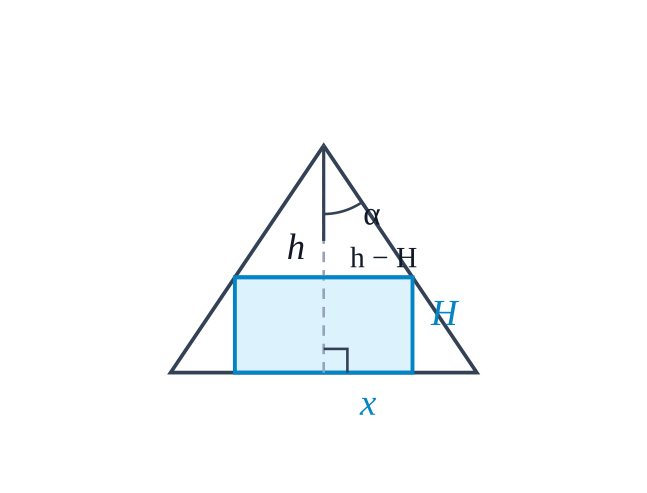 The cone has height \(\displaystyle h\) and semi-vertical angle \(\displaystyle \alpha\), so its base radius is \(\displaystyle h\tan\alpha\). Let the inscribed cylinder have radius \(\displaystyle x\) and height \(\displaystyle H\), standing on the base of the cone with its axis along the cone's axis.The top rim of the cylinder lies on the slant surface, at height \(\displaystyle H\) above the base, i.e. at distance \(\displaystyle h-H\) below the apex. The cross-section of the cone at that level is a circle of radius \(\displaystyle (h-H)\tan\alpha\) (similar triangles from the apex), so
\[x=(h-H)\tan\alpha\ \Rightarrow\ H=h-x\cot\alpha. \]Hence the volume of the cylinder, in terms of \(\displaystyle x\) alone, is
\[V(x)=\pi x^{2}H=\pi x^{2}\left(h-x\cot\alpha\right)=\pi\left(hx^{2}-x^{3}\cot\alpha\right),\qquad 0<x<h\tan\alpha. \]Differentiate:
\[V'(x)=\pi\left(2hx-3x^{2}\cot\alpha\right)=\pi x\left(2h-3x\cot\alpha\right). \]
Since \(\displaystyle x>0\),
\[V'(x)=0\ \Rightarrow\ 3x\cot\alpha=2h\ \Rightarrow\ x=\frac{2h\tan\alpha}{3}. \]Second derivative test:
\[V''(x)=\pi\left(2h-6x\cot\alpha\right),\qquad V''\!\left(\frac{2h\tan\alpha}{3}\right)=\pi\left(2h-4h\right)=-2\pi h<0, \]
so this \(\displaystyle x\) maximises \(\displaystyle V\).The corresponding height is
\[H=h-\frac{2h\tan\alpha}{3}\cot\alpha=h-\frac{2h}{3}=\frac{h}{3}, \]
which is one-third the height of the cone, as claimed.The greatest volume is
\[V=\pi\left(\frac{2h\tan\alpha}{3}\right)^{2}\cdot\frac{h}{3}=\pi\cdot\frac{4h^{2}\tan^{2}\alpha}{9}\cdot\frac{h}{3}=\frac{4}{27}\pi h^{3}\tan^{2}\alpha. \]
The cone has height \(\displaystyle h\) and semi-vertical angle \(\displaystyle \alpha\), so its base radius is \(\displaystyle h\tan\alpha\). Let the inscribed cylinder have radius \(\displaystyle x\) and height \(\displaystyle H\), standing on the base of the cone with its axis along the cone's axis.The top rim of the cylinder lies on the slant surface, at height \(\displaystyle H\) above the base, i.e. at distance \(\displaystyle h-H\) below the apex. The cross-section of the cone at that level is a circle of radius \(\displaystyle (h-H)\tan\alpha\) (similar triangles from the apex), so
\[x=(h-H)\tan\alpha\ \Rightarrow\ H=h-x\cot\alpha. \]Hence the volume of the cylinder, in terms of \(\displaystyle x\) alone, is
\[V(x)=\pi x^{2}H=\pi x^{2}\left(h-x\cot\alpha\right)=\pi\left(hx^{2}-x^{3}\cot\alpha\right),\qquad 0<x<h\tan\alpha. \]Differentiate:
\[V'(x)=\pi\left(2hx-3x^{2}\cot\alpha\right)=\pi x\left(2h-3x\cot\alpha\right). \]
Since \(\displaystyle x>0\),
\[V'(x)=0\ \Rightarrow\ 3x\cot\alpha=2h\ \Rightarrow\ x=\frac{2h\tan\alpha}{3}. \]Second derivative test:
\[V''(x)=\pi\left(2h-6x\cot\alpha\right),\qquad V''\!\left(\frac{2h\tan\alpha}{3}\right)=\pi\left(2h-4h\right)=-2\pi h<0, \]
so this \(\displaystyle x\) maximises \(\displaystyle V\).The corresponding height is
\[H=h-\frac{2h\tan\alpha}{3}\cot\alpha=h-\frac{2h}{3}=\frac{h}{3}, \]
which is one-third the height of the cone, as claimed.The greatest volume is
\[V=\pi\left(\frac{2h\tan\alpha}{3}\right)^{2}\cdot\frac{h}{3}=\pi\cdot\frac{4h^{2}\tan^{2}\alpha}{9}\cdot\frac{h}{3}=\frac{4}{27}\pi h^{3}\tan^{2}\alpha. \]