Exercise 1
Maximise subject to the constraints : .
Not cross-checked
This solution has not been cross-checked against the answer printed in NCERT.
NCERT’s answer
Maximum \(\displaystyle \mathrm{Z}=16\) at \(\displaystyle (0,4)\)
Corner Point Method. For a linear objective function on a bounded feasible region, the maximum and the minimum each occur at a corner (vertex) of the region.The line \(\displaystyle x+y=4\) meets the axes at \(\displaystyle (4,0)\) and \(\displaystyle (0,4)\). Testing the origin: \(\displaystyle 0+0=0\le 4\) is true, so \(\displaystyle x+y\le 4\) is the half-plane containing \(\displaystyle O\). Together with \(\displaystyle x\ge 0,\ y\ge 0\) the feasible region is the closed triangle \(\displaystyle OAB\) with \(\displaystyle O(0,0),\ A(4,0),\ B(0,4)\), which is bounded.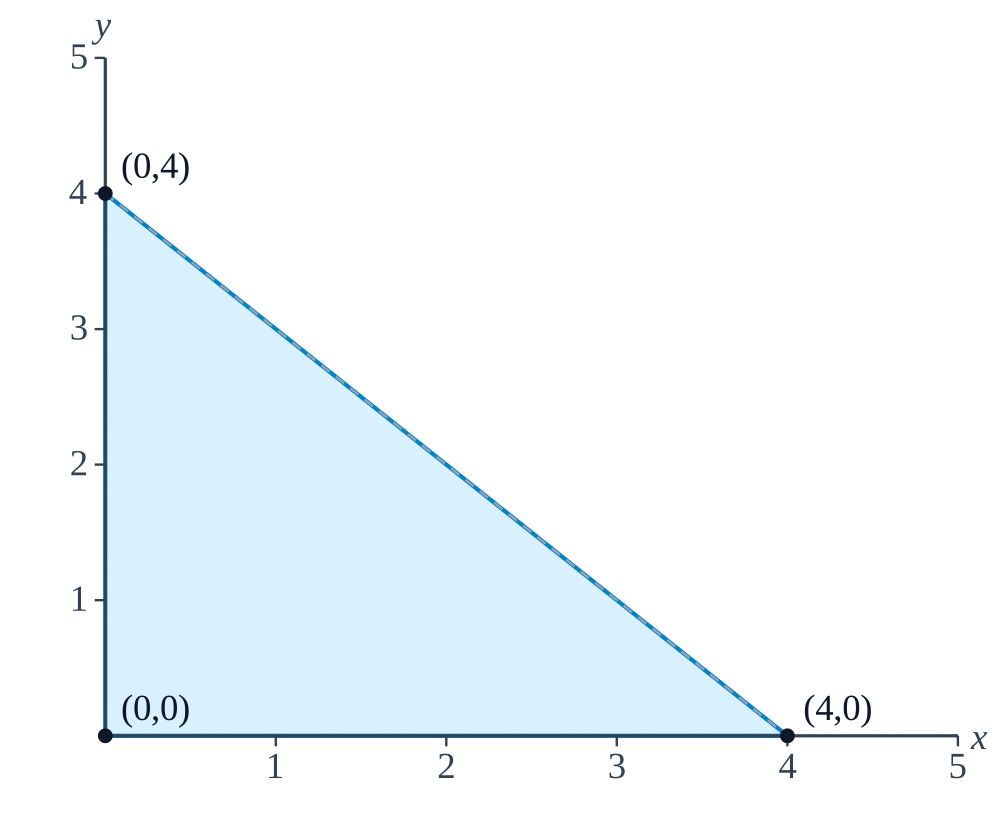 Evaluate \(\displaystyle \mathrm{Z}=3x+4y\) at the corners:
\[\mathrm{Z}(0,0)=0,\qquad \mathrm{Z}(4,0)=12,\qquad \mathrm{Z}(0,4)=16.\]The largest of these is \(\displaystyle 16\).Maximum \(\displaystyle \mathrm{Z}=16\), attained at the corner \(\displaystyle (0,4)\).
Evaluate \(\displaystyle \mathrm{Z}=3x+4y\) at the corners:
\[\mathrm{Z}(0,0)=0,\qquad \mathrm{Z}(4,0)=12,\qquad \mathrm{Z}(0,4)=16.\]The largest of these is \(\displaystyle 16\).Maximum \(\displaystyle \mathrm{Z}=16\), attained at the corner \(\displaystyle (0,4)\).
Evaluate \(\displaystyle \mathrm{Z}=3x+4y\) at the corners:
\[\mathrm{Z}(0,0)=0,\qquad \mathrm{Z}(4,0)=12,\qquad \mathrm{Z}(0,4)=16.\]The largest of these is \(\displaystyle 16\).Maximum \(\displaystyle \mathrm{Z}=16\), attained at the corner \(\displaystyle (0,4)\).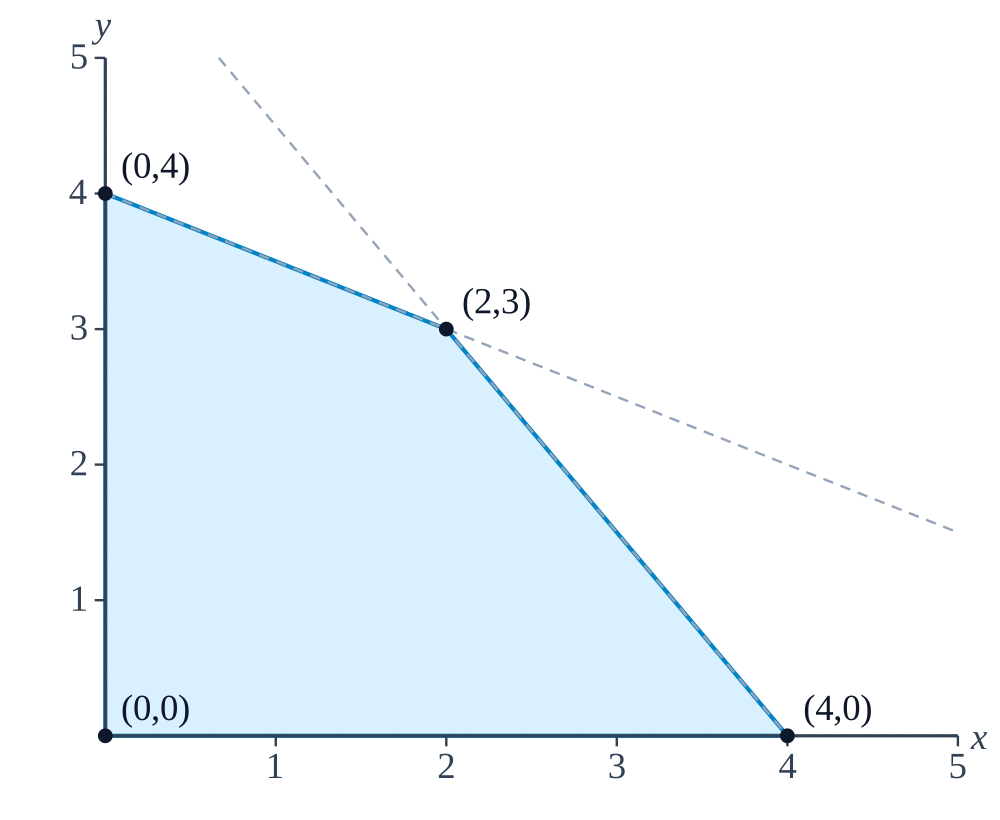 Evaluate \(\displaystyle \mathrm{Z}=-3x+4y\):
\[\mathrm{Z}(0,0)=0,\quad \mathrm{Z}(4,0)=-12,\quad \mathrm{Z}(2,3)=-6+12=6,\quad \mathrm{Z}(0,4)=16.\]Minimum \(\displaystyle \mathrm{Z}=-12\), attained at \(\displaystyle (4,0)\).
Evaluate \(\displaystyle \mathrm{Z}=-3x+4y\):
\[\mathrm{Z}(0,0)=0,\quad \mathrm{Z}(4,0)=-12,\quad \mathrm{Z}(2,3)=-6+12=6,\quad \mathrm{Z}(0,4)=16.\]Minimum \(\displaystyle \mathrm{Z}=-12\), attained at \(\displaystyle (4,0)\).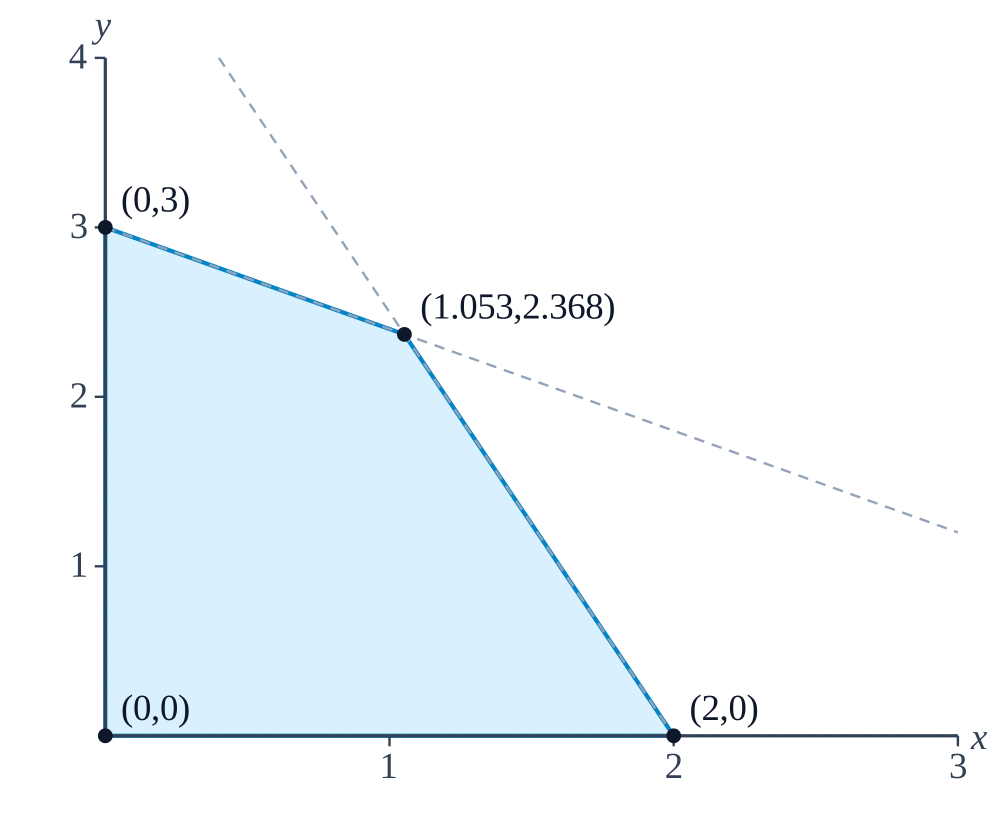 Evaluate \(\displaystyle \mathrm{Z}=5x+3y\):
\[\mathrm{Z}(0,0)=0,\quad \mathrm{Z}(2,0)=10,\quad \mathrm{Z}\!\left(\tfrac{20}{19},\tfrac{45}{19}\right)=\frac{100+135}{19}=\frac{235}{19},\quad \mathrm{Z}(0,3)=9.\]
Since \(\displaystyle \dfrac{235}{19}\approx 12.37\) exceeds \(\displaystyle 10\) and \(\displaystyle 9\):Maximum \(\displaystyle \mathrm{Z}=\dfrac{235}{19}\), attained at \(\displaystyle \left(\dfrac{20}{19},\dfrac{45}{19}\right)\).
Evaluate \(\displaystyle \mathrm{Z}=5x+3y\):
\[\mathrm{Z}(0,0)=0,\quad \mathrm{Z}(2,0)=10,\quad \mathrm{Z}\!\left(\tfrac{20}{19},\tfrac{45}{19}\right)=\frac{100+135}{19}=\frac{235}{19},\quad \mathrm{Z}(0,3)=9.\]
Since \(\displaystyle \dfrac{235}{19}\approx 12.37\) exceeds \(\displaystyle 10\) and \(\displaystyle 9\):Maximum \(\displaystyle \mathrm{Z}=\dfrac{235}{19}\), attained at \(\displaystyle \left(\dfrac{20}{19},\dfrac{45}{19}\right)\).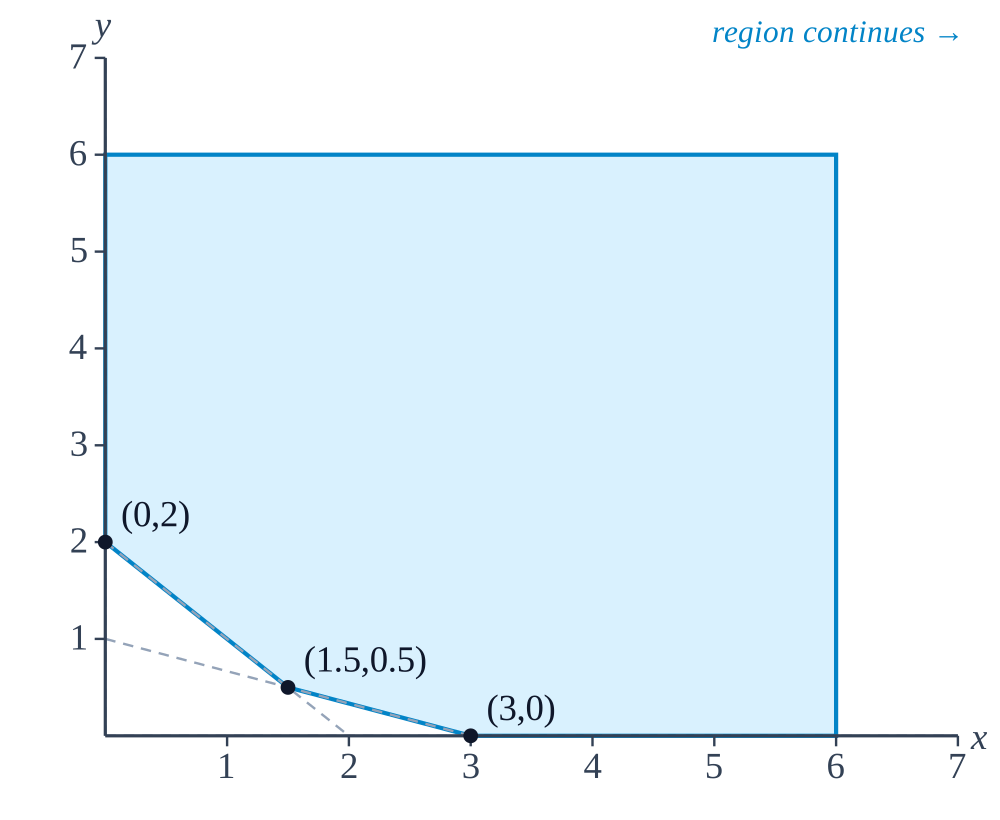 Evaluate \(\displaystyle \mathrm{Z}=3x+5y\):
\[\mathrm{Z}(3,0)=9,\qquad \mathrm{Z}\!\left(\tfrac32,\tfrac12\right)=\tfrac92+\tfrac52=7,\qquad \mathrm{Z}(0,2)=10.\]Smallest corner value \(\displaystyle m=7\). Test \(\displaystyle 3x+5y<7\): for any feasible point,
\[3x+5y=(x+3y)+2(x+y)\ \ge\ 3+2(2)=7,\]
so the open half-plane \(\displaystyle 3x+5y<7\) contains no feasible point and \(\displaystyle 7\) is genuinely the minimum.Minimum \(\displaystyle \mathrm{Z}=7\), attained at \(\displaystyle \left(\dfrac32,\dfrac12\right)\).
Evaluate \(\displaystyle \mathrm{Z}=3x+5y\):
\[\mathrm{Z}(3,0)=9,\qquad \mathrm{Z}\!\left(\tfrac32,\tfrac12\right)=\tfrac92+\tfrac52=7,\qquad \mathrm{Z}(0,2)=10.\]Smallest corner value \(\displaystyle m=7\). Test \(\displaystyle 3x+5y<7\): for any feasible point,
\[3x+5y=(x+3y)+2(x+y)\ \ge\ 3+2(2)=7,\]
so the open half-plane \(\displaystyle 3x+5y<7\) contains no feasible point and \(\displaystyle 7\) is genuinely the minimum.Minimum \(\displaystyle \mathrm{Z}=7\), attained at \(\displaystyle \left(\dfrac32,\dfrac12\right)\).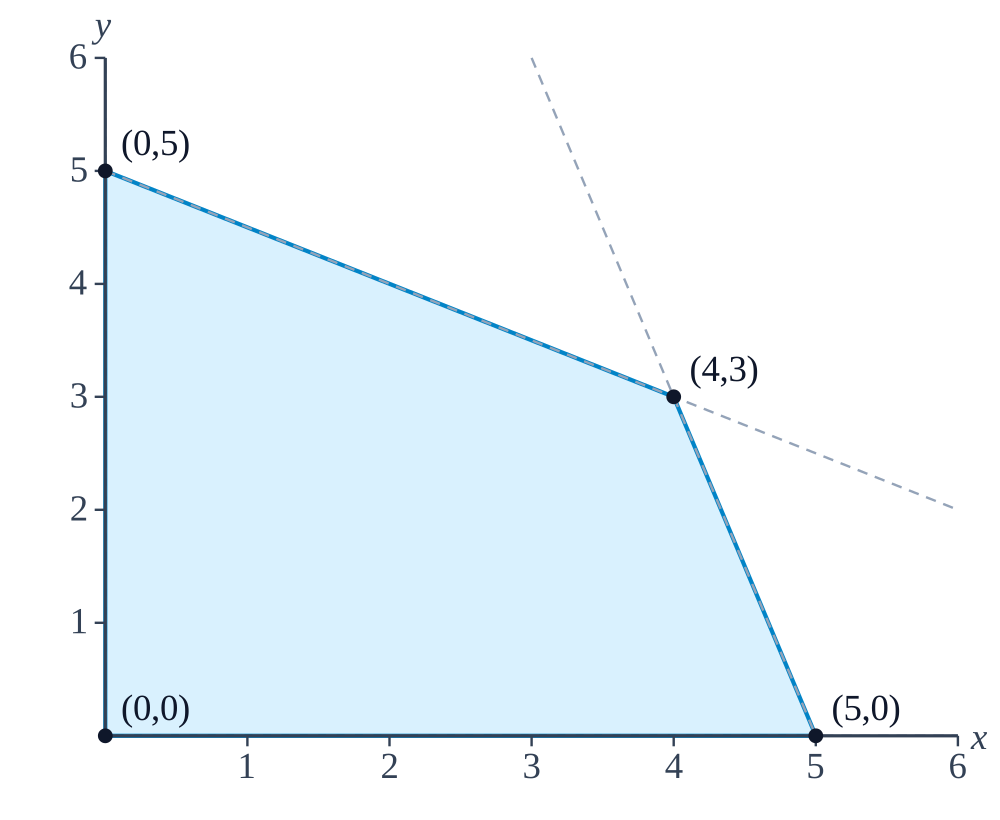 Evaluate \(\displaystyle \mathrm{Z}=3x+2y\):
\[\mathrm{Z}(0,0)=0,\quad \mathrm{Z}(5,0)=15,\quad \mathrm{Z}(4,3)=12+6=18,\quad \mathrm{Z}(0,5)=10.\]Maximum \(\displaystyle \mathrm{Z}=18\), attained at \(\displaystyle (4,3)\).
Evaluate \(\displaystyle \mathrm{Z}=3x+2y\):
\[\mathrm{Z}(0,0)=0,\quad \mathrm{Z}(5,0)=15,\quad \mathrm{Z}(4,3)=12+6=18,\quad \mathrm{Z}(0,5)=10.\]Maximum \(\displaystyle \mathrm{Z}=18\), attained at \(\displaystyle (4,3)\).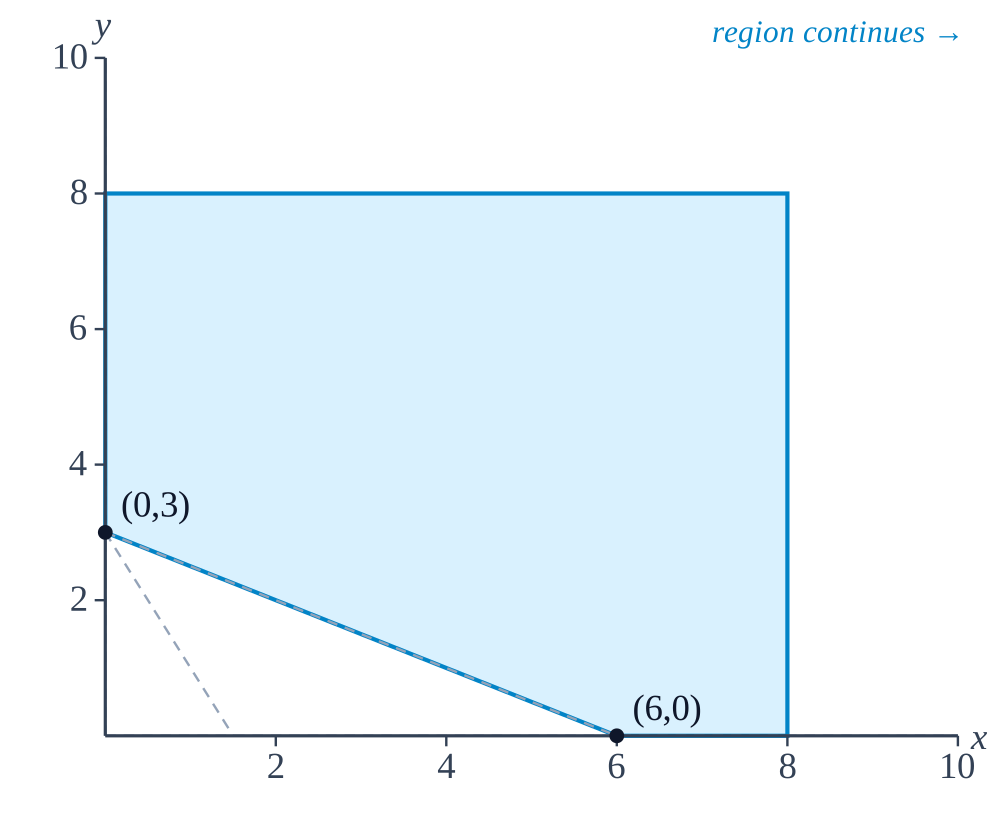 Evaluate \(\displaystyle \mathrm{Z}=x+2y\):
\[\mathrm{Z}(0,3)=0+6=6,\qquad \mathrm{Z}(6,0)=6+0=6.\]Smallest corner value \(\displaystyle m=6\). Test \(\displaystyle x+2y<6\): this directly contradicts the constraint \(\displaystyle x+2y\ge 6\), so the open half-plane contains no feasible point and \(\displaystyle 6\) is the minimum.Because the two corner values are equal, the minimum is attained at every point of the boundary segment \(\displaystyle AB\), which lies on the line \(\displaystyle x+2y=6\); every such point gives \(\displaystyle \mathrm{Z}=6\). For instance \(\displaystyle (0,3),\ (2,2),\ (4,1),\ (6,0)\) all give \(\displaystyle \mathrm{Z}=6\).Minimum \(\displaystyle \mathrm{Z}=6\), attained at every point of the segment joining \(\displaystyle (0,3)\) and \(\displaystyle (6,0)\) — infinitely many points, so certainly at more than two points.
Evaluate \(\displaystyle \mathrm{Z}=x+2y\):
\[\mathrm{Z}(0,3)=0+6=6,\qquad \mathrm{Z}(6,0)=6+0=6.\]Smallest corner value \(\displaystyle m=6\). Test \(\displaystyle x+2y<6\): this directly contradicts the constraint \(\displaystyle x+2y\ge 6\), so the open half-plane contains no feasible point and \(\displaystyle 6\) is the minimum.Because the two corner values are equal, the minimum is attained at every point of the boundary segment \(\displaystyle AB\), which lies on the line \(\displaystyle x+2y=6\); every such point gives \(\displaystyle \mathrm{Z}=6\). For instance \(\displaystyle (0,3),\ (2,2),\ (4,1),\ (6,0)\) all give \(\displaystyle \mathrm{Z}=6\).Minimum \(\displaystyle \mathrm{Z}=6\), attained at every point of the segment joining \(\displaystyle (0,3)\) and \(\displaystyle (6,0)\) — infinitely many points, so certainly at more than two points.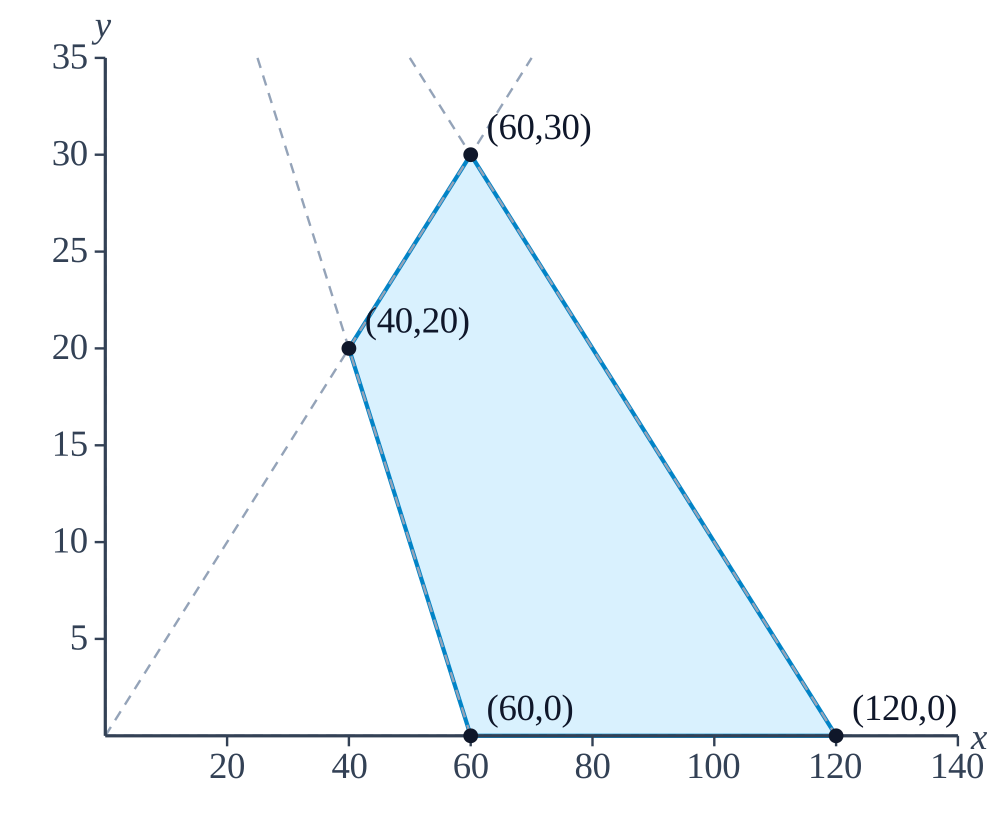 Evaluate \(\displaystyle \mathrm{Z}=5x+10y\):
\[\mathrm{Z}(60,0)=300,\quad \mathrm{Z}(120,0)=600,\quad \mathrm{Z}(60,30)=300+300=600,\quad \mathrm{Z}(40,20)=200+200=400.\]The maximum value \(\displaystyle 600\) occurs at two corners, so it occurs at every point of the segment joining them; that segment lies on \(\displaystyle x+2y=120\), i.e. on \(\displaystyle 5x+10y=600\).Minimum \(\displaystyle \mathrm{Z}=300\) at \(\displaystyle (60,0)\); maximum \(\displaystyle \mathrm{Z}=600\) at every point of the segment joining \(\displaystyle (120,0)\) and \(\displaystyle (60,30)\).
Evaluate \(\displaystyle \mathrm{Z}=5x+10y\):
\[\mathrm{Z}(60,0)=300,\quad \mathrm{Z}(120,0)=600,\quad \mathrm{Z}(60,30)=300+300=600,\quad \mathrm{Z}(40,20)=200+200=400.\]The maximum value \(\displaystyle 600\) occurs at two corners, so it occurs at every point of the segment joining them; that segment lies on \(\displaystyle x+2y=120\), i.e. on \(\displaystyle 5x+10y=600\).Minimum \(\displaystyle \mathrm{Z}=300\) at \(\displaystyle (60,0)\); maximum \(\displaystyle \mathrm{Z}=600\) at every point of the segment joining \(\displaystyle (120,0)\) and \(\displaystyle (60,30)\).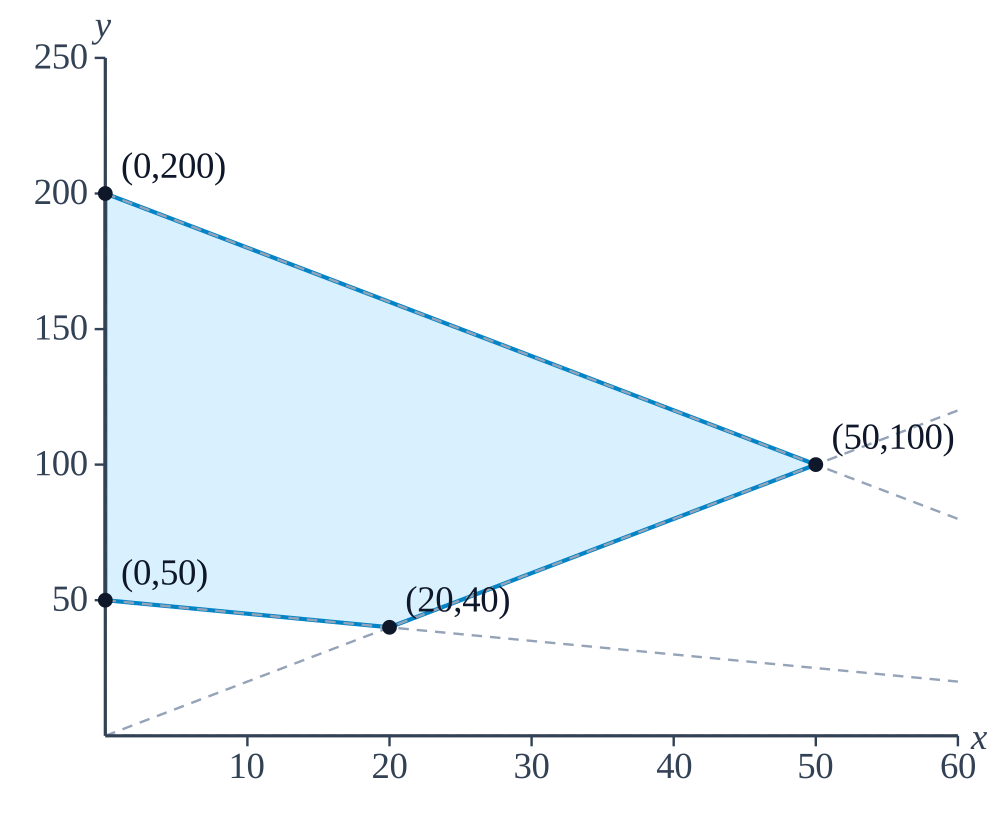 Evaluate \(\displaystyle \mathrm{Z}=x+2y\):
\[\mathrm{Z}(0,50)=100,\quad \mathrm{Z}(20,40)=20+80=100,\quad \mathrm{Z}(50,100)=50+200=250,\quad \mathrm{Z}(0,200)=400.\]The minimum value \(\displaystyle 100\) occurs at two corners, hence at every point of the segment joining them; that segment lies on the line \(\displaystyle x+2y=100\).Minimum \(\displaystyle \mathrm{Z}=100\) at every point of the segment joining \(\displaystyle (0,50)\) and \(\displaystyle (20,40)\); maximum \(\displaystyle \mathrm{Z}=400\) at \(\displaystyle (0,200)\).
Evaluate \(\displaystyle \mathrm{Z}=x+2y\):
\[\mathrm{Z}(0,50)=100,\quad \mathrm{Z}(20,40)=20+80=100,\quad \mathrm{Z}(50,100)=50+200=250,\quad \mathrm{Z}(0,200)=400.\]The minimum value \(\displaystyle 100\) occurs at two corners, hence at every point of the segment joining them; that segment lies on the line \(\displaystyle x+2y=100\).Minimum \(\displaystyle \mathrm{Z}=100\) at every point of the segment joining \(\displaystyle (0,50)\) and \(\displaystyle (20,40)\); maximum \(\displaystyle \mathrm{Z}=400\) at \(\displaystyle (0,200)\).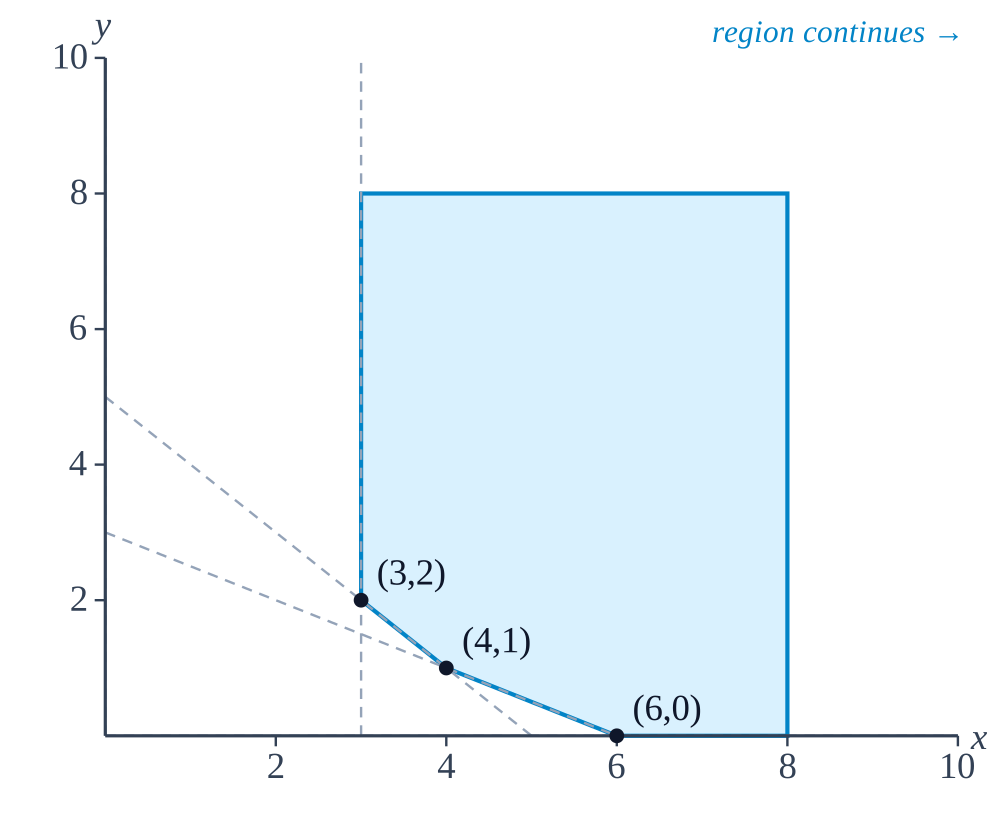 Evaluate \(\displaystyle \mathrm{Z}=-x+2y\):
\[\mathrm{Z}(6,0)=-6,\qquad \mathrm{Z}(4,1)=-4+2=-2,\qquad \mathrm{Z}(3,2)=-3+4=1.\]Largest corner value \(\displaystyle M=1\). Now apply the test on \(\displaystyle -x+2y>1\): the point \(\displaystyle (3,100)\) satisfies \(\displaystyle x\ge3,\ x+y=103\ge 5,\ x+2y=203\ge 6,\ y\ge 0\), so it is feasible, yet \(\displaystyle \mathrm{Z}=-3+200=197>1\). The open half-plane does meet the region. More generally, along \(\displaystyle x=3\) the value \(\displaystyle \mathrm{Z}=-3+2y\) increases without bound as \(\displaystyle y\to\infty\).Z has no maximum value: it is unbounded above on this feasible region.
Evaluate \(\displaystyle \mathrm{Z}=-x+2y\):
\[\mathrm{Z}(6,0)=-6,\qquad \mathrm{Z}(4,1)=-4+2=-2,\qquad \mathrm{Z}(3,2)=-3+4=1.\]Largest corner value \(\displaystyle M=1\). Now apply the test on \(\displaystyle -x+2y>1\): the point \(\displaystyle (3,100)\) satisfies \(\displaystyle x\ge3,\ x+y=103\ge 5,\ x+2y=203\ge 6,\ y\ge 0\), so it is feasible, yet \(\displaystyle \mathrm{Z}=-3+200=197>1\). The open half-plane does meet the region. More generally, along \(\displaystyle x=3\) the value \(\displaystyle \mathrm{Z}=-3+2y\) increases without bound as \(\displaystyle y\to\infty\).Z has no maximum value: it is unbounded above on this feasible region.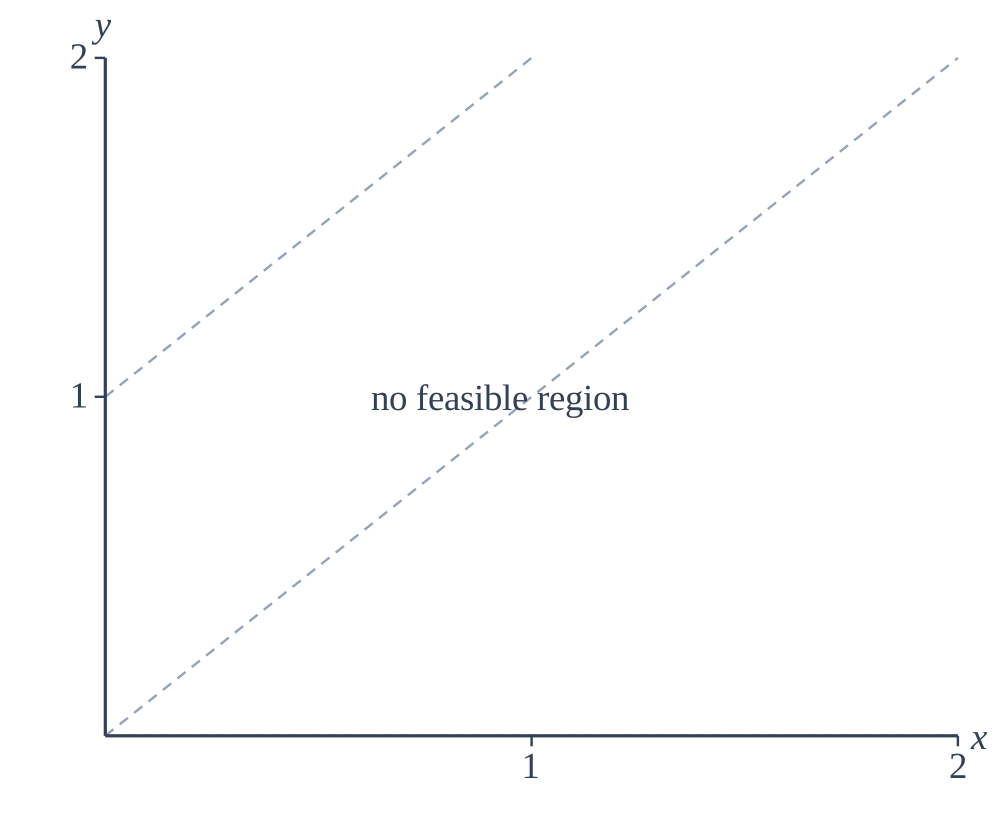 The feasible region is therefore empty.There is no feasible solution, so \(\displaystyle \mathrm{Z}=x+y\) has no maximum value.