SolveItClass 12 · NCERT

NCERT Solutions · Class 12 Mathematics Application of Derivatives

82 questions · 82 still being checked

EXERCISE 6.3 21–29 (part 7 of 9)

  1. Exercise 21

    Of all the closed cylindrical cans (right circular), of a given volume of 100\displaystyle 100 cubic centimetres, find the dimensions of the can which has the minimum surface area?

    Not cross-checked

    This solution has not been cross-checked against the answer printed in NCERT.

    NCERT’s answer
    radius \(\displaystyle =\left(\frac{50}{\pi}\right)^{\frac{1}{3}} \mathrm{~cm}\) and height \(\displaystyle =2\left(\frac{50}{\pi}\right)^{\frac{1}{3}} \mathrm{~cm}\)
    Let the can have base radius \(\displaystyle r\) cm and height \(\displaystyle h\) cm. The volume is fixed: \[\pi r^{2}h=100\ \Longrightarrow\ h=\frac{100}{\pi r^{2}}. \] The can is closed, so it has two circular ends and the curved surface: \[S=2\pi r^{2}+2\pi rh=2\pi r^{2}+2\pi r\cdot\frac{100}{\pi r^{2}}=2\pi r^{2}+\frac{200}{r},\qquad r>0. \] \[\frac{dS}{dr}=4\pi r-\frac{200}{r^{2}}=0\ \Longrightarrow\ 4\pi r^{3}=200\ \Longrightarrow\ r^{3}=\frac{50}{\pi}\ \Longrightarrow\ r=\left(\frac{50}{\pi}\right)^{1/3}. \] \[\frac{d^{2}S}{dr^{2}}=4\pi+\frac{400}{r^{3}}>0\quad\text{for all }r>0, \] so this \(\displaystyle r\) gives the minimum surface area. For the height, use \(\displaystyle \pi r^{3}=50\): \[h=\frac{100}{\pi r^{2}}=\frac{100r}{\pi r^{3}}=\frac{100r}{50}=2r. \] The can of least surface area has \[r=\left(\frac{50}{\pi}\right)^{1/3}\ \text{cm}\approx 2.52\ \text{cm},\qquad h=2\left(\frac{50}{\pi}\right)^{1/3}\ \text{cm}\approx 5.03\ \text{cm}, \] that is, its height equals the diameter of its base.
  2. Exercise 22

    A wire of length 28\displaystyle 28 m is to be cut into two pieces. One of the pieces is to be made into a square and the other into a circle. What should be the length of the two pieces so that the combined area of the square and the circle is minimum?

    Not cross-checked

    This solution has not been cross-checked against the answer printed in NCERT.

    Let one piece have length \(\displaystyle x\) m and be bent into the square; the other piece then has length \(\displaystyle (28-x)\) m and is bent into the circle, where \(\displaystyle 0\le x\le 28\). Square: perimeter \(\displaystyle x\Rightarrow\) side \(\displaystyle \frac{x}{4}\Rightarrow\) area \(\displaystyle \frac{x^{2}}{16}\). Circle: circumference \(\displaystyle 28-x=2\pi r\Rightarrow r=\frac{28-x}{2\pi}\Rightarrow\) area \(\displaystyle \pi r^{2}=\pi\cdot\frac{(28-x)^{2}}{4\pi^{2}}=\frac{(28-x)^{2}}{4\pi}\). Combined area: \[A(x)=\frac{x^{2}}{16}+\frac{(28-x)^{2}}{4\pi}. \] \[A'(x)=\frac{x}{8}+\frac{2(28-x)(-1)}{4\pi}=\frac{x}{8}-\frac{28-x}{2\pi}=0\ \Longrightarrow\ 2\pi x=8(28-x)\ \Longrightarrow\ \pi x+4x=112\ \Longrightarrow\ x=\frac{112}{\pi+4}. \] \[A''(x)=\frac{1}{8}+\frac{1}{2\pi}>0, \] so this \(\displaystyle x\) gives the minimum combined area. The second piece is \[28-\frac{112}{\pi+4}=\frac{28(\pi+4)-112}{\pi+4}=\frac{28\pi}{\pi+4}. \] The wire should be cut into a piece of \(\displaystyle \dfrac{112}{\pi+4}\) m \(\displaystyle (\approx 15.68\) m, bent into the square\(\displaystyle )\) and a piece of \(\displaystyle \dfrac{28\pi}{\pi+4}\) m \(\displaystyle (\approx 12.32\) m, bent into the circle\(\displaystyle )\).
  3. Exercise 23

    Prove that the volume of the largest cone that can be inscribed in a sphere of radius R is 827\displaystyle \frac{8}{27} of the volume of the sphere.

    Not cross-checked

    This solution has not been cross-checked against the answer printed in NCERT.

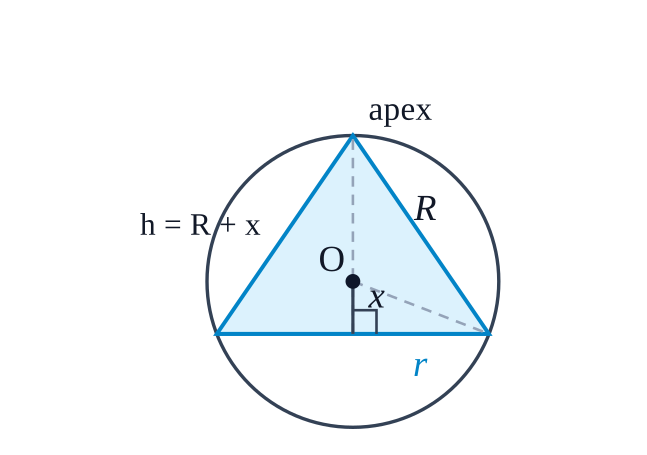
    NCERT_Solution_Class12_Maths_Ch6_Ex6-3_Q23Let the sphere have centre \(\displaystyle O\) and radius \(\displaystyle R\), and let the inscribed cone have base radius \(\displaystyle r\) and height \(\displaystyle h\). Work in the axial cross-section: if the centre \(\displaystyle O\) lies at a distance \(\displaystyle x\) from the plane of the base \(\displaystyle (0\le x<R)\), then joining \(\displaystyle O\) to a point of the base circle gives a right triangle with hypotenuse \(\displaystyle R\), so by Pythagoras \[r^{2}=R^{2}-x^{2},\qquad h=R+x. \]\[V(x)=\frac{1}{3}\pi r^{2}h=\frac{\pi}{3}\left(R^{2}-x^{2}\right)(R+x),\qquad 0\le x<R. \] \[\frac{dV}{dx}=\frac{\pi}{3}\left[-2x(R+x)+\left(R^{2}-x^{2}\right)\right]=\frac{\pi}{3}\left(R^{2}-2Rx-3x^{2}\right)=\frac{\pi}{3}(R-3x)(R+x). \] Since \(\displaystyle R+x>0\), the only admissible root is \(\displaystyle x=\frac{R}{3}\). \[\frac{d^{2}V}{dx^{2}}=\frac{\pi}{3}\left(-2R-6x\right)<0, \] so \(\displaystyle x=\frac{R}{3}\) gives the maximum volume. Then \[h=R+\frac{R}{3}=\frac{4R}{3},\qquad r^{2}=R^{2}-\frac{R^{2}}{9}=\frac{8R^{2}}{9}, \] \[V_{\max}=\frac{1}{3}\pi\cdot\frac{8R^{2}}{9}\cdot\frac{4R}{3}=\frac{32\pi R^{3}}{81}. \] Comparing with the volume of the sphere, \(\displaystyle \frac{4}{3}\pi R^{3}\): \[\frac{V_{\max}}{\dfrac{4}{3}\pi R^{3}}=\frac{32\pi R^{3}}{81}\times\frac{3}{4\pi R^{3}}=\frac{8}{27}. \] Hence the largest cone inscribed in a sphere of radius \(\displaystyle R\) has volume \(\displaystyle \frac{8}{27}\) of the volume of the sphere.
  4. Exercise 24

    Show that the right circular cone of least curved surface and given volume has an altitude equal to 2\displaystyle \sqrt{2} time the radius of the base.

    Not cross-checked

    This solution has not been cross-checked against the answer printed in NCERT.

    Let the cone have base radius \(\displaystyle r\), altitude \(\displaystyle h\) and slant height \(\displaystyle l=\sqrt{r^{2}+h^{2}}\), with the volume \(\displaystyle V\) given (constant): \[V=\frac{1}{3}\pi r^{2}h\ \Longrightarrow\ h=\frac{3V}{\pi r^{2}}. \] The curved surface is \(\displaystyle C=\pi r l=\pi r\sqrt{r^{2}+h^{2}}\). Since \(\displaystyle C>0\), minimising \(\displaystyle C\) is the same as minimising \(\displaystyle C^{2}\), which avoids the square root: \[C^{2}=\pi^{2}r^{2}\left(r^{2}+h^{2}\right)=\pi^{2}r^{2}\left(r^{2}+\frac{9V^{2}}{\pi^{2}r^{4}}\right)=\pi^{2}r^{4}+\frac{9V^{2}}{r^{2}}. \] \[\frac{d\left(C^{2}\right)}{dr}=4\pi^{2}r^{3}-\frac{18V^{2}}{r^{3}}=0\ \Longrightarrow\ 4\pi^{2}r^{6}=18V^{2}\ \Longrightarrow\ V^{2}=\frac{2\pi^{2}r^{6}}{9}\ \Longrightarrow\ V=\frac{\sqrt{2}\,\pi r^{3}}{3}. \] \[\frac{d^{2}\left(C^{2}\right)}{dr^{2}}=12\pi^{2}r^{2}+\frac{54V^{2}}{r^{4}}>0, \] so this radius gives the least curved surface. Equating the two expressions for the same volume, \[\frac{1}{3}\pi r^{2}h=\frac{\sqrt{2}}{3}\pi r^{3}\ \Longrightarrow\ h=\sqrt{2}\,r. \] Hence the right circular cone of least curved surface with a given volume has altitude \(\displaystyle \sqrt{2}\) times the radius of its base.
  5. Exercise 25

    Show that the semi-vertical angle of the cone of the maximum volume and of given slant height is tan12\displaystyle \tan ^{-1} \sqrt{2}.

    Not cross-checked

    This solution has not been cross-checked against the answer printed in NCERT.

    Let the slant height \(\displaystyle l\) be given (constant) and let \(\displaystyle \theta\) be the semi-vertical angle, \(\displaystyle 0<\theta<\frac{\pi}{2}\). Then the radius and height of the cone are \[r=l\sin\theta,\qquad h=l\cos\theta, \] and the volume, expressed in the single variable \(\displaystyle \theta\), is \[V(\theta)=\frac{1}{3}\pi r^{2}h=\frac{1}{3}\pi l^{3}\sin^{2}\theta\cos\theta. \] \[\frac{dV}{d\theta}=\frac{\pi l^{3}}{3}\left(2\sin\theta\cos^{2}\theta-\sin^{3}\theta\right)=\frac{\pi l^{3}}{3}\sin\theta\left(2\cos^{2}\theta-\sin^{2}\theta\right). \] On \(\displaystyle \left(0,\frac{\pi}{2}\right)\) we have \(\displaystyle \sin\theta\neq 0\), so \[\frac{dV}{d\theta}=0\ \Longrightarrow\ 2\cos^{2}\theta=\sin^{2}\theta\ \Longrightarrow\ \tan^{2}\theta=2\ \Longrightarrow\ \tan\theta=\sqrt{2}. \] This is a maximum: dividing \(\displaystyle 2\cos^{2}\theta-\sin^{2}\theta\) by \(\displaystyle \cos^{2}\theta>0\) gives \(\displaystyle 2-\tan^{2}\theta\), which is positive while \(\displaystyle \tan\theta<\sqrt{2}\) and negative once \(\displaystyle \tan\theta>\sqrt{2}\); so \(\displaystyle V\) increases and then decreases, and \(\displaystyle \frac{dV}{d\theta}\) changes sign from \(\displaystyle +\) to \(\displaystyle -\) at \(\displaystyle \tan\theta=\sqrt{2}\). Hence the cone of maximum volume with a given slant height has semi-vertical angle \(\displaystyle \theta=\tan^{-1}\sqrt{2}\).
  6. Exercise 26

    Show that semi-vertical angle of right circular cone of given surface area and maximum volume is sin113\displaystyle \sin ^{-1} \frac{1}{3}. Choose the correct answer in Questions 27\displaystyle 27 and 29.

    Not cross-checked

    This solution has not been cross-checked against the answer printed in NCERT.

    Let the cone have base radius \(\displaystyle r\), height \(\displaystyle h\), slant height \(\displaystyle l\) and semi-vertical angle \(\displaystyle \theta\), and let its total surface area \(\displaystyle S=\pi rl+\pi r^{2}\) be given (constant). Solve for \(\displaystyle l\) and then for \(\displaystyle h\): \[l=\frac{S-\pi r^{2}}{\pi r}=\frac{S}{\pi r}-r, \] \[h^{2}=l^{2}-r^{2}=\left(\frac{S}{\pi r}-r\right)^{2}-r^{2}=\frac{S^{2}}{\pi^{2}r^{2}}-\frac{2S}{\pi}+r^{2}-r^{2}=\frac{S^{2}}{\pi^{2}r^{2}}-\frac{2S}{\pi}. \] Since \(\displaystyle V>0\), maximise \(\displaystyle V^{2}\) rather than \(\displaystyle V\) (this clears the square root): \[V^{2}=\frac{1}{9}\pi^{2}r^{4}h^{2}=\frac{1}{9}\pi^{2}r^{4}\left(\frac{S^{2}}{\pi^{2}r^{2}}-\frac{2S}{\pi}\right)=\frac{1}{9}\left(S^{2}r^{2}-2\pi Sr^{4}\right). \] \[\frac{d\left(V^{2}\right)}{dr}=\frac{1}{9}\left(2S^{2}r-8\pi Sr^{3}\right)=\frac{2Sr}{9}\left(S-4\pi r^{2}\right)=0\ \Longrightarrow\ S=4\pi r^{2}\quad(r>0). \] \[\frac{d^{2}\left(V^{2}\right)}{dr^{2}}=\frac{1}{9}\left(2S^{2}-24\pi Sr^{2}\right)\ \overset{S=4\pi r^{2}}{=}\ \frac{1}{9}\left(32\pi^{2}r^{4}-96\pi^{2}r^{4}\right)=-\frac{64\pi^{2}r^{4}}{9}<0, \] so the volume is maximum when \(\displaystyle S=4\pi r^{2}\). Substituting this back, \[l=\frac{S}{\pi r}-r=\frac{4\pi r^{2}}{\pi r}-r=4r-r=3r, \] and therefore \[\sin\theta=\frac{r}{l}=\frac{r}{3r}=\frac{1}{3}\ \Longrightarrow\ \theta=\sin^{-1}\frac{1}{3}. \] Hence the semi-vertical angle of the cone of given surface area and maximum volume is \(\displaystyle \sin^{-1}\frac{1}{3}\).
  7. Exercise 27

    The point on the curve x2=2y\displaystyle x^{2}=2 y which is nearest to the point (0,5)\displaystyle (0,5) is (A) (22,4)\displaystyle (2 \sqrt{2}, 4) (B) (22,0)\displaystyle (2 \sqrt{2}, 0) (C) (0,0)\displaystyle (0,0) (D) (2,2)\displaystyle (2,2)

    Not cross-checked

    This solution has not been cross-checked against the answer printed in NCERT.

    A general point of the curve \(\displaystyle x^{2}=2y\) is \(\displaystyle \left(x,\frac{x^{2}}{2}\right)\). Its distance from \(\displaystyle (0,5)\) is least exactly when the square of the distance is least (the square root is an increasing function), so minimise \[D=x^{2}+\left(\frac{x^{2}}{2}-5\right)^{2}. \] Substituting \(\displaystyle t=x^{2}\ (t\ge 0)\) makes it a quadratic: \[D(t)=t+\left(\frac{t}{2}-5\right)^{2}=t+\frac{t^{2}}{4}-5t+25=\frac{t^{2}}{4}-4t+25. \] \[\frac{dD}{dt}=\frac{t}{2}-4=0\ \Longrightarrow\ t=8,\qquad \frac{d^{2}D}{dt^{2}}=\frac{1}{2}>0, \] so \(\displaystyle t=8\) gives the minimum. Then \(\displaystyle x^{2}=8\Rightarrow x=\pm2\sqrt{2}\) and \(\displaystyle y=\frac{x^{2}}{2}=4\). The nearest points are \(\displaystyle \left(\pm2\sqrt{2},\,4\right)\), and the one listed is \(\displaystyle \left(2\sqrt{2},4\right)\). Correct answer: (A) \(\displaystyle \left(2\sqrt{2},4\right)\).
  8. Exercise 28

    For all real values of x\displaystyle x, the minimum value of 1x+x21+x+x2\displaystyle \frac{1-x+x^{2}}{1+x+x^{2}} is (A) 0\displaystyle 0 (B) 1\displaystyle 1 (C) 3\displaystyle 3 (D) 13\displaystyle \frac{1}{3}

    Not cross-checked

    This solution has not been cross-checked against the answer printed in NCERT.

    NCERT’s answer
    D
    Let \(\displaystyle f(x)=\dfrac{1-x+x^{2}}{1+x+x^{2}}\). First note the denominator never vanishes: \(\displaystyle 1+x+x^{2}=\left(x+\frac{1}{2}\right)^{2}+\frac{3}{4}>0\) for all real \(\displaystyle x\), so \(\displaystyle f\) is defined and differentiable on \(\displaystyle \mathbb{R}\). By the quotient rule, \[f'(x)=\frac{(-1+2x)\left(1+x+x^{2}\right)-\left(1-x+x^{2}\right)(1+2x)}{\left(1+x+x^{2}\right)^{2}}. \] Expanding the two products: \(\displaystyle (2x-1)\left(x^{2}+x+1\right)=2x^{3}+x^{2}+x-1\) and \(\displaystyle \left(x^{2}-x+1\right)(2x+1)=2x^{3}-x^{2}+x+1\), so \[f'(x)=\frac{2x^{2}-2}{\left(1+x+x^{2}\right)^{2}}=\frac{2(x-1)(x+1)}{\left(1+x+x^{2}\right)^{2}}. \] Hence \(\displaystyle f'(x)=0\) at \(\displaystyle x=\pm1\). The denominator is positive, so \(\displaystyle f'<0\) on \(\displaystyle (-1,1)\) and \(\displaystyle f'>0\) outside \(\displaystyle [-1,1]\): at \(\displaystyle x=1\) the sign changes from \(\displaystyle -\) to \(\displaystyle +\), a minimum. \[f(1)=\frac{1-1+1}{1+1+1}=\frac{1}{3}. \] At \(\displaystyle x=-1\), \(\displaystyle f(-1)=\frac{3}{1}=3\) is a local maximum, and \(\displaystyle f(x)\to1\) as \(\displaystyle x\to\pm\infty\), so \(\displaystyle \frac{1}{3}\) is the least value over all real \(\displaystyle x\). Correct answer: (D) \(\displaystyle \frac{1}{3}\).
  9. Exercise 29

    The maximum value of [x(x1)+1]13,0x1\displaystyle [x(x-1)+1]^{\frac{1}{3}}, 0 \leq x \leq 1 is (A) 1313\displaystyle \frac{1}{3}^{\frac{1}{3}} (B) 12\displaystyle \frac{1}{2} (C) 1\displaystyle 1 (D) 0\displaystyle 0

    Not cross-checked

    This solution has not been cross-checked against the answer printed in NCERT.

    NCERT’s answer
    C
    Let \(\displaystyle F(x)=\left[x(x-1)+1\right]^{1/3}=\left(x^{2}-x+1\right)^{1/3}\) on \(\displaystyle [0,1]\). The cube-root function is increasing, so \(\displaystyle F\) is greatest exactly where \(\displaystyle g(x)=x^{2}-x+1\) is greatest; it is enough to maximise \(\displaystyle g\) on \(\displaystyle [0,1]\). \[g'(x)=2x-1=0\ \Longrightarrow\ x=\frac{1}{2}. \] Compare this critical value with the endpoint values: \[g(0)=1,\qquad g\left(\frac{1}{2}\right)=\frac{1}{4}-\frac{1}{2}+1=\frac{3}{4},\qquad g(1)=1-1+1=1. \] (The interior critical point is in fact the minimum, since \(\displaystyle g''(x)=2>0\); the maximum sits at the endpoints.) So the greatest value of \(\displaystyle g\) on \(\displaystyle [0,1]\) is \(\displaystyle 1\), attained at \(\displaystyle x=0\) and \(\displaystyle x=1\), and therefore \[F_{\max}=1^{1/3}=1. \] Correct answer: (C) 1.