Exercise 11
In a triangle is a point on PR such that . If , prove that .
Not cross-checked
NCERT prints no numerical answer for this exercise, so this working has not been cross-checked against the book.
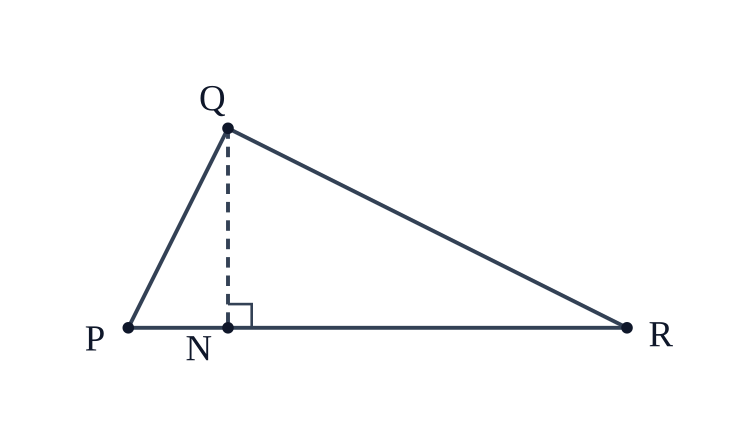 \[\angle PNQ = \angle QNR = 90^\circ \quad \text{(} QN \perp PR\text{, given)} \]
\[PN \cdot NR = QN^2 \Rightarrow \frac{PN}{QN} = \frac{QN}{NR} \quad \text{(given)} \]
\[\triangle PNQ \sim \triangle QNR \quad \text{(SAS similarity)} \]
\[\angle NPQ = \angle NQR, \ \ \angle PQN = \angle QRN \quad \text{(corr. angles)} \]
\[\angle PQR = \angle PQN + \angle NQR = \angle R + \angle P \]
\[\angle P + \angle Q + \angle R = 180^\circ \quad \text{(angle sum, } \triangle PQR\text{)} \]
\[\angle Q = \angle P + \angle R = 180^\circ - \angle Q \Rightarrow 2\angle Q = 180^\circ \]
\[\angle Q = 90^\circ \]Answer: \(\displaystyle \angle PQR = 90^\circ\).
\[\angle PNQ = \angle QNR = 90^\circ \quad \text{(} QN \perp PR\text{, given)} \]
\[PN \cdot NR = QN^2 \Rightarrow \frac{PN}{QN} = \frac{QN}{NR} \quad \text{(given)} \]
\[\triangle PNQ \sim \triangle QNR \quad \text{(SAS similarity)} \]
\[\angle NPQ = \angle NQR, \ \ \angle PQN = \angle QRN \quad \text{(corr. angles)} \]
\[\angle PQR = \angle PQN + \angle NQR = \angle R + \angle P \]
\[\angle P + \angle Q + \angle R = 180^\circ \quad \text{(angle sum, } \triangle PQR\text{)} \]
\[\angle Q = \angle P + \angle R = 180^\circ - \angle Q \Rightarrow 2\angle Q = 180^\circ \]
\[\angle Q = 90^\circ \]Answer: \(\displaystyle \angle PQR = 90^\circ\).
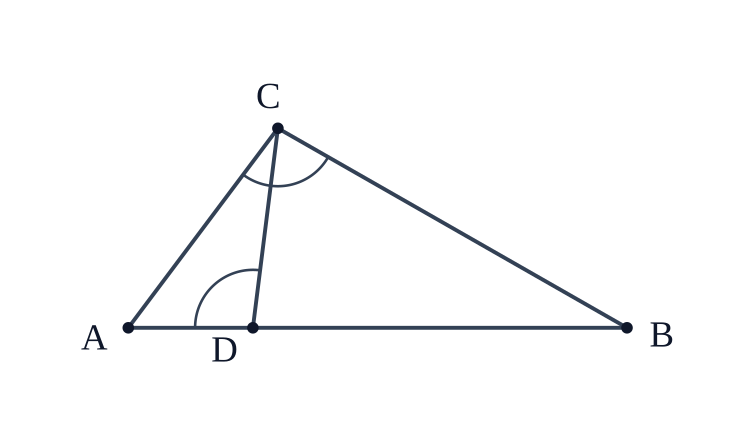 \[\angle DAC = \angle CAB \quad \text{(common angle)} \]
\[\angle ADC = \angle ACB \quad \text{(given)} \]
\[\triangle ADC \sim \triangle ACB \quad \text{(AA similarity)} \]
\[\frac{AD}{AC} = \frac{AC}{AB} \Rightarrow AC^2 = AD \cdot AB \]
\[64 = 3(3 + BD) \Rightarrow 3 + BD = \frac{64}{3} \]
\[BD = \frac{64}{3} - 3 = \frac{55}{3} \text{ cm} \]Answer: \(\displaystyle BD = \dfrac{55}{3}\) cm.
\[\angle DAC = \angle CAB \quad \text{(common angle)} \]
\[\angle ADC = \angle ACB \quad \text{(given)} \]
\[\triangle ADC \sim \triangle ACB \quad \text{(AA similarity)} \]
\[\frac{AD}{AC} = \frac{AC}{AB} \Rightarrow AC^2 = AD \cdot AB \]
\[64 = 3(3 + BD) \Rightarrow 3 + BD = \frac{64}{3} \]
\[BD = \frac{64}{3} - 3 = \frac{55}{3} \text{ cm} \]Answer: \(\displaystyle BD = \dfrac{55}{3}\) cm.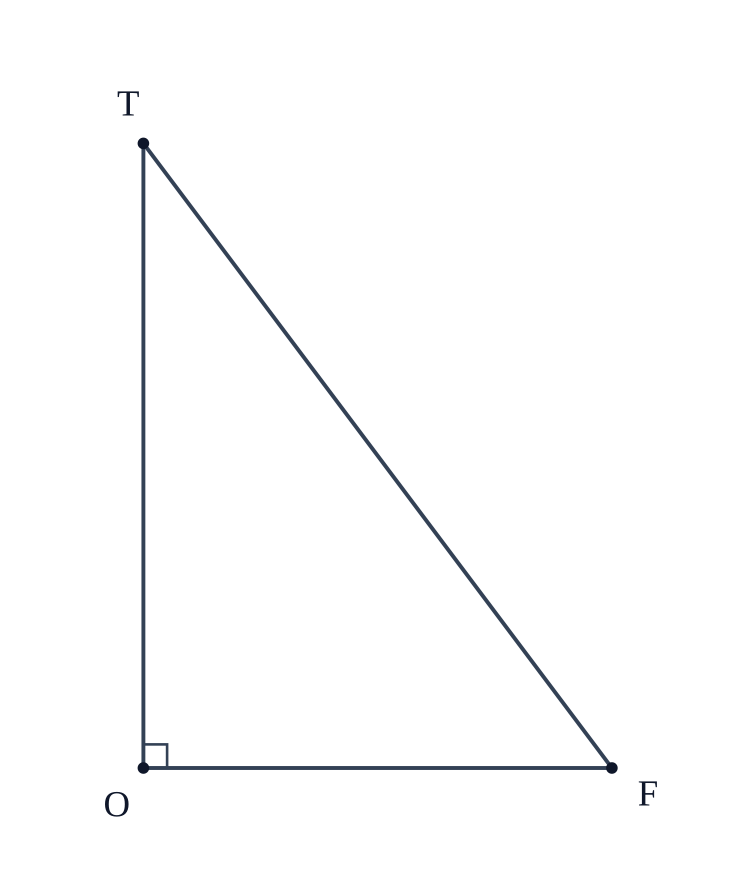 \[h^2 + 6^2 = 10^2 \quad \text{(Pythagoras theorem)} \]
\[h^2 = 100 - 36 = 64 \]
\[h = 8 \text{ m} \]Answer: \(\displaystyle 8\) m.
\[h^2 + 6^2 = 10^2 \quad \text{(Pythagoras theorem)} \]
\[h^2 = 100 - 36 = 64 \]
\[h = 8 \text{ m} \]Answer: \(\displaystyle 8\) m.