Exercise 1
In a and M is a point on side PR such that . Prove that
Not cross-checked
NCERT prints no numerical answer for this exercise, so this working has not been cross-checked against the book.
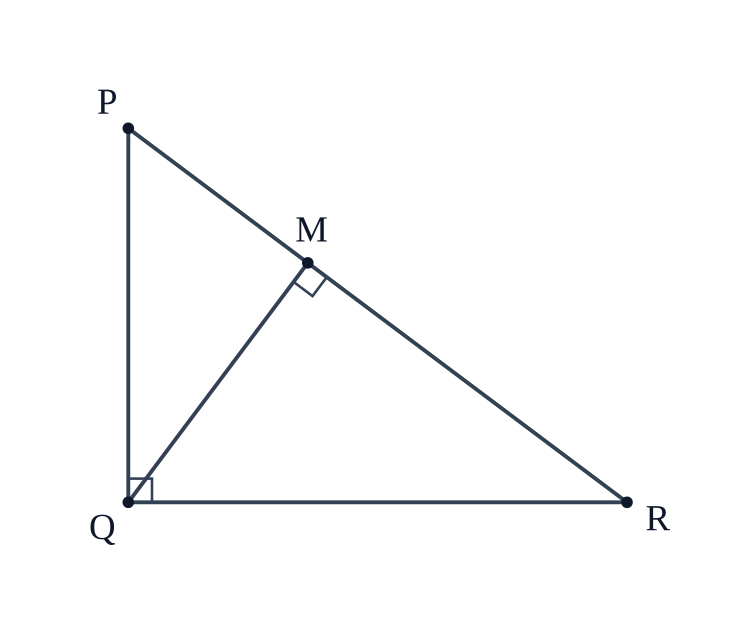 \[PR^2 = PQ^2+QR^2 \quad \text{(given, rearranged)} \]
\[\angle PQR = 90^\circ \quad \text{(converse of Pythagoras theorem)} \]
In \(\displaystyle \Delta PMQ\) and \(\displaystyle \Delta QMR\):
\[\angle PMQ = \angle QMR = 90^\circ \quad (QM \perp PR) \]
\[\angle MPQ = 90^\circ-\angle PQM \quad \text{(angle sum in } \Delta PMQ\text{)} \]
\[\angle MPQ = \angle MQR \quad \text{(} \angle PQM+\angle MQR = \angle PQR = 90^\circ\text{)} \]
\[\Delta PMQ \sim \Delta QMR \quad \text{(AA)} \]
\[\frac{PM}{QM} = \frac{QM}{MR} \]
\[QM^2 = PM \times MR \]
Answer: \(\displaystyle QM^2 = PM \times MR \)
\[PR^2 = PQ^2+QR^2 \quad \text{(given, rearranged)} \]
\[\angle PQR = 90^\circ \quad \text{(converse of Pythagoras theorem)} \]
In \(\displaystyle \Delta PMQ\) and \(\displaystyle \Delta QMR\):
\[\angle PMQ = \angle QMR = 90^\circ \quad (QM \perp PR) \]
\[\angle MPQ = 90^\circ-\angle PQM \quad \text{(angle sum in } \Delta PMQ\text{)} \]
\[\angle MPQ = \angle MQR \quad \text{(} \angle PQM+\angle MQR = \angle PQR = 90^\circ\text{)} \]
\[\Delta PMQ \sim \Delta QMR \quad \text{(AA)} \]
\[\frac{PM}{QM} = \frac{QM}{MR} \]
\[QM^2 = PM \times MR \]
Answer: \(\displaystyle QM^2 = PM \times MR \)
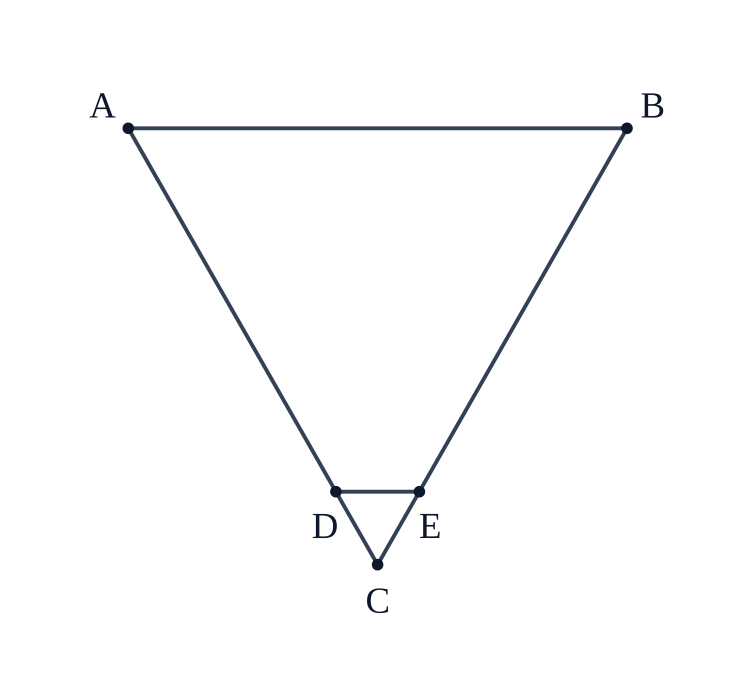 \[\frac{CD}{DA} = \frac{CE}{EB} \quad \text{(converse of the basic proportionality theorem, } DE \parallel AB\text{)} \]
\[\frac{x+3}{3x+19} = \frac{x}{3x+4} \]
\[(x+3)(3x+4) = x(3x+19) \]
\[3x^2+13x+12 = 3x^2+19x \]
\[6x = 12 \]
\[x = 2 \]
Answer: \(\displaystyle x = 2 \)
\[\frac{CD}{DA} = \frac{CE}{EB} \quad \text{(converse of the basic proportionality theorem, } DE \parallel AB\text{)} \]
\[\frac{x+3}{3x+19} = \frac{x}{3x+4} \]
\[(x+3)(3x+4) = x(3x+19) \]
\[3x^2+13x+12 = 3x^2+19x \]
\[6x = 12 \]
\[x = 2 \]
Answer: \(\displaystyle x = 2 \)
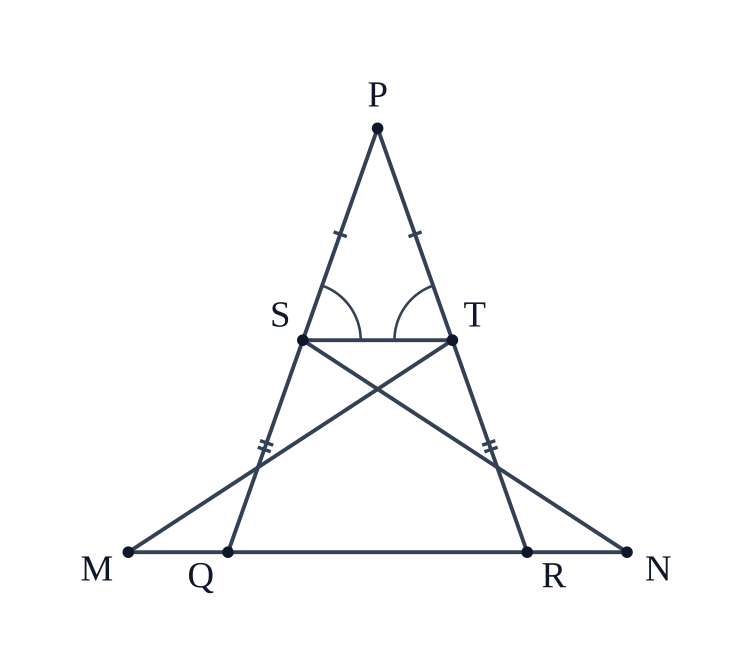 \[\angle PST = \angle 1 = \angle 2 = \angle PTS \quad \text{(given)} \]
\[PS = PT \quad \text{(sides opposite equal angles of } \Delta PST\text{)} \]
\[SQ = TR \quad \text{(CPCT, } \Delta NSQ \cong \Delta MTR\text{)} \]
\[PQ = PS+SQ = PT+TR = PR \]
In \(\displaystyle \Delta PTS\) and \(\displaystyle \Delta PRQ\):
\[\angle TPS = \angle RPQ \quad \text{(common, since } S \in PQ,\ T \in PR\text{)} \]
\[\frac{PT}{PR} = \frac{PS}{PQ} \quad (PT=PS,\ PR=PQ) \]
\[\Delta PTS \sim \Delta PRQ \quad \text{(SAS)} \]
Answer: \(\displaystyle \Delta PTS \sim \Delta PRQ \)
\[\angle PST = \angle 1 = \angle 2 = \angle PTS \quad \text{(given)} \]
\[PS = PT \quad \text{(sides opposite equal angles of } \Delta PST\text{)} \]
\[SQ = TR \quad \text{(CPCT, } \Delta NSQ \cong \Delta MTR\text{)} \]
\[PQ = PS+SQ = PT+TR = PR \]
In \(\displaystyle \Delta PTS\) and \(\displaystyle \Delta PRQ\):
\[\angle TPS = \angle RPQ \quad \text{(common, since } S \in PQ,\ T \in PR\text{)} \]
\[\frac{PT}{PR} = \frac{PS}{PQ} \quad (PT=PS,\ PR=PQ) \]
\[\Delta PTS \sim \Delta PRQ \quad \text{(SAS)} \]
Answer: \(\displaystyle \Delta PTS \sim \Delta PRQ \)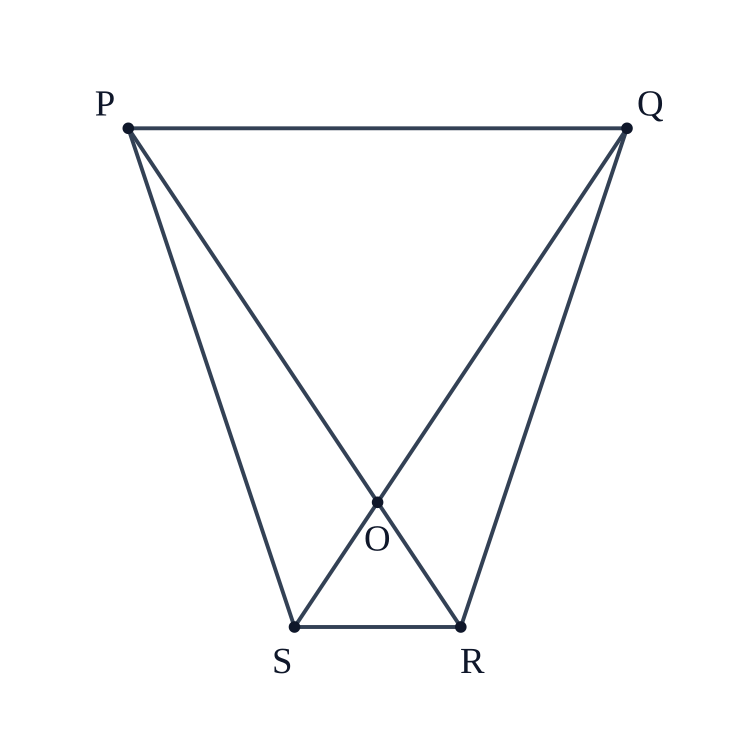 In \(\displaystyle \Delta POQ\) and \(\displaystyle \Delta ROS\):
\[\angle POQ = \angle ROS \quad \text{(vertically opposite angles)} \]
\[\angle OPQ = \angle ORS \quad \text{(alternate angles, } PQ \parallel RS\text{)} \]
\[\Delta POQ \sim \Delta ROS \quad \text{(AA)} \]
\[\frac{ar(\Delta POQ)}{ar(\Delta ROS)} = \left(\frac{PQ}{RS}\right)^2 = \left(\frac{3RS}{RS}\right)^2 = 9 \]
Answer: \(\displaystyle ar(\Delta POQ) : ar(\Delta ROS) = 9:1 \)
In \(\displaystyle \Delta POQ\) and \(\displaystyle \Delta ROS\):
\[\angle POQ = \angle ROS \quad \text{(vertically opposite angles)} \]
\[\angle OPQ = \angle ORS \quad \text{(alternate angles, } PQ \parallel RS\text{)} \]
\[\Delta POQ \sim \Delta ROS \quad \text{(AA)} \]
\[\frac{ar(\Delta POQ)}{ar(\Delta ROS)} = \left(\frac{PQ}{RS}\right)^2 = \left(\frac{3RS}{RS}\right)^2 = 9 \]
Answer: \(\displaystyle ar(\Delta POQ) : ar(\Delta ROS) = 9:1 \)
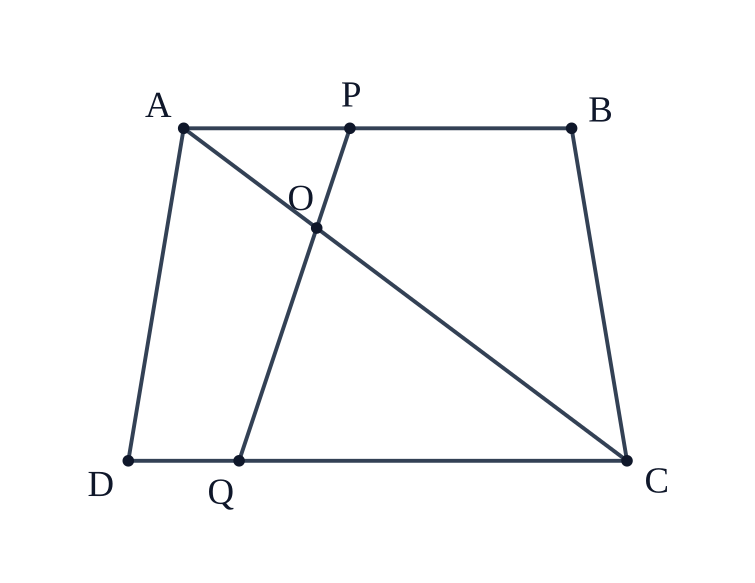 In \(\displaystyle \Delta OAP\) and \(\displaystyle \Delta OCQ\):
\[\angle AOP = \angle COQ \quad \text{(vertically opposite angles)} \]
\[\angle OAP = \angle OCQ \quad \text{(alternate angles, } AB \parallel DC,\ AC \text{ transversal)} \]
\[\Delta OAP \sim \Delta OCQ \quad \text{(AA)} \]
\[\frac{OA}{OC} = \frac{AP}{CQ} \]
\[OA \times CQ = OC \times AP \]
Answer: \(\displaystyle OA \times CQ = OC \times AP \)
In \(\displaystyle \Delta OAP\) and \(\displaystyle \Delta OCQ\):
\[\angle AOP = \angle COQ \quad \text{(vertically opposite angles)} \]
\[\angle OAP = \angle OCQ \quad \text{(alternate angles, } AB \parallel DC,\ AC \text{ transversal)} \]
\[\Delta OAP \sim \Delta OCQ \quad \text{(AA)} \]
\[\frac{OA}{OC} = \frac{AP}{CQ} \]
\[OA \times CQ = OC \times AP \]
Answer: \(\displaystyle OA \times CQ = OC \times AP \)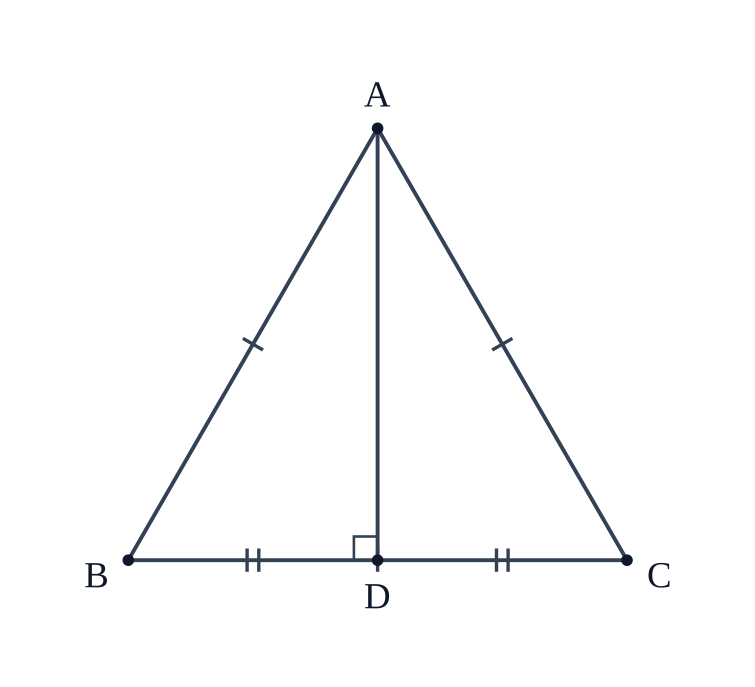 \[BD = DC = \frac{8}{2} = 4 \text{ cm} \quad (AD \perp BC \text{ bisects } BC \text{ in an equilateral } \Delta) \]
\[AD^2 = AB^2-BD^2 = 8^2-4^2 = 48 \]
\[AD = 4\sqrt3 \text{ cm} \]
Answer: \(\displaystyle 4\sqrt3 \) cm
\[BD = DC = \frac{8}{2} = 4 \text{ cm} \quad (AD \perp BC \text{ bisects } BC \text{ in an equilateral } \Delta) \]
\[AD^2 = AB^2-BD^2 = 8^2-4^2 = 48 \]
\[AD = 4\sqrt3 \text{ cm} \]
Answer: \(\displaystyle 4\sqrt3 \) cm
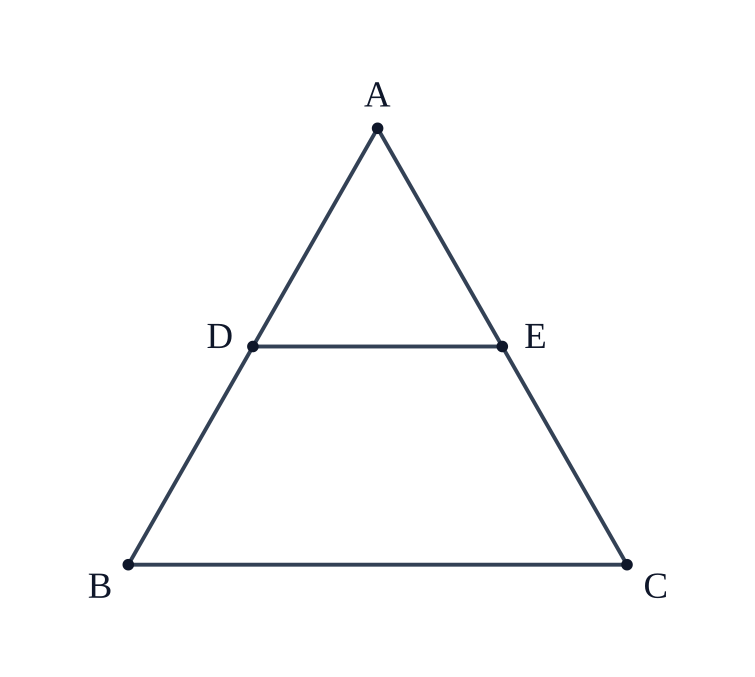 \[\Delta ADE \sim \Delta ABC \quad (DE \parallel BC,\ \angle A \text{ common}) \]
\[\frac{ar(\Delta ADE)}{ar(\Delta ABC)} = \left(\frac{DE}{BC}\right)^2 = \left(\frac{6}{12}\right)^2 = \frac14 \]
\[ar(DECB) = ar(\Delta ABC)-ar(\Delta ADE) = 4k-k = 3k \quad (ar(\Delta ADE)=k) \]
Answer: \(\displaystyle ar(\Delta ADE) : ar(DECB) = 1:3 \)
\[\Delta ADE \sim \Delta ABC \quad (DE \parallel BC,\ \angle A \text{ common}) \]
\[\frac{ar(\Delta ADE)}{ar(\Delta ABC)} = \left(\frac{DE}{BC}\right)^2 = \left(\frac{6}{12}\right)^2 = \frac14 \]
\[ar(DECB) = ar(\Delta ABC)-ar(\Delta ADE) = 4k-k = 3k \quad (ar(\Delta ADE)=k) \]
Answer: \(\displaystyle ar(\Delta ADE) : ar(DECB) = 1:3 \)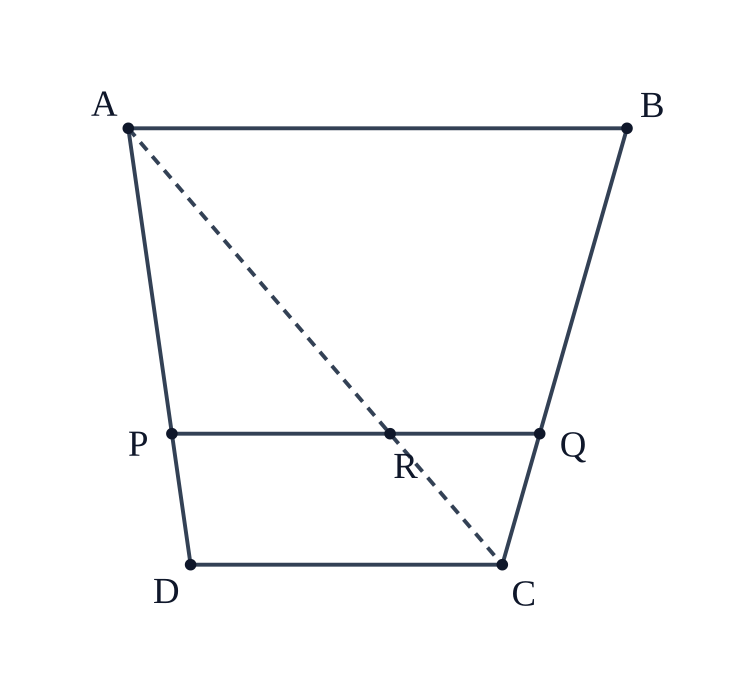 Join AC meeting PQ at R.
\[\frac{AP}{PD} = \frac{AR}{RC} \quad \text{(BPT in } \triangle ADC,\ PR \parallel DC\text{)} \]
\[\frac{AR}{RC} = \frac{BQ}{QC} \quad \text{(BPT in } \triangle CAB,\ RQ \parallel AB\text{)} \]
\[\frac{AP}{PD} = \frac{BQ}{QC} = \frac{35}{15} = \frac{7}{3} \]
\[AP = \frac{7}{3} \times 18 = 42 \text{ cm} \]
\[AD = AP + PD = 42 + 18 = 60 \text{ cm} \]Answer: \(\displaystyle AD = 60\) cm.
Join AC meeting PQ at R.
\[\frac{AP}{PD} = \frac{AR}{RC} \quad \text{(BPT in } \triangle ADC,\ PR \parallel DC\text{)} \]
\[\frac{AR}{RC} = \frac{BQ}{QC} \quad \text{(BPT in } \triangle CAB,\ RQ \parallel AB\text{)} \]
\[\frac{AP}{PD} = \frac{BQ}{QC} = \frac{35}{15} = \frac{7}{3} \]
\[AP = \frac{7}{3} \times 18 = 42 \text{ cm} \]
\[AD = AP + PD = 42 + 18 = 60 \text{ cm} \]Answer: \(\displaystyle AD = 60\) cm.