SolveIt is under development
SolveItNCERT · CBSE · NEET

NCERT Exemplar · Class 10 Mathematics Triangles

57 questions · 57 still being checked

EXERCISE 6.2 1–12 (part 2 of 6)

  1. Exercise 1

    Is the triangle with sides 25\displaystyle 25 cm, 5\displaystyle 5 cm and 24\displaystyle 24 cm a right triangle? Give reasons for your answer.

    Matches the book, not yet reviewed

    This working reaches the answer NCERT prints. It has not yet been read through by hand.

    NCERT’s answer
    No, \(\displaystyle 25^2 \neq 5^2+24^2\)
    False. \[5^2+24^2 = 25+576 = 601, \quad 25^2 = 625 \] Since \(\displaystyle 601 \neq 625\), the sides do not satisfy the Pythagoras relation; the triangle is not right-angled.
  2. Exercise 2

    It is given that ΔDEF∼ΔRPQ\displaystyle \Delta \mathrm{DEF} \sim \Delta \mathrm{RPQ}. Is it true to say that ∠D=∠R\displaystyle \angle \mathrm{D}=\angle \mathrm{R} and ∠F=∠P\displaystyle \angle \mathrm{F}=\angle \mathrm{P} ? Why?

    Matches the book, not yet reviewed

    This working reaches the answer NCERT prints. It has not yet been read through by hand.

    NCERT’s answer
    No, \(\displaystyle \angle \mathrm{D}=\angle \mathrm{R}\) but \(\displaystyle \angle \mathrm{F} \neq \angle \mathrm{P}\).
    False. \[\triangle DEF \sim \triangle RPQ \ \Rightarrow\ \angle D=\angle R,\ \angle E=\angle P,\ \angle F=\angle Q \] \(\displaystyle \angle D=\angle R\) holds, but the second pairing is wrong: \(\displaystyle \angle F=\angle Q\), not \(\displaystyle \angle P\).
  3. Exercise 3

    A and B are respectively the points on the sides PQ and PR of a triangle PQR such that PQ=12.5 cm,PA=5 cm,BR=6 cm\displaystyle \mathrm{PQ}=12.5 \mathrm{~cm}, \mathrm{PA}=5 \mathrm{~cm}, \mathrm{BR}=6 \mathrm{~cm} and PB=4 cm\displaystyle \mathrm{PB}=4 \mathrm{~cm}. Is AB∥QR\displaystyle \mathrm{AB} \| \mathrm{QR} ? Give reasons for your answer.

    Matches the book, not yet reviewed

    This working reaches the answer NCERT prints. It has not yet been read through by hand.

    NCERT’s answer
    Yes, because \(\displaystyle \frac{\mathrm{PA}}{\mathrm{QA}}=\frac{\mathrm{PB}}{\mathrm{BR}}\)
    True. \[AQ = PQ-PA = 12.5-5 = 7.5\text{ cm}, \quad PR = PB+BR = 4+6 = 10\text{ cm} \] \[\frac{PA}{AQ}=\frac{5}{7.5}=\frac23, \quad \frac{PB}{BR}=\frac{4}{6}=\frac23 \] Since \(\displaystyle \frac{PA}{AQ}=\frac{PB}{BR}\), by the converse of the Basic Proportionality Theorem, \(\displaystyle AB \parallel QR\). NCERT_Solution_Class10_Maths_Exemplar_Ch6_Ex6-2_Q3
  4. Exercise 4

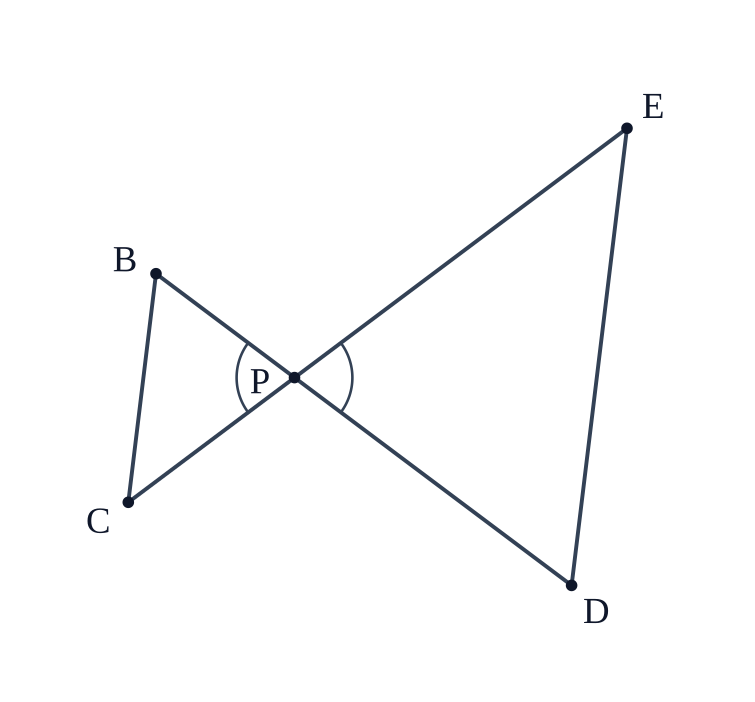
    In Fig 6.4\displaystyle 6.4, BD and CE intersect each other at the point P. Is ΔPBC∼ΔPDE\displaystyle \Delta \mathrm{PBC} \sim \Delta \mathrm{PDE} ? Why? NCERT_Question_Class10_Maths_Exemplar_Ch6_Ex6-2_Q4

    Matches the book, not yet reviewed

    This working reaches the answer NCERT prints. It has not yet been read through by hand.

    NCERT’s answer
    Yes, SAS criterion.
    True. \[\frac{PB}{PD}=\frac{5}{10}=\frac12, \quad \frac{PC}{PE}=\frac{6}{12}=\frac12 \] \[\angle BPC=\angle DPE \quad \text{(vertically opposite angles)} \] By SAS similarity, \(\displaystyle \triangle PBC \sim \triangle PDE\). NCERT_Solution_Class10_Maths_Exemplar_Ch6_Ex6-2_Q4
  5. Exercise 5

    In triangles PQR and MST, ∠P=55∘,∠Q=25∘,∠M=100∘\displaystyle \angle \mathrm{P}=55^{\circ}, \angle \mathrm{Q}=25^{\circ}, \angle \mathrm{M}=100^{\circ} and ∠S=25∘\displaystyle \angle \mathrm{S}=25^{\circ}. Is ΔQPR∼ΔTSM\displaystyle \Delta \mathrm{QPR} \sim \Delta \mathrm{TSM} ? Why?

    Matches the book, not yet reviewed

    This working reaches the answer NCERT prints. It has not yet been read through by hand.

    NCERT’s answer
    No, \(\displaystyle \Delta \mathrm{QPR} \sim \Delta \mathrm{STM}\)
    False. \[\angle R = 180^\circ-55^\circ-25^\circ=100^\circ, \quad \angle T=180^\circ-100^\circ-25^\circ=55^\circ \] \[\angle P=\angle T=55^\circ,\ \angle Q=\angle S=25^\circ,\ \angle R=\angle M=100^\circ \] The matching correspondence is \(\displaystyle \triangle PQR \sim \triangle TSM\), not \(\displaystyle \triangle QPR \sim \triangle TSM\).
  6. Exercise 6

    Is the following statement true? Why? "Two quadrilaterals are similar, if their corresponding angles are equal".

    Matches the book, not yet reviewed

    This working reaches the answer NCERT prints. It has not yet been read through by hand.

    NCERT’s answer
    No, Corresponding sides must also be proportional.
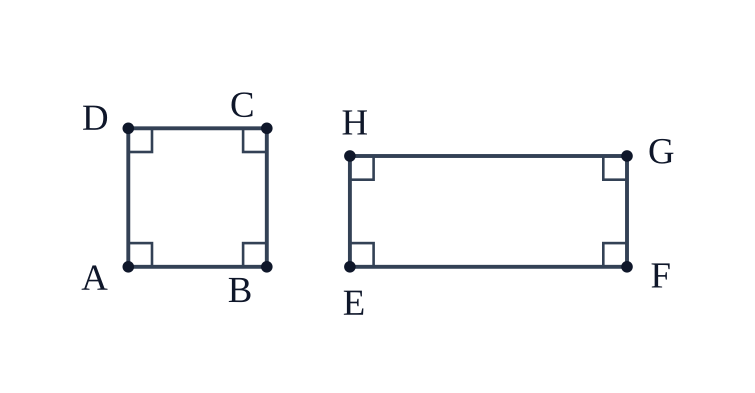
    False. Take a square \(\displaystyle ABCD\) and a rectangle \(\displaystyle EFGH\). NCERT_Solution_Class10_Maths_Exemplar_Ch6_Ex6-2_Q6 \[\angle A=\angle B=\angle C=\angle D=\angle E=\angle F=\angle G=\angle H=90^\circ \] \[AB=BC=2.5, \quad EF=5, \quad FG=2 \] \[\frac{AB}{EF}=\frac{2.5}{5}=\frac12 \neq \frac{BC}{FG}=\frac{2.5}{2}=\frac54 \] Equal angles, sides not proportional, so not similar.
  7. Exercise 7

    Two sides and the perimeter of one triangle are respectively three times the corresponding sides and the perimeter of the other triangle. Are the two triangles similar? Why?

    Matches the book, not yet reviewed

    This working reaches the answer NCERT prints. It has not yet been read through by hand.

    NCERT’s answer
    Yes, as the corresponding two sides and the perimeters are equal, their third sides will also be equal.
    True. \[AB = 3DE, \quad BC = 3EF \quad \text{(given, corresponding sides)} \] \[AB+BC+CA = 3(DE+EF+FD) \quad \text{(given, perimeters)} \] \[3DE+3EF+CA = 3DE+3EF+3FD \] \[\Rightarrow CA = 3FD \] \[\Rightarrow \frac{AB}{DE}=\frac{BC}{EF}=\frac{CA}{FD}=3 \] \[\triangle ABC \sim \triangle DEF \quad \text{(SSS similarity)} \]
  8. Exercise 8

    If in two right triangles, one of the acute angles of one triangle is equal to an acute angle of the other triangle, can you say that the two triangles will be similar? Why?

    Matches the book, not yet reviewed

    This working reaches the answer NCERT prints. It has not yet been read through by hand.

    NCERT’s answer
    Yes, AAA criterion.
    True. \[\angle B = \angle E = 90^\circ \quad \text{(given, right triangles)} \] \[\angle A = \angle D \quad \text{(given, equal acute angles)} \] \[\triangle ABC \sim \triangle DEF \quad \text{(AA similarity)} \]
  9. Exercise 9

    The ratio of the corresponding altitudes of two similar triangles is 35\displaystyle \frac{3}{5}. Is it correct to say that ratio of their areas is 65\displaystyle \frac{6}{5} ? Why?

    Matches the book, not yet reviewed

    This working reaches the answer NCERT prints. It has not yet been read through by hand.

    NCERT’s answer
    No, ratio will be \(\displaystyle \frac{9}{25}\).
    False. \[\frac{\text{ar}(\triangle_1)}{\text{ar}(\triangle_2)} = \left(\frac{h_1}{h_2}\right)^2 \quad \text{(similar triangles)} \] \[= \left(\frac{3}{5}\right)^2 = \frac{9}{25} \]
  10. Exercise 10

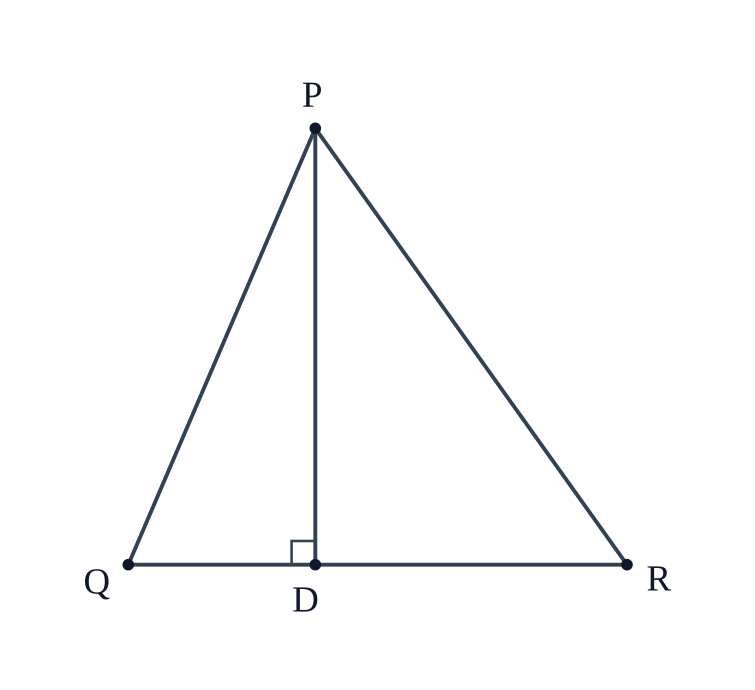
    D is a point on side QR of ΔPQR\displaystyle \Delta \mathrm{PQR} such that PD⊥QR\displaystyle \mathrm{PD} \perp \mathrm{QR}. Will it be correct to say that ΔPQD∼ΔRPD\displaystyle \Delta \mathrm{PQD} \sim \Delta \mathrm{RPD} ? Why?

    Matches the book, not yet reviewed

    This working reaches the answer NCERT prints. It has not yet been read through by hand.

    NCERT’s answer
    No, For this, \(\displaystyle \angle \mathrm{P}\) should be $\displaystyle 90$°.
    False. NCERT_Solution_Class10_Maths_Exemplar_Ch6_Ex6-2_Q10 \[\angle PDQ = \angle PDR = 90^\circ \quad \text{(given)} \] \[\angle Q = 90^\circ - \angle QPD \quad \text{(angle sum, } \triangle PQD\text{)} \] \[\angle Q = \angle RPD \iff \angle QPD + \angle RPD = 90^\circ \iff \angle QPR = 90^\circ \quad \text{(D lies on QR)} \] So \(\displaystyle \triangle PQD \sim \triangle RPD\) only when \(\displaystyle \angle QPR = 90^\circ\), which is not given.
  11. Exercise 11

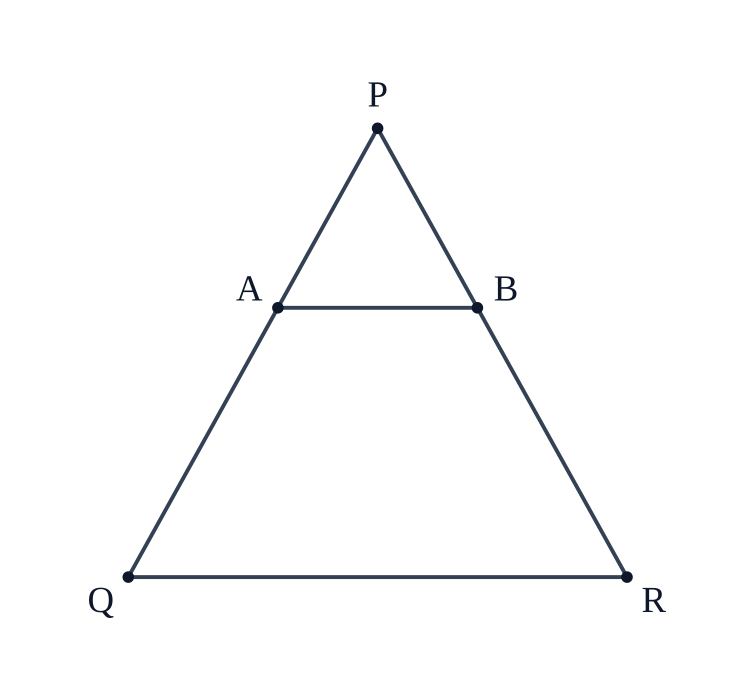
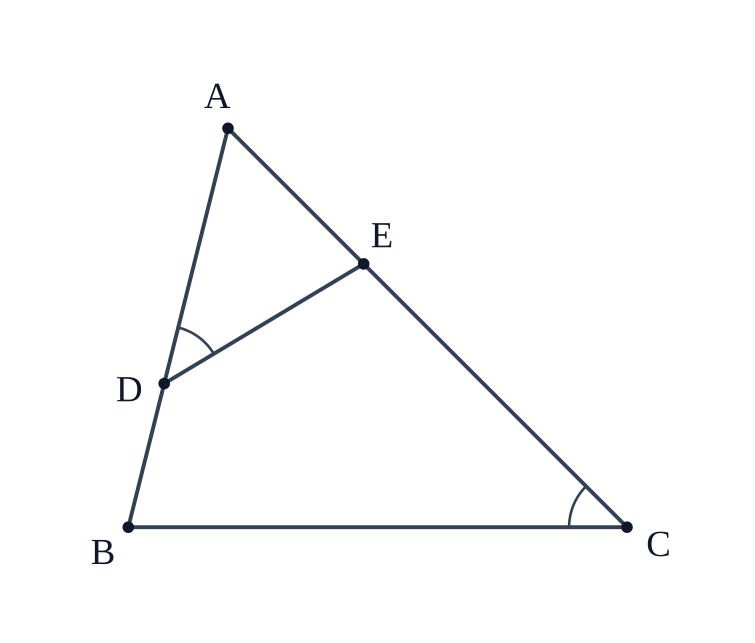
    In Fig. 6.5\displaystyle 6.5, if ∠D=∠C\displaystyle \angle \mathrm{D}=\angle \mathrm{C}, then is it true that ΔADE∼ΔACB\displaystyle \Delta \mathrm{ADE} \sim \Delta \mathrm{ACB} ? Why?

    Matches the book, not yet reviewed

    This working reaches the answer NCERT prints. It has not yet been read through by hand.

    NCERT’s answer
    Yes, AA criterion.
    True. NCERT_Solution_Class10_Maths_Exemplar_Ch6_Ex6-2_Q11 \[\angle A = \angle A \quad \text{(common)} \] \[\angle ADE = \angle ACB \quad \text{(given)} \] \[\triangle ADE \sim \triangle ACB \quad \text{(AA similarity)} \]
  12. Exercise 12

    Is it true to say that if in two triangles, an angle of one triangle is equal to an angle of another triangle and two sides of one triangle are proportional to the two sides of the other triangle, then the triangles are similar? Give reasons for your answer.

    Matches the book, not yet reviewed

    This working reaches the answer NCERT prints. It has not yet been read through by hand.

    NCERT’s answer
    No, angles should be included angles between the two pairs of proportional sides.
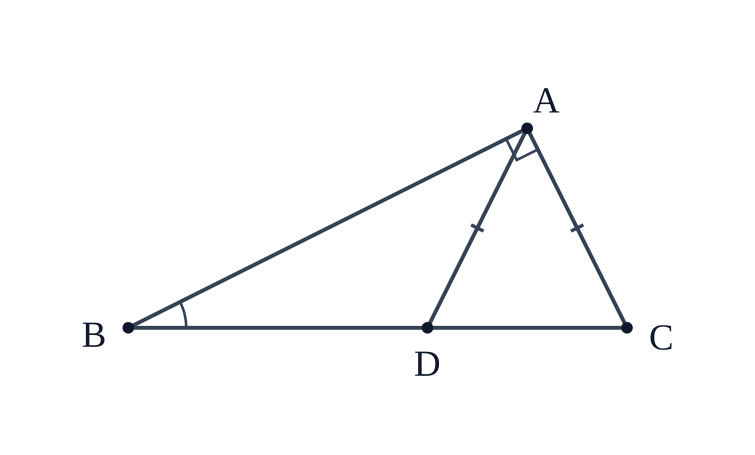
    False. SAS needs the equal angle between the proportional sides: \[\angle P = \angle X, \quad \frac{PQ}{XY} = \frac{PR}{XZ} \implies \triangle PQR \sim \triangle XYZ \] A non-included angle fails: in \(\displaystyle \triangle ABC\) with \(\displaystyle \angle BAC = 90^\circ\), take \(\displaystyle D\) on \(\displaystyle BC\) with \(\displaystyle AD = AC\). NCERT_Solution_Class10_Maths_Exemplar_Ch6_Ex6-2_Q12 \[\angle ABD = \angle ABC \quad \text{(common)} \] \[\frac{AB}{AB} = \frac{AD}{AC} = 1 \quad (AD = AC) \] \[\angle ADC = \angle ACB < 90^\circ \quad (AD = AC;\ \angle BAC = 90^\circ) \] \[\angle ADB = 180^\circ - \angle ADC > 90^\circ \quad \text{(linear pair)} \] \(\displaystyle \triangle ABD\) has an obtuse angle, \(\displaystyle \triangle ABC\) none, so they are not similar.