SolveIt is under development
SolveItNCERT · CBSE · NEET

NCERT Exemplar · Class 10 Mathematics Triangles

57 questions · 57 still being checked

EXERCISE 6.1 1–12 (part 1 of 6)

  1. Choose the correct answer from the given four options:

    Exercise 1

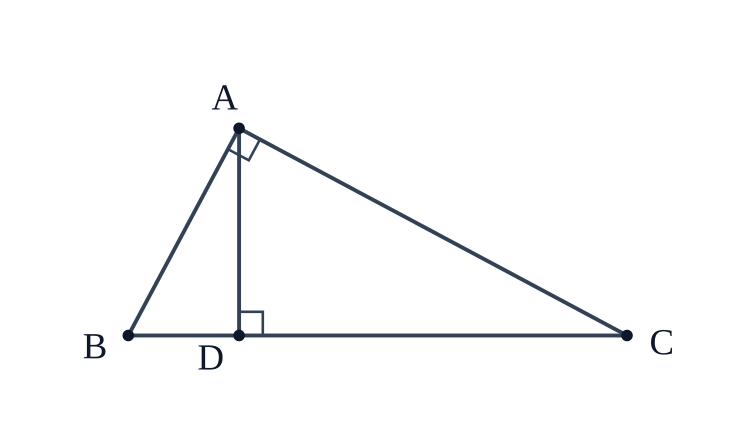
    In Fig. 6.2\displaystyle 6.2, ∠BAC=90∘\displaystyle \angle \mathrm{BAC}=90^{\circ} and AD⊥BC\displaystyle \mathrm{AD} \perp \mathrm{BC}. Then,
    (A)
    BD.CD=BC2\displaystyle \mathrm{BD} . \mathrm{CD}=\mathrm{BC}^2
    (B)
    AB.AC=BC2\displaystyle \mathrm{AB} . \mathrm{AC}=\mathrm{BC}^2
    (C)
    BD.CD=AD2\displaystyle \mathrm{BD} . \mathrm{CD}=\mathrm{AD}^2
    (D)
    AB.AC=AD2\displaystyle \mathrm{AB} . \mathrm{AC}=\mathrm{AD}^2
    NCERT_Question_Class10_Maths_Exemplar_Ch6_Ex6-1_Q1

    Matches the book, not yet reviewed

    This working reaches the answer NCERT prints. It has not yet been read through by hand.

    NCERT’s answer
    (C)
    (C) \(\displaystyle \text{BD}\cdot\text{CD}=\text{AD}^2\) NCERT_Solution_Class10_Maths_Exemplar_Ch6_Ex6-1_Q1 \[\angle B = 90^\circ - \angle C = \angle CAD \quad \text{(angle sum in } \triangle ABC \text{ and } \triangle ADC\text{)} \] \[\triangle ABD \sim \triangle CAD \quad \text{(AA: } \angle ADB=\angle CDA=90^\circ,\ \angle B=\angle CAD\text{)} \] \[\frac{BD}{AD}=\frac{AD}{CD} \] \[AD^2=BD\cdot CD \]
  2. Exercise 2

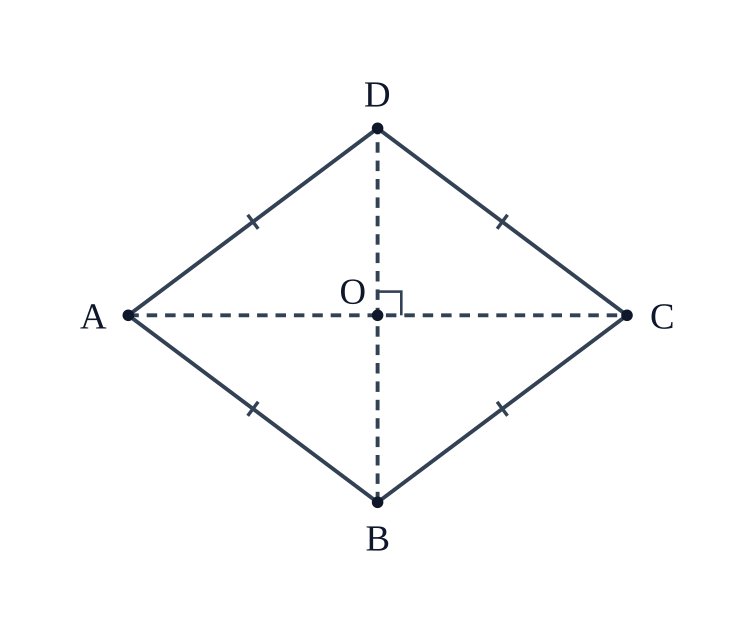
    The lengths of the diagonals of a rhombus are 16\displaystyle 16 cm and 12\displaystyle 12 cm. Then, the length of the side of the rhombus is
    (A)
    9\displaystyle 9 cm
    (B)
    10\displaystyle 10 cm
    (C)
    8\displaystyle 8 cm
    (D)
    20\displaystyle 20 cm

    Matches the book, not yet reviewed

    This working reaches the answer NCERT prints. It has not yet been read through by hand.

    NCERT’s answer
    (B)
    (B) \(\displaystyle 10\) cm NCERT_Solution_Class10_Maths_Exemplar_Ch6_Ex6-1_Q2 \[AO=\frac{16}{2}=8,\quad BO=\frac{12}{2}=6 \quad \text{(diagonals bisect at right angles)} \] \[AB=\sqrt{AO^2+BO^2}=\sqrt{8^2+6^2}=\sqrt{100}=10 \text{ cm} \]
  3. Exercise 3

    If ΔABC∼ΔEDF\displaystyle \Delta \mathrm{ABC} \sim \Delta \mathrm{EDF} and ΔABC\displaystyle \Delta \mathrm{ABC} is not similar to ΔDEF\displaystyle \Delta \mathrm{DEF}, then which of the following is not true?
    (A)
    BC.EF=AC.FD\displaystyle \mathrm{BC} . \mathrm{EF}=\mathrm{AC} . \mathrm{FD}
    (B)
    AB.EF=AC.DE\displaystyle \mathrm{AB} . \mathrm{EF}=\mathrm{AC} . \mathrm{DE}
    (C)
    BC.DE=AB.EF\displaystyle \mathrm{BC} . \mathrm{DE}=\mathrm{AB} . \mathrm{EF}
    (D)
    BC.DE=AB.FD\displaystyle \mathrm{BC} . \mathrm{DE}=\mathrm{AB} . \mathrm{FD}

    Matches the book, not yet reviewed

    This working reaches the answer NCERT prints. It has not yet been read through by hand.

    NCERT’s answer
    (C)
    (C) \(\displaystyle \text{BC}\cdot\text{DE}=\text{AB}\cdot\text{EF}\) \[\triangle ABC \sim \triangle EDF \Rightarrow \frac{AB}{ED}=\frac{BC}{DF}=\frac{CA}{FE} \] \[\frac{AB}{ED}=\frac{BC}{DF} \Rightarrow AB\cdot DF=BC\cdot DE \] Option (C) swaps \(\displaystyle DF\) for \(\displaystyle EF\), not implied in general.
  4. Exercise 4

    If in two triangles ABC and PQR,ABQR=BCPR=CAPQ\displaystyle \mathrm{PQR}, \frac{\mathrm{AB}}{\mathrm{QR}}=\frac{\mathrm{BC}}{\mathrm{PR}}=\frac{\mathrm{CA}}{\mathrm{PQ}}, then
    (A)
    ΔPQR∼ΔCAB\displaystyle \Delta \mathrm{PQR} \sim \Delta \mathrm{CAB}
    (B)
    ΔPQR∼ΔABC\displaystyle \Delta \mathrm{PQR} \sim \Delta \mathrm{ABC}
    (C)
    ΔCBA∼ΔPQR\displaystyle \Delta \mathrm{CBA} \sim \Delta \mathrm{PQR}
    (D)
    ΔBCA∼ΔPQR\displaystyle \Delta \mathrm{BCA} \sim \Delta \mathrm{PQR}

    Matches the book, not yet reviewed

    This working reaches the answer NCERT prints. It has not yet been read through by hand.

    NCERT’s answer
    (A)
    (A) \(\displaystyle \triangle PQR \sim \triangle CAB\) \[\frac{AB}{QR}=\frac{BC}{PR}=\frac{CA}{PQ} \Rightarrow \triangle ABC \sim \triangle QRP \] \[\Rightarrow \triangle PQR \sim \triangle CAB \] Vertex shared by two sides fixes the match: \(\displaystyle B\leftrightarrow R,\ A\leftrightarrow Q,\ C\leftrightarrow P\).
  5. Exercise 5

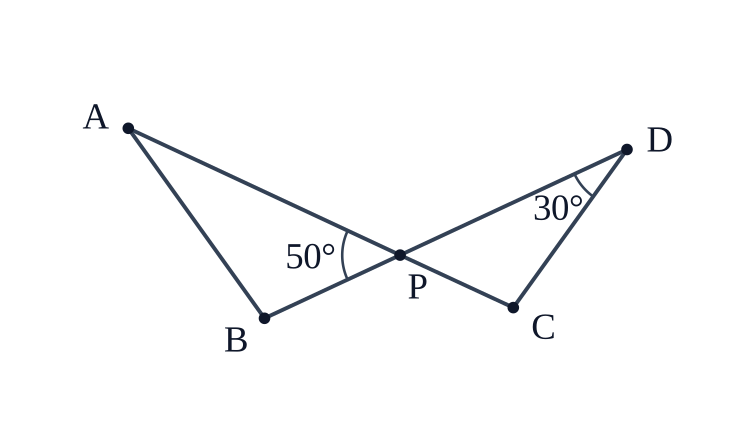
    In Fig.6.3, two line segments AC and BD intersect each other at the point P such that PA=6 cm, PB=3 cm,PC=2.5 cm,PD=5 cm,∠APB=50∘\displaystyle \mathrm{PA}=6 \mathrm{~cm}, \mathrm{~PB}=3 \mathrm{~cm}, \mathrm{PC}=2.5 \mathrm{~cm}, \mathrm{PD}=5 \mathrm{~cm}, \angle \mathrm{APB}=50^{\circ} and ∠CDP=30∘\displaystyle \angle \mathrm{CDP}=30^{\circ}. Then, ∠PBA\displaystyle \angle \mathrm{PBA} is equal to
    (A)
    50\displaystyle 50°
    (B)
    30\displaystyle 30°
    (C)
    60\displaystyle 60°
    (D)
    100\displaystyle 100°
    NCERT_Question_Class10_Maths_Exemplar_Ch6_Ex6-1_Q5

    Matches the book, not yet reviewed

    This working reaches the answer NCERT prints. It has not yet been read through by hand.

    NCERT’s answer
    (D)
    (D) \(\displaystyle 100^{\circ}\) NCERT_Solution_Class10_Maths_Exemplar_Ch6_Ex6-1_Q5 \[PA=6,\ PD=5,\ PB=3,\ PC=2.5 \Rightarrow \frac{PA}{PD}=\frac{PB}{PC}=1.2 \] \[\angle APB=\angle DPC=50^{\circ} \quad \text{(vertically opposite)} \] \[\triangle APB \sim \triangle DPC \ (SAS) \Rightarrow \angle PAB=\angle PDC=30^{\circ} \] \[\angle PBA=180^{\circ}-50^{\circ}-30^{\circ}=100^{\circ} \]
  6. Exercise 6

    If in two triangles DEF and PQR, ∠D=∠Q\displaystyle \angle \mathrm{D}=\angle \mathrm{Q} and ∠R=∠E\displaystyle \angle \mathrm{R}=\angle \mathrm{E}, then which of the following is not true?
    (A)
    EFPR=DFPQ\displaystyle \frac{\mathrm{EF}}{\mathrm{PR}}=\frac{\mathrm{DF}}{\mathrm{PQ}}
    (B)
    DEPQ=EFRP\displaystyle \frac{\mathrm{DE}}{\mathrm{PQ}}=\frac{\mathrm{EF}}{\mathrm{RP}}
    (C)
    DEQR=DFPQ\displaystyle \frac{\mathrm{DE}}{\mathrm{QR}}=\frac{\mathrm{DF}}{\mathrm{PQ}}
    (D)
    EFRP=DEQR\displaystyle \frac{\mathrm{EF}}{\mathrm{RP}}=\frac{\mathrm{DE}}{\mathrm{QR}}

    Matches the book, not yet reviewed

    This working reaches the answer NCERT prints. It has not yet been read through by hand.

    NCERT’s answer
    (B)
    (B) \(\displaystyle \dfrac{DE}{PQ}=\dfrac{EF}{RP}\) \[\angle D=\angle Q,\ \angle E=\angle R \Rightarrow \triangle DEF \sim \triangle QRP \] \[\frac{DE}{QR}=\frac{EF}{RP}=\frac{FD}{PQ} \] Option (B) pairs \(\displaystyle DE\) with \(\displaystyle PQ\) instead of \(\displaystyle QR\), not implied.
  7. Exercise 7

    In triangles ABC and DEF,∠B=∠E,∠F=∠C\displaystyle \mathrm{DEF}, \angle \mathrm{B}=\angle \mathrm{E}, \angle \mathrm{F}=\angle \mathrm{C} and AB=3DE\displaystyle \mathrm{AB}=3 \mathrm{DE}. Then, the two triangles are
    (A)
    congruent but not similar
    (B)
    similar but not congruent
    (C)
    neither congruent nor similar
    (D)
    congruent as well as similar

    Matches the book, not yet reviewed

    This working reaches the answer NCERT prints. It has not yet been read through by hand.

    NCERT’s answer
    (B)
    (B) \(\displaystyle \triangle ABC \sim \triangle DEF\), similar but not congruent\[\angle B=\angle E,\quad \angle C=\angle F \quad \text{(given)} \] \[\triangle ABC \sim \triangle DEF \quad \text{(AA similarity)} \] \[AB=3\,DE \neq DE \quad \Rightarrow \quad \text{sides not equal, not congruent} \]
  8. Exercise 8

    It is given that ΔABC∼ΔPQR\displaystyle \Delta \mathrm{ABC} \sim \Delta \mathrm{PQR}, with BCQR=13\displaystyle \frac{\mathrm{BC}}{\mathrm{QR}}=\frac{1}{3}. Then, ar⁡(PRQ)ar⁡(BCA)\displaystyle \frac{\operatorname{ar}(\mathrm{PRQ})}{\operatorname{ar}(\mathrm{BCA})} is equal to
    (A)
    9\displaystyle 9 (B) 3\displaystyle 3 (C) 13\displaystyle \frac{1}{3}
    (D)
    19\displaystyle \frac{1}{9}

    Matches the book, not yet reviewed

    This working reaches the answer NCERT prints. It has not yet been read through by hand.

    NCERT’s answer
    (A)
    (A) \(\displaystyle 9\)\[\triangle ABC \sim \triangle PQR \] \[\frac{\operatorname{ar}(ABC)}{\operatorname{ar}(PQR)}=\left(\frac{BC}{QR}\right)^2=\left(\frac{1}{3}\right)^2=\frac{1}{9} \] \[\frac{\operatorname{ar}(PRQ)}{\operatorname{ar}(BCA)}=\frac{\operatorname{ar}(PQR)}{\operatorname{ar}(ABC)}=9 \]
  9. Exercise 9

    It is given that ΔABC∼ΔDFE,∠A=30∘,∠C=50∘,AB=5 cm,AC=8 cm\displaystyle \Delta \mathrm{ABC} \sim \Delta \mathrm{DFE}, \angle \mathrm{A}=30^{\circ}, \angle \mathrm{C}=50^{\circ}, \mathrm{AB}=5 \mathrm{~cm}, \mathrm{AC}=8 \mathrm{~cm} and DF=7.5 cm\displaystyle \mathrm{DF}=7.5 \mathrm{~cm}. Then, the following is true:
    (A)
    DE=12 cm,∠ F=50∘\displaystyle \mathrm{DE}=12 \mathrm{~cm}, \angle \mathrm{~F}=50^{\circ}
    (B)
    DE=12 cm,∠ F=100∘\displaystyle \mathrm{DE}=12 \mathrm{~cm}, \angle \mathrm{~F}=100^{\circ}
    (C)
    EF=12 cm,∠D=100∘\displaystyle \mathrm{EF}=12 \mathrm{~cm}, \angle \mathrm{D}=100^{\circ}
    (D)
    EF=12 cm,∠D=30∘\displaystyle \mathrm{EF}=12 \mathrm{~cm}, \angle \mathrm{D}=30^{\circ}

    Matches the book, not yet reviewed

    This working reaches the answer NCERT prints. It has not yet been read through by hand.

    NCERT’s answer
    (B)
    (B) \(\displaystyle DE=12\text{ cm},\ \angle F=100^\circ\)\[\triangle ABC \sim \triangle DFE \quad \Rightarrow \quad \angle A=\angle D,\ \angle B=\angle F,\ \angle C=\angle E \] \[\angle D=30^\circ,\ \angle E=50^\circ \quad \Rightarrow \quad \angle F=180^\circ-30^\circ-50^\circ=100^\circ \] \[\frac{AB}{DF}=\frac{AC}{DE} \quad \Rightarrow \quad \frac{5}{7.5}=\frac{8}{DE} \quad \Rightarrow \quad DE=12\text{ cm} \]
  10. Exercise 10

    If in triangles ABC and DEF,ABDE=BCFD\displaystyle \mathrm{DEF}, \frac{\mathrm{AB}}{\mathrm{DE}}=\frac{\mathrm{BC}}{\mathrm{FD}}, then they will be similar, when
    (A)
    ∠B=∠E\displaystyle \angle \mathrm{B}=\angle \mathrm{E}
    (B)
    ∠A=∠D\displaystyle \angle \mathrm{A}=\angle \mathrm{D}
    (C)
    ∠B=∠D\displaystyle \angle \mathrm{B}=\angle \mathrm{D}
    (D)
    ∠A=∠F\displaystyle \angle \mathrm{A}=\angle \mathrm{F}

    Matches the book, not yet reviewed

    This working reaches the answer NCERT prints. It has not yet been read through by hand.

    NCERT’s answer
    (C)
    (C) \(\displaystyle \angle B=\angle D\)\[\frac{AB}{DE}=\frac{BC}{FD} \] \[\angle B \text{ included between } AB,BC; \quad \angle D \text{ included between } DE,FD \] \[\angle B=\angle D \quad \Rightarrow \quad \triangle ABC \sim \triangle EDF \quad \text{(SAS similarity)} \]
  11. Exercise 11

    If ΔABC∼ΔQRP,ar⁡(ABC)ar⁡(PQR)=94,AB=18 cm\displaystyle \Delta \mathrm{ABC} \sim \Delta \mathrm{QRP}, \frac{\operatorname{ar}(\mathrm{ABC})}{\operatorname{ar}(\mathrm{PQR})}=\frac{9}{4}, \mathrm{AB}=18 \mathrm{~cm} and BC=15 cm\displaystyle \mathrm{BC}=15 \mathrm{~cm}, then PR is equal to
    (A)
    10\displaystyle 10 cm
    (B)
    12\displaystyle 12 cm
    (C)
    203 cm\displaystyle \frac{20}{3} \mathrm{~cm}
    (D)
    8\displaystyle 8 cm

    Matches the book, not yet reviewed

    This working reaches the answer NCERT prints. It has not yet been read through by hand.

    NCERT’s answer
    (A)
    (A) \(\displaystyle 10\text{ cm}\)\[\triangle ABC \sim \triangle QRP \quad \Rightarrow \quad A\leftrightarrow Q,\ B\leftrightarrow R,\ C\leftrightarrow P \] \[\frac{\operatorname{ar}(ABC)}{\operatorname{ar}(QRP)}=\left(\frac{AB}{QR}\right)^2=\left(\frac{BC}{RP}\right)^2=\frac{9}{4} \] \[\frac{15}{RP}=\frac{3}{2} \quad \Rightarrow \quad RP=10\text{ cm} \]
  12. Exercise 12

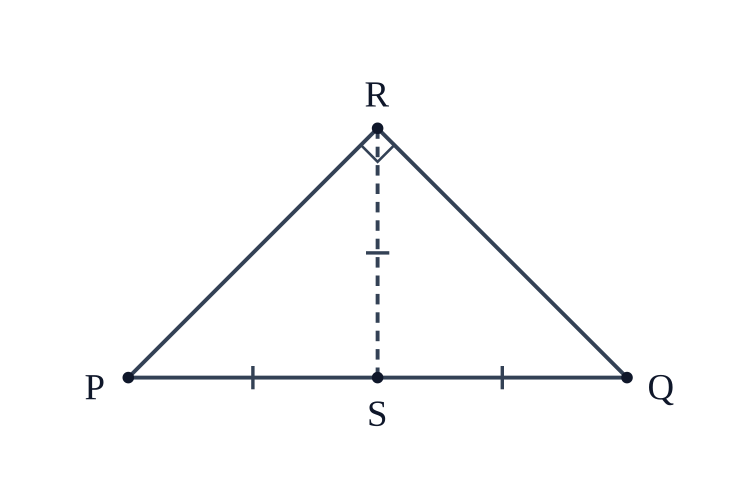
    If S is a point on side PQ of a ΔPQR\displaystyle \Delta \mathrm{PQR} such that PS=QS=RS\displaystyle \mathrm{PS}=\mathrm{QS}=\mathrm{RS}, then
    (A)
    PR.QR=RS2\displaystyle \mathrm{PR} . \mathrm{QR}=\mathrm{RS}^2
    (B)
    QS2+RS2=QR2\displaystyle \mathrm{QS}^2+\mathrm{RS}^2=\mathrm{QR}^2
    (C)
    PR2+QR2=PQ2\displaystyle \mathrm{PR}^2+\mathrm{QR}^2=\mathrm{PQ}^2
    (D)
    PS2+RS2=PR2\displaystyle \mathrm{PS}^2+\mathrm{RS}^2=\mathrm{PR}^2

    Matches the book, not yet reviewed

    This working reaches the answer NCERT prints. It has not yet been read through by hand.

    NCERT’s answer
    (C)
    (C) \(\displaystyle PR^2+QR^2=PQ^2\)\[PS=QS=RS \quad \Rightarrow \quad S \text{ equidistant from } P,Q,R \] \[S\in PQ,\ SP=SQ=SR \quad \Rightarrow \quad PQ \text{ diameter of circle centre } S,\ \angle PRQ=90^\circ \] NCERT_Solution_Class10_Maths_Exemplar_Ch6_Ex6-1_Q12 \[PR^2+QR^2=PQ^2 \quad \text{(Pythagoras in } \triangle PRQ\text{)} \]