Exercise 11
In such that D lies on QR . If and , prove that .
Not cross-checked
NCERT prints no numerical answer for this exercise, so this working has not been cross-checked against the book.
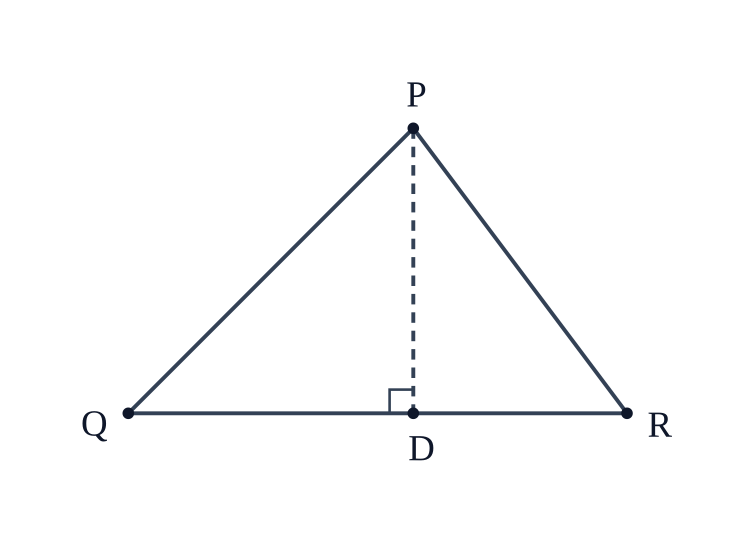 \[PQ^2 = PD^2+QD^2 \quad \text{(Pythagoras, } \triangle PDQ, \angle PDQ=90^\circ\text{)} \]
\[a^2 = PD^2+c^2 \quad \cdots(i) \]
\[PR^2 = PD^2+DR^2 \quad \text{(Pythagoras, } \triangle PDR, \angle PDR=90^\circ\text{)} \]
\[b^2 = PD^2+d^2 \quad \cdots(ii) \]
\[(i)-(ii): \quad a^2-b^2 = c^2-d^2 \]
\[(a+b)(a-b) = (c+d)(c-d) \]Answer: \(\displaystyle (a+b)(a-b)=(c+d)(c-d)\)
\[PQ^2 = PD^2+QD^2 \quad \text{(Pythagoras, } \triangle PDQ, \angle PDQ=90^\circ\text{)} \]
\[a^2 = PD^2+c^2 \quad \cdots(i) \]
\[PR^2 = PD^2+DR^2 \quad \text{(Pythagoras, } \triangle PDR, \angle PDR=90^\circ\text{)} \]
\[b^2 = PD^2+d^2 \quad \cdots(ii) \]
\[(i)-(ii): \quad a^2-b^2 = c^2-d^2 \]
\[(a+b)(a-b) = (c+d)(c-d) \]Answer: \(\displaystyle (a+b)(a-b)=(c+d)(c-d)\)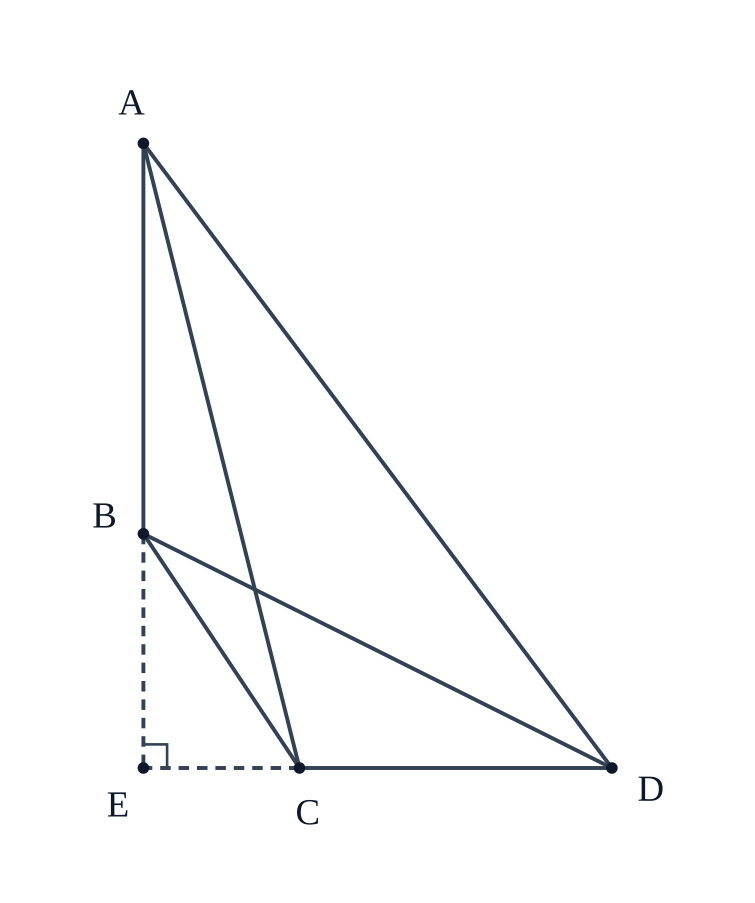 \[\angle EAD=\angle A, \quad \angle ADE=\angle D \quad \text{(E on AB, DC produced)} \]
\[\angle A+\angle D = 90^\circ \quad \text{(given)} \]
\[\angle AED = 180^\circ-(\angle A+\angle D) = 90^\circ \quad \text{(angle sum, } \triangle AED\text{)} \]
\[AD^2 = AE^2+ED^2 \quad \text{(Pythagoras, } \triangle AED\text{)} \]
\[BC^2 = BE^2+EC^2 \quad \text{(Pythagoras, } \triangle BEC, \angle BEC=90^\circ\text{)} \]
\[AC^2 = AE^2+EC^2, \quad BD^2 = BE^2+ED^2 \quad \text{(Pythagoras, } \triangle AEC, \triangle BED\text{)} \]
\[AC^2+BD^2 = (AE^2+ED^2)+(BE^2+EC^2) \]
\[AC^2+BD^2 = AD^2+BC^2 \]Answer: \(\displaystyle AC^2+BD^2=AD^2+BC^2\)
\[\angle EAD=\angle A, \quad \angle ADE=\angle D \quad \text{(E on AB, DC produced)} \]
\[\angle A+\angle D = 90^\circ \quad \text{(given)} \]
\[\angle AED = 180^\circ-(\angle A+\angle D) = 90^\circ \quad \text{(angle sum, } \triangle AED\text{)} \]
\[AD^2 = AE^2+ED^2 \quad \text{(Pythagoras, } \triangle AED\text{)} \]
\[BC^2 = BE^2+EC^2 \quad \text{(Pythagoras, } \triangle BEC, \angle BEC=90^\circ\text{)} \]
\[AC^2 = AE^2+EC^2, \quad BD^2 = BE^2+ED^2 \quad \text{(Pythagoras, } \triangle AEC, \triangle BED\text{)} \]
\[AC^2+BD^2 = (AE^2+ED^2)+(BE^2+EC^2) \]
\[AC^2+BD^2 = AD^2+BC^2 \]Answer: \(\displaystyle AC^2+BD^2=AD^2+BC^2\)
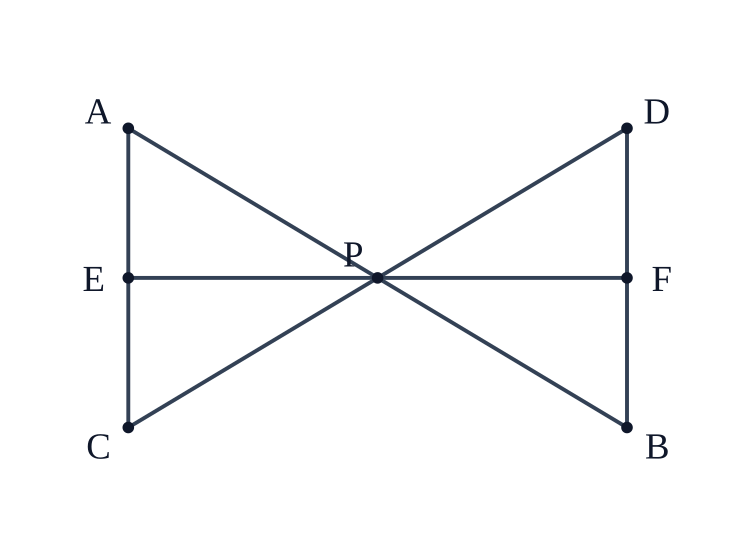 \[\angle APC = \angle BPD \quad \text{(vert.\ opp.)} \]
\[\angle PCA = \angle PDB \quad \text{(alt.\ }\angle s,\ l\|m\text{)} \]
\[\triangle APC \sim \triangle BPD \implies \frac{AP}{BP}=\frac{CP}{DP}=\frac{AC}{BD} \]
\[\angle APE = \angle BPF \quad \text{(vert.\ opp.)} \]
\[\angle PEA = \angle PFB \quad \text{(alt.\ }\angle s,\ l\|m\text{)} \]
\[\triangle APE \sim \triangle BPF \implies \frac{AP}{BP}=\frac{EP}{FP}=\frac{AE}{BF} \]
\[\angle CPE = \angle DPF \quad \text{(vert.\ opp.)} \]
\[\angle PEC = \angle PFD \quad \text{(alt.\ }\angle s,\ l\|m\text{)} \]
\[\triangle CPE \sim \triangle DPF \implies \frac{CP}{DP}=\frac{EP}{FP}=\frac{CE}{FD} \]
\[\frac{AP}{BP}=\frac{CP}{DP}=\frac{EP}{FP} \implies \frac{AE}{BF}=\frac{AC}{BD}=\frac{CE}{FD} \]
Answer: \(\displaystyle \dfrac{AE}{BF}=\dfrac{AC}{BD}=\dfrac{CE}{FD} \)
\[\angle APC = \angle BPD \quad \text{(vert.\ opp.)} \]
\[\angle PCA = \angle PDB \quad \text{(alt.\ }\angle s,\ l\|m\text{)} \]
\[\triangle APC \sim \triangle BPD \implies \frac{AP}{BP}=\frac{CP}{DP}=\frac{AC}{BD} \]
\[\angle APE = \angle BPF \quad \text{(vert.\ opp.)} \]
\[\angle PEA = \angle PFB \quad \text{(alt.\ }\angle s,\ l\|m\text{)} \]
\[\triangle APE \sim \triangle BPF \implies \frac{AP}{BP}=\frac{EP}{FP}=\frac{AE}{BF} \]
\[\angle CPE = \angle DPF \quad \text{(vert.\ opp.)} \]
\[\angle PEC = \angle PFD \quad \text{(alt.\ }\angle s,\ l\|m\text{)} \]
\[\triangle CPE \sim \triangle DPF \implies \frac{CP}{DP}=\frac{EP}{FP}=\frac{CE}{FD} \]
\[\frac{AP}{BP}=\frac{CP}{DP}=\frac{EP}{FP} \implies \frac{AE}{BF}=\frac{AC}{BD}=\frac{CE}{FD} \]
Answer: \(\displaystyle \dfrac{AE}{BF}=\dfrac{AC}{BD}=\dfrac{CE}{FD} \)
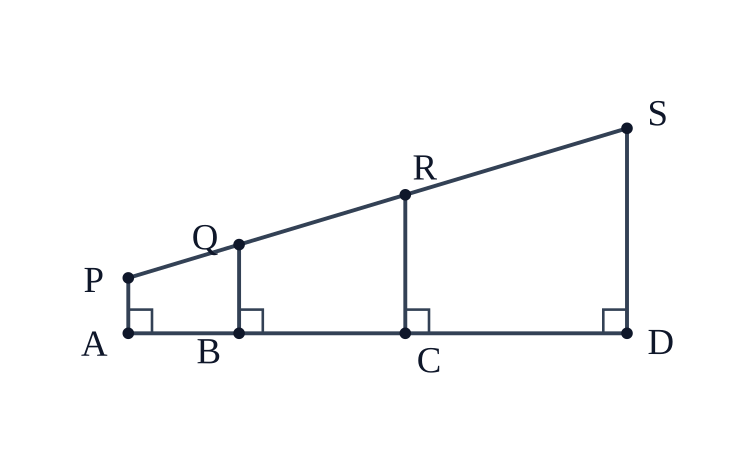 Let \(\displaystyle \theta\) be the angle line \(\displaystyle PQRS\) makes with \(\displaystyle l\).
\[PQ\cos\theta = AB,\quad QR\cos\theta = BC,\quad RS\cos\theta = CD \]
\[PQ:QR:RS = AB:BC:CD = 6:9:12 = 2:3:4 \]
Let \(\displaystyle PQ=2k,\ QR=3k,\ RS=4k\).
\[PQ+QR+RS = SP \]
\[2k+3k+4k = 36 \]
\[9k = 36 \implies k = 4 \]
\[PQ = 8\text{ cm},\quad QR = 12\text{ cm},\quad RS = 16\text{ cm} \]
Answer: \(\displaystyle PQ=8\text{ cm},\ QR=12\text{ cm},\ RS=16\text{ cm}\)
Let \(\displaystyle \theta\) be the angle line \(\displaystyle PQRS\) makes with \(\displaystyle l\).
\[PQ\cos\theta = AB,\quad QR\cos\theta = BC,\quad RS\cos\theta = CD \]
\[PQ:QR:RS = AB:BC:CD = 6:9:12 = 2:3:4 \]
Let \(\displaystyle PQ=2k,\ QR=3k,\ RS=4k\).
\[PQ+QR+RS = SP \]
\[2k+3k+4k = 36 \]
\[9k = 36 \implies k = 4 \]
\[PQ = 8\text{ cm},\quad QR = 12\text{ cm},\quad RS = 16\text{ cm} \]
Answer: \(\displaystyle PQ=8\text{ cm},\ QR=12\text{ cm},\ RS=16\text{ cm}\)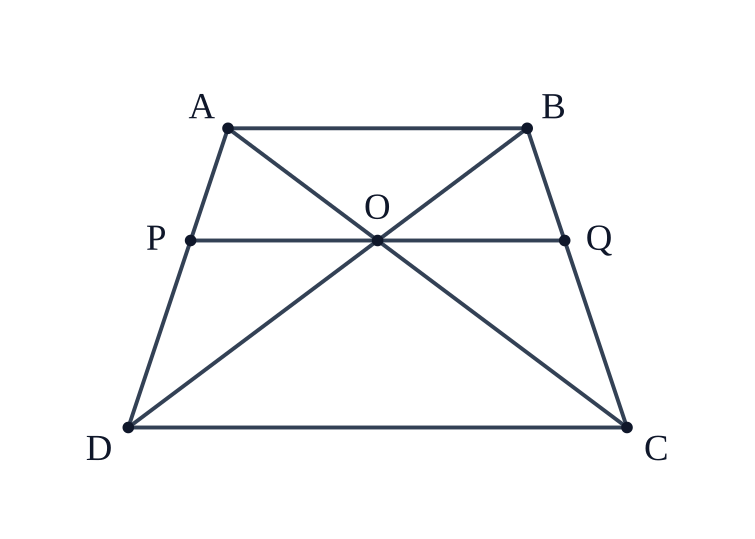 \[\angle AOB=\angle COD \quad \text{(vert.\ opp.)} \]
\[\angle OAB=\angle OCD \quad \text{(alt.\ }\angle s,\ AB\|DC\text{)} \]
\[\triangle AOB \sim \triangle COD \implies \frac{AO}{CO}=\frac{BO}{DO} \]
\[\implies \frac{AO}{AC}=\frac{BO}{BD} \quad \text{(componendo)} \]
In \(\displaystyle \triangle ADC\), \(\displaystyle PO\|DC\):
\[\triangle APO \sim \triangle ADC \implies \frac{PO}{DC}=\frac{AO}{AC} \]
In \(\displaystyle \triangle BDC\), \(\displaystyle QO\|DC\):
\[\triangle BQO \sim \triangle BDC \implies \frac{QO}{DC}=\frac{BO}{BD} \]
\[\frac{PO}{DC}=\frac{AO}{AC}=\frac{BO}{BD}=\frac{QO}{DC} \implies PO=QO \]
Answer: \(\displaystyle PO=QO\)
\[\angle AOB=\angle COD \quad \text{(vert.\ opp.)} \]
\[\angle OAB=\angle OCD \quad \text{(alt.\ }\angle s,\ AB\|DC\text{)} \]
\[\triangle AOB \sim \triangle COD \implies \frac{AO}{CO}=\frac{BO}{DO} \]
\[\implies \frac{AO}{AC}=\frac{BO}{BD} \quad \text{(componendo)} \]
In \(\displaystyle \triangle ADC\), \(\displaystyle PO\|DC\):
\[\triangle APO \sim \triangle ADC \implies \frac{PO}{DC}=\frac{AO}{AC} \]
In \(\displaystyle \triangle BDC\), \(\displaystyle QO\|DC\):
\[\triangle BQO \sim \triangle BDC \implies \frac{QO}{DC}=\frac{BO}{BD} \]
\[\frac{PO}{DC}=\frac{AO}{AC}=\frac{BO}{BD}=\frac{QO}{DC} \implies PO=QO \]
Answer: \(\displaystyle PO=QO\)
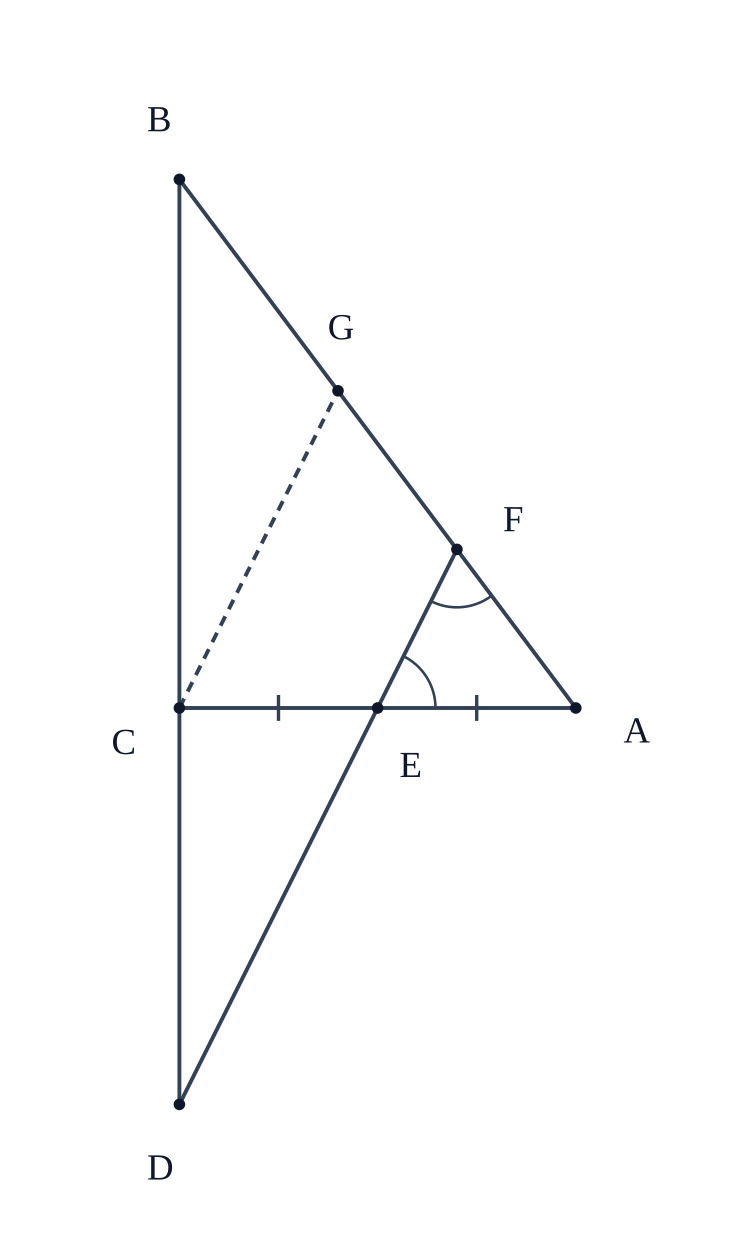 Construction: \(\displaystyle G\) on \(\displaystyle AB\) with \(\displaystyle CG\|DF\).
In \(\displaystyle \triangle AGC\), \(\displaystyle FE\|GC\):
\[\frac{AF}{FG}=\frac{AE}{EC}=1 \quad (E\text{ midpt.\ of }AC) \implies AF=FG \]
\[AE=AF \quad (\angle AEF=\angle AFE) \implies FG=AE=EC \]
In \(\displaystyle \triangle BFD\), \(\displaystyle CG\|FD\):
\[\frac{BC}{CD}=\frac{BG}{GF} \implies \frac{BC+CD}{CD}=\frac{BG+GF}{GF} \]
\[\frac{BD}{CD}=\frac{BF}{FG}=\frac{BF}{CE} \]
Answer: \(\displaystyle \dfrac{BD}{CD}=\dfrac{BF}{CE}\)
Construction: \(\displaystyle G\) on \(\displaystyle AB\) with \(\displaystyle CG\|DF\).
In \(\displaystyle \triangle AGC\), \(\displaystyle FE\|GC\):
\[\frac{AF}{FG}=\frac{AE}{EC}=1 \quad (E\text{ midpt.\ of }AC) \implies AF=FG \]
\[AE=AF \quad (\angle AEF=\angle AFE) \implies FG=AE=EC \]
In \(\displaystyle \triangle BFD\), \(\displaystyle CG\|FD\):
\[\frac{BC}{CD}=\frac{BG}{GF} \implies \frac{BC+CD}{CD}=\frac{BG+GF}{GF} \]
\[\frac{BD}{CD}=\frac{BF}{FG}=\frac{BF}{CE} \]
Answer: \(\displaystyle \dfrac{BD}{CD}=\dfrac{BF}{CE}\)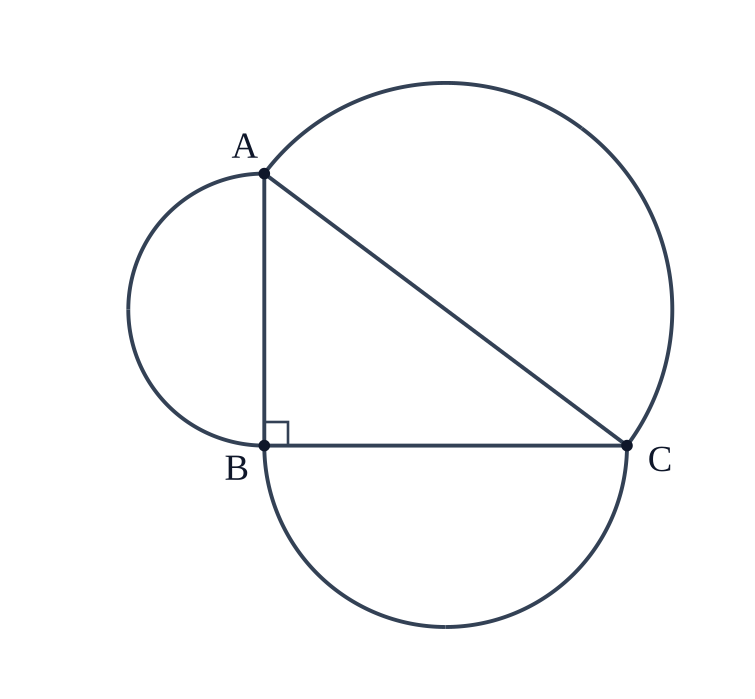 Area of a semicircle of diameter \(\displaystyle d\) is \(\displaystyle \dfrac{\pi d^2}{8}\).
\[AC^2 = AB^2+BC^2 \quad \text{(Pythagoras, }\angle B=90^\circ\text{)} \]
\[\frac{\pi\, AC^2}{8} = \frac{\pi\, AB^2}{8}+\frac{\pi\, BC^2}{8} \]
Answer: area on \(\displaystyle AC\) = area on \(\displaystyle AB\) + area on \(\displaystyle BC\)
Area of a semicircle of diameter \(\displaystyle d\) is \(\displaystyle \dfrac{\pi d^2}{8}\).
\[AC^2 = AB^2+BC^2 \quad \text{(Pythagoras, }\angle B=90^\circ\text{)} \]
\[\frac{\pi\, AC^2}{8} = \frac{\pi\, AB^2}{8}+\frac{\pi\, BC^2}{8} \]
Answer: area on \(\displaystyle AC\) = area on \(\displaystyle AB\) + area on \(\displaystyle BC\)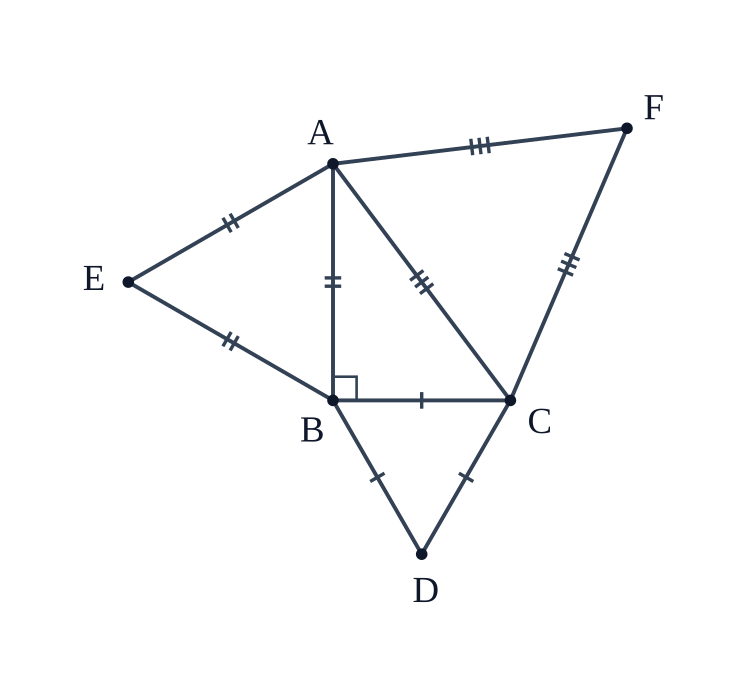 Area of an equilateral triangle of side \(\displaystyle a\) is \(\displaystyle \dfrac{\sqrt3}{4}a^2\).
\[AC^2 = AB^2+BC^2 \quad \text{(Pythagoras, }\angle B=90^\circ\text{)} \]
\[\frac{\sqrt3}{4}AC^2 = \frac{\sqrt3}{4}AB^2+\frac{\sqrt3}{4}BC^2 \]
Answer: area on \(\displaystyle AC\) = area on \(\displaystyle AB\) + area on \(\displaystyle BC\)
Area of an equilateral triangle of side \(\displaystyle a\) is \(\displaystyle \dfrac{\sqrt3}{4}a^2\).
\[AC^2 = AB^2+BC^2 \quad \text{(Pythagoras, }\angle B=90^\circ\text{)} \]
\[\frac{\sqrt3}{4}AC^2 = \frac{\sqrt3}{4}AB^2+\frac{\sqrt3}{4}BC^2 \]
Answer: area on \(\displaystyle AC\) = area on \(\displaystyle AB\) + area on \(\displaystyle BC\)