SolveIt is under development
SolveItNCERT · CBSE · NEET

NCERT Exemplar · Class 10 Mathematics Triangles

57 questions · 57 still being checked

EXERCISE 6.4 1–10 (part 5 of 6)

  1. Exercise 1

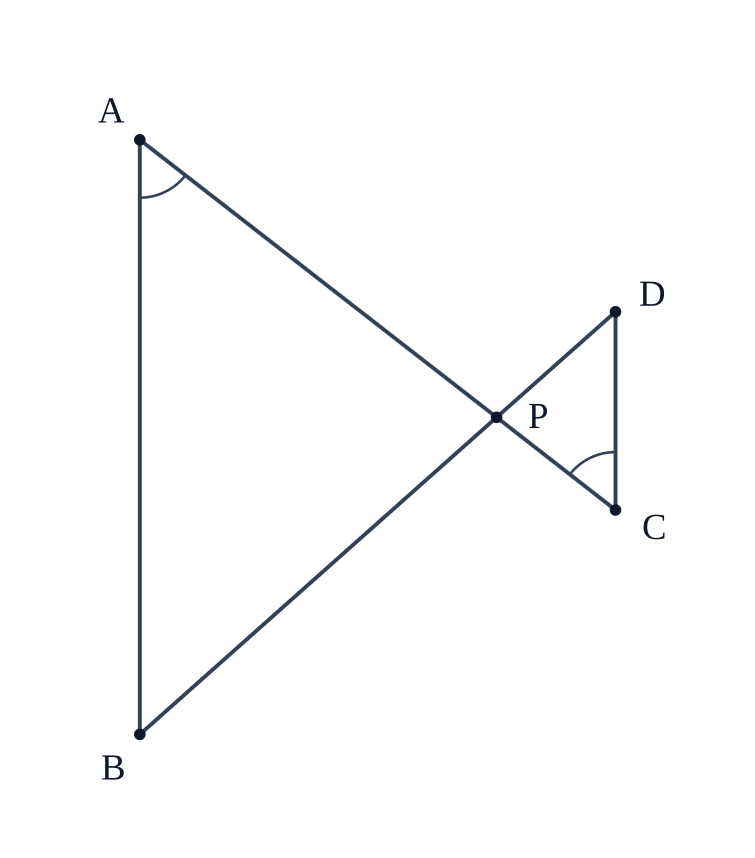
    In Fig. 6.16\displaystyle 6.16, if ∠A=∠C,AB=6 cm,BP=15 cm\displaystyle \angle \mathrm{A}=\angle \mathrm{C}, \mathrm{AB}=6 \mathrm{~cm}, \mathrm{BP}=15 \mathrm{~cm}, AP=12 cm\displaystyle \mathrm{AP}=12 \mathrm{~cm} and CP=4 cm\displaystyle \mathrm{CP}=4 \mathrm{~cm}, then find the lengths of PD and CD. NCERT_Question_Class10_Maths_Exemplar_Ch6_Ex6-4_Q1

    Matches the book, not yet reviewed

    This working reaches the answer NCERT prints. It has not yet been read through by hand.

    NCERT’s answer
    $\displaystyle 5$ cm, $\displaystyle 2$ cm
    \[\angle APB = \angle CPD \quad \text{(vertically opposite angles)} \] \[\angle A = \angle C \quad \text{(given)} \] \[\triangle APB \sim \triangle CPD \quad \text{(AA similarity)} \] NCERT_Solution_Class10_Maths_Exemplar_Ch6_Ex6-4_Q1 \[\frac{AP}{CP} = \frac{PB}{PD} = \frac{AB}{CD} \] \[\frac{12}{4} = \frac{15}{PD} = \frac{6}{CD} \] \[PD = \frac{15 \times 4}{12} = 5 \text{ cm} \] \[CD = \frac{6 \times 4}{12} = 2 \text{ cm} \] Answer: \(\displaystyle PD = 5 \) cm, \(\displaystyle CD = 2 \) cm.
  2. Exercise 2

    It is given that ΔABC∼ΔEDF\displaystyle \Delta \mathrm{ABC} \sim \Delta \mathrm{EDF} such that AB=5 cm\displaystyle \mathrm{AB}=5 \mathrm{~cm}, AC=7 cm,DF=15 cm\displaystyle \mathrm{AC}=7 \mathrm{~cm}, \mathrm{DF}=15 \mathrm{~cm} and DE=12 cm\displaystyle \mathrm{DE}=12 \mathrm{~cm}. Find the lengths of the remaining sides of the triangles.

    Matches the book, not yet reviewed

    This working reaches the answer NCERT prints. It has not yet been read through by hand.

    NCERT’s answer
    BC = $\displaystyle 6.25$ cm, EF = $\displaystyle 16.8$ cm.
    \[\triangle ABC \sim \triangle EDF \] \[\frac{AB}{ED} = \frac{BC}{DF} = \frac{AC}{EF} \] \[\frac{5}{12} = \frac{BC}{15} = \frac{7}{EF} \] \[BC = \frac{5 \times 15}{12} = 6.25 \text{ cm} \] \[EF = \frac{7 \times 12}{5} = 16.8 \text{ cm} \] Answer: \(\displaystyle BC = 6.25 \) cm, \(\displaystyle EF = 16.8 \) cm.
  3. Exercise 3

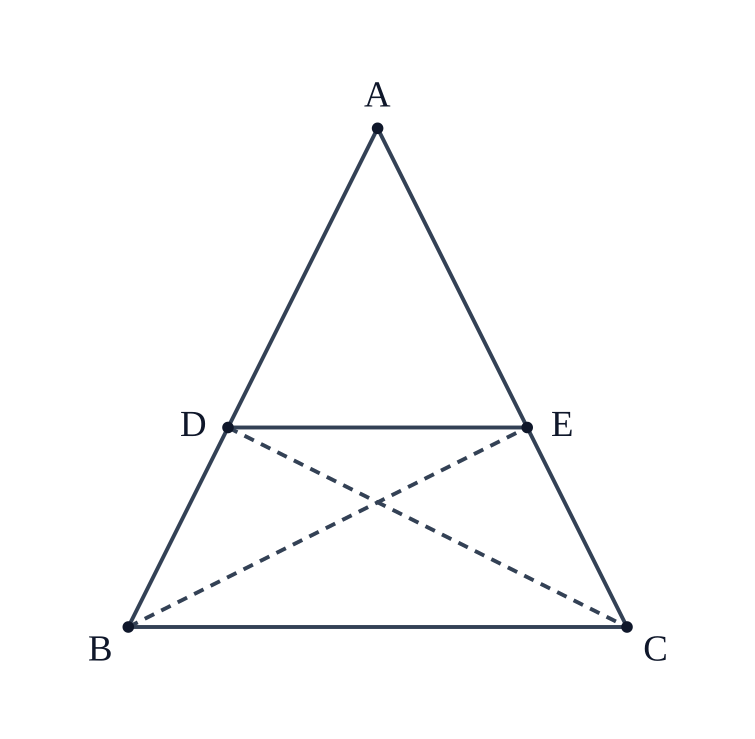
    Prove that if a line is drawn parallel to one side of a triangle to intersect the other two sides, then the two sides are divided in the same ratio.

    Not cross-checked

    NCERT prints no numerical answer for this exercise, so this working has not been cross-checked against the book.

    \[DE \parallel BC, \quad D \text{ on } AB, \quad E \text{ on } AC \quad \text{(given)} \] Construction: \(\displaystyle BE\), \(\displaystyle CD\) joined. NCERT_Solution_Class10_Maths_Exemplar_Ch6_Ex6-4_Q3 \[\frac{\text{ar}(\triangle ADE)}{\text{ar}(\triangle DBE)} = \frac{AD}{DB} \quad \text{(equal height from } E\text{, bases on } AB\text{)} \] \[\frac{\text{ar}(\triangle ADE)}{\text{ar}(\triangle DEC)} = \frac{AE}{EC} \quad \text{(equal height from } D\text{, bases on } AC\text{)} \] \[\text{ar}(\triangle DBE) = \text{ar}(\triangle DEC) \quad \text{(same base } DE\text{, } DE \parallel BC\text{)} \] \[\frac{AD}{DB} = \frac{AE}{EC} \] Answer: \(\displaystyle \dfrac{AD}{DB} = \dfrac{AE}{EC} \)
  4. Exercise 4

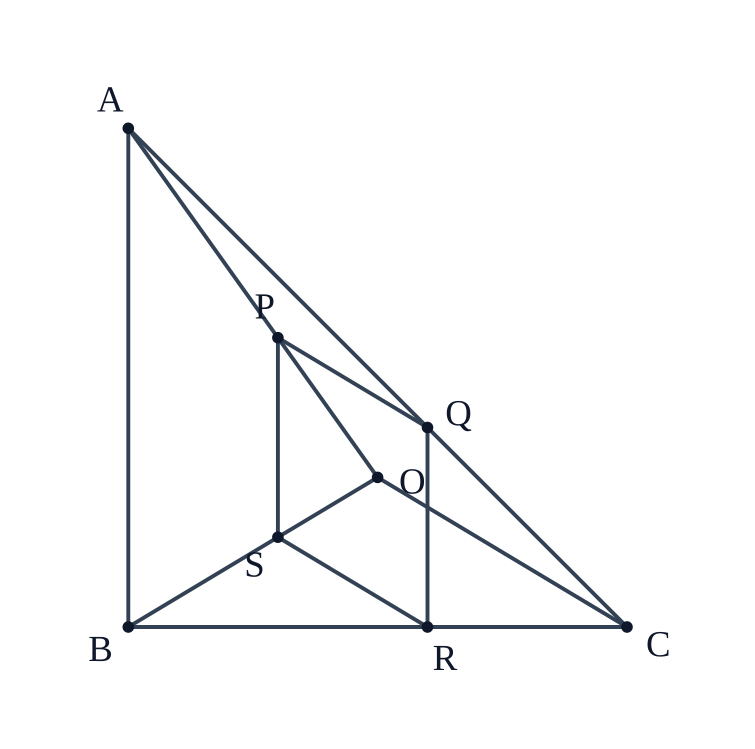
    In Fig 6.17\displaystyle 6.17, if PQRS is a parallelogram and AB∥PS\displaystyle \mathrm{AB} \| \mathrm{PS}, then prove that OC∥SR\displaystyle \mathrm{OC} \| \mathrm{SR}. NCERT_Question_Class10_Maths_Exemplar_Ch6_Ex6-4_Q4

    Not cross-checked

    NCERT prints no numerical answer for this exercise, so this working has not been cross-checked against the book.

    \[PS \parallel AB \implies \triangle OPS \sim \triangle OAB \quad \text{(AA)} \] \[\frac{OP}{OA} = \frac{OS}{OB} = \frac{PS}{AB} = k \] \[QR \parallel PS \parallel AB \quad \text{(opp. sides of the } \|\text{gm)} \] \[\triangle CQR \sim \triangle CAB \quad \text{(AA)} \implies \frac{CQ}{CA} = \frac{CR}{CB} = \frac{QR}{AB} = m \] \[QR = PS \quad \text{(} \|\text{gm sides)} \implies m = k \] NCERT_Solution_Class10_Maths_Exemplar_Ch6_Ex6-4_Q4 \[\frac{AQ}{QC} = \frac{CA-CQ}{CQ} = \frac{1-k}{k} = \frac{OA-OP}{OP} = \frac{AP}{PO} \] \[\text{In } \triangle AOC: \frac{AP}{PO} = \frac{AQ}{QC} \implies PQ \parallel OC \quad \text{(converse BPT)} \] \[PQ \parallel SR \quad \text{(opp. sides of the } \|\text{gm)} \implies OC \parallel SR \] Answer: \(\displaystyle OC \parallel SR \)
  5. Exercise 5

    A 5\displaystyle 5 m long ladder is placed leaning towards a vertical wall such that it reaches the wall at a point 4\displaystyle 4 m high. If the foot of the ladder is moved 1.6\displaystyle 1.6 m towards the wall, then find the distance by which the top of the ladder would slide upwards on the wall.

    Matches the book, not yet reviewed

    This working reaches the answer NCERT prints. It has not yet been read through by hand.

    NCERT’s answer
    0.$\displaystyle 8$ m
    \[\text{Ground distance}_1 = \sqrt{5^2-4^2} = \sqrt{9} = 3 \text{ m} \] \[\text{New ground distance} = 3 - 1.6 = 1.4 \text{ m} \] \[\text{New height} = \sqrt{5^2-1.4^2} = \sqrt{23.04} = 4.8 \text{ m} \] NCERT_Solution_Class10_Maths_Exemplar_Ch6_Ex6-4_Q5 \[\text{Rise} = 4.8 - 4 = 0.8 \text{ m} \] Answer: The top slides up by \(\displaystyle 0.8 \) m.
  6. Exercise 6

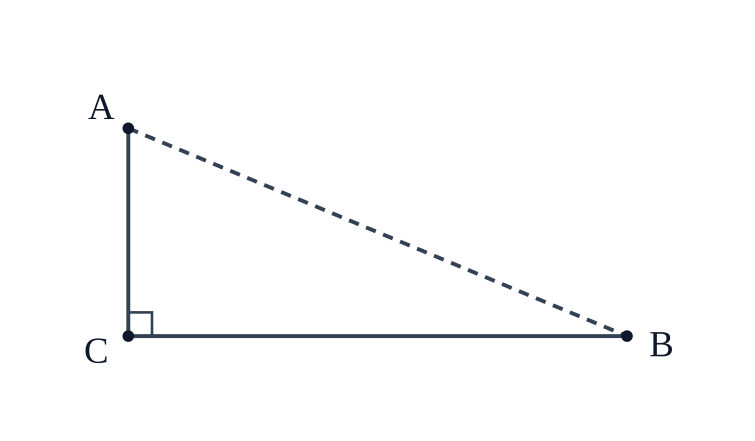
    For going to a city B from city A, there is a route via city C such that AC⊥CB\displaystyle \mathrm{AC} \perp \mathrm{CB}, AC=2x km\displaystyle \mathrm{AC}=2 x \mathrm{~km} and CB=2(x+7)km\displaystyle \mathrm{CB}=2(x+7) \mathrm{km}. It is proposed to construct a 26\displaystyle 26 km highway which directly connects the two cities A and B. Find how much distance will be saved in reaching city B from city A after the construction of the highway.

    Matches the book, not yet reviewed

    This working reaches the answer NCERT prints. It has not yet been read through by hand.

    NCERT’s answer
    $\displaystyle 8$ km
    \[AC^2 + CB^2 = AB^2 \quad \text{(Pythagoras, } \angle C = 90^\circ\text{)} \] \[(2x)^2 + [2(x+7)]^2 = 26^2 \] \[4x^2 + 4(x+7)^2 = 676 \] \[x^2 + (x+7)^2 = 169 \] \[2x^2 + 14x - 120 = 0 \implies x^2 + 7x - 60 = 0 \] \[x = \frac{-7+\sqrt{49+240}}{2} = \frac{-7+17}{2} = 5 \quad (x>0) \] \[AC = 2x = 10 \text{ km}, \quad CB = 2(x+7) = 24 \text{ km} \] NCERT_Solution_Class10_Maths_Exemplar_Ch6_Ex6-4_Q6 \[\text{Distance saved} = (AC+CB) - AB = 34 - 26 = 8 \text{ km} \] Answer: \(\displaystyle 8 \) km.
  7. Exercise 7

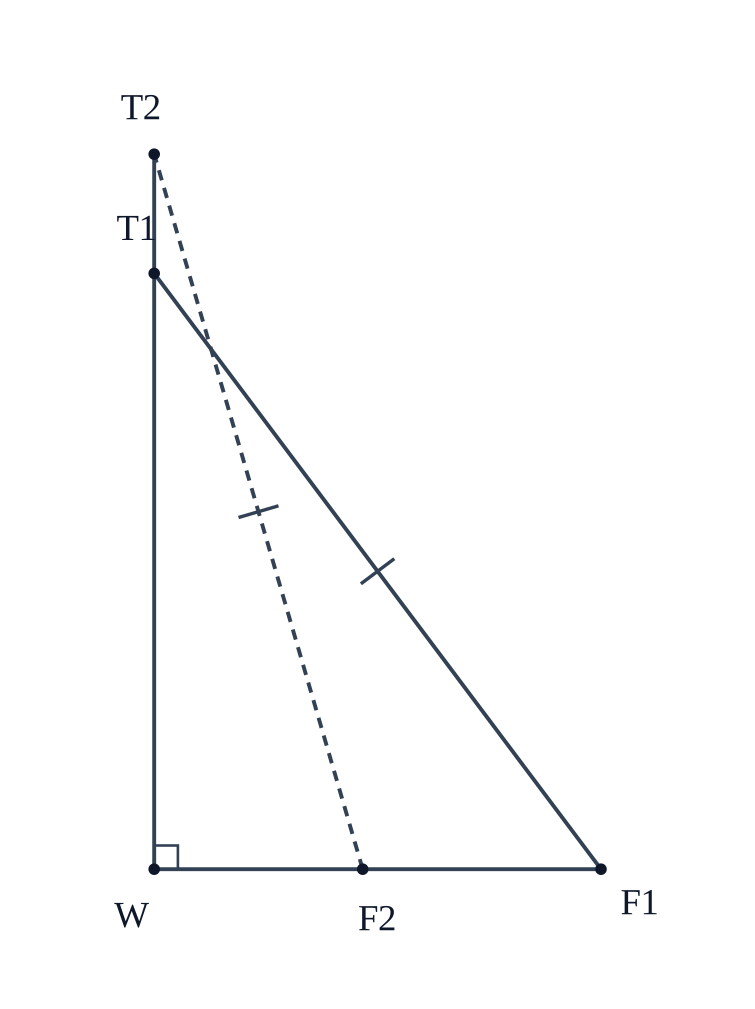
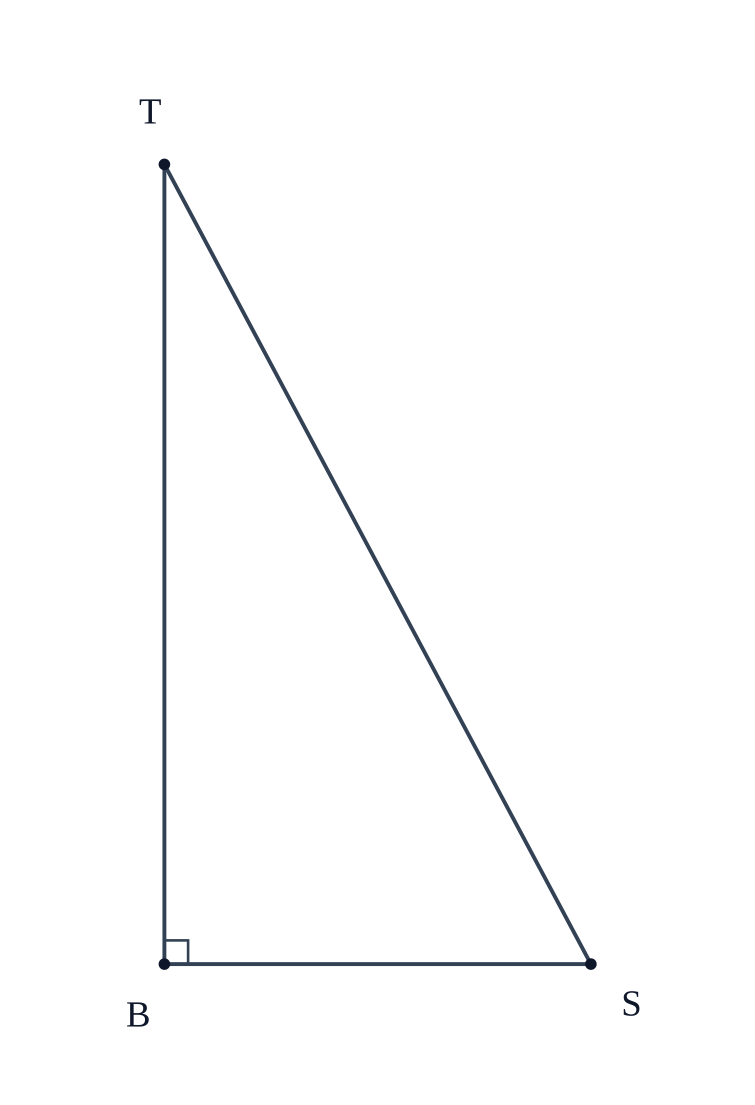
    A flag pole 18\displaystyle 18 m high casts a shadow 9.6\displaystyle 9.6 m long. Find the distance of the top of the pole from the far end of the shadow.

    Matches the book, not yet reviewed

    This working reaches the answer NCERT prints. It has not yet been read through by hand.

    NCERT’s answer
    20.$\displaystyle 4$ m
    NCERT_Solution_Class10_Maths_Exemplar_Ch6_Ex6-4_Q7 \[BT = 18\text{ m (pole)}, \quad BS = 9.6\text{ m (shadow)}, \quad \angle TBS = 90^\circ \quad \text{(given)} \] \[TS^2 = BT^2+BS^2 \quad \text{(Pythagoras theorem)} \] \[TS^2 = 18^2+9.6^2 = 324+92.16 = 416.16 \] \[TS = \sqrt{416.16} = 20.4\text{ m} \]Answer: \(\displaystyle 20.4\) m
  8. Exercise 8

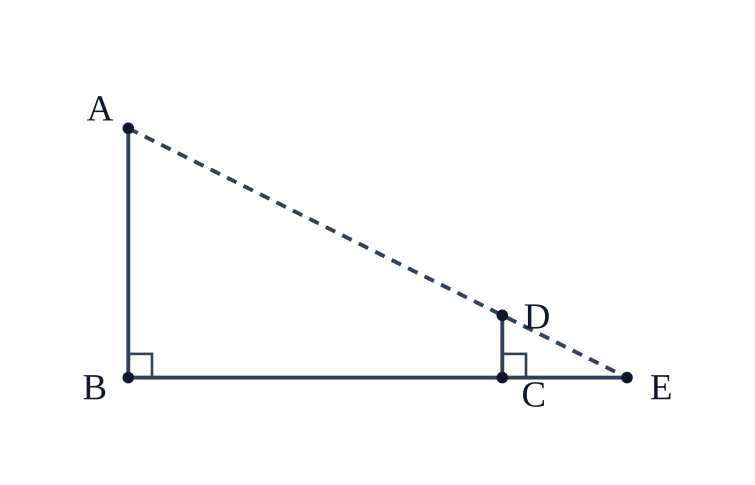
    A street light bulb is fixed on a pole 6\displaystyle 6 m above the level of the street. If a woman of height 1.5\displaystyle 1.5 m casts a shadow of 3m, find how far she is away from the base of the pole.

    Matches the book, not yet reviewed

    This working reaches the answer NCERT prints. It has not yet been read through by hand.

    NCERT’s answer
    $\displaystyle 9$ m
    NCERT_Solution_Class10_Maths_Exemplar_Ch6_Ex6-4_Q8 \[AB = 6\text{ m (pole)}, \quad DC = 1.5\text{ m (woman)}, \quad CE = 3\text{ m (shadow)} \quad \text{(given)} \] \[\triangle ABE \sim \triangle DCE \quad \text{(} \angle E \text{ common, } \angle ABE=\angle DCE=90^\circ\text{)} \] \[\frac{AB}{DC}=\frac{BE}{CE} \] \[\frac{6}{1.5}=\frac{BE}{3} \implies BE=12\text{ m} \] \[BC = BE-CE = 12-3 = 9\text{ m} \]Answer: \(\displaystyle 9\) m
  9. Exercise 9

    In Fig. 6.18\displaystyle 6.18, ABC is a triangle right angled at B and BD⊥AC\displaystyle \mathrm{BD} \perp \mathrm{AC}. If AD=4 cm\displaystyle \mathrm{AD}=4 \mathrm{~cm}, and CD=5 cm\displaystyle \mathrm{CD}=5 \mathrm{~cm}, find BD and AB. NCERT_Question_Class10_Maths_Exemplar_Ch6_Ex6-4_Q9

    Matches the book, not yet reviewed

    This working reaches the answer NCERT prints. It has not yet been read through by hand.

    NCERT’s answer
    \(\displaystyle 2 \sqrt{5} \mathrm{~cm}, 6 \mathrm{~cm}\)
    \[\triangle ADB \sim \triangle BDC \quad \text{(altitude-on-hypotenuse: } \angle ADB=\angle BDC=90^\circ\text{)} \] \[\frac{AD}{BD}=\frac{BD}{DC} \implies BD^2 = AD \cdot DC = 4\times5 = 20 \] \[BD = 2\sqrt5 \text{ cm} \] \[AC = AD + DC = 4+5 = 9 \text{ cm} \] \[\triangle ADB \sim \triangle ABC \quad \text{(} \angle A \text{ common, } \angle ADB=\angle ABC=90^\circ\text{)} \] \[\frac{AD}{AB}=\frac{AB}{AC} \implies AB^2 = AD \cdot AC = 4\times9 = 36 \] \[AB = 6 \text{ cm} \]Answer: \(\displaystyle BD=2\sqrt5\) cm, \(\displaystyle AB=6\) cm
  10. Exercise 10

    In Fig. 6.19\displaystyle 6.19, PQR is a right triangle right angled at Q and QS⊥PR\displaystyle \mathrm{QS} \perp \mathrm{PR}. If PQ=6 cm\displaystyle \mathrm{PQ}=6 \mathrm{~cm} and PS=4 cm\displaystyle \mathrm{PS}=4 \mathrm{~cm}, find QS,RS\displaystyle \mathrm{QS}, \mathrm{RS} and QR. NCERT_Question_Class10_Maths_Exemplar_Ch6_Ex6-4_Q10

    Matches the book, not yet reviewed

    This working reaches the answer NCERT prints. It has not yet been read through by hand.

    NCERT’s answer
    \(\displaystyle 2 \sqrt{5} \mathrm{~cm}, 5 \mathrm{~cm}, 3 \sqrt{5} \mathrm{~cm}\)
    \[\triangle PSQ \sim \triangle PQR \quad \text{(} \angle P \text{ common, } \angle PSQ=\angle PQR=90^\circ\text{)} \] \[\frac{PS}{PQ}=\frac{PQ}{PR} \implies PQ^2 = PS \cdot PR \] \[36 = 4\times PR \implies PR = 9 \text{ cm} \] \[RS = PR-PS = 9-4 = 5 \text{ cm} \] \[\triangle PSQ \sim \triangle QSR \quad \text{(altitude-on-hypotenuse: } \angle PSQ=\angle QSR=90^\circ\text{)} \] \[QS^2 = PS \cdot RS = 4\times5 = 20 \implies QS = 2\sqrt5 \text{ cm} \] \[QR^2 = QS^2+RS^2 = 20+25 = 45 \implies QR = 3\sqrt5 \text{ cm} \]Answer: \(\displaystyle QS=2\sqrt5\) cm, \(\displaystyle RS=5\) cm, \(\displaystyle QR=3\sqrt5\) cm