SolveIt is under development
SolveItNCERT · CBSE · NEET

NCERT Exemplar · Class 10 Mathematics Coordinate Geometry

58 questions · 58 still being checked

EXERCISE 7.3 1–10 (part 4 of 6)

  1. Exercise 1

    Name the type of triangle formed by the points A(−5,6),B(−4,−2)\displaystyle \mathrm{A}(-5,6), \mathrm{B}(-4,-2) and C(7,5)\displaystyle \mathrm{C}(7,5).

    Matches the book, not yet reviewed

    This working reaches the answer NCERT prints. It has not yet been read through by hand.

    NCERT’s answer
    Scalene triangle
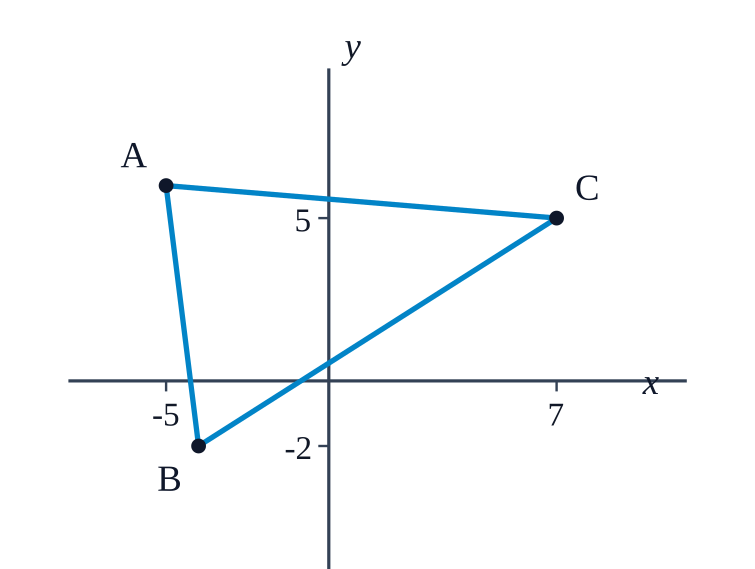
    NCERT_Solution_Class10_Maths_Exemplar_Ch7_Ex7-3_Q1 \[AB=\sqrt{(-4-(-5))^2+(-2-6)^2}=\sqrt{1+64}=\sqrt{65} \] \[BC=\sqrt{(7-(-4))^2+(5-(-2))^2}=\sqrt{121+49}=\sqrt{170} \] \[CA=\sqrt{(-5-7)^2+(6-5)^2}=\sqrt{144+1}=\sqrt{145} \] All three sides are unequal, and no pair of squared sides sums to the third, so no angle is \(\displaystyle 90^\circ\).Answer: Scalene triangle.
  2. Exercise 2

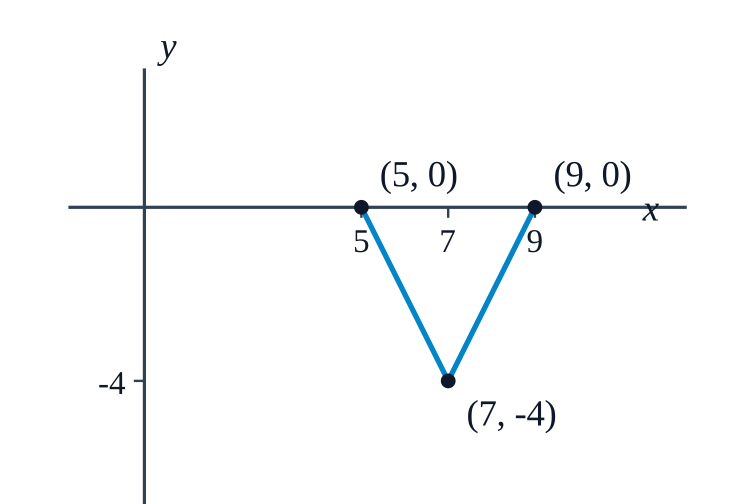
    Find the points on the x\displaystyle x-axis which are at a distance of 25\displaystyle 2 \sqrt{5} from the point (7,−4)\displaystyle (7, -4). How many such points are there?

    Matches the book, not yet reviewed

    This working reaches the answer NCERT prints. It has not yet been read through by hand.

    NCERT’s answer
    $\displaystyle (9, 0)$, $\displaystyle (5, 0)$, $\displaystyle 2$ points
    \[(x-7)^2+(0-(-4))^2=(2\sqrt5)^2 \] \[(x-7)^2+16=20 \] \[(x-7)^2=4 \implies x=9 \text{ or } x=5 \] NCERT_Solution_Class10_Maths_Exemplar_Ch7_Ex7-3_Q2Answer: \(\displaystyle (5,0)\) and \(\displaystyle (9,0)\); two such points.
  3. Exercise 3

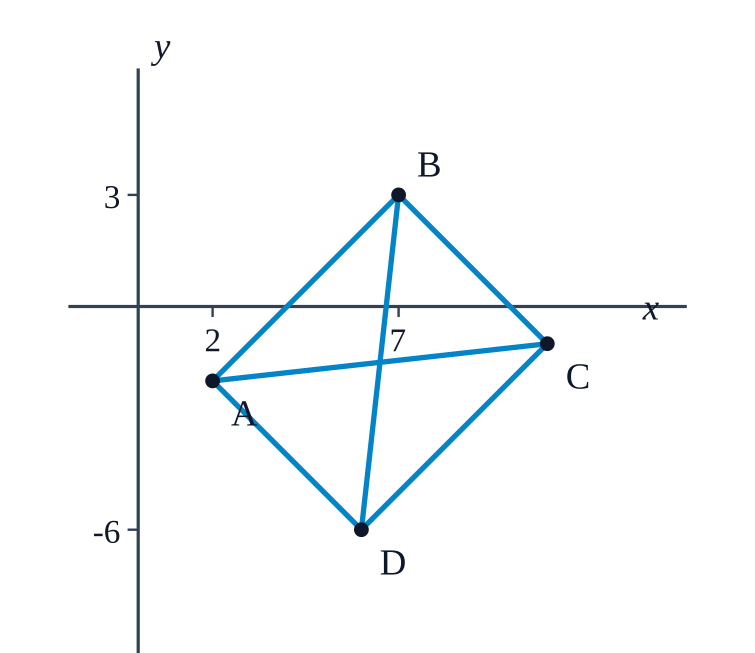
    What type of a quadrilateral do the points A (2,−2)\displaystyle (2, -2), B (7,3)\displaystyle (7, 3), C (11,−1)\displaystyle (11, -1) and D (6,−6)\displaystyle (6, -6) taken in that order, form?

    Matches the book, not yet reviewed

    This working reaches the answer NCERT prints. It has not yet been read through by hand.

    NCERT’s answer
    Rectangle
    NCERT_Solution_Class10_Maths_Exemplar_Ch7_Ex7-3_Q3 \[AB=\sqrt{(7-2)^2+(3-(-2))^2}=\sqrt{25+25}=5\sqrt2 \] \[BC=\sqrt{(11-7)^2+(-1-3)^2}=\sqrt{16+16}=4\sqrt2 \] \[CD=\sqrt{(6-11)^2+(-6-(-1))^2}=\sqrt{25+25}=5\sqrt2 \] \[DA=\sqrt{(2-6)^2+(-2-(-6))^2}=\sqrt{16+16}=4\sqrt2 \] \[AC=\sqrt{(11-2)^2+(-1-(-2))^2}=\sqrt{81+1}=\sqrt{82} \] \[BD=\sqrt{(6-7)^2+(-6-3)^2}=\sqrt{1+81}=\sqrt{82} \] Opposite sides are equal (\(\displaystyle AB=CD\), \(\displaystyle BC=DA\)), so ABCD is a parallelogram; its diagonals are equal too (\(\displaystyle AC=BD\)), so it is a rectangle — not a square, since adjacent sides differ.Answer: Rectangle.
  4. Exercise 4

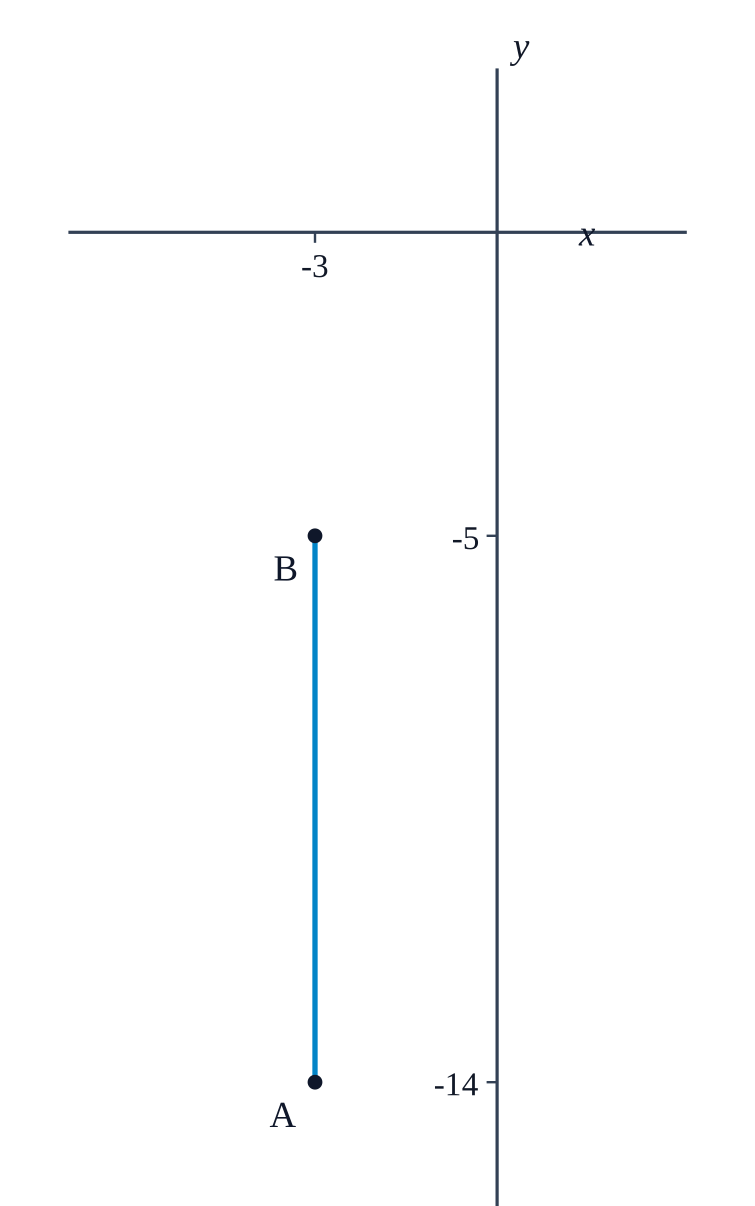
    Find the value of a\displaystyle a, if the distance between the points A(−3,−14)\displaystyle \mathrm{A}(-3,-14) and B(a,−5)\displaystyle \mathrm{B}(a,-5) is 9\displaystyle 9 units.

    Matches the book, not yet reviewed

    This working reaches the answer NCERT prints. It has not yet been read through by hand.

    NCERT’s answer
    \(\displaystyle a=-3\)
    \[AB^2=(a-(-3))^2+(-5-(-14))^2=9^2 \] \[(a+3)^2+81=81 \] \[(a+3)^2=0 \implies a=-3 \] NCERT_Solution_Class10_Maths_Exemplar_Ch7_Ex7-3_Q4Answer: \(\displaystyle a=-3\)
  5. Exercise 5

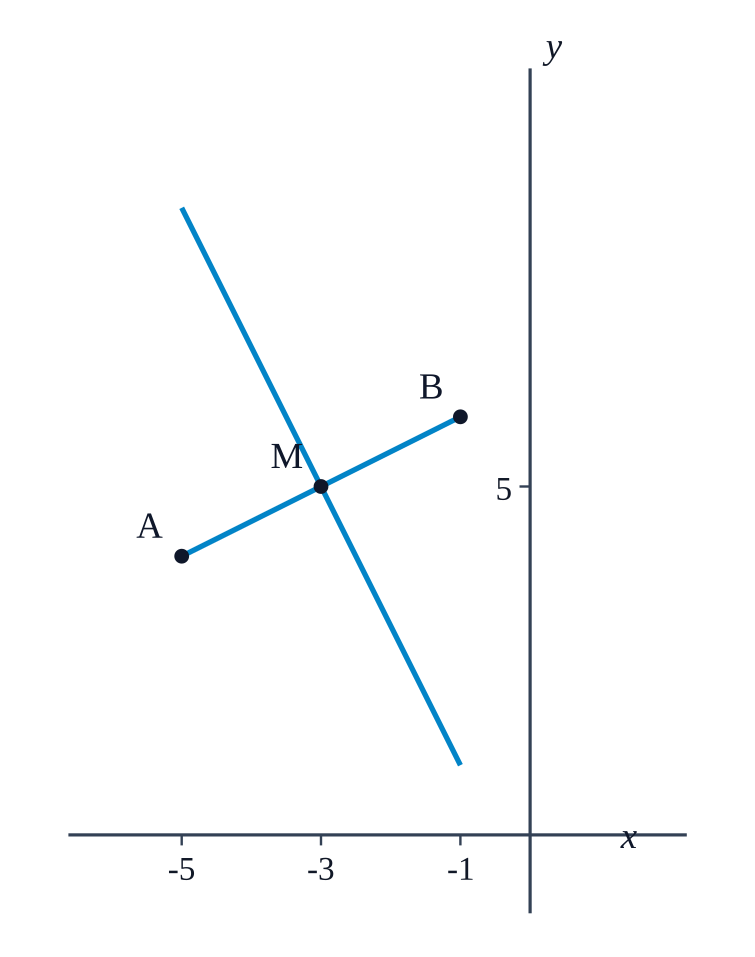
    Find a point which is equidistant from the points A(−5,4)\displaystyle \mathrm{A}(-5,4) and B(−1,6)\displaystyle \mathrm{B}(-1,6)? How many such points are there?

    Matches the book, not yet reviewed

    This working reaches the answer NCERT prints. It has not yet been read through by hand.

    NCERT’s answer
    \(\displaystyle (-3,5)\) the middle point of AB. Infinite number of points. In fact all points which are solutions of the equation \(\displaystyle 2 x+y+1=0\).
    NCERT_Solution_Class10_Maths_Exemplar_Ch7_Ex7-3_Q5 \[M=\left(\frac{-5+(-1)}{2},\ \frac{4+6}{2}\right)=(-3,\ 5) \] \[MA^2=(-3-(-5))^2+(5-4)^2=5, \qquad MB^2=(-3-(-1))^2+(5-6)^2=5 \] \[PA^2=PB^2 \implies (x+5)^2+(y-4)^2=(x+1)^2+(y-6)^2 \implies 2x+y+1=0 \] Every point \(\displaystyle P(x,y)\) of this line is equidistant from A and B, so there are infinitely many such points.Answer: \(\displaystyle M(-3,5)\) is one; infinitely many points lie on the line \(\displaystyle 2x+y+1=0\), the perpendicular bisector of AB.
  6. Exercise 6

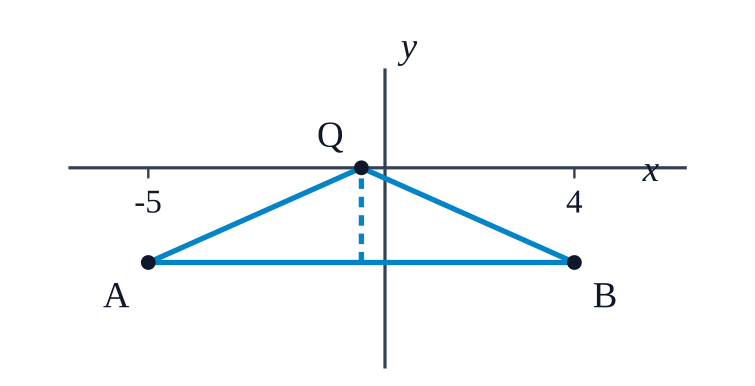
    Find the coordinates of the point Q on the x\displaystyle x-axis which lies on the perpendicular bisector of the line segment joining the points A(−5,−2)\displaystyle \mathrm{A}(-5,-2) and B(4,−2)\displaystyle \mathrm{B}(4,-2). Name the type of triangle formed by the points Q, A and B.

    Matches the book, not yet reviewed

    This working reaches the answer NCERT prints. It has not yet been read through by hand.

    NCERT’s answer
    \(\displaystyle \left(\frac{-1}{2}, 0\right)\), isosceles triangle
    \[\text{Midpoint of } AB=\left(\frac{-5+4}{2},\ \frac{-2-2}{2}\right)=\left(-\tfrac12,\ -2\right) \] AB is horizontal; its perpendicular bisector is the vertical line \(\displaystyle x=-\tfrac12\), meeting the x-axis at: \[Q=\left(-\tfrac12,\ 0\right) \] \[QA^2=\left(\tfrac92\right)^2+2^2=\tfrac{97}{4}, \qquad QB^2=\left(\tfrac92\right)^2+2^2=\tfrac{97}{4} \] \(\displaystyle QA=QB\), so \(\displaystyle \triangle QAB\) is isosceles. NCERT_Solution_Class10_Maths_Exemplar_Ch7_Ex7-3_Q6Answer: \(\displaystyle Q\left(-\tfrac12,0\right)\); \(\displaystyle \triangle QAB\) is isosceles.
  7. Exercise 7

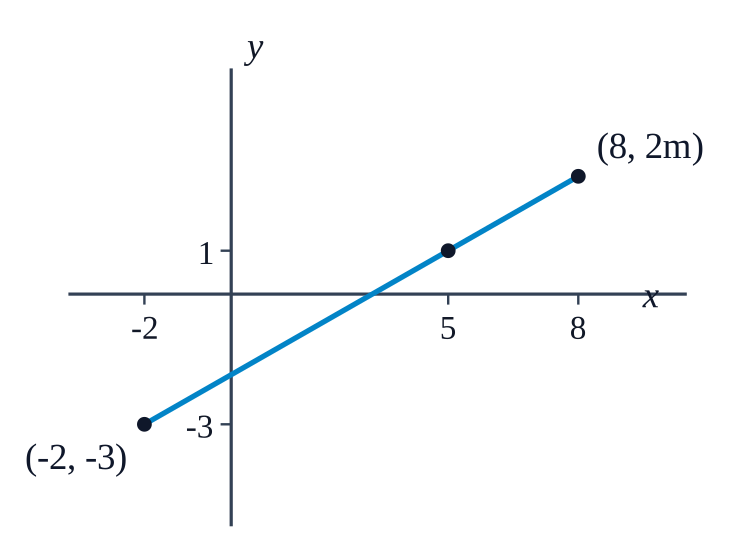
    Find the value of m\displaystyle m if the points (5,1),(−2,−3)\displaystyle (5,1),(-2,-3) and (8,2m)\displaystyle (8,2 m) are collinear.

    Matches the book, not yet reviewed

    This working reaches the answer NCERT prints. It has not yet been read through by hand.

    NCERT’s answer
    \(\displaystyle \frac{19}{14}\)
    Collinear points enclose zero area: \[\tfrac12\left|5(-3-2m)+(-2)(2m-1)+8(1-(-3))\right|=0 \] \[-15-10m-4m+2+32=0 \] \[19-14m=0 \implies m=\tfrac{19}{14} \] NCERT_Solution_Class10_Maths_Exemplar_Ch7_Ex7-3_Q7Answer: \(\displaystyle m=\dfrac{19}{14}\)
  8. Exercise 8

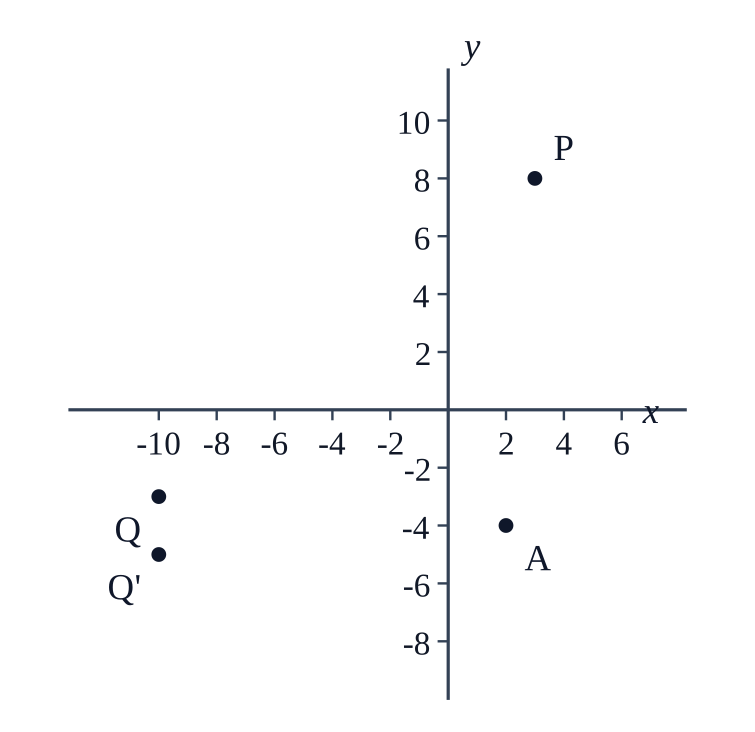
    If the point A(2,−4)\displaystyle \mathrm{A}(2,-4) is equidistant from P(3,8)\displaystyle \mathrm{P}(3,8) and Q(−10,y)\displaystyle \mathrm{Q}(-10, y), find the values of y\displaystyle y. Also find distance PQ.

    Matches the book, not yet reviewed

    This working reaches the answer NCERT prints. It has not yet been read through by hand.

    NCERT’s answer
    \(\displaystyle y=-3,-5, \mathrm{PQ}=\sqrt{290}, 13 \sqrt{2}\)
    Equidistant: \(\displaystyle AP = AQ\). \[AP^2=(3-2)^2+(8+4)^2=145 \] \[AQ^2=(-10-2)^2+(y+4)^2=144+(y+4)^2 \] \[145=144+(y+4)^2 \] \[(y+4)^2=1 \] \[y=-3\ (Q)\quad\text{or}\quad y=-5\ (Q') \] NCERT_Solution_Class10_Maths_Exemplar_Ch7_Ex7-3_Q8 \[PQ=\sqrt{(-10-3)^2+(y-8)^2} \] \[y=-3:\ PQ=\sqrt{169+121}=\sqrt{290} \] \[y=-5:\ PQ'=\sqrt{169+169}=13\sqrt{2} \] Answer: \(\displaystyle y=-3,\ PQ=\sqrt{290}\) or \(\displaystyle y=-5,\ PQ=13\sqrt2\).
  9. Exercise 9

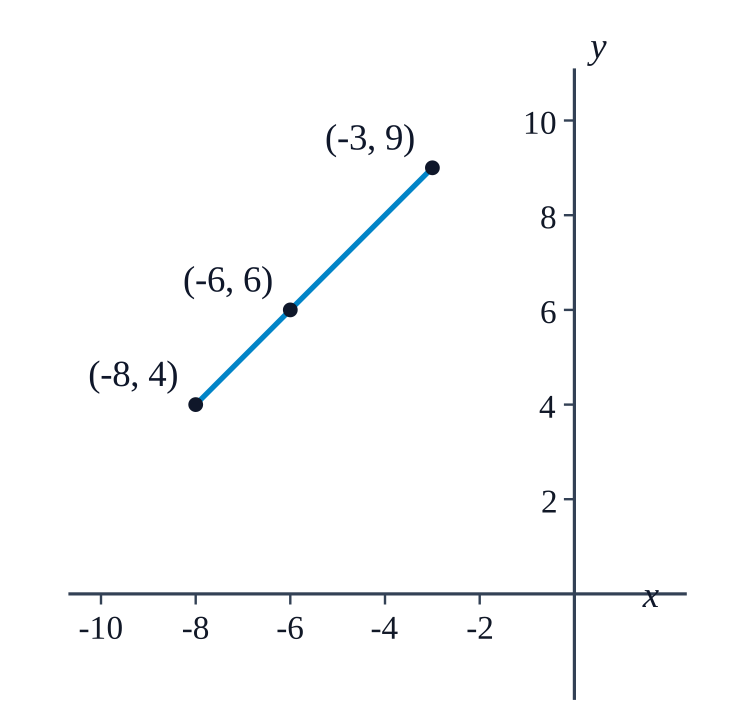
    Find the area of the triangle whose vertices are (−8,4)\displaystyle (-8, 4), (−6,6)\displaystyle (-6, 6) and (−3,9)\displaystyle (-3, 9).

    Matches the book, not yet reviewed

    This working reaches the answer NCERT prints. It has not yet been read through by hand.

    NCERT’s answer
    $\displaystyle 0$
    \[\text{Area}=\tfrac12\big|x_1(y_2-y_3)+x_2(y_3-y_1)+x_3(y_1-y_2)\big| \] \[=\tfrac12\big|(-8)(6-9)+(-6)(9-4)+(-3)(4-6)\big| \] \[=\tfrac12|24-30+6| \] \[=\tfrac12(0)=0 \] Area \(\displaystyle 0\): the points are collinear. NCERT_Solution_Class10_Maths_Exemplar_Ch7_Ex7-3_Q9 Answer: \(\displaystyle 0\); the points are collinear.
  10. Exercise 10

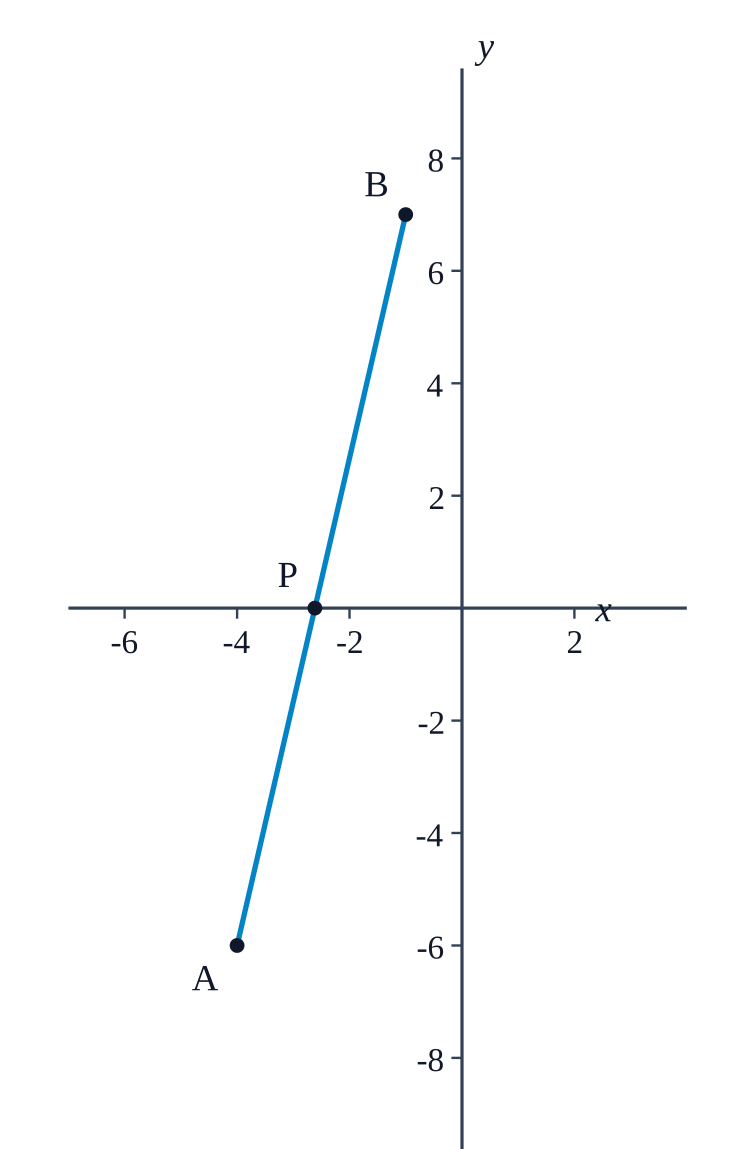
    In what ratio does the x\displaystyle x-axis divide the line segment joining the points (−4,−6)\displaystyle (-4, -6) and (−1,7)\displaystyle (-1, 7)? Find the coordinates of the point of division.

    Matches the book, not yet reviewed

    This working reaches the answer NCERT prints. It has not yet been read through by hand.

    NCERT’s answer
    $\displaystyle 6$:$\displaystyle 7$, \(\displaystyle \left(\frac{-34}{13}, 0\right)\)
    Let the \(\displaystyle x\)-axis divide \(\displaystyle A(-4,-6)\), \(\displaystyle B(-1,7)\) at \(\displaystyle P\) in ratio \(\displaystyle m:n\). \[0=\dfrac{7m-6n}{m+n} \] \[7m=6n \quad\Rightarrow\quad m:n=6:7 \] \[x=\dfrac{6(-1)+7(-4)}{6+7}=\dfrac{-34}{13} \] NCERT_Solution_Class10_Maths_Exemplar_Ch7_Ex7-3_Q10 Answer: ratio \(\displaystyle 6:7\), point \(\displaystyle \left(-\tfrac{34}{13}, 0\right)\).