SolveIt is under development
SolveItNCERT · CBSE · NEET

NCERT Exemplar · Class 10 Mathematics Coordinate Geometry

58 questions · 58 still being checked

EXERCISE 7.2 1–12 (part 3 of 6)

  1. State whether the following statements are true or false. Justify your answer.

    Exercise 1

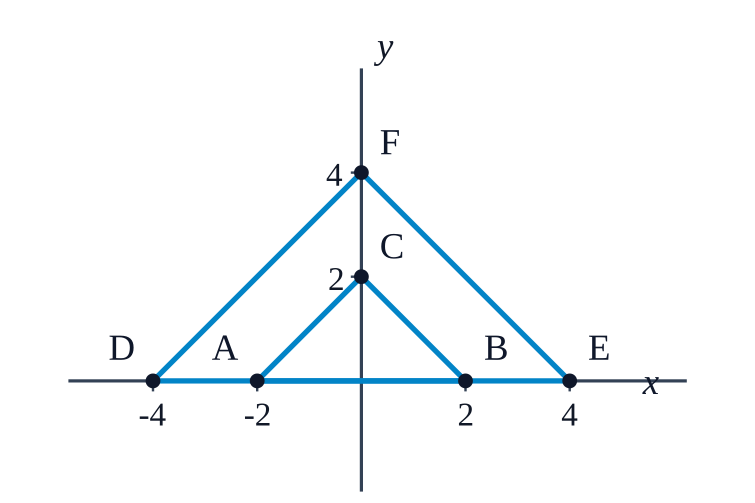
    △ABC\displaystyle \triangle \mathrm{ABC} with vertices A(−2,0),B(2,0)\displaystyle \mathrm{A}(-2,0), \mathrm{B}(2,0) and C(0,2)\displaystyle \mathrm{C}(0,2) is similar to △DEF\displaystyle \triangle \mathrm{DEF} with vertices D(−4,0)\displaystyle \mathrm{D}(-4,0) E(4,0)\displaystyle \mathrm{E}(4,0) and F(0,4)\displaystyle \mathrm{F}(0,4).

    Matches the book, not yet reviewed

    This working reaches the answer NCERT prints. It has not yet been read through by hand.

    NCERT’s answer
    True. Because all three sides of both triangles are proportional.
    True \[AB=\sqrt{(2-(-2))^2}=4,\quad BC=\sqrt{2^2+2^2}=2\sqrt2,\quad CA=\sqrt{2^2+2^2}=2\sqrt2 \] \[DE=\sqrt{(4-(-4))^2}=8,\quad EF=\sqrt{4^2+4^2}=4\sqrt2,\quad FD=\sqrt{4^2+4^2}=4\sqrt2 \] \[\frac{AB}{DE}=\frac{BC}{EF}=\frac{CA}{FD}=\frac12 \] NCERT_Solution_Class10_Maths_Exemplar_Ch7_Ex7-2_Q1 Sides are proportional (SSS similarity), so the triangles are similar.
  2. Exercise 2

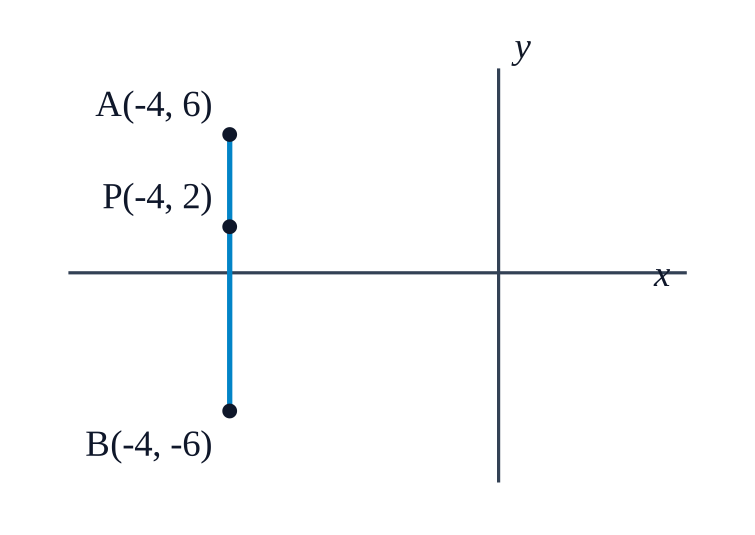
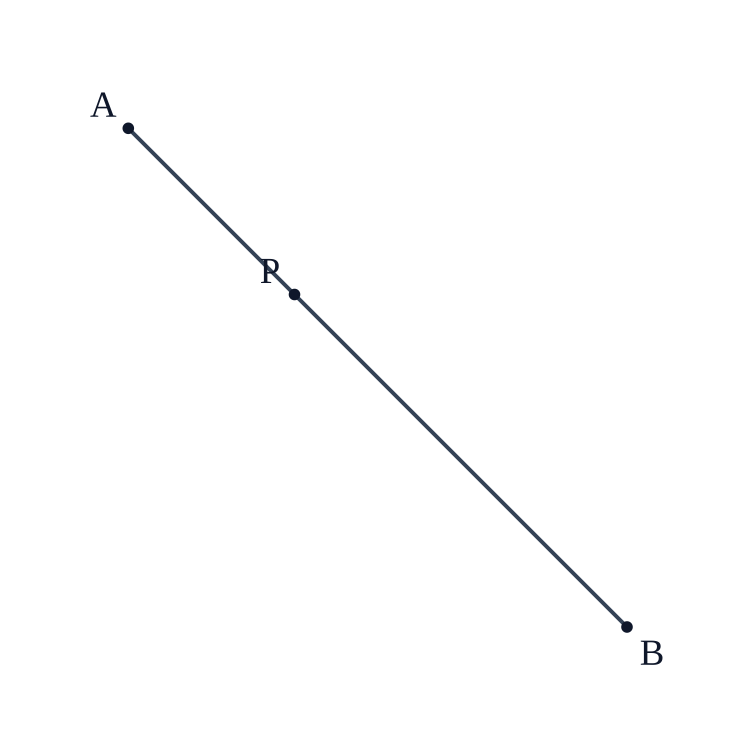
    Point P(−4,2)\displaystyle \mathrm{P}(-4,2) lies on the line segment joining the points A(−4,6)\displaystyle \mathrm{A}(-4,6) and B(−4,−6)\displaystyle \mathrm{B}(-4,-6).

    Matches the book, not yet reviewed

    This working reaches the answer NCERT prints. It has not yet been read through by hand.

    NCERT’s answer
    True. The three points lie on the line \(\displaystyle x=-4\).
    True \[AP=\sqrt{(-4-(-4))^2+(6-2)^2}=4,\quad PB=\sqrt{(-4-(-4))^2+(2-(-6))^2}=8 \] \[AP+PB=4+8=12=AB \] NCERT_Solution_Class10_Maths_Exemplar_Ch7_Ex7-2_Q2 \(\displaystyle A, P, B\) all lie on \(\displaystyle x=-4\) and \(\displaystyle AP+PB=AB\), so \(\displaystyle P\) lies between \(\displaystyle A\) and \(\displaystyle B\).
  3. Exercise 3

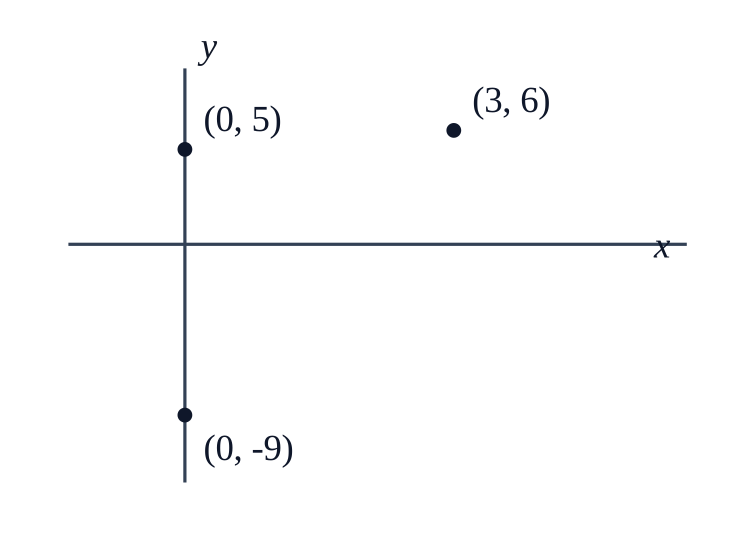
    The points (0,5),(0,−9)\displaystyle (0,5),(0,-9) and (3,6)\displaystyle (3,6) are collinear.

    Matches the book, not yet reviewed

    This working reaches the answer NCERT prints. It has not yet been read through by hand.

    NCERT’s answer
    False, since two points lie on the \(\displaystyle y\)-axis and one point lies in quadrant I.
    False \[\text{Area}=\tfrac12\big|x_1(y_2-y_3)+x_2(y_3-y_1)+x_3(y_1-y_2)\big| \] \[=\tfrac12\big|0(-9-6)+0(6-5)+3(5-(-9))\big|=\tfrac12(42)=21\neq0 \] NCERT_Solution_Class10_Maths_Exemplar_Ch7_Ex7-2_Q3 A nonzero area means the three points are not collinear.
  4. Exercise 4

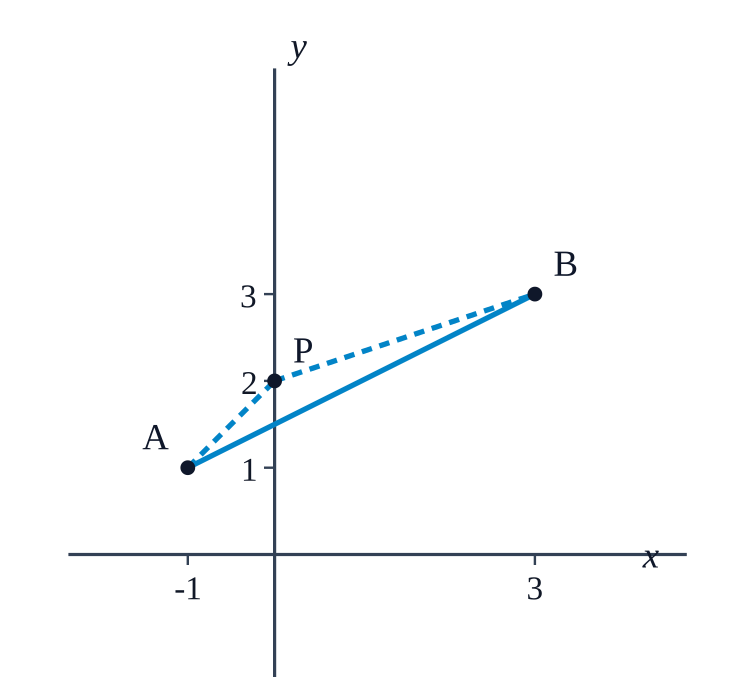
    Point P(0,2)\displaystyle \mathrm{P}(0,2) is the point of intersection of y\displaystyle y-axis and perpendicular bisector of line segment joining the points A(−1,1)\displaystyle \mathrm{A}(-1,1) and B(3,3)\displaystyle \mathrm{B}(3,3).

    Matches the book, not yet reviewed

    This working reaches the answer NCERT prints. It has not yet been read through by hand.

    NCERT’s answer
    False. \(\displaystyle \mathrm{PA}=\sqrt{2}\) and \(\displaystyle \mathrm{PB}=\sqrt{10}\), i.e., \(\displaystyle \mathrm{PA} \neq \mathrm{PB}\).
    False \[PA=\sqrt{(0+1)^2+(2-1)^2}=\sqrt2 \] \[PB=\sqrt{(0-3)^2+(2-3)^2}=\sqrt{10} \] \[PA\neq PB \] NCERT_Solution_Class10_Maths_Exemplar_Ch7_Ex7-2_Q4 Every point of the perpendicular bisector is equidistant from \(\displaystyle A\) and \(\displaystyle B\), so \(\displaystyle P(0,2)\) is not on it.
  5. Exercise 5

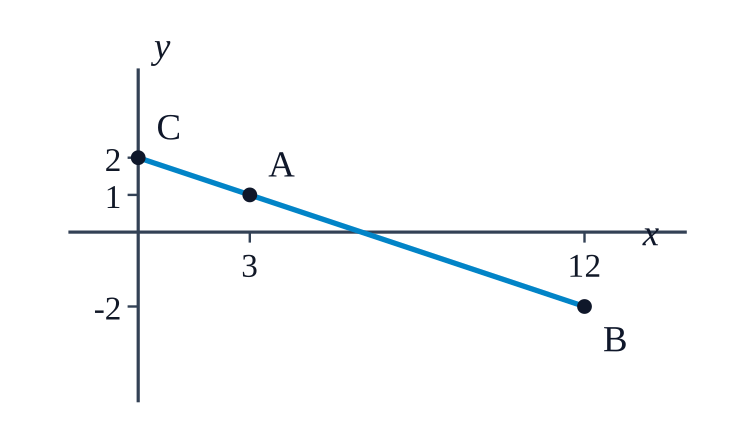
    Points A(3,1),B(12,−2)\displaystyle \mathrm{A}(3,1), \mathrm{B}(12,-2) and C(0,2)\displaystyle \mathrm{C}(0,2) cannot be the vertices of a triangle.

    Matches the book, not yet reviewed

    This working reaches the answer NCERT prints. It has not yet been read through by hand.

    NCERT’s answer
    True, since ar \(\displaystyle (\Delta \mathrm{ABC})=0\).
    True \[\text{Area}=\tfrac12\big|3(-2-2)+12(2-1)+0(1-(-2))\big| \] \[=\tfrac12|-12+12|=0 \] NCERT_Solution_Class10_Maths_Exemplar_Ch7_Ex7-2_Q5 Zero area means A, B, C are collinear, so they cannot be the vertices of a triangle.
  6. Exercise 6

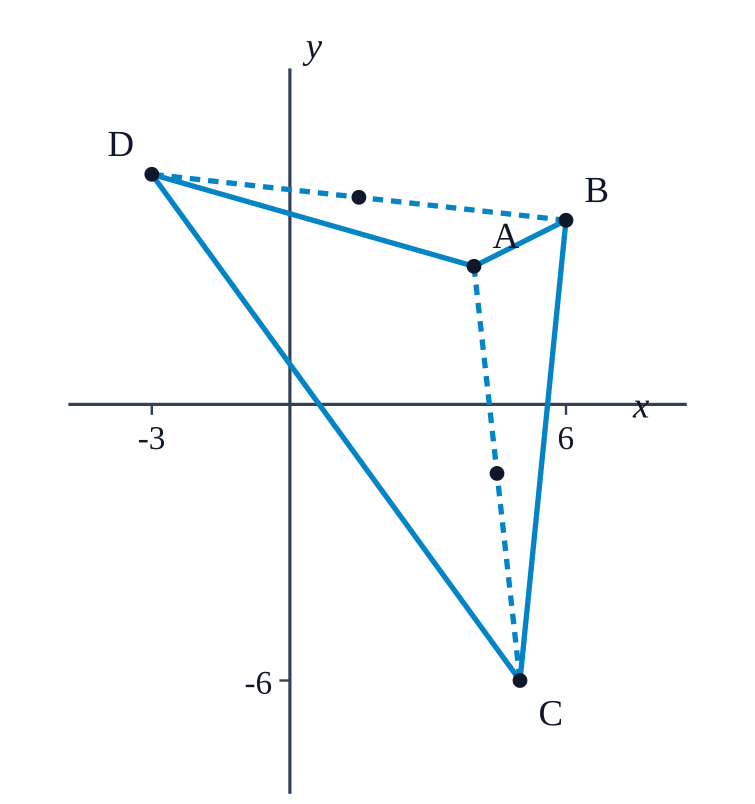
    Points A(4,3),B(6,4),C(5,−6)\displaystyle \mathrm{A}(4,3), \mathrm{B}(6,4), \mathrm{C}(5,-6) and D(−3,5)\displaystyle \mathrm{D}(-3,5) are the vertices of a parallelogram.

    Matches the book, not yet reviewed

    This working reaches the answer NCERT prints. It has not yet been read through by hand.

    NCERT’s answer
    False, since the diagonals donot bisect each other.
    False \[\text{Midpoint of }AC=\left(\frac{4+5}{2},\frac{3-6}{2}\right)=(4.5,-1.5) \] \[\text{Midpoint of }BD=\left(\frac{6-3}{2},\frac{4+5}{2}\right)=(1.5,4.5) \] NCERT_Solution_Class10_Maths_Exemplar_Ch7_Ex7-2_Q6 Diagonals of a parallelogram bisect each other; these midpoints differ, so ABCD is not one.
  7. Exercise 7

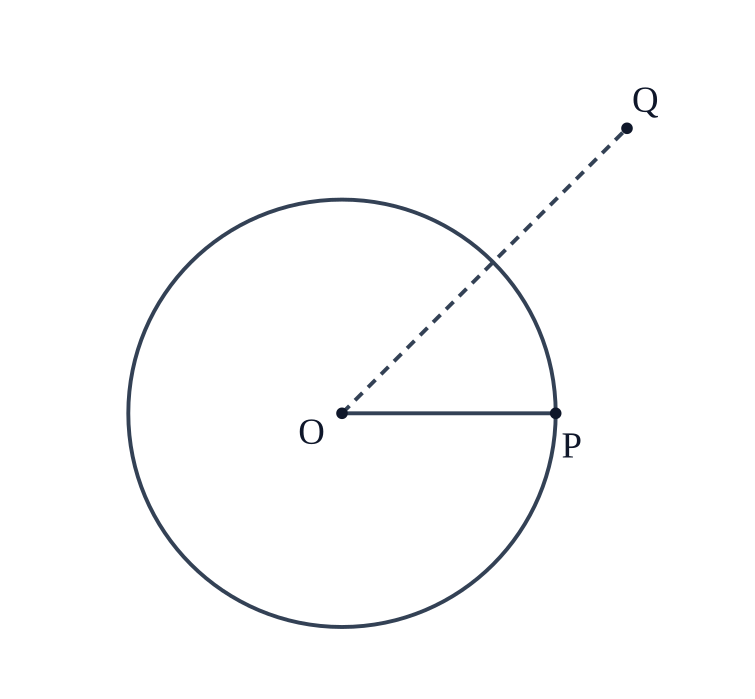
    A circle has its centre at the origin and a point P(5,0)\displaystyle \mathrm{P}(5,0) lies on it. The point Q(6,8)\displaystyle \mathrm{Q}(6,8) lies outside the circle.

    Matches the book, not yet reviewed

    This working reaches the answer NCERT prints. It has not yet been read through by hand.

    NCERT’s answer
    True, radius of the circle \(\displaystyle =5\) and \(\displaystyle \mathrm{OP}>5\)
    True. \(\displaystyle OP\) is the circle's radius. \[OP=\sqrt{5^2+0^2}=5 \] \[OQ=\sqrt{6^2+8^2}=\sqrt{100}=10 \] NCERT_Solution_Class10_Maths_Exemplar_Ch7_Ex7-2_Q7 \(\displaystyle OQ=10>5=OP\), so Q lies outside the circle.
  8. Exercise 8

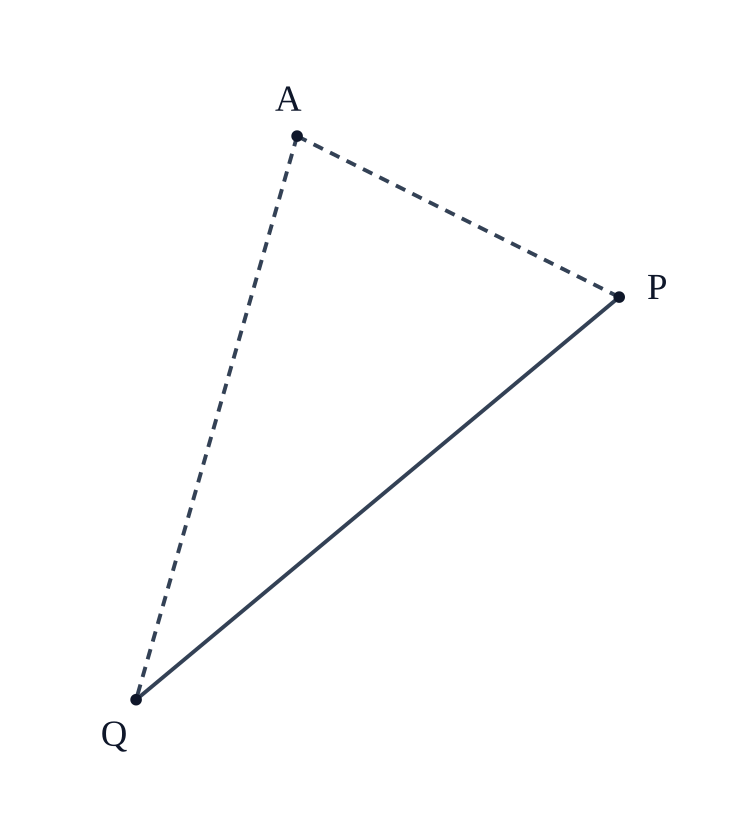
    The point A(2,7)\displaystyle \mathrm{A}(2,7) lies on the perpendicular bisector of line segment joining the points P(6,5)\displaystyle \mathrm{P}(6,5) and Q(0,−4)\displaystyle \mathrm{Q}(0,-4).

    Matches the book, not yet reviewed

    This working reaches the answer NCERT prints. It has not yet been read through by hand.

    NCERT’s answer
    False, since \(\displaystyle \mathrm{AP} \neq \mathrm{AQ}\)
    False. A point on the perpendicular bisector of \(\displaystyle PQ\) is equidistant from \(\displaystyle P\) and \(\displaystyle Q\). \[AP=\sqrt{(6-2)^2+(5-7)^2}=\sqrt{20} \] \[AQ=\sqrt{(0-2)^2+(-4-7)^2}=\sqrt{125} \] NCERT_Solution_Class10_Maths_Exemplar_Ch7_Ex7-2_Q8 \(\displaystyle AP\neq AQ\), so A does not lie on the bisector.
  9. Exercise 9

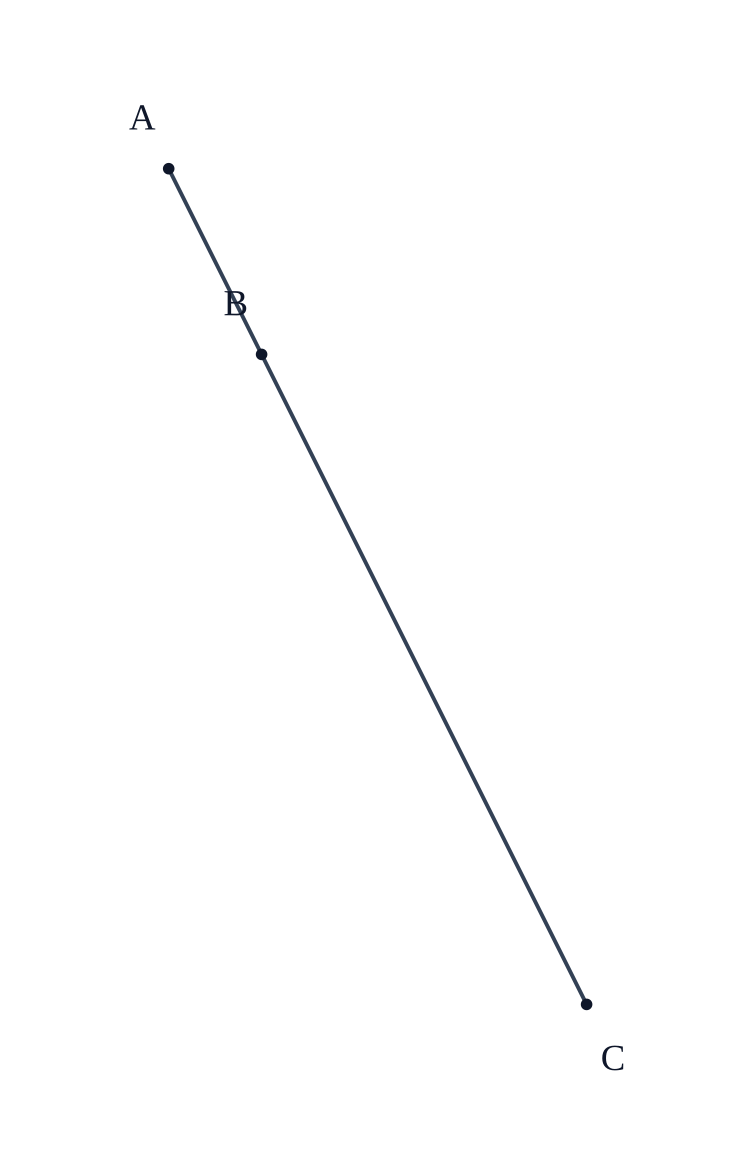
    Point P(5,−3)\displaystyle \mathrm{P}(5,-3) is one of the two points of trisection of the line segment joining the points A(7,−2)\displaystyle \mathrm{A}(7,-2) and B(1,−5)\displaystyle \mathrm{B}(1,-5).

    Matches the book, not yet reviewed

    This working reaches the answer NCERT prints. It has not yet been read through by hand.

    NCERT’s answer
    True, since P divides AB in the ratio \(\displaystyle 1: 2\)
    True. The trisection point nearer \(\displaystyle A\) divides \(\displaystyle AB\) in ratio \(\displaystyle 1:2\). \[\left(\frac{1(1)+2(7)}{1+2},\ \frac{1(-5)+2(-2)}{1+2}\right)=(5,-3) \] NCERT_Solution_Class10_Maths_Exemplar_Ch7_Ex7-2_Q9 This equals \(\displaystyle P\), so \(\displaystyle P\) is a point of trisection of \(\displaystyle AB\).
  10. Exercise 10

    Points A(−6,10),B(−4,6)\displaystyle \mathrm{A}(-6,10), \mathrm{B}(-4,6) and C(3,−8)\displaystyle \mathrm{C}(3,-8) are collinear such that AB=29AC\displaystyle \mathrm{AB}=\frac{2}{9} \mathrm{AC}.

    Matches the book, not yet reviewed

    This working reaches the answer NCERT prints. It has not yet been read through by hand.

    NCERT’s answer
    True, since B divides AC in the ratio \(\displaystyle 2: 7\)
    True. \[AB=\sqrt{(-4+6)^2+(6-10)^2}=\sqrt{20}=2\sqrt5 \] \[BC=\sqrt{(3+4)^2+(-8-6)^2}=\sqrt{245}=7\sqrt5 \] \[AC=\sqrt{(3+6)^2+(-8-10)^2}=\sqrt{405}=9\sqrt5 \] NCERT_Solution_Class10_Maths_Exemplar_Ch7_Ex7-2_Q10 \[AB+BC=2\sqrt5+7\sqrt5=9\sqrt5=AC \] So \(\displaystyle B\) lies on \(\displaystyle AC\), between \(\displaystyle A\) and \(\displaystyle C\). \[\frac{AB}{AC}=\frac{2\sqrt5}{9\sqrt5}=\frac{2}{9} \]
  11. Exercise 11

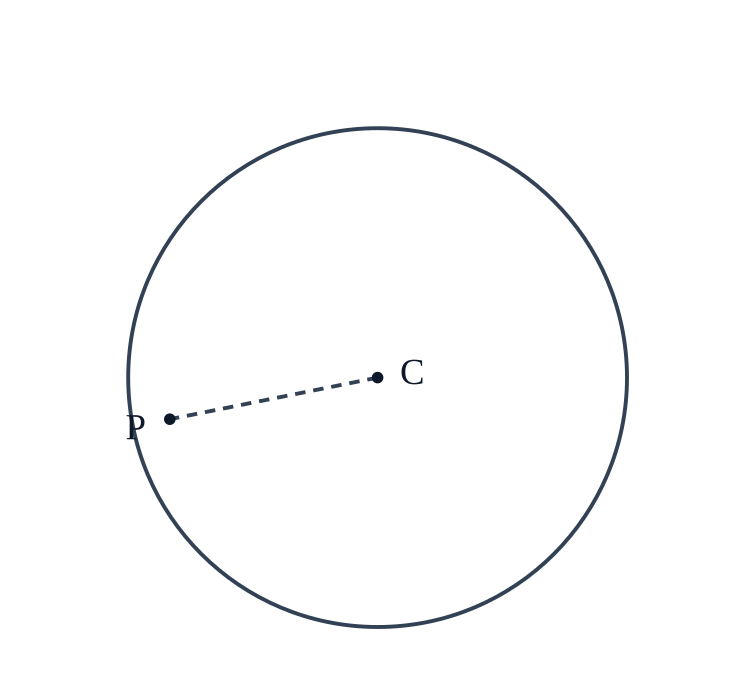
    The point P(−2,4)\displaystyle \mathrm{P}(-2,4) lies on a circle of radius 6\displaystyle 6 and centre C (3,5)\displaystyle (3, 5).

    Matches the book, not yet reviewed

    This working reaches the answer NCERT prints. It has not yet been read through by hand.

    NCERT’s answer
    False, since \(\displaystyle \mathrm{PC}=\sqrt{26}<6\), P will lie inside the circle.
    False. \(\displaystyle PC\) is the distance from \(\displaystyle P\) to the centre. \[PC=\sqrt{(3-(-2))^2+(5-4)^2}=\sqrt{25+1}=\sqrt{26} \] NCERT_Solution_Class10_Maths_Exemplar_Ch7_Ex7-2_Q11 \(\displaystyle \sqrt{26}\neq 6\); since \(\displaystyle \sqrt{26}<6\), P lies inside the circle, not on it.
  12. Exercise 12

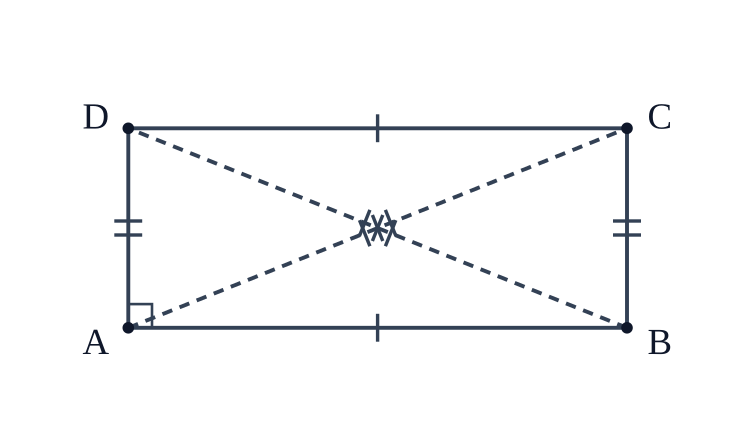
    The points A (−1,−2)\displaystyle (-1, -2), B (4,3)\displaystyle (4, 3), C (2,5)\displaystyle (2, 5) and D (−3,0)\displaystyle (-3, 0) in that order form a rectangle.

    Matches the book, not yet reviewed

    This working reaches the answer NCERT prints. It has not yet been read through by hand.

    NCERT’s answer
    True, Mid-points of both the diagonals are the same and the diagonals are of equal length.
    True. \[AB=\sqrt{5^2+5^2}=\sqrt{50},\quad BC=\sqrt{2^2+2^2}=\sqrt{8} \] \[CD=\sqrt{5^2+5^2}=\sqrt{50},\quad DA=\sqrt{2^2+2^2}=\sqrt{8} \] \(\displaystyle AB=CD\) and \(\displaystyle BC=DA\) make \(\displaystyle ABCD\) a parallelogram. \[AC=\sqrt{3^2+7^2}=\sqrt{58},\quad BD=\sqrt{7^2+3^2}=\sqrt{58} \] NCERT_Solution_Class10_Maths_Exemplar_Ch7_Ex7-2_Q12 Equal diagonals in a parallelogram make it a rectangle.