SolveIt is under development
SolveItNCERT · CBSE · NEET

NCERT Exemplar · Class 10 Mathematics Coordinate Geometry

58 questions · 58 still being checked

EXERCISE 7.1 11–20 (part 2 of 6)

  1. Choose the correct answer from the given four options:

    Exercise 11

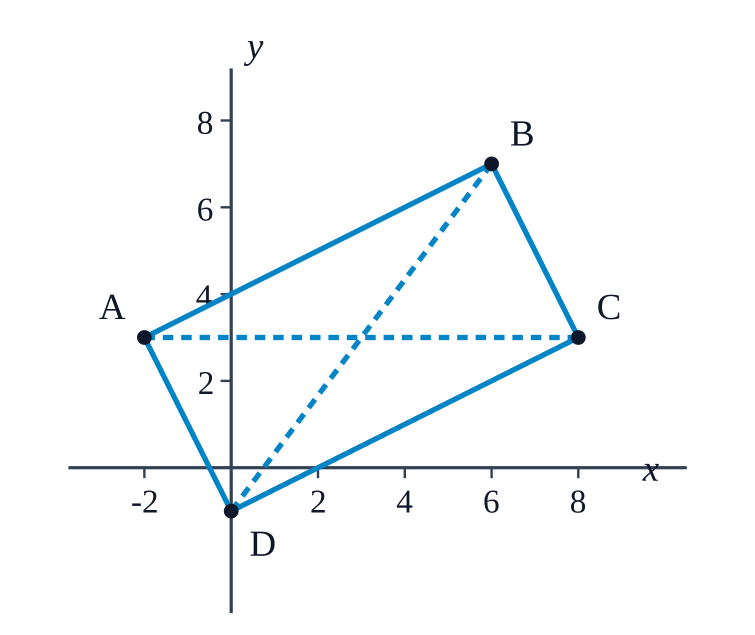
    The fourth vertex D of a parallelogram ABCD whose three vertices are A(−2,3),B(6,7)\displaystyle \mathrm{A}(-2,3), \mathrm{B}(6,7) and C(8,3)\displaystyle \mathrm{C}(8,3) is
    (A)
    (0,1)\displaystyle (0,1)
    (B)
    (0,−1)\displaystyle (0,-1)
    (C)
    (−1,0)\displaystyle (-1,0)
    (D)
    (1,0)\displaystyle (1,0)

    Matches the book, not yet reviewed

    This working reaches the answer NCERT prints. It has not yet been read through by hand.

    NCERT’s answer
    (B)
    (B) \(\displaystyle (0,-1)\) \[\text{Midpoint of }AC=\left(\frac{-2+8}{2},\frac{3+3}{2}\right)=(3,3) \] \[D(x,y):\quad \text{midpoint of }BD=\left(\frac{6+x}{2},\frac{7+y}{2}\right)=(3,3) \] \[6+x=6,\quad 7+y=6\ \Rightarrow\ D=(0,-1) \] NCERT_Solution_Class10_Maths_Exemplar_Ch7_Ex7-1_Q11 Diagonals of a parallelogram bisect each other.
  2. Exercise 12

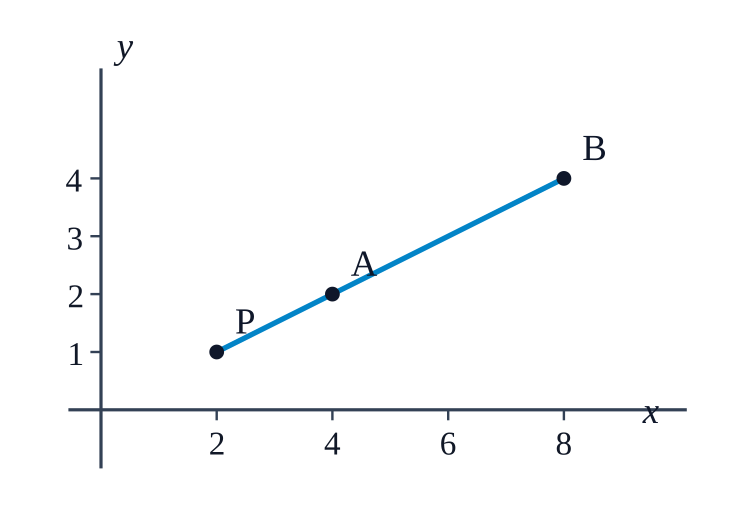
    If the point P(2,1)\displaystyle \mathrm{P}(2,1) lies on the line segment joining points A(4,2)\displaystyle \mathrm{A}(4,2) and B(8,4)\displaystyle \mathrm{B}(8,4), then
    (A)
    AP=13AB\displaystyle \mathrm{AP}=\frac{1}{3} \mathrm{AB}
    (B)
    AP=PB\displaystyle \mathrm{AP}=\mathrm{PB}
    (C)
    PB=13AB\displaystyle \mathrm{PB}=\frac{1}{3} \mathrm{AB}
    (D)
    AP=12AB\displaystyle \mathrm{AP}=\frac{1}{2} \mathrm{AB}

    Matches the book, not yet reviewed

    This working reaches the answer NCERT prints. It has not yet been read through by hand.

    NCERT’s answer
    (D)
    (D) \(\displaystyle AP=\frac{1}{2}AB\) \[AP=\sqrt{(4-2)^2+(2-1)^2}=\sqrt5 \] \[AB=\sqrt{(8-4)^2+(4-2)^2}=2\sqrt5 \] NCERT_Solution_Class10_Maths_Exemplar_Ch7_Ex7-1_Q12 The distance ratio gives \(\displaystyle AP=\tfrac12AB\).
  3. Exercise 13

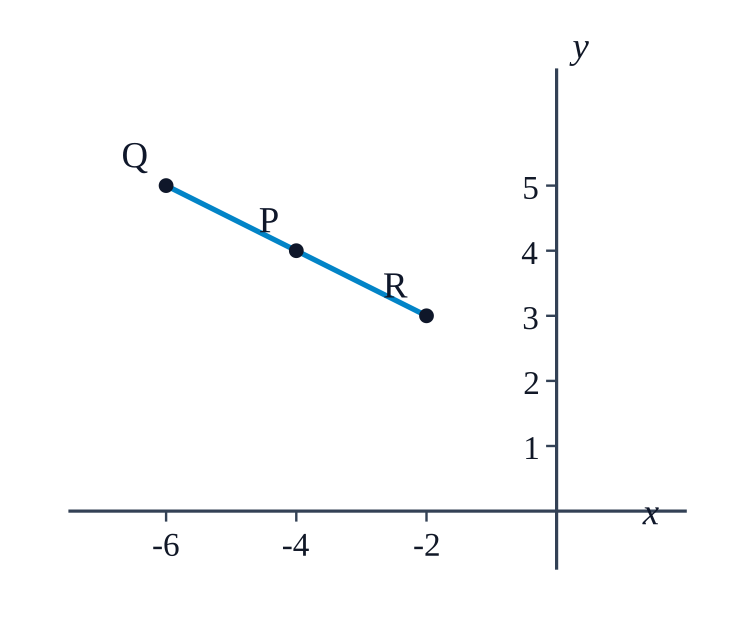
    If P(a3,4)\displaystyle \mathrm{P}\left(\frac{a}{3}, 4\right) is the mid-point of the line segment joining the points Q(−6,5)\displaystyle \mathrm{Q}(-6,5) and R(−2,3)\displaystyle \mathrm{R}(-2,3), then the value of a\displaystyle a is
    (A)
    −4\displaystyle -4 (B) −12\displaystyle -12
    (C)
    12\displaystyle 12

    Matches the book, not yet reviewed

    This working reaches the answer NCERT prints. It has not yet been read through by hand.

    NCERT’s answer
    (B)
    (B) \(\displaystyle -12\) \[\left(\frac{a}{3},4\right)=\left(\frac{-6-2}{2},\frac{5+3}{2}\right)=(-4,4) \] \[\frac{a}{3}=-4\ \Rightarrow\ a=-12 \] NCERT_Solution_Class10_Maths_Exemplar_Ch7_Ex7-1_Q13 The \(\displaystyle y\)-coordinate $\displaystyle 4$ matches, confirming the midpoint.
  4. Exercise 14

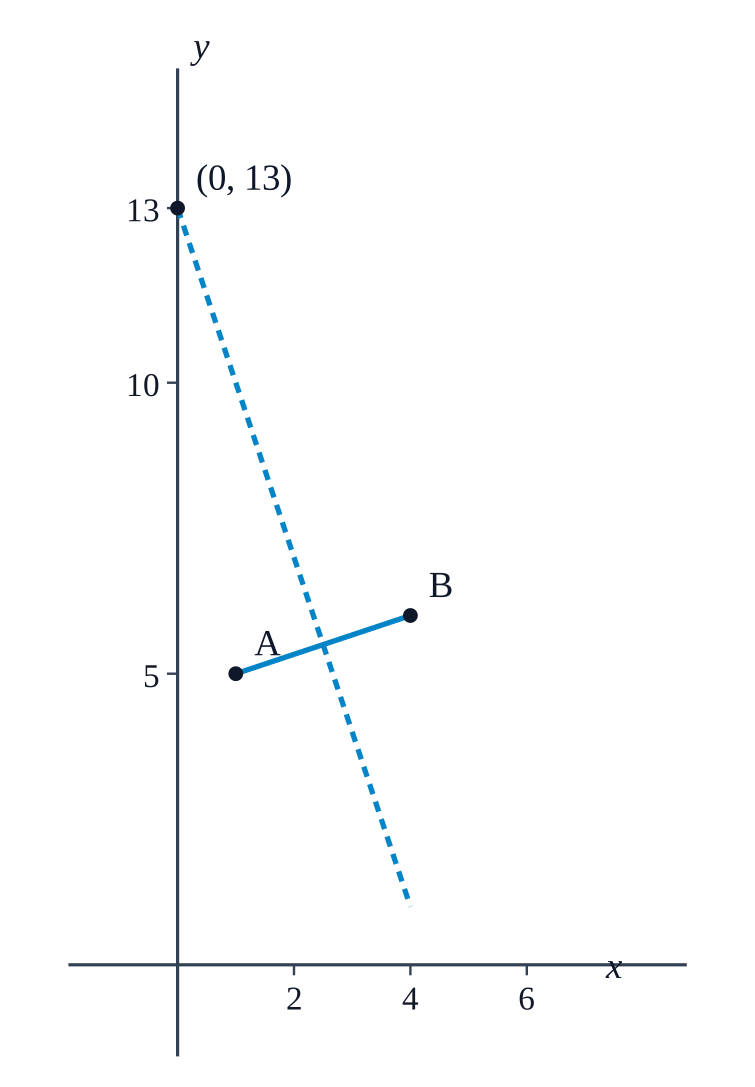
    The perpendicular bisector of the line segment joining the points A(1,5)\displaystyle \mathrm{A}(1,5) and B(4,6)\displaystyle \mathrm{B}(4,6) cuts the y\displaystyle y-axis at
    (A)
    (0,13)\displaystyle (0,13)
    (B)
    (0,−13)\displaystyle (0,-13)
    (C)
    (0,12)\displaystyle (0,12)
    (D)
    (13,0)\displaystyle (13,0)

    Matches the book, not yet reviewed

    This working reaches the answer NCERT prints. It has not yet been read through by hand.

    NCERT’s answer
    (A)
    (A) \(\displaystyle (0,13)\) Point \(\displaystyle P(0,y)\) on the bisector is equidistant from \(\displaystyle A\) and \(\displaystyle B\). \[PA^2=PB^2 \] \[(0-1)^2+(y-5)^2=(0-4)^2+(y-6)^2 \] \[1+y^2-10y+25=16+y^2-12y+36 \] \[2y=26\ \Rightarrow\ y=13 \] NCERT_Solution_Class10_Maths_Exemplar_Ch7_Ex7-1_Q14
  5. Exercise 15

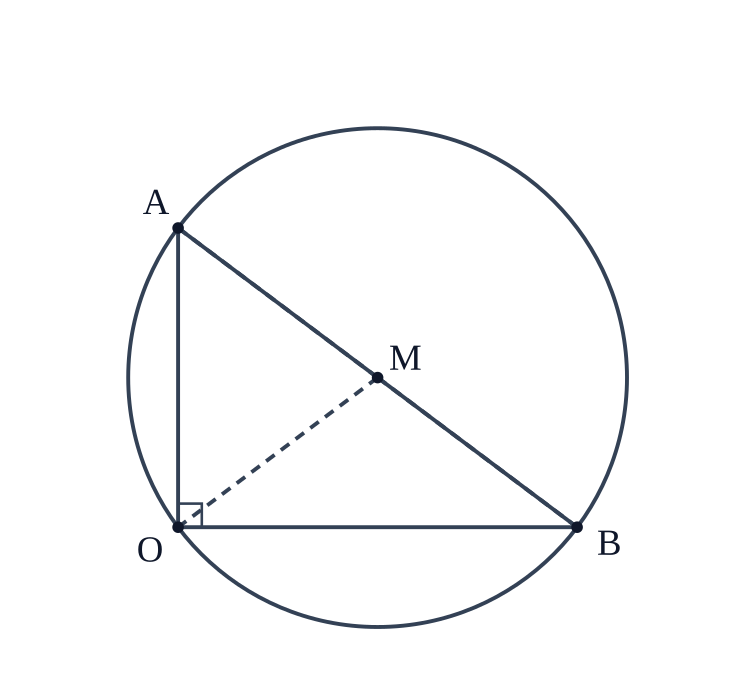
    The coordinates of the point which is equidistant from the three vertices of the ΔAOB\displaystyle \Delta \mathrm{AOB} as shown in the Fig. 7.1\displaystyle 7.1 is
    (A)
    (x,y)\displaystyle (x, y)
    (B)
    (y,x)\displaystyle (y, x)
    (C)
    (x2,y2)\displaystyle \left(\frac{x}{2}, \frac{y}{2}\right)
    (D)
    (y2,x2)\displaystyle \left(\frac{y}{2}, \frac{x}{2}\right)
    NCERT_Question_Class10_Maths_Exemplar_Ch7_Ex7-1_Q15

    Matches the book, not yet reviewed

    This working reaches the answer NCERT prints. It has not yet been read through by hand.

    NCERT’s answer
    (A)
    (A) \(\displaystyle \left(x, y\right)\)Right \(\displaystyle \Delta AOB\) has its right angle at \(\displaystyle O\), so the point equidistant from \(\displaystyle A\), \(\displaystyle O\) and \(\displaystyle B\) is the midpoint of hypotenuse \(\displaystyle AB\).NCERT_Solution_Class10_Maths_Exemplar_Ch7_Ex7-1_Q15\[\text{Midpoint of } AB = \left( \frac{0+2x}{2},\ \frac{2y+0}{2} \right) = (x, y) \]
  6. Exercise 16

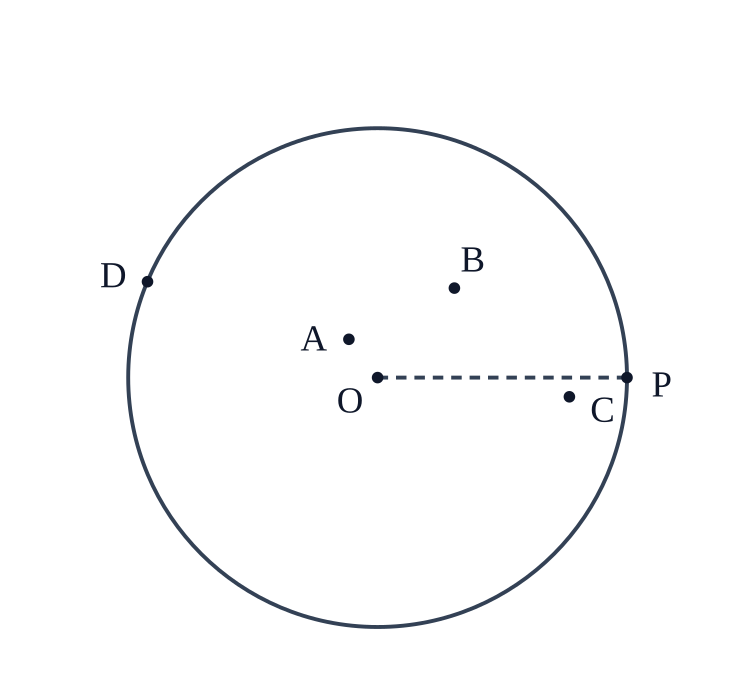
    A circle drawn with origin as the centre passes through (132,0)\displaystyle \left(\frac{13}{2}, 0\right). The point which does not lie in the interior of the circle is
    (A)
    (−34,1)\displaystyle \left(\frac{-3}{4}, 1\right)
    (B)
    (2,73)\displaystyle \left(2, \frac{7}{3}\right)
    (C)
    (5,−12)\displaystyle \left(5, \frac{-1}{2}\right)
    (D)
    (−6,52)\displaystyle \left(-6, \frac{5}{2}\right)

    Matches the book, not yet reviewed

    This working reaches the answer NCERT prints. It has not yet been read through by hand.

    NCERT’s answer
    (D)
    (D) \(\displaystyle \left(-6, \dfrac{5}{2}\right)\)A point is interior only if its squared distance from \(\displaystyle O\) is less than \(\displaystyle r^2\), where \(\displaystyle r=OP=\tfrac{13}{2}\).NCERT_Solution_Class10_Maths_Exemplar_Ch7_Ex7-1_Q16\[r^2 = \tfrac{169}{4} \] \[OA^2 = \tfrac{9}{16}+1 = \tfrac{25}{16} < r^2 \] \[OB^2 = 4+\tfrac{49}{9} = \tfrac{85}{9} < r^2 \] \[OC^2 = 25+\tfrac{1}{4} = \tfrac{101}{4} < r^2 \] \[OD^2 = 36+\tfrac{25}{4} = \tfrac{169}{4} = r^2 \]So \(\displaystyle D\) lies on the circle, not in its interior.
  7. Exercise 17

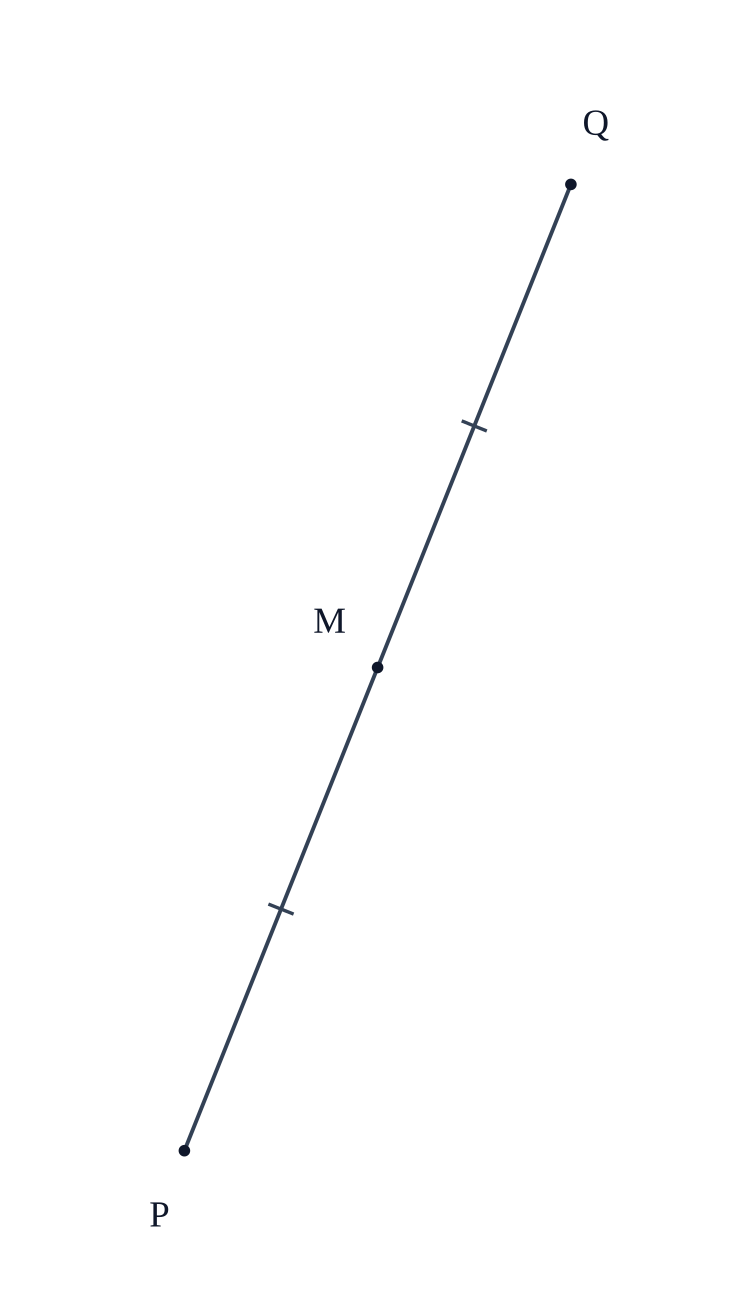
    A line intersects the y\displaystyle y-axis and x\displaystyle x-axis at the points P and Q, respectively. If (2,−5)\displaystyle (2,-5) is the mid-point of PQ, then the coordinates of P and Q are, respectively
    (A)
    (0,−5)\displaystyle (0,-5) and (2,0)\displaystyle (2,0)
    (B)
    (0,10)\displaystyle (0,10) and (−4,0)\displaystyle (-4,0)
    (C)
    (0,4)\displaystyle (0,4) and (−10,0)\displaystyle (-10,0)
    (D)
    (0,−10)\displaystyle (0,-10) and (4,0)\displaystyle (4,0)

    Matches the book, not yet reviewed

    This working reaches the answer NCERT prints. It has not yet been read through by hand.

    NCERT’s answer
    (D)
    (D) \(\displaystyle (0,-10)\) and \(\displaystyle (4,0)\)\(\displaystyle P(0,p)\) is on the \(\displaystyle y\)-axis and \(\displaystyle Q(q,0)\) on the \(\displaystyle x\)-axis; their midpoint is \(\displaystyle (2,-5)\).NCERT_Solution_Class10_Maths_Exemplar_Ch7_Ex7-1_Q17\[\left( \frac{0+q}{2},\ \frac{p+0}{2} \right) = (2,-5) \] \[q = 4, \qquad p = -10 \]So \(\displaystyle P=(0,-10)\) and \(\displaystyle Q=(4,0)\).
  8. Exercise 18

    The area of a triangle with vertices (a,b+c),(b,c+a)\displaystyle (a, b+c),(b, c+a) and (c,a+b)\displaystyle (c, a+b) is
    (A)
    (a+b+c)2\displaystyle (a+b+c)^2
    (B)
    0\displaystyle 0 (C) a+b+c\displaystyle a+b+c
    (D)
    abc\displaystyle a b c

    Matches the book, not yet reviewed

    This working reaches the answer NCERT prints. It has not yet been read through by hand.

    NCERT’s answer
    (B)
    (B) \(\displaystyle 0\)Area of the triangle with vertices \(\displaystyle (a,b+c)\), \(\displaystyle (b,c+a)\), \(\displaystyle (c,a+b)\):\[\text{Area} = \frac12\Big| a\{(c+a)-(a+b)\} + b\{(a+b)-(b+c)\} + c\{(b+c)-(c+a)\} \Big| \] \[= \frac12\big| a(c-b) + b(a-c) + c(b-a) \big| \] \[= \frac12\big| ac-ab+ab-bc+bc-ac \big| = \frac12(0) = 0 \]
  9. Exercise 19

    If the distance between the points (4,p)\displaystyle (4, p) and (1,0)\displaystyle (1,0) is 5\displaystyle 5, then the value of p\displaystyle p is
    (A)
    4\displaystyle 4 only
    (B)
    ±4\displaystyle \pm 4
    (C)
    −4\displaystyle -4 only

    Matches the book, not yet reviewed

    This working reaches the answer NCERT prints. It has not yet been read through by hand.

    NCERT’s answer
    (B)
    (B) \(\displaystyle \pm 4\)NCERT_Solution_Class10_Maths_Exemplar_Ch7_Ex7-1_Q19\[Q(1,0), \quad P(4,p), \quad PQ = 5 \] \[\sqrt{(4-1)^2+(p-0)^2} = 5 \] \[9+p^2 = 25 \] \[p^2 = 16 \implies p = \pm 4 \]
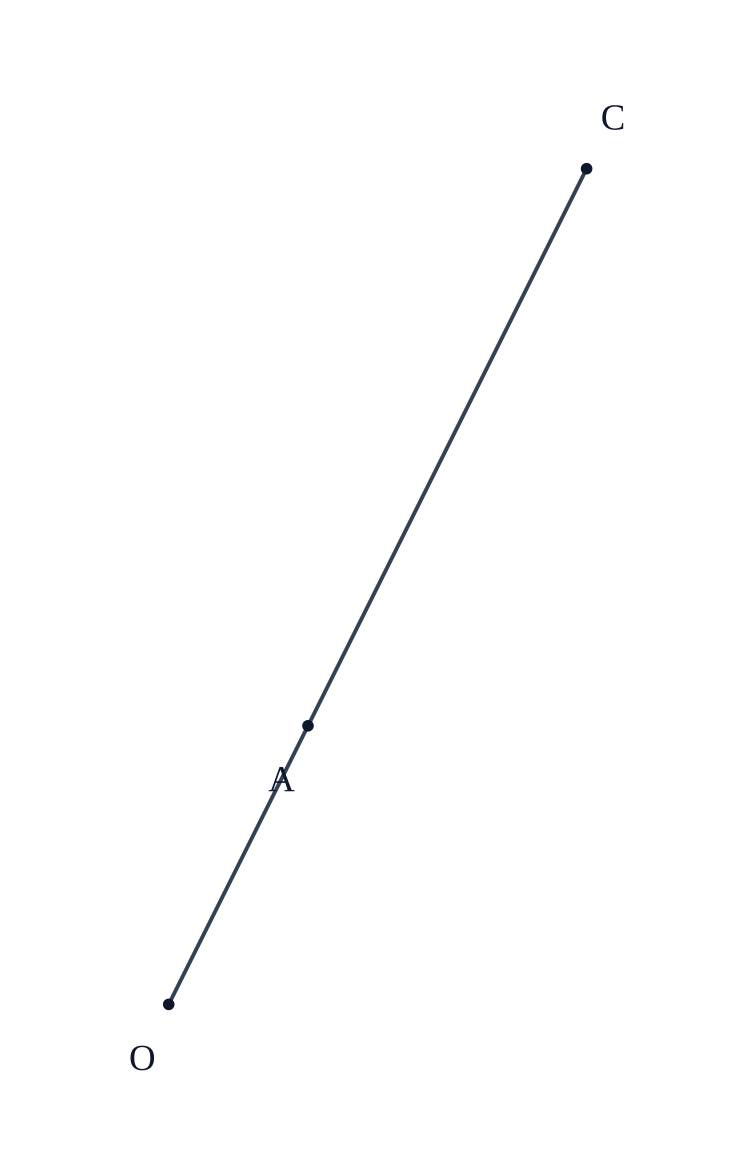
  10. Exercise 20

    If the points A(1,2),O(0,0)\displaystyle \mathrm{A}(1,2), \mathrm{O}(0,0) and C(a,b)\displaystyle \mathrm{C}(a, b) are collinear, then
    (A)
    a=b\displaystyle a=b
    (B)
    a=2b\displaystyle a=2 b
    (C)
    2a=b\displaystyle 2 a=b
    (D)
    a=−b\displaystyle a=-b

    Matches the book, not yet reviewed

    This working reaches the answer NCERT prints. It has not yet been read through by hand.

    NCERT’s answer
    (C)
    (C) \(\displaystyle 2a=b\)\(\displaystyle O\), \(\displaystyle A\) and \(\displaystyle C\) collinear means \(\displaystyle C\) lies on line \(\displaystyle OA\), so the slope from \(\displaystyle O\) to \(\displaystyle C\) equals the slope from \(\displaystyle O\) to \(\displaystyle A\).NCERT_Solution_Class10_Maths_Exemplar_Ch7_Ex7-1_Q20\[\text{slope } OA = \frac{2-0}{1-0} = 2, \qquad \text{slope } OC = \frac{b-0}{a-0} = \frac{b}{a} \] \[\frac{b}{a} = 2 \implies b = 2a \implies 2a = b \]