Exercise 1
If and are two vertices of an equilateral triangle, find the coordinates of the third vertex, given that the origin lies in the interior of the triangle.
Matches the book, not yet reviewed
This working reaches the answer NCERT prints. It has not yet been read through by hand.
NCERT’s answer
\(\displaystyle (0, 3-4 \sqrt{3})\)
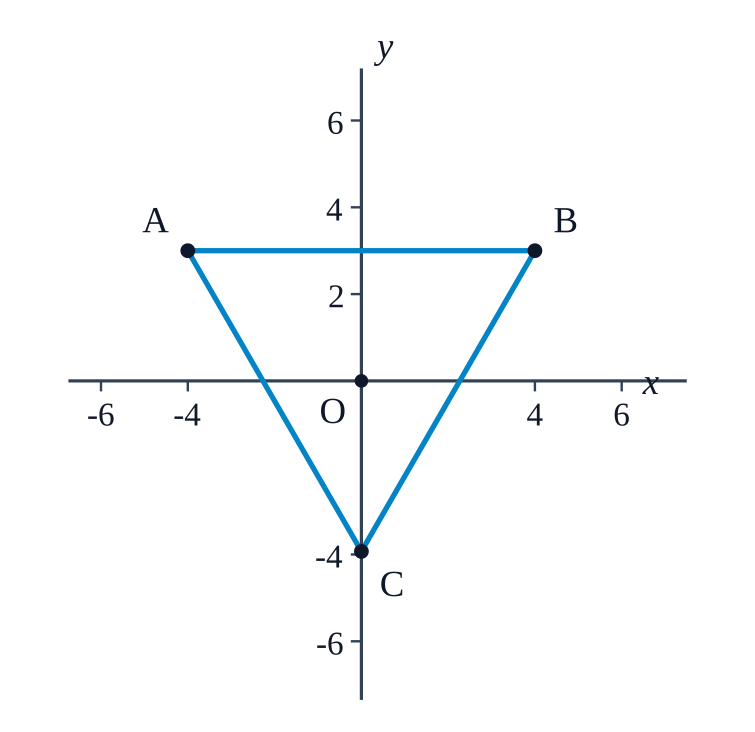 \[A(-4,3),\ B(4,3): \qquad AB = 4-(-4) = 8, \qquad M = \left(\frac{-4+4}{2},\,3\right) = (0,3) \]
Third vertex \(\displaystyle C\) lies on the perpendicular bisector of \(\displaystyle AB\), the line \(\displaystyle x=0\).
\[h = \frac{\sqrt3}{2}\cdot AB = \frac{\sqrt3}{2}\cdot 8 = 4\sqrt3 \]
\[C = (0,\ 3 \pm 4\sqrt3) \]
The origin is below \(\displaystyle AB\) (\(\displaystyle y=3\)), so \(\displaystyle C\) must be below \(\displaystyle AB\) too.
Answer: \(\displaystyle (0,\ 3-4\sqrt3) \)
\[A(-4,3),\ B(4,3): \qquad AB = 4-(-4) = 8, \qquad M = \left(\frac{-4+4}{2},\,3\right) = (0,3) \]
Third vertex \(\displaystyle C\) lies on the perpendicular bisector of \(\displaystyle AB\), the line \(\displaystyle x=0\).
\[h = \frac{\sqrt3}{2}\cdot AB = \frac{\sqrt3}{2}\cdot 8 = 4\sqrt3 \]
\[C = (0,\ 3 \pm 4\sqrt3) \]
The origin is below \(\displaystyle AB\) (\(\displaystyle y=3\)), so \(\displaystyle C\) must be below \(\displaystyle AB\) too.
Answer: \(\displaystyle (0,\ 3-4\sqrt3) \)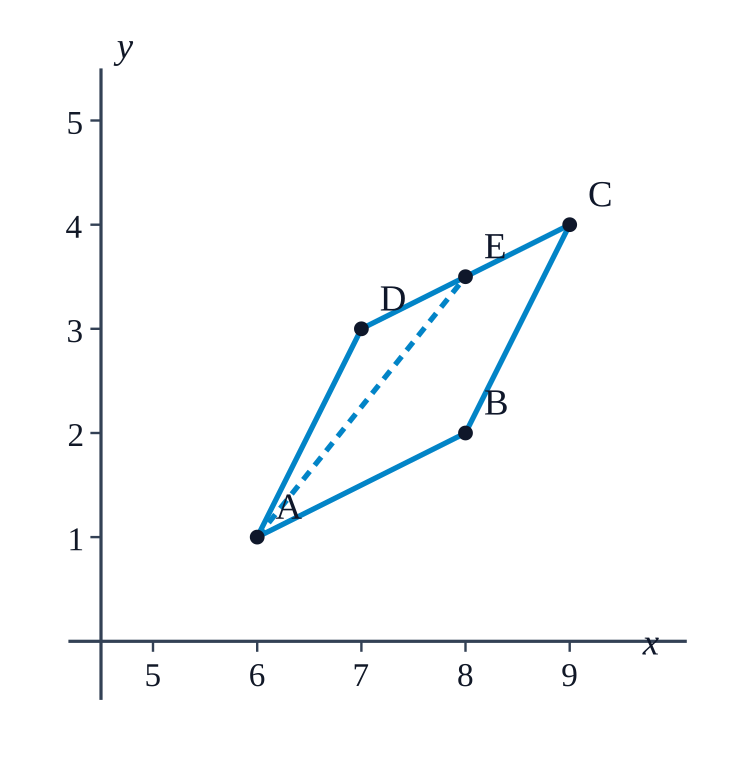 Diagonals of a parallelogram bisect each other:
\[\text{mid}(AC) = \left(\frac{6+9}{2},\,\frac{1+4}{2}\right) = (7.5,\,2.5) = \text{mid}(BD) \]
\[B=(8,2) \ \Rightarrow\ D = \big(2(7.5)-8,\ 2(2.5)-2\big) = (7,3) \]
\[E = \text{mid}(D,C) = \left(\frac{7+9}{2},\,\frac{3+4}{2}\right) = (8,\,3.5) \]
\[\text{Area}(\triangle ADE) = \tfrac12\big|\,x_A(y_D-y_E)+x_D(y_E-y_A)+x_E(y_A-y_D)\,\big| \]
\[= \tfrac12\big|\,6(-0.5)+7(2.5)+8(-2)\,\big| = \tfrac12(1.5) \]
Answer: \(\displaystyle \dfrac{3}{4} \) sq units
Diagonals of a parallelogram bisect each other:
\[\text{mid}(AC) = \left(\frac{6+9}{2},\,\frac{1+4}{2}\right) = (7.5,\,2.5) = \text{mid}(BD) \]
\[B=(8,2) \ \Rightarrow\ D = \big(2(7.5)-8,\ 2(2.5)-2\big) = (7,3) \]
\[E = \text{mid}(D,C) = \left(\frac{7+9}{2},\,\frac{3+4}{2}\right) = (8,\,3.5) \]
\[\text{Area}(\triangle ADE) = \tfrac12\big|\,x_A(y_D-y_E)+x_D(y_E-y_A)+x_E(y_A-y_D)\,\big| \]
\[= \tfrac12\big|\,6(-0.5)+7(2.5)+8(-2)\,\big| = \tfrac12(1.5) \]
Answer: \(\displaystyle \dfrac{3}{4} \) sq units
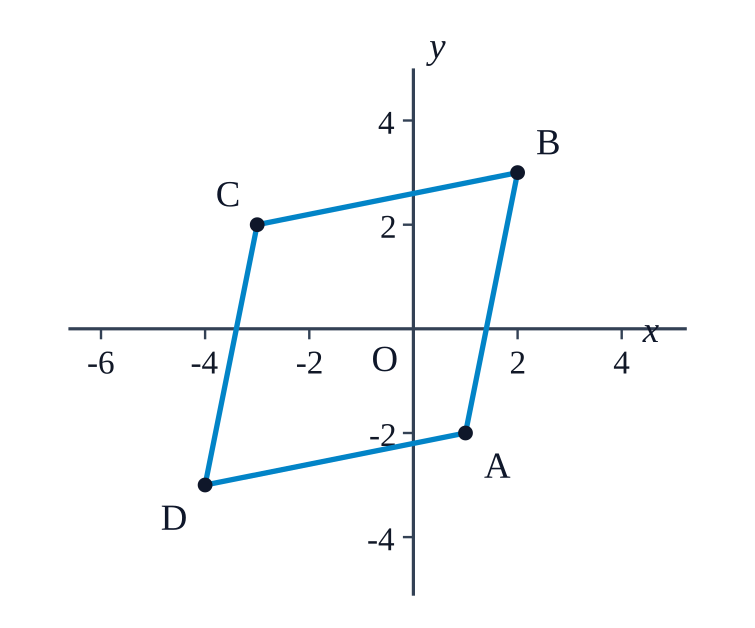 Diagonals of parallelogram \(\displaystyle ABCD\) bisect each other:
\[\text{mid}(AC) = \text{mid}(BD) \ \Rightarrow\ \left(\frac{1+a}{2},\,\frac{-2+2}{2}\right) = \left(\frac{2-4}{2},\,\frac{3-3}{2}\right) = (-1,0) \]
\[1+a = -2 \ \Rightarrow\ a = -3 \]
So \(\displaystyle C=(-3,2)\).
\[\text{ar}(\triangle ABC) = \tfrac12\big|\,1(3-2)+2(2+2)+(-3)(-2-3)\,\big| = \tfrac12(1+8+15) = 12 \]
\[\text{ar}(ABCD) = 2\,\text{ar}(\triangle ABC) = 24 \]
\[AB = \sqrt{(2-1)^2+(3+2)^2} = \sqrt{26} \]
\[\text{height} = \frac{\text{ar}(ABCD)}{AB} = \frac{24}{\sqrt{26}} = \frac{12\sqrt{26}}{13} \]
Answer: \(\displaystyle a=-3,\quad \text{height} = \dfrac{12\sqrt{26}}{13} \) units
Diagonals of parallelogram \(\displaystyle ABCD\) bisect each other:
\[\text{mid}(AC) = \text{mid}(BD) \ \Rightarrow\ \left(\frac{1+a}{2},\,\frac{-2+2}{2}\right) = \left(\frac{2-4}{2},\,\frac{3-3}{2}\right) = (-1,0) \]
\[1+a = -2 \ \Rightarrow\ a = -3 \]
So \(\displaystyle C=(-3,2)\).
\[\text{ar}(\triangle ABC) = \tfrac12\big|\,1(3-2)+2(2+2)+(-3)(-2-3)\,\big| = \tfrac12(1+8+15) = 12 \]
\[\text{ar}(ABCD) = 2\,\text{ar}(\triangle ABC) = 24 \]
\[AB = \sqrt{(2-1)^2+(3+2)^2} = \sqrt{26} \]
\[\text{height} = \frac{\text{ar}(ABCD)}{AB} = \frac{24}{\sqrt{26}} = \frac{12\sqrt{26}}{13} \]
Answer: \(\displaystyle a=-3,\quad \text{height} = \dfrac{12\sqrt{26}}{13} \) units
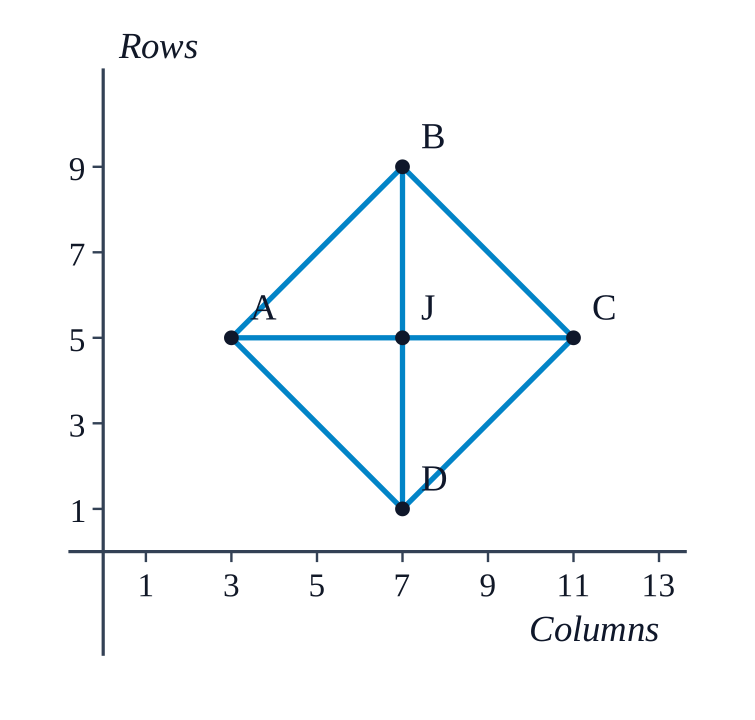 From the figure: \(\displaystyle A(3,5),\ B(7,9),\ C(11,5),\ D(7,1)\).
\[\text{mid}(AC) = \left(\frac{3+11}{2},\frac{5+5}{2}\right) = (7,5), \qquad \text{mid}(BD) = \left(\frac{7+7}{2},\frac{9+1}{2}\right) = (7,5) \]
\[AC = 11-3 = 8, \qquad BD = 9-1 = 8 \]
Both diagonals share the midpoint \(\displaystyle J(7,5)\) and have equal length \(\displaystyle 8\), so
\[JA=JC=\frac{AC}{2}=4, \qquad JB=JD=\frac{BD}{2}=4 \]
Answer: Yes, at \(\displaystyle J(7,5)\): column $\displaystyle 7$, row 5.
From the figure: \(\displaystyle A(3,5),\ B(7,9),\ C(11,5),\ D(7,1)\).
\[\text{mid}(AC) = \left(\frac{3+11}{2},\frac{5+5}{2}\right) = (7,5), \qquad \text{mid}(BD) = \left(\frac{7+7}{2},\frac{9+1}{2}\right) = (7,5) \]
\[AC = 11-3 = 8, \qquad BD = 9-1 = 8 \]
Both diagonals share the midpoint \(\displaystyle J(7,5)\) and have equal length \(\displaystyle 8\), so
\[JA=JC=\frac{AC}{2}=4, \qquad JB=JD=\frac{BD}{2}=4 \]
Answer: Yes, at \(\displaystyle J(7,5)\): column $\displaystyle 7$, row 5.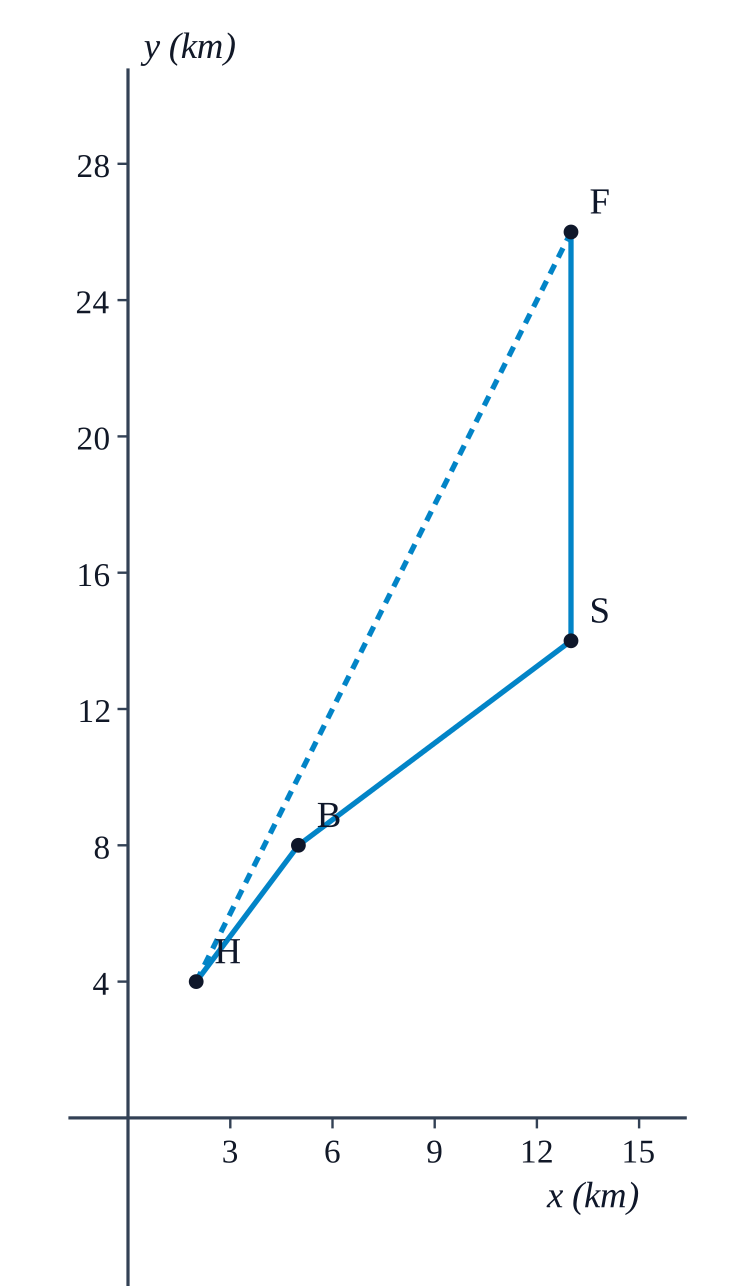 House \(\displaystyle H(2,4)\), bank \(\displaystyle B(5,8)\), school \(\displaystyle S(13,14)\), office \(\displaystyle F(13,26)\).
\[HB = \sqrt{(5-2)^2+(8-4)^2} = 5 \]
\[BS = \sqrt{(13-5)^2+(14-8)^2} = 10 \]
\[SF = \sqrt{(13-13)^2+(26-14)^2} = 12 \]
\[\text{route} = HB+BS+SF = 5+10+12 = 27 \]
\[HF = \sqrt{(13-2)^2+(26-4)^2} = \sqrt{605} = 11\sqrt5 \]
\[\text{extra} = 27-11\sqrt5 \]
Answer: \(\displaystyle (27-11\sqrt5)\ \text{km} \approx 2.4\ \text{km} \)
House \(\displaystyle H(2,4)\), bank \(\displaystyle B(5,8)\), school \(\displaystyle S(13,14)\), office \(\displaystyle F(13,26)\).
\[HB = \sqrt{(5-2)^2+(8-4)^2} = 5 \]
\[BS = \sqrt{(13-5)^2+(14-8)^2} = 10 \]
\[SF = \sqrt{(13-13)^2+(26-14)^2} = 12 \]
\[\text{route} = HB+BS+SF = 5+10+12 = 27 \]
\[HF = \sqrt{(13-2)^2+(26-4)^2} = \sqrt{605} = 11\sqrt5 \]
\[\text{extra} = 27-11\sqrt5 \]
Answer: \(\displaystyle (27-11\sqrt5)\ \text{km} \approx 2.4\ \text{km} \)