SolveIt is under development
SolveItNCERT · CBSE · NEET

NCERT Exemplar · Class 10 Mathematics Coordinate Geometry

58 questions · 58 still being checked

EXERCISE 7.3 11–20 (part 5 of 6)

  1. Exercise 11

    Find the ratio in which the point P(34,512)\displaystyle \mathrm{P}\left(\frac{3}{4}, \frac{5}{12}\right) divides the line segment joining the points A(12,32)\displaystyle \mathrm{A}\left(\frac{1}{2}, \frac{3}{2}\right) and B(2,−5)\displaystyle \mathrm{B}(2,-5).

    Matches the book, not yet reviewed

    This working reaches the answer NCERT prints. It has not yet been read through by hand.

    NCERT’s answer
    $\displaystyle 1$:$\displaystyle 5$
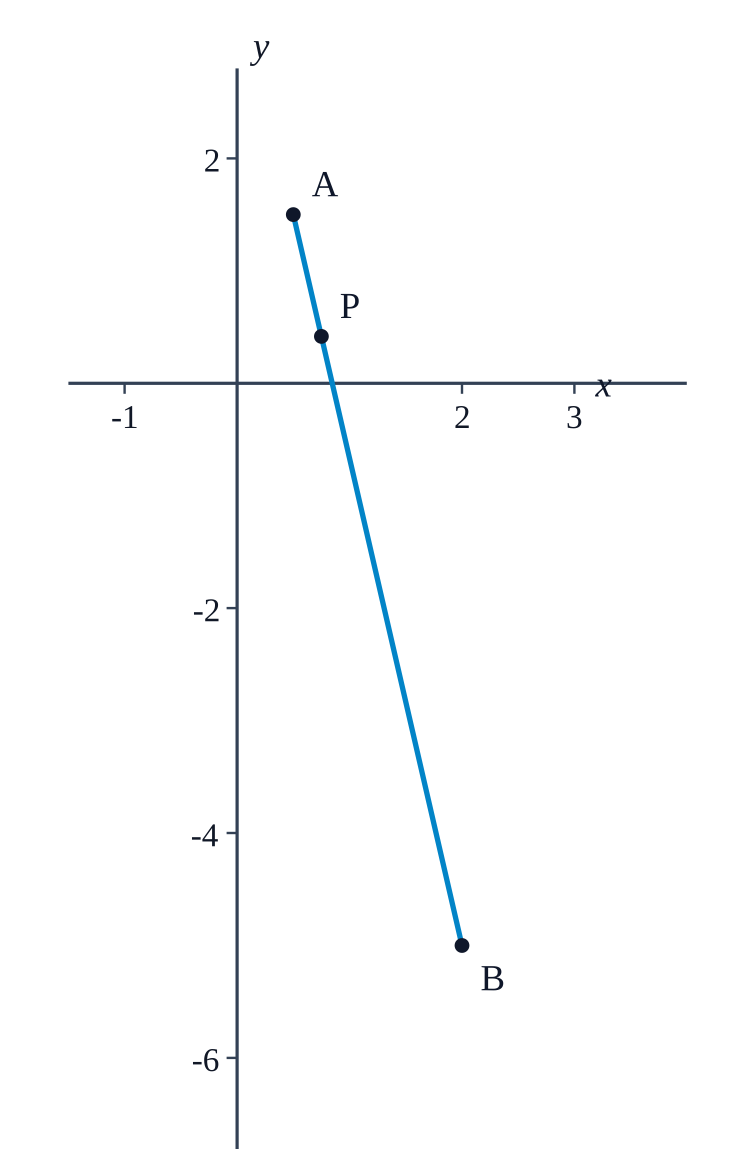
    Let \(\displaystyle P\) divide \(\displaystyle AB\) in ratio \(\displaystyle k:1\). \[\dfrac34=\dfrac{2k+\tfrac12}{k+1} \] \[3(k+1)=4\left(2k+\tfrac12\right) \] \[3k+3=8k+2 \] \[1=5k \quad\Rightarrow\quad k=\dfrac15 \] NCERT_Solution_Class10_Maths_Exemplar_Ch7_Ex7-3_Q11 Answer: \(\displaystyle 1:5\).
  2. Exercise 12

    If P(9a−2,−b)\displaystyle \mathrm{P}(9 a-2,-b) divides line segment joining A(3a+1,−3)\displaystyle \mathrm{A}(3 a+1,-3) and B(8a,5)\displaystyle \mathrm{B}(8 a, 5) in the ratio 3\displaystyle 3 : 1\displaystyle 1, find the values of a\displaystyle a and b\displaystyle b.

    Matches the book, not yet reviewed

    This working reaches the answer NCERT prints. It has not yet been read through by hand.

    NCERT’s answer
    \(\displaystyle a=1 \quad b=-3\)
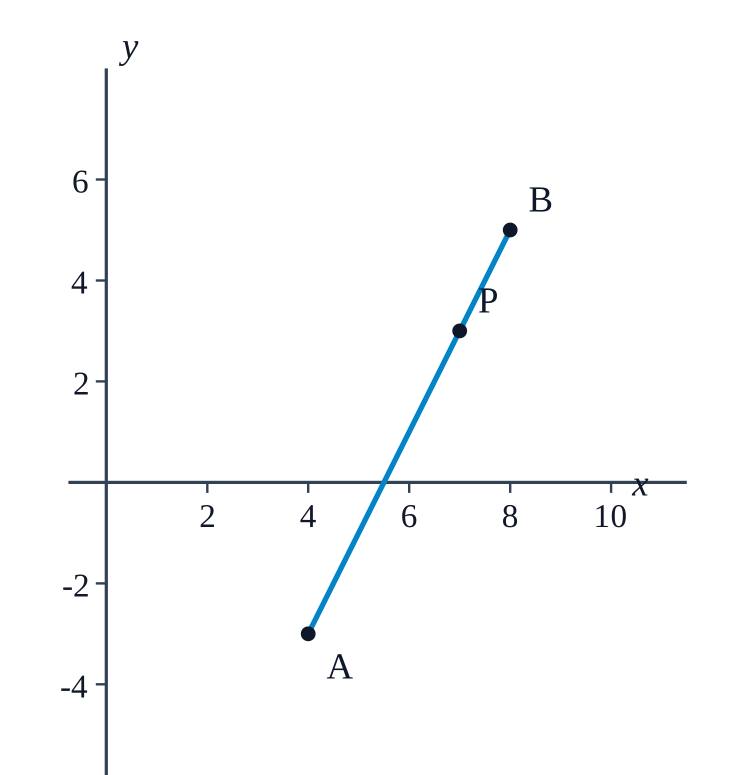
    Section formula, ratio \(\displaystyle 3:1\) from \(\displaystyle A\) to \(\displaystyle B\): \[9a-2=\dfrac{3(8a)+1(3a+1)}{3+1}=\dfrac{27a+1}{4} \] \[36a-8=27a+1 \] \[9a=9 \quad\Rightarrow\quad a=1 \] \[-b=\dfrac{3(5)+1(-3)}{4}=\dfrac{12}{4}=3 \quad\Rightarrow\quad b=-3 \] \[A(4,-3),\quad P(7,3),\quad B(8,5) \] NCERT_Solution_Class10_Maths_Exemplar_Ch7_Ex7-3_Q12 Answer: \(\displaystyle a=1,\ b=-3\).
  3. Exercise 13

    If (a,b)\displaystyle (a, b) is the mid-point of the line segment joining the points A(10,−6)\displaystyle \mathrm{A}(10,-6) and B (k,4)\displaystyle (k, 4) and a−2b=18\displaystyle a-2 b=18, find the value of k\displaystyle k and the distance AB.

    Matches the book, not yet reviewed

    This working reaches the answer NCERT prints. It has not yet been read through by hand.

    NCERT’s answer
    \(\displaystyle k=22, \mathrm{AB}=2 \sqrt{61}\)
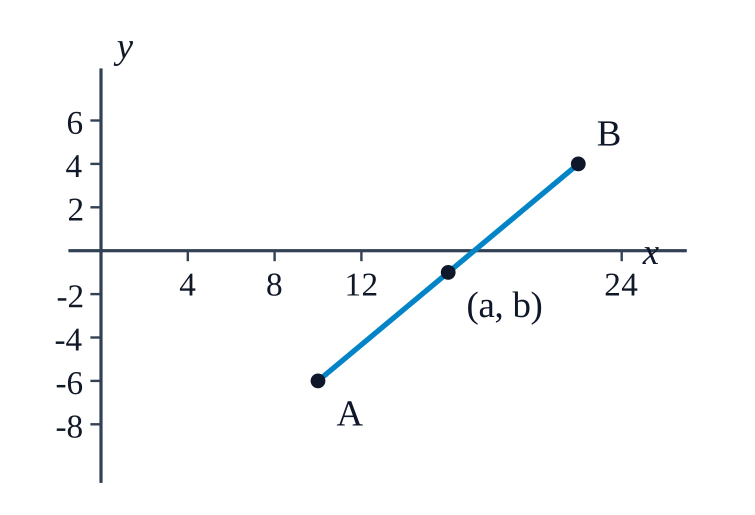
    \[a=\dfrac{10+k}{2},\quad b=\dfrac{-6+4}{2}=-1 \] \[a-2b=18 \] \[\dfrac{10+k}{2}-2(-1)=18 \] \[\dfrac{10+k}{2}=16 \] \[k=22 \] \[(a,b)=(16,-1) \] NCERT_Solution_Class10_Maths_Exemplar_Ch7_Ex7-3_Q13 \[AB=\sqrt{(22-10)^2+(4+6)^2}=\sqrt{144+100}=\sqrt{244}=2\sqrt{61} \] Answer: \(\displaystyle k=22,\ AB=2\sqrt{61}\).
  4. Exercise 14

    The centre of a circle is (2a,a−7)\displaystyle (2 a, a-7). Find the values of a\displaystyle a if the circle passes through the point (11,−9)\displaystyle (11, -9) and has diameter 102\displaystyle 10 \sqrt{2} units.

    Matches the book, not yet reviewed

    This working reaches the answer NCERT prints. It has not yet been read through by hand.

    NCERT’s answer
    \(\displaystyle a=5,3\)
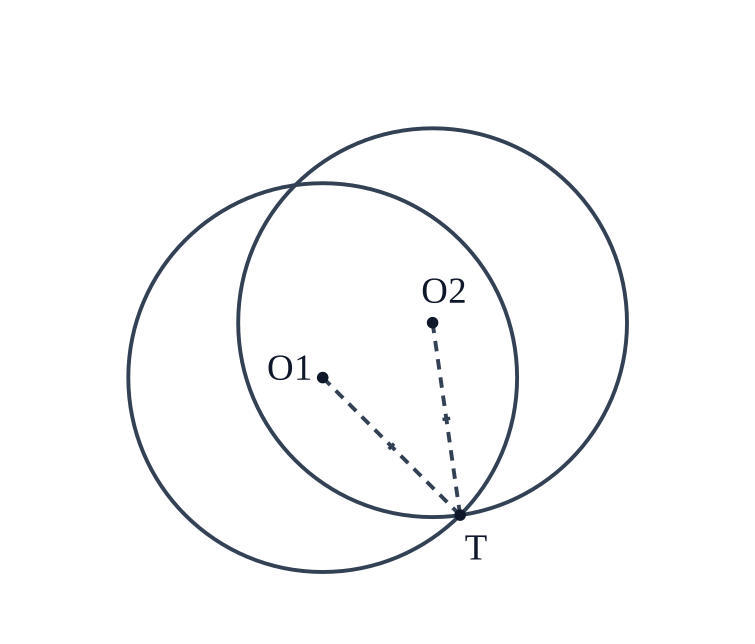
    \[r=\dfrac{10\sqrt2}{2}=5\sqrt2 \] \[(2a-11)^2+(a-7+9)^2=(5\sqrt2)^2 \] \[(2a-11)^2+(a+2)^2=50 \] \[4a^2-44a+121+a^2+4a+4=50 \] \[5a^2-40a+75=0 \] \[a^2-8a+15=0 \] \[(a-3)(a-5)=0 \] \[a=3 \ \text{or}\ a=5 \] \[a=3:\ O_1(6,-4),\qquad a=5:\ O_2(10,-2) \] NCERT_Solution_Class10_Maths_Exemplar_Ch7_Ex7-3_Q14 Answer: \(\displaystyle a=3\) or \(\displaystyle a=5\).
  5. Exercise 15

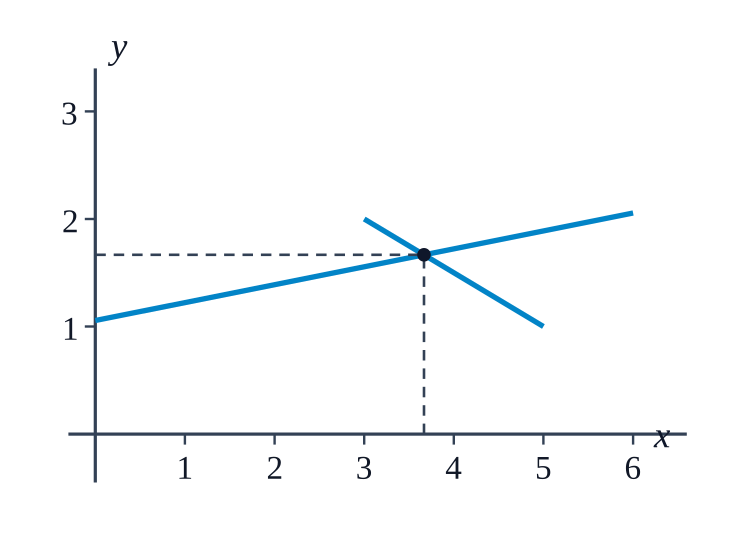
    The line segment joining the points A(3,2)\displaystyle \mathrm{A}(3,2) and B(5,1)\displaystyle \mathrm{B}(5,1) is divided at the point P in the ratio 1\displaystyle 1:2\displaystyle 2 and it lies on the line 3x−18y+k=0\displaystyle 3 x-18 y+k=0. Find the value of k\displaystyle k.

    Matches the book, not yet reviewed

    This working reaches the answer NCERT prints. It has not yet been read through by hand.

    NCERT’s answer
    $\displaystyle 19$
    By the section formula, with \(\displaystyle P\) dividing \(\displaystyle AB\) in the ratio \(\displaystyle 1:2\): \[P = \left( \frac{1(5)+2(3)}{1+2}, \frac{1(1)+2(2)}{1+2} \right) = \left( \frac{11}{3}, \frac{5}{3} \right) \] NCERT_Solution_Class10_Maths_Exemplar_Ch7_Ex7-3_Q15 Since \(\displaystyle P\) lies on \(\displaystyle 3x-18y+k=0\): \[3\left(\frac{11}{3}\right) - 18\left(\frac{5}{3}\right) + k = 0 \] \[11 - 30 + k = 0 \] \[k = 19 \] Answer: \(\displaystyle k = 19\)
  6. Exercise 16

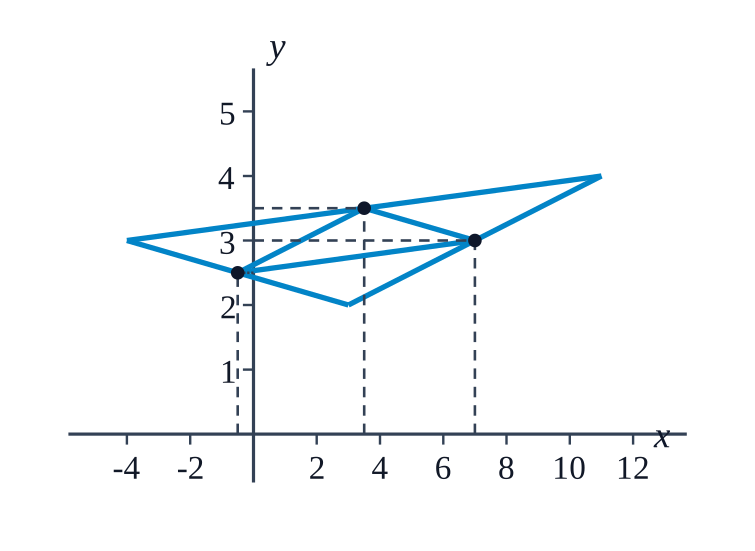
    If D(−12,52),E(7,3)\displaystyle \mathrm{D}\left(\frac{-1}{2}, \frac{5}{2}\right), \mathrm{E}(7,3) and F(72,72)\displaystyle \mathrm{F}\left(\frac{7}{2}, \frac{7}{2}\right) are the midpoints of sides of ΔABC\displaystyle \Delta \mathrm{ABC}, find the area of the ΔABC\displaystyle \Delta \mathrm{ABC}.

    Matches the book, not yet reviewed

    This working reaches the answer NCERT prints. It has not yet been read through by hand.

    NCERT’s answer
    $\displaystyle 11$
    By the shoelace formula on the midpoints: \[\text{ar}(\triangle DEF) = \frac12\left| x_D(y_E-y_F)+x_E(y_F-y_D)+x_F(y_D-y_E) \right| \] \[= \frac12\left| \left(-\frac12\right)\left(-\frac12\right) + 7(1) + \frac72\left(-\frac12\right) \right| = \frac12 \cdot \frac{11}{2} = \frac{11}{4} \] NCERT_Solution_Class10_Maths_Exemplar_Ch7_Ex7-3_Q16 The midpoints of the sides of a triangle form a triangle similar to it in ratio \(\displaystyle 1:2\), so \[\text{ar}(\triangle ABC) = 4\,\text{ar}(\triangle DEF) = 4 \times \frac{11}{4} = 11 \] Answer: \(\displaystyle 11\) square units
  7. Exercise 17

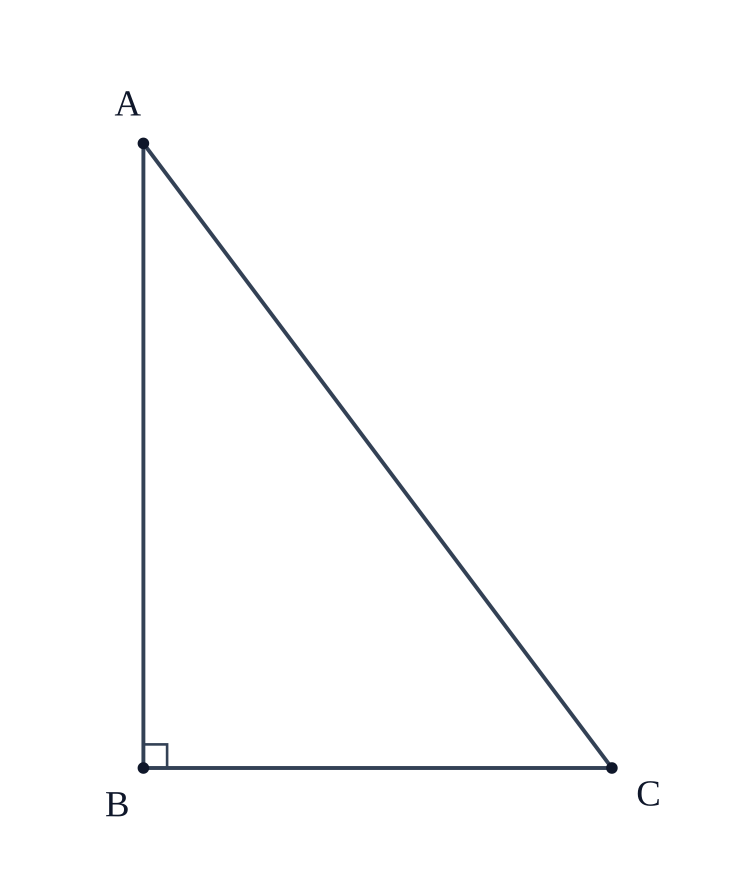
    The points A(2,9),B(a,5)\displaystyle \mathrm{A}(2,9), \mathrm{B}(a, 5) and C(5,5)\displaystyle \mathrm{C}(5,5) are the vertices of a triangle ABC right angled at B. Find the values of a\displaystyle a and hence the area of ΔABC\displaystyle \Delta \mathrm{ABC}.

    Matches the book, not yet reviewed

    This working reaches the answer NCERT prints. It has not yet been read through by hand.

    NCERT’s answer
    \(\displaystyle a=2\), Area \(\displaystyle =6\) sq. unit
    Since \(\displaystyle B(a,5)\) and \(\displaystyle C(5,5)\) share \(\displaystyle y=5\), \(\displaystyle BC\) is horizontal; a right angle at \(\displaystyle B\) forces \(\displaystyle BA\) vertical, so \(\displaystyle a=2\). NCERT_Solution_Class10_Maths_Exemplar_Ch7_Ex7-3_Q17 \[AB = \sqrt{(2-2)^2+(9-5)^2} = 4, \quad BC = \sqrt{(5-2)^2+(5-5)^2} = 3 \] \[\text{ar}(\triangle ABC) = \frac12 \cdot BC \cdot AB = \frac12 \cdot 3 \cdot 4 = 6 \] Answer: \(\displaystyle a = 2\), area \(\displaystyle = 6\) square units
  8. Exercise 18

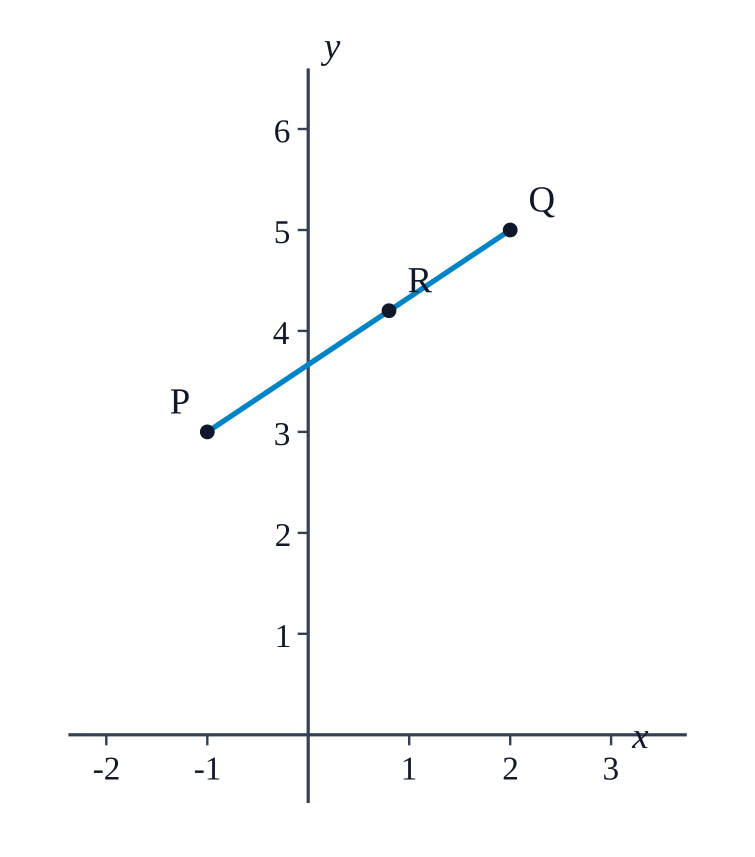
    Find the coordinates of the point R on the line segment joining the points P(−1,3)\displaystyle \mathrm{P}(-1,3) and Q(2,5)\displaystyle \mathrm{Q}(2,5) such that PR=35PQ\displaystyle \mathrm{PR}=\frac{3}{5} \mathrm{PQ}.

    Matches the book, not yet reviewed

    This working reaches the answer NCERT prints. It has not yet been read through by hand.

    NCERT’s answer
    \(\displaystyle \left(\frac{4}{5}, \frac{21}{5}\right)\)
    \(\displaystyle PR=\frac35PQ\) means \(\displaystyle R\) divides \(\displaystyle PQ\) in the ratio \(\displaystyle 3:2\). By the section formula: \[R = \left( \frac{3(2)+2(-1)}{3+2}, \frac{3(5)+2(3)}{3+2} \right) = \left( \frac{4}{5}, \frac{21}{5} \right) \] NCERT_Solution_Class10_Maths_Exemplar_Ch7_Ex7-3_Q18 Answer: \(\displaystyle R = \left(\dfrac{4}{5}, \dfrac{21}{5}\right)\)
  9. Exercise 19

    Find the values of k\displaystyle k if the points A(k+1,2k),B(3k,2k+3)\displaystyle \mathrm{A}(k+1,2 k), \mathrm{B}(3 k, 2 k+3) and C(5k−1,5k)\displaystyle \mathrm{C}(5 k-1,5 k) are collinear.

    Matches the book, not yet reviewed

    This working reaches the answer NCERT prints. It has not yet been read through by hand.

    NCERT’s answer
    \(\displaystyle 2, \frac{1}{2}\)
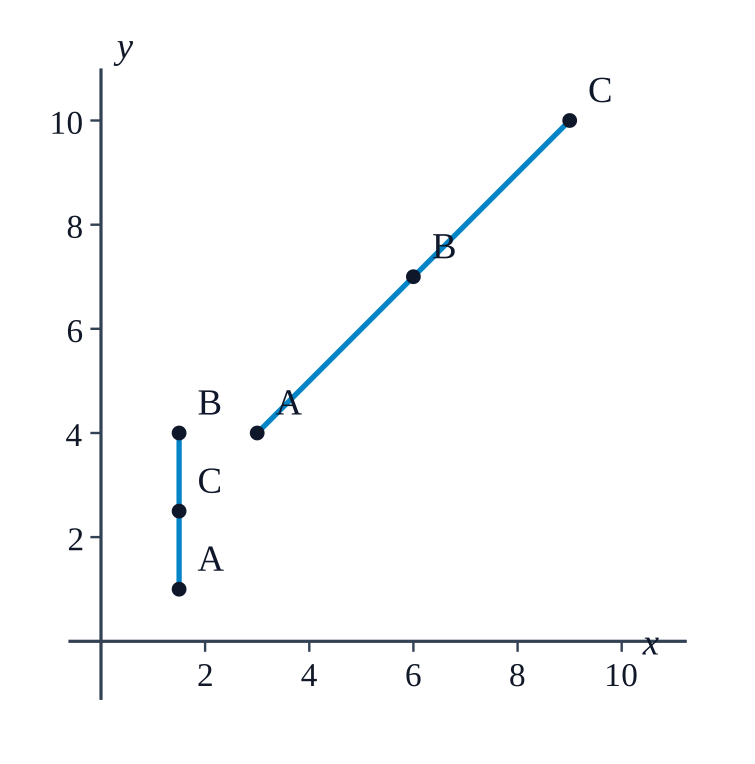
    Collinearity of \(\displaystyle A, B, C\) requires \(\displaystyle \text{ar}(\triangle ABC) = 0\): \[(k+1)(3-3k) + 3k(3k) + (5k-1)(-3) = 0 \] \[3 - 3k^2 + 9k^2 - 15k + 3 = 0 \] \[2k^2 - 5k + 2 = 0 \] \[(2k-1)(k-2) = 0 \] NCERT_Solution_Class10_Maths_Exemplar_Ch7_Ex7-3_Q19 Answer: \(\displaystyle k = \dfrac{1}{2}\) or \(\displaystyle k = 2\)
  10. Exercise 20

    Find the ratio in which the line 2x+3y−5=0\displaystyle 2 x+3 y-5=0 divides the line segment joining the points (8,−9)\displaystyle (8, -9) and (2,1)\displaystyle (2, 1). Also find the coordinates of the point of division.

    Matches the book, not yet reviewed

    This working reaches the answer NCERT prints. It has not yet been read through by hand.

    NCERT’s answer
    $\displaystyle 8$:$\displaystyle 1$, \(\displaystyle \left(\frac{8}{3}, \frac{-1}{9}\right)\)
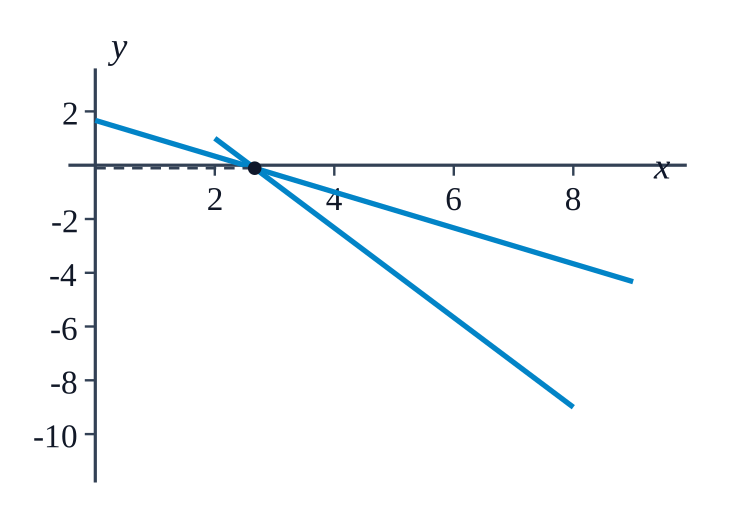
    Let the line meet \(\displaystyle P(8,-9)Q(2,1)\) at the point dividing it in ratio \(\displaystyle k:1\): \[\left( \frac{2k+8}{k+1}, \frac{k-9}{k+1} \right) \] NCERT_Solution_Class10_Maths_Exemplar_Ch7_Ex7-3_Q20 On \(\displaystyle 2x+3y-5=0\): \[2(2k+8) + 3(k-9) - 5(k+1) = 0 \] \[4k+16+3k-27-5k-5 = 0 \] \[2k - 16 = 0 \implies k = 8 \] \[\text{Point} = \left( \frac{2(8)+8}{9}, \frac{8-9}{9} \right) = \left( \frac{8}{3}, -\frac{1}{9} \right) \] Answer: ratio \(\displaystyle 8:1\), point \(\displaystyle \left(\dfrac{8}{3}, -\dfrac{1}{9}\right)\)