SolveIt is under development
SolveItNCERT · CBSE · NEET

NCERT Exemplar · Class 10 Mathematics Coordinate Geometry

58 questions · 58 still being checked

EXERCISE 7.1 1–10 (part 1 of 6)

  1. Choose the correct answer from the given four options:

    Exercise 1

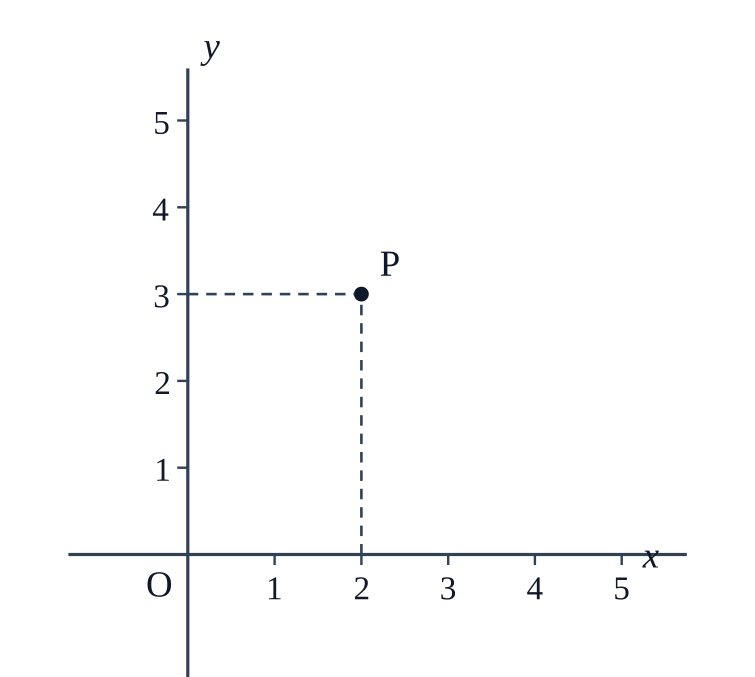
    The distance of the point P(2,3)\displaystyle \mathrm{P}(2,3) from the x\displaystyle x-axis is
    (A)
    2\displaystyle 2 (B) 3\displaystyle 3 (C) 1\displaystyle 1 (D) 5\displaystyle 5

    Matches the book, not yet reviewed

    This working reaches the answer NCERT prints. It has not yet been read through by hand.

    NCERT’s answer
    (B)
    (B) \(\displaystyle 3\) NCERT_Solution_Class10_Maths_Exemplar_Ch7_Ex7-1_Q1 \[\text{Distance of } P(x,y) \text{ from the } x\text{-axis} = |y| \] \[P(2,3) \ \Rightarrow\ |y| = 3 \]
  2. Exercise 2

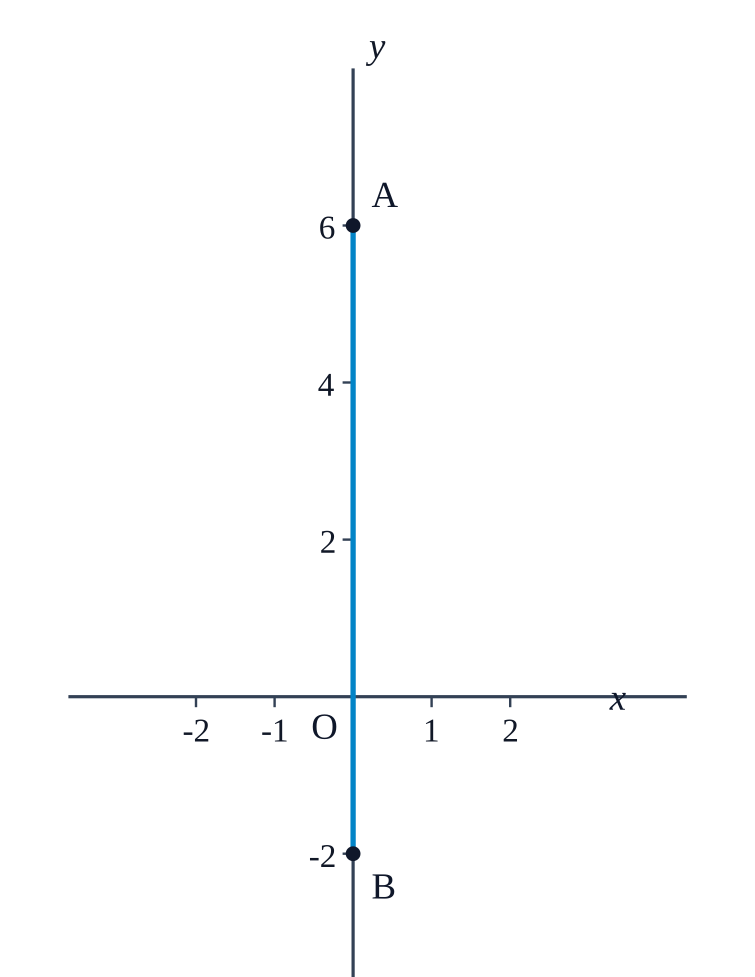
    The distance between the points A(0,6)\displaystyle \mathrm{A}(0,6) and B(0,−2)\displaystyle \mathrm{B}(0,-2) is
    (A)
    6\displaystyle 6 (B) 8\displaystyle 8 (C) 4\displaystyle 4 (D) 2\displaystyle 2

    Matches the book, not yet reviewed

    This working reaches the answer NCERT prints. It has not yet been read through by hand.

    NCERT’s answer
    (B)
    (B) \(\displaystyle 8\) NCERT_Solution_Class10_Maths_Exemplar_Ch7_Ex7-1_Q2 \[AB = \sqrt{(x_2-x_1)^2+(y_2-y_1)^2} \] \[AB = \sqrt{(0-0)^2+(-2-6)^2} = \sqrt{64} = 8 \]
  3. Exercise 3

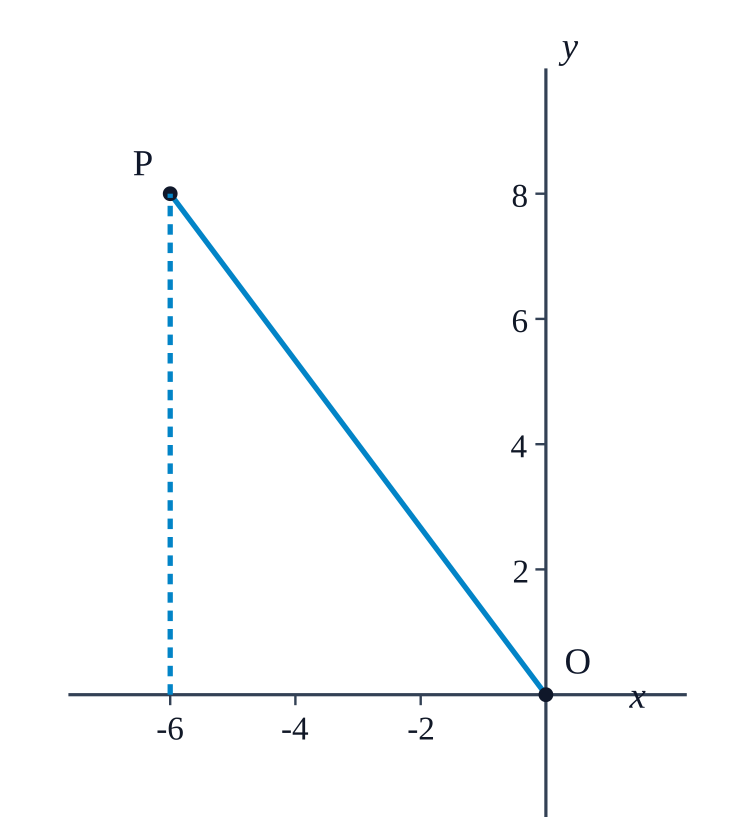
    The distance of the point P(−6,8)\displaystyle \mathrm{P}(-6,8) from the origin is
    (A)
    8\displaystyle 8 (B) 27\displaystyle 2 \sqrt{7}
    (C)
    10\displaystyle 10

    Matches the book, not yet reviewed

    This working reaches the answer NCERT prints. It has not yet been read through by hand.

    NCERT’s answer
    (C)
    (C) \(\displaystyle 10\) NCERT_Solution_Class10_Maths_Exemplar_Ch7_Ex7-1_Q3 \[OP = \sqrt{x^2+y^2} \] \[OP = \sqrt{(-6)^2+8^2} = \sqrt{36+64} = \sqrt{100} = 10 \]
  4. Exercise 4

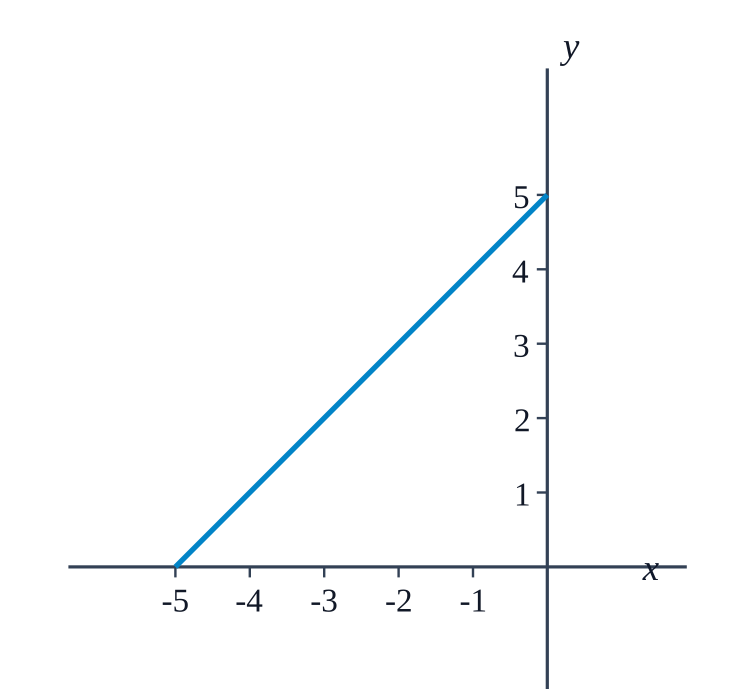
    The distance between the points (0,5)\displaystyle (0,5) and (−5,0)\displaystyle (-5,0) is
    (A)
    5\displaystyle 5 (B) 52\displaystyle 5 \sqrt{2}
    (C)
    25\displaystyle 2 \sqrt{5}
    (D)
    10\displaystyle 10

    Matches the book, not yet reviewed

    This working reaches the answer NCERT prints. It has not yet been read through by hand.

    NCERT’s answer
    (B)
    (B) \(\displaystyle 5\sqrt{2}\) NCERT_Solution_Class10_Maths_Exemplar_Ch7_Ex7-1_Q4 \[d = \sqrt{(x_2-x_1)^2+(y_2-y_1)^2} \] \[d = \sqrt{(-5-0)^2+(0-5)^2} = \sqrt{50} = 5\sqrt{2} \]
  5. Exercise 5

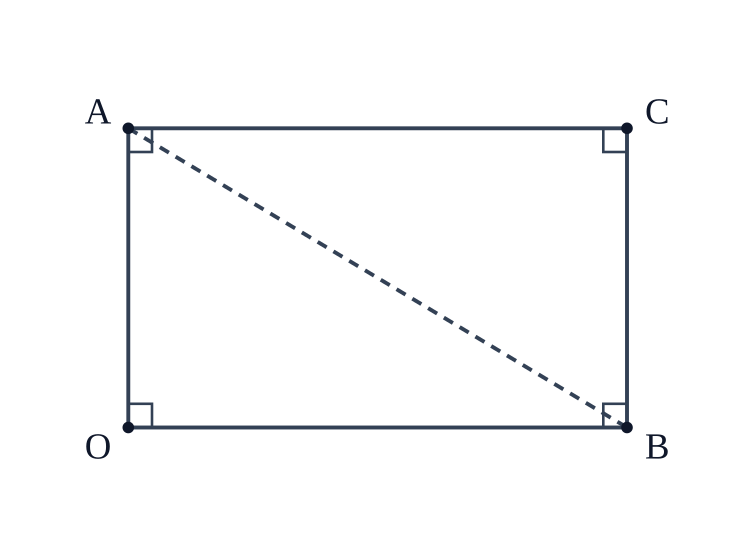
    AOBC is a rectangle whose three vertices are vertices A(0,3),O(0,0)\displaystyle \mathrm{A}(0,3), \mathrm{O}(0,0) and B(5,0)\displaystyle \mathrm{B}(5,0). The length of its diagonal is
    (A)
    5\displaystyle 5 (B) 3\displaystyle 3 (C) 34\displaystyle \sqrt{34}

    Matches the book, not yet reviewed

    This working reaches the answer NCERT prints. It has not yet been read through by hand.

    NCERT’s answer
    (C)
    (C) \(\displaystyle \sqrt{34}\) NCERT_Solution_Class10_Maths_Exemplar_Ch7_Ex7-1_Q5 \[C = A + B - O = (5,3) \] \[AB = \sqrt{(5-0)^2+(0-3)^2} = \sqrt{25+9} = \sqrt{34} \]
  6. Exercise 6

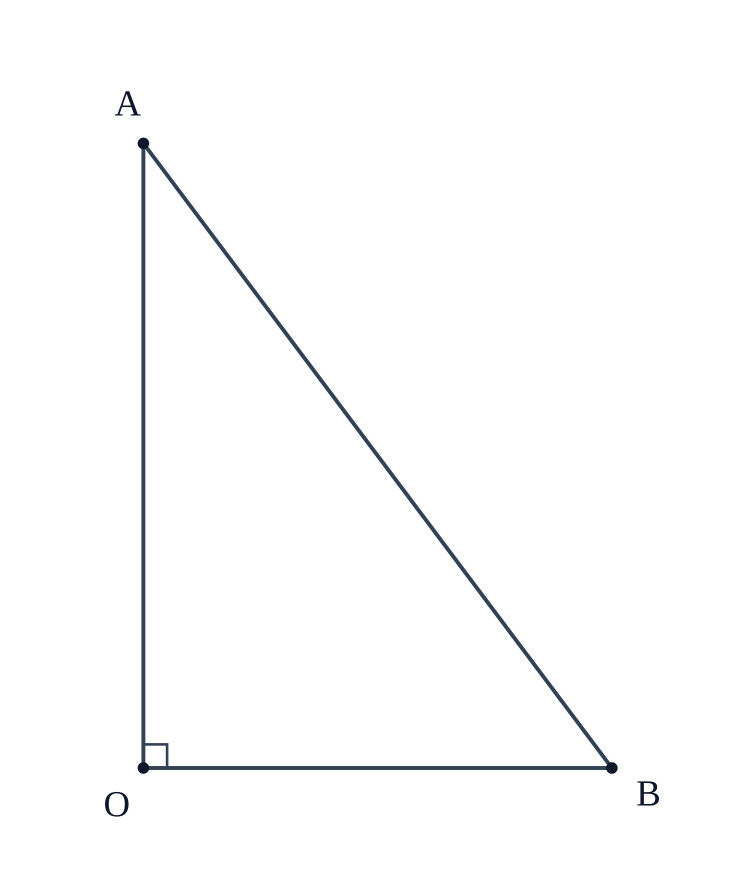
    The perimeter of a triangle with vertices (0,4),(0,0)\displaystyle (0,4),(0,0) and (3,0)\displaystyle (3,0) is
    (A)
    5\displaystyle 5 (B) 12\displaystyle 12
    (C)
    11\displaystyle 11
    (D)
    7+5\displaystyle 7+\sqrt{5}

    Matches the book, not yet reviewed

    This working reaches the answer NCERT prints. It has not yet been read through by hand.

    NCERT’s answer
    (B)
    (B) \(\displaystyle 12\) NCERT_Solution_Class10_Maths_Exemplar_Ch7_Ex7-1_Q6 \[\sqrt{(0-0)^2+(4-0)^2}=4,\quad \sqrt{(3-0)^2+(0-0)^2}=3,\quad \sqrt{(3-0)^2+(0-4)^2}=5 \] \[\text{Perimeter} = 4+3+5 = 12 \]
  7. Exercise 7

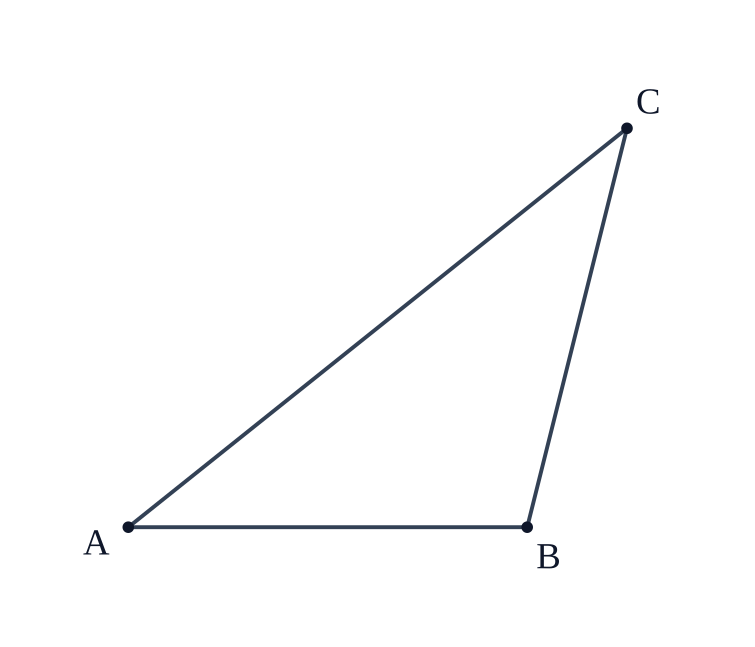
    The area of a triangle with vertices A(3,0),B(7,0)\displaystyle \mathrm{A}(3,0), \mathrm{B}(7,0) and C(8,4)\displaystyle \mathrm{C}(8,4) is
    (A)
    14\displaystyle 14
    (B)
    28\displaystyle 28
    (C)
    8\displaystyle 8 (D) 6\displaystyle 6

    Matches the book, not yet reviewed

    This working reaches the answer NCERT prints. It has not yet been read through by hand.

    NCERT’s answer
    (C)
    (C) \(\displaystyle 8\) NCERT_Solution_Class10_Maths_Exemplar_Ch7_Ex7-1_Q7 \[\text{Area} = \tfrac12\big|x_A(y_B-y_C)+x_B(y_C-y_A)+x_C(y_A-y_B)\big| \] \[= \tfrac12\big|3(0-4)+7(4-0)+8(0-0)\big| = \tfrac12(16) = 8 \]
  8. Exercise 8

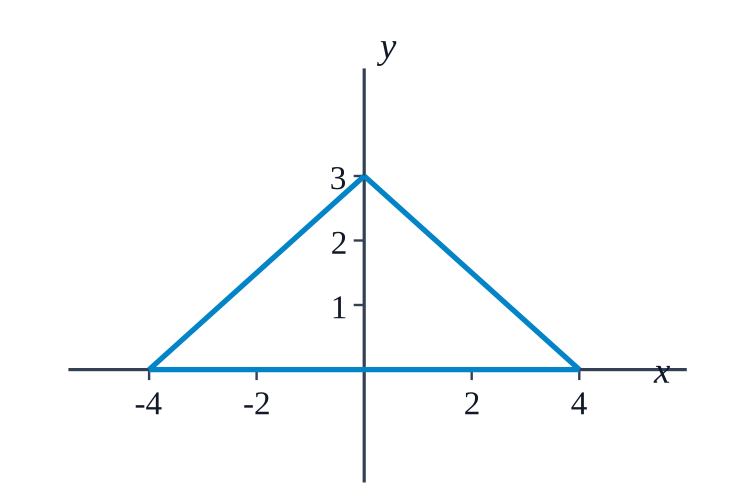
    The points (−4,0),(4,0),(0,3)\displaystyle (-4,0),(4,0),(0,3) are the vertices of a
    (A)
    right triangle
    (B)
    isosceles triangle
    (C)
    equilateral triangle
    (D)
    scalene triangle

    Matches the book, not yet reviewed

    This working reaches the answer NCERT prints. It has not yet been read through by hand.

    NCERT’s answer
    (B)
    (B) isosceles triangle \[AB=\sqrt{(4-(-4))^2+(0-0)^2}=8 \] \[AC=\sqrt{(0-(-4))^2+(3-0)^2}=5 \] \[BC=\sqrt{(0-4)^2+(3-0)^2}=5 \] NCERT_Solution_Class10_Maths_Exemplar_Ch7_Ex7-1_Q8 \(\displaystyle AC=BC\ne AB\), so the triangle is isosceles.
  9. Exercise 9

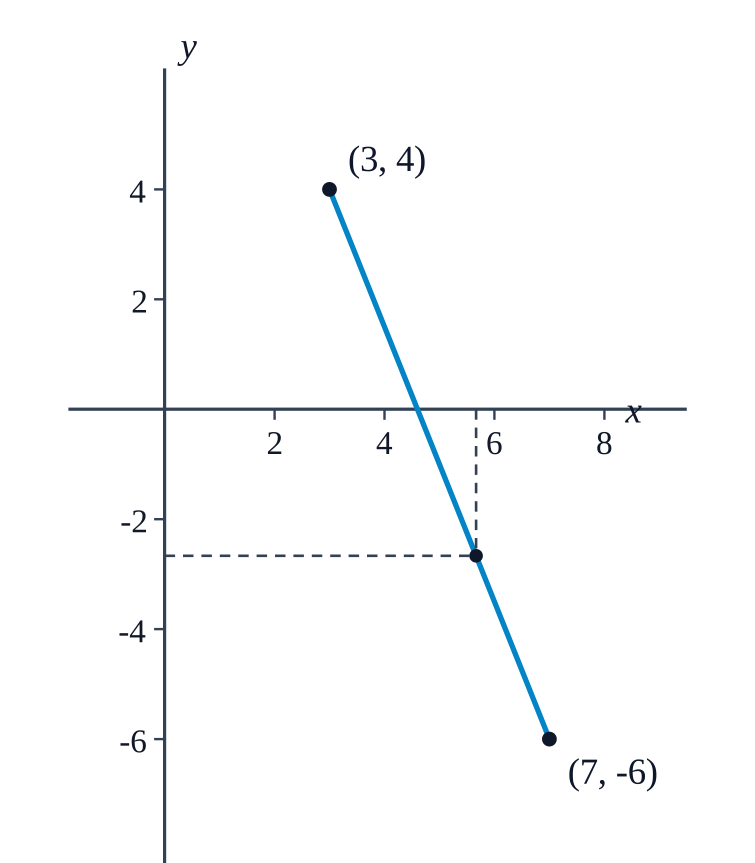
    The point which divides the line segment joining the points (7,−6)\displaystyle (7,-6) and (3,4)\displaystyle (3,4) in ratio 1\displaystyle 1 : 2\displaystyle 2 internally lies in the
    (A)
    I quadrant
    (B)
    II quadrant
    (C)
    III quadrant
    (D)
    IV quadrant

    Matches the book, not yet reviewed

    This working reaches the answer NCERT prints. It has not yet been read through by hand.

    NCERT’s answer
    (D)
    (D) IV quadrant \[x=\frac{1\cdot3+2\cdot7}{1+2}=\frac{17}{3} \] \[y=\frac{1\cdot4+2\cdot(-6)}{1+2}=-\frac{8}{3} \] NCERT_Solution_Class10_Maths_Exemplar_Ch7_Ex7-1_Q9 \(\displaystyle x>0\) and \(\displaystyle y<0\), so the point lies in the fourth quadrant.
  10. Exercise 10

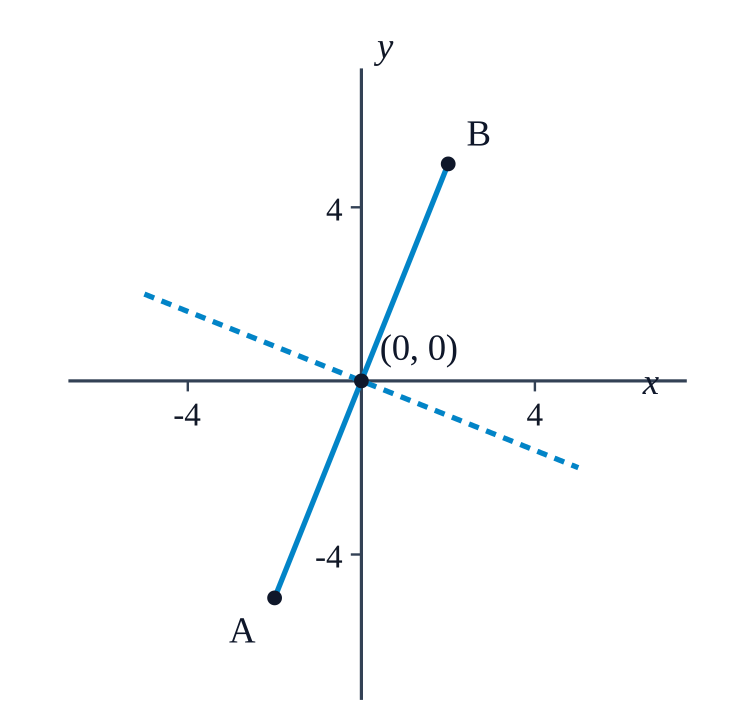
    The point which lies on the perpendicular bisector of the line segment joining the points A(−2,−5)\displaystyle \mathrm{A}(-2,-5) and B(2,5)\displaystyle \mathrm{B}(2,5) is
    (A)
    (0,0)\displaystyle (0,0)
    (B)
    (0,2)\displaystyle (0,2)
    (C)
    (2,0)\displaystyle (2,0)
    (D)
    (−2,0)\displaystyle (-2,0)

    Matches the book, not yet reviewed

    This working reaches the answer NCERT prints. It has not yet been read through by hand.

    NCERT’s answer
    (A)
    (A) \(\displaystyle (0,0)\) \[\text{Midpoint of }AB=\left(\frac{-2+2}{2},\frac{-5+5}{2}\right)=(0,0) \] NCERT_Solution_Class10_Maths_Exemplar_Ch7_Ex7-1_Q10 The perpendicular bisector always passes through the midpoint of the segment.