SolveItClass 9 · NCERT

NCERT Solutions · Class 9 Social Science State and Society up to 1000 CE

32 questions · 32 still being checked

Think About It 5.1–5.5 (part 5 of 7)

  1. Exercise 5.1

    In modern democracies, heads of government exercise power but are bound by constitutions and parliaments, which function as representative bodies that check the powers of elected leaders. Do the roles of the rājā and the assemblies in Vedic times suggest a similar principle? Can we say that systems of governance in Indian history—since their early institutionalised forms—were guided by the idea of ensuring people’s participation in the political process?

    The book prints no answer for this

    NCERT publishes no answers for this textbook, so there is nothing in the book to check this working against. It has also not yet been read through by hand.

    Do the rājā and the assemblies suggest a similar principle?NCERT_Solution_Class9_SocialScience_Ch5_TAI_Q5-1
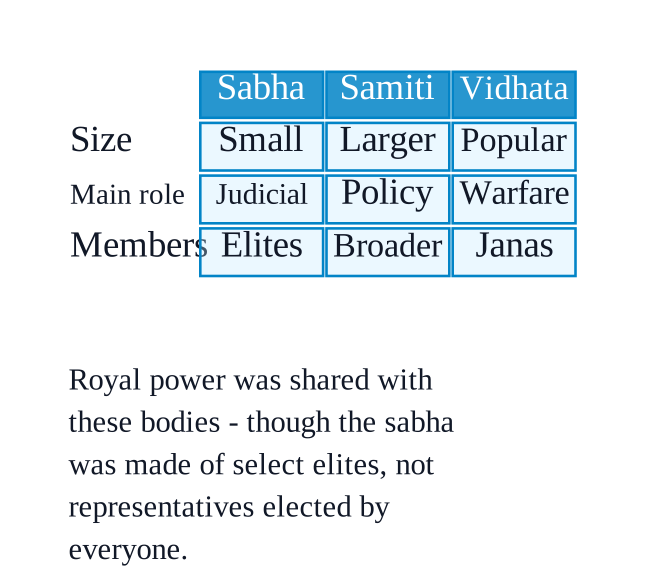
    Yes, in principle — the Vedic rājā's power was shared with assemblies, which is the same basic idea as checking a leader's power, though the two systems are not the same thing.
    The sabhā was a smaller body, composed of select elites, that primarily served a judicial function.
    The samiti was a larger assembly focused on policy decisions and political affairs, and represented the broader population.
    The vidhata was a popular gathering attended by members of the community (janas), and a forum for discussions on warfare and other political matters.
    The chapter adds that although kingship was generally hereditary, there are references to kings being elected or even expelled — so royal authority was not always absolute.
    Can we say governance in India was guided by participation from its earliest forms?
    Yes — participation in political decisions is a very old idea here, present at the earliest institutionalised stage of Indian governance.
    But say it carefully: the sabhā was made of select elites, not representatives elected by everyone, and there was no written constitution binding the rājā.
    The fair conclusion is that the principle of shared, consultative decision-making is ancient, while the machinery of modern democracy is new.
  2. Exercise 5.2

    Texts such as the Mahābhārata and the Arthaśhāstra describe the king’s duties as protecting people and ensuring justice. Why do you think it was important for rulers to protect people and ensure justice? What do these descriptions tell us about ideas of governance and the relationship between rulers and subjects during that period?

    The book prints no answer for this

    NCERT publishes no answers for this textbook, so there is nothing in the book to check this working against. It has also not yet been read through by hand.

    Why protection and justice matteredNCERT_Solution_Class9_SocialScience_Ch5_TAI_Q5-2
    Because a king's right to rule rested on doing them — they were his duties, not favours he granted.
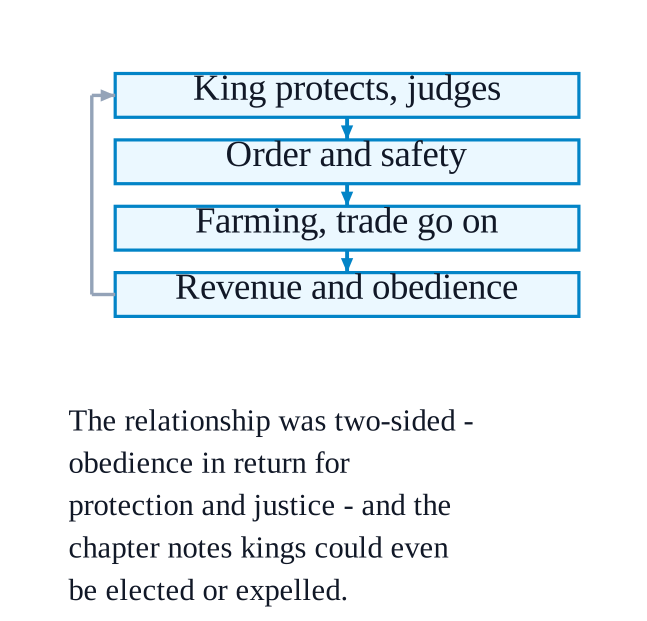
    Without protection from external threats and internal disorder, farming, trade and ordinary life could not carry on, and the state's own revenue would dry up.
    Settling cases such as abduction, robbery, theft and adultery kept order, so that disputes did not become private fights; serious offences carried severe punishments.
    People will only obey and pay taxes to a ruler who keeps them safe, so protection was also what held the state together.
    What this tells us about governance and the ruler–subject relationship
    Governance was understood as an ethical duty, not just command. The Śhānti Parva of the Mahābhārata guides rulers on ethical conduct, justice and responsibility towards subjects.
    The Yajurveda coronation oath asks the king to judge the strong and the weak impartially and fairly, to protect the country from all calamities, and to do good to the people.
    Kauṭilya's Arthaśhāstra ties the whole administration to the king's own conduct: "Only if a king is himself energetically active, do his officers follow him energetically."
    So the relationship was two-sided — obedience in return for protection and justice — and the chapter notes kings could even be elected or expelled, which shows royal authority was not always absolute.
  3. Exercise 5.3

    Why do you think different rulers chose to record their inscriptions on the same stone instead of a new one? Discuss your answers with your classmates.

    The book prints no answer for this

    NCERT publishes no answers for this textbook, so there is nothing in the book to check this working against. It has also not yet been read through by hand.

    Because a stone that already carried a royal record had become a place of authority — adding to it borrowed that authority.
    NCERT_Solution_Class9_SocialScience_Ch5_TAI_Q5-3
    The chapter's example is the Junagadh Rock Inscription near Girnar, Gujarat, written on by three rulers across about $\displaystyle 700$ years: Aśhoka (3rd century BCE), the Western Satrap Rudradaman I (c. $\displaystyle 150$ CE) and the Gupta emperor Skandagupta (5th century CE).
    Such a rock stood where people already came and read, so a new message reached a ready-made audience.
    Writing beside earlier rulers linked a new king to a line of famous predecessors and made his own claim look legitimate.
    There was a practical reason too: the later two records concern the same public work — Rudradaman I describes repairing the Sudarshana Lake, and Skandagupta records restoring it after severe damage — so the rock became the running record of that lake.
    The result is that one site now preserves the records of the Maurya, Western Satrap and Gupta dynasties together, telling us about administration, public works and political history at once.
  4. Exercise 5.4

    How would dividing a kingdom into provinces, districts, and villages have helped rulers manage their empires? What similarities can you identify between these administrative divisions and the system of governance in India today?

    The book prints no answer for this

    NCERT publishes no answers for this textbook, so there is nothing in the book to check this working against. It has also not yet been read through by hand.

    How dividing the kingdom helped rulersNCERT_Solution_Class9_SocialScience_Ch5_TAI_Q5-4
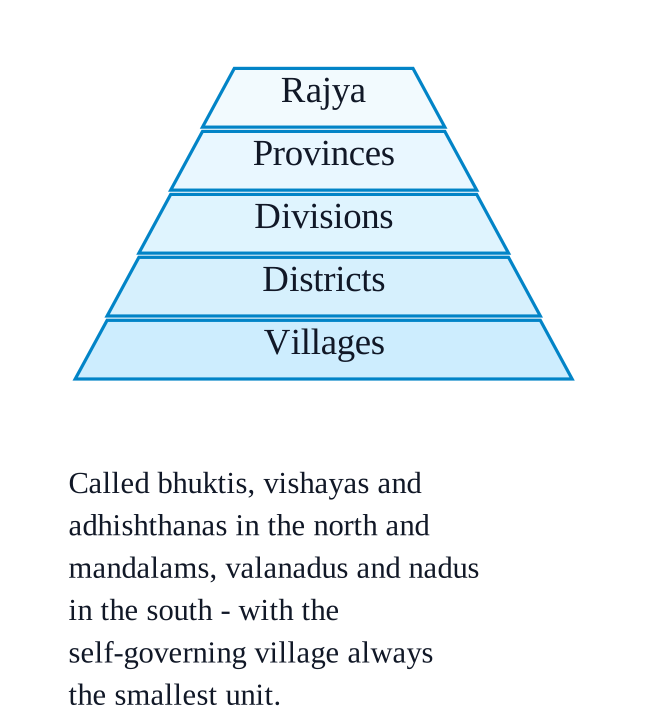
    It let a king rule through officers close to the people instead of trying to reach every village himself.
    Every level had someone answerable: provinces under governors, districts under officers such as the pradeśhikas, villages under a headman like the grāmika.
    Revenue could be collected and disputes settled locally, so orders and complaints travelled shorter distances.
    Local knowledge improved decisions — the chapter notes district officers often decided after consulting bankers, caravan leaders, artisans and scribes.
    Villages could run their own affairs through assemblies and small committees (variyams) for irrigation, gardens and temple management, so the state was not burdened with everything.
    Between about $\displaystyle 300$ CE and $\displaystyle 800$ CE this became deliberate policy: the rājya was divided into bhuktis or manḍalas, then viṣhayas or valanāḍus, then districts, then villages, for administrative convenience.
    Similarities with governance in India today
    India is still governed in layers — the country, then states, then districts, then villages — just as a rājya was divided into provinces, districts and villages.
    Elected village bodies handle local work today, much as the old village assemblies managed irrigation, records and local disputes.
    Officers still head districts, as the pradeśhikas once did.
    Be careful in the exam: this chapter names no modern institution. Say that the pattern of layered administration continues, and take the details from what you learned under 'Governance and Democracy' in earlier grades.
  5. Exercise 5.5

    Why do you think irrigational structures like dams and canals were considered so important that their construction was recorded in inscriptions?

    The book prints no answer for this

    NCERT publishes no answers for this textbook, so there is nothing in the book to check this working against. It has also not yet been read through by hand.

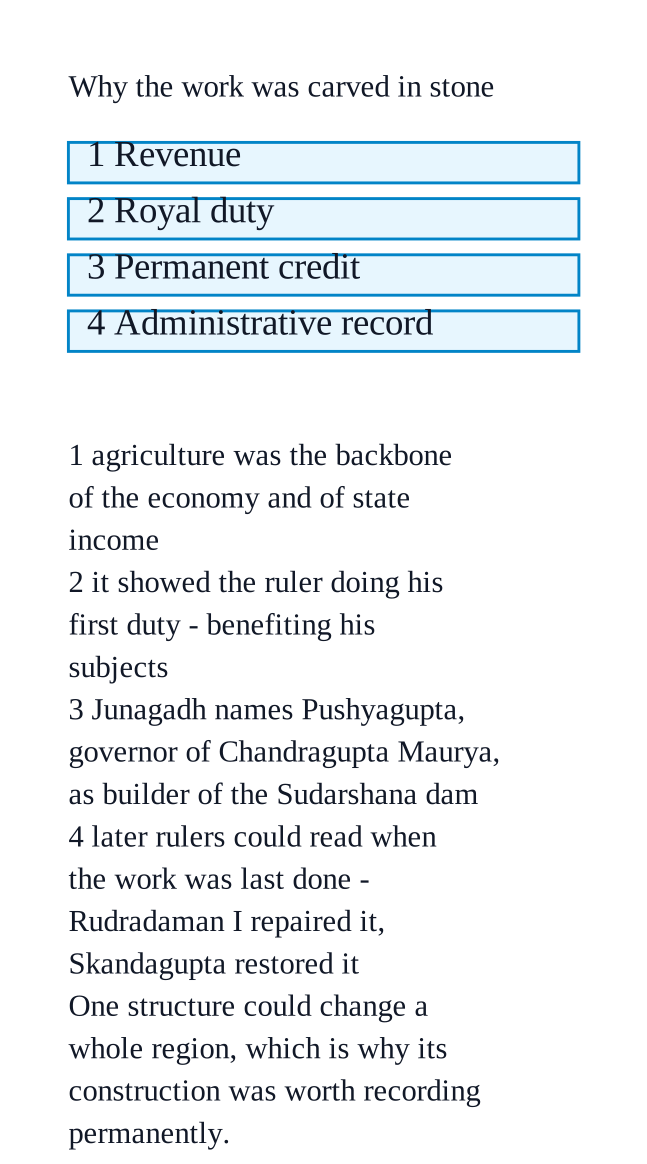
    Because irrigation decided whether the harvest succeeded — and the harvest was where the kingdom's revenue came from.
    NCERT_Solution_Class9_SocialScience_Ch5_TAI_Q5-5
    The chapter says agriculture remained the backbone of the economy, sustaining both rural livelihoods and state revenue, so facilitating it "continued to be a major preoccupation of the state".
    Dams, canals and reservoirs stored and distributed water, supported farming and encouraged settlements to grow — one structure could change a whole region.
    Recording the work in stone showed the ruler doing his first duty, protecting and benefiting his subjects, which is exactly the ideal the texts set for kings.
    An inscription also fixed the credit permanently: the Junagadh inscription names Puṣhyagupta, a governor appointed by Chandragupta Maurya, as builder of the dam on Sudarshana Lake near Girnar, and the same rock later records Rudradaman I's repair and Skandagupta's restoration of it.
    It doubled as an administrative record — later rulers reading the stone knew when the work was last done, and by whom.