SolveItClass 9 · NCERT

NCERT Solutions · Class 9 Social Science State and Society up to 1000 CE

32 questions · 32 still being checked

The Big Questions 5.1–5.4 (part 1 of 7)

  1. Exercise 5.1

    How did society and state organise themselves prior to 1000\displaystyle 1000 CE?

    The book prints no answer for this

    NCERT publishes no answers for this textbook, so there is nothing in the book to check this working against. It has also not yet been read through by hand.

    Society was held together by custom and kinship, while the State was an organised political system of rules, laws and offices.
    NCERT_Solution_Class9_SocialScience_Ch5_BQ_Q5-1
    The chapter defines society as a system of social relationships among people who share a territory, a culture and a sense of belonging — built from families (kula) and institutions like marriage, and regulated mostly by customs rather than formal laws.
    The earliest political unit was the jana, a kin-based clan; the Ṛigveda alone mentions about thirty janas, five of them together called the pañchajana.
    The rājā was a clan chief who led the group in warfare and protected its members — not yet a ruler of a fixed territory.
    Three assemblies — sabhā, samiti and vidhata — shared in decisions, so the rājā did not decide alone.
    Later the jana grew into territory-based janapadas, then mahājanapadas, then empires with a council of ministers, provinces, districts and villages.
  2. Exercise 5.2

    How did states and societies emerge and spread to different parts of the Indian subcontinent?

    The book prints no answer for this

    NCERT publishes no answers for this textbook, so there is nothing in the book to check this working against. It has also not yet been read through by hand.

    States spread by moving from kinship to territory, and from small clans to empires covering much of the subcontinent.
    NCERT_Solution_Class9_SocialScience_Ch5_BQ_Q5-2
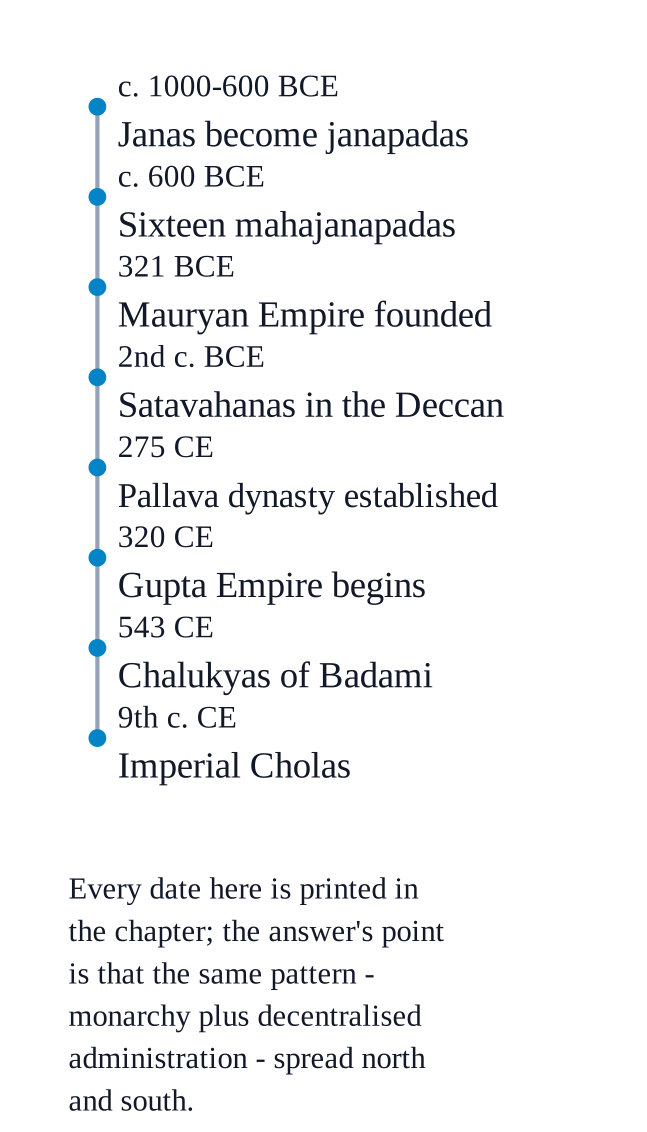
    Between about $\displaystyle 1000$ BCE and $\displaystyle 600$ BCE, janas became janapadas — the word means where a people (jana) first set its feet, so belonging to a land began to matter more than belonging to a clan.
    Iron implements, more grain (especially paddy) and control of land and trade routes let the Ganga plains fill up; from about $\displaystyle 600$ BCE the sources speak of sixteen mahājanapadas, with Magadha the strongest because of its location, fertile plains and strong rulers.
    Northern India then held two kinds of state side by side — monarchies (rājyas) and republics (gaṇas or saṁghas) — and Magadha's expansion grew into the Mauryan Empire, later followed by the Guptas.
    In the south the Satavāhanas succeeded the Mauryas in the Deccan, while the Cholas, Pandyas, Keralaputras (Cheras) and Satiyaputras ruled the far south and are named in Aśhokan inscriptions.
    Later came the Pallavas, the Chālukyas of Badami, the Gurjara-Pratihāras, Pālas and Rāṣhṭrakūṭas, and the imperial Cholas — all using a similar mix of monarchy and decentralised administration.
  3. Exercise 5.3

    How did the ideas of dharma and chakravarti samrāṭ help create unity in social values and governance, and promote the idea of the Indian subcontinent as one political entity?

    The book prints no answer for this

    NCERT publishes no answers for this textbook, so there is nothing in the book to check this working against. It has also not yet been read through by hand.

    Dharma gave rulers a shared moral rule; the chakravarti ideal gave them a shared political map — together they made the subcontinent feel like one world.
    In this chapter dharma does not mean religion: it means duty, obligation, righteousness and moral conduct, and it applied to everyone, the king included.
    Because kings everywhere were judged by the same standard — protect the people, give justice, work "for the welfare of all beings" — governance rested on common values from the Mauryas to the Cholas.
    Terms such as Jambudvīpa, Bhāratavarṣha, Prithivi and chakravarti kśhetra, and rituals such as the aśhvamedha and rājasūya yajña, expressed authority over the whole land; the Arthaśhāstra defines prithivi as "the area lying between the Himavat (Himalayas) and the sea" and equates it with the chakravarti kśhetra, the "domain of a universal paramount ruler".
    Rulers far apart chased the same ideal: the Chera king Nedunjeral Adan is described as extending his conquests up to the Himalayas, and in the 11th century CE the Chola Rajendra I took the title Gangaikonda for his conquest along the Ganga.
  4. Exercise 5.4

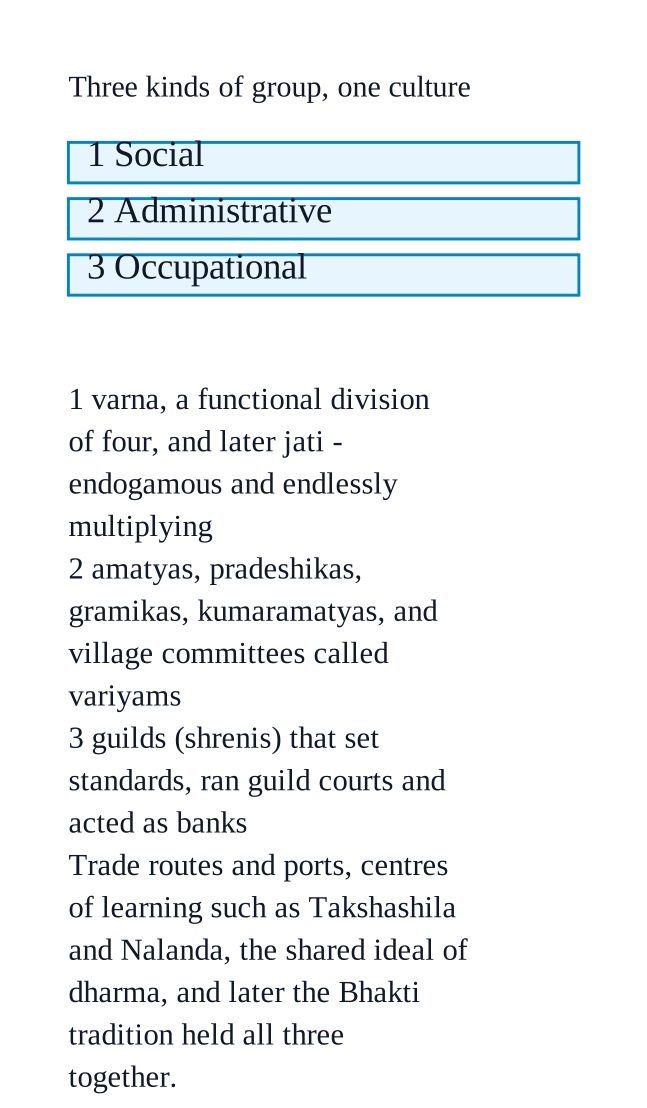
    How did different social, administrative, and occupational groups take shape over time and come together culturally?

    The book prints no answer for this

    NCERT publishes no answers for this textbook, so there is nothing in the book to check this working against. It has also not yet been read through by hand.

    Groups formed around occupation and locality first, later hardening into varṇa and jāti — while shared texts, trade, learning and devotion kept them culturally connected.
    NCERT_Solution_Class9_SocialScience_Ch5_BQ_Q5-4
    The four varṇas began as a functional division; the Ṛigveda verse about a poet, a physician father and a corn-grinding mother shows occupations were not fixed by birth.
    Jātis grew later from intermarriage among varṇas, migrating communities becoming endogamous, and territorial differences; varṇas stayed four, but jātis kept multiplying as new groups and occupations appeared.
    Administrative groups appeared as states grew — amātyas, pradeśhikas, grāmikas, kumārāmātyas, and village committees called variyams.
    Occupational groups organised themselves as guilds (śhreṇīs), which fixed standards, ran guild courts and even acted as banks.
    They came together culturally through trade routes and ports, centres of learning such as Takṣhaśhilā, Nālandā and Vikramśhilā, the shared ideal of dharma, and later the Bhakti tradition, which was open to all regardless of class or gender.