SolveItClass 9 · NCERT

NCERT Solutions · Class 9 Social Science State and Society up to 1000 CE

32 questions · 32 still being checked

Let's Recall 5.1–5.5 (part 2 of 7)

  1. Exercise 5.1

    In previous grades, you have read that the name ‘Bharata’ first appears in the Ṛigveda. It is used in reference to the ‘Bharata jana’, or the people who were ruled by the family of the Bharatas. What does this tell us about how early communities identified themselves and their rulers?

    The book prints no answer for this

    NCERT publishes no answers for this textbook, so there is nothing in the book to check this working against. It has also not yet been read through by hand.

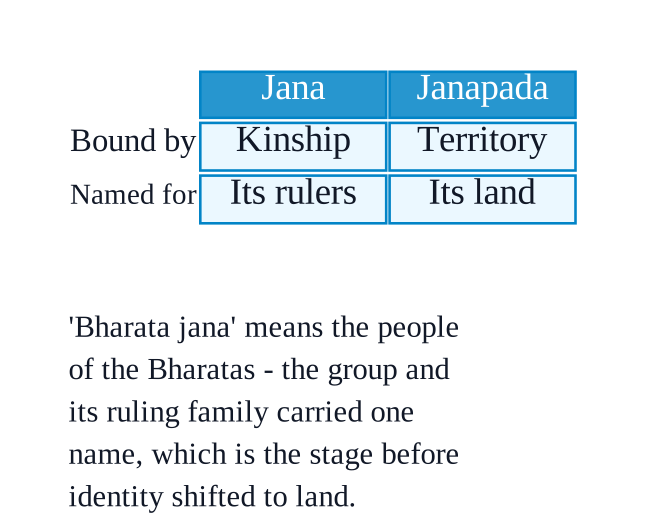
    It tells us that early communities identified themselves by kinship, not by territory — a people took its name from its ruling family.
    NCERT_Solution_Class9_SocialScience_Ch5_LR_Q5-1
    'Bharata jana' means the people of the Bharatas: the name of the group and the name of its rulers were the same thing.
    So the ruler was not separate from the people. The chapter says the rājā at this stage was a clan chief who led the group in warfare and ensured the protection of its members.
    Many such clan identities existed together — the Ṛigveda mentions about thirty janas, five of them (Yadu, Turvaśha, Puru, Anu, Druhyu) known collectively as the pañchajana.
    This is the stage before identity shifted to land, which happened when janas became janapadas.
  2. Exercise 5.2

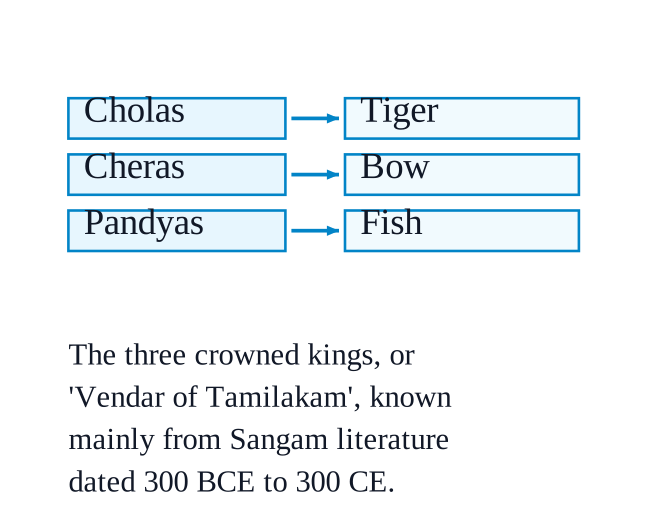
    You may remember from your previous grades that the three important kingdoms of southern India, the Cholas, Cheras, and Pandyas, had their own royal emblems. The tiger was the emblem of the Cholas, the bow represented the Cheras, and the fish symbolised the Pandyas. Much of what we know about these early Tamil kingdoms comes from Sangam literature, the earliest Tamil literary tradition, which dates between 300\displaystyle 300 BCE and 300\displaystyle 300 CE. The Chera, Chola, and Pandya rulers were known as the three crowned kings or “Vendar of Tamilakam”, and their kingdoms flourished in fertile rice-growing regions. Sangam poems also describe brave and ambitious kings, including a Chera ruler who earned the title adhirāja after defeating several crowned kings. These poems further mention Vedic yajñas and links with epic traditions. However, these early kingdoms should not be confused with the later imperial Chola, Chera, and Pandya kingdoms that emerged many centuries later.

    The book prints no answer for this

    NCERT publishes no answers for this textbook, so there is nothing in the book to check this working against. It has also not yet been read through by hand.

    What this box asks you to recallNCERT_Solution_Class9_SocialScience_Ch5_LR_Q5-2
    The three crowned kings of Tamilakam — the Cholas, Cheras and Pandyas — and how we know about them.
    Their emblems
    Tiger — the Cholas.
    Bow — the Cheras.
    Fish — the Pandyas.
    How we know about them
    Mainly from Sangam literature, the earliest Tamil literary tradition, dated between $\displaystyle 300$ BCE and $\displaystyle 300$ CE.
    These rulers were known as the three crowned kings, or "Vendar of Tamilakam", and their kingdoms flourished in fertile rice-growing regions.
    Sangam poems describe brave and ambitious kings, including a Chera ruler who earned the title adhirāja after defeating several crowned kings, and they also mention Vedic yajñas and links with epic traditions.
    The caution to remember
    Do not confuse these early kingdoms with the later imperial Chola, Chera and Pandya kingdoms, which emerged many centuries afterwards.
  3. Exercise 5.3

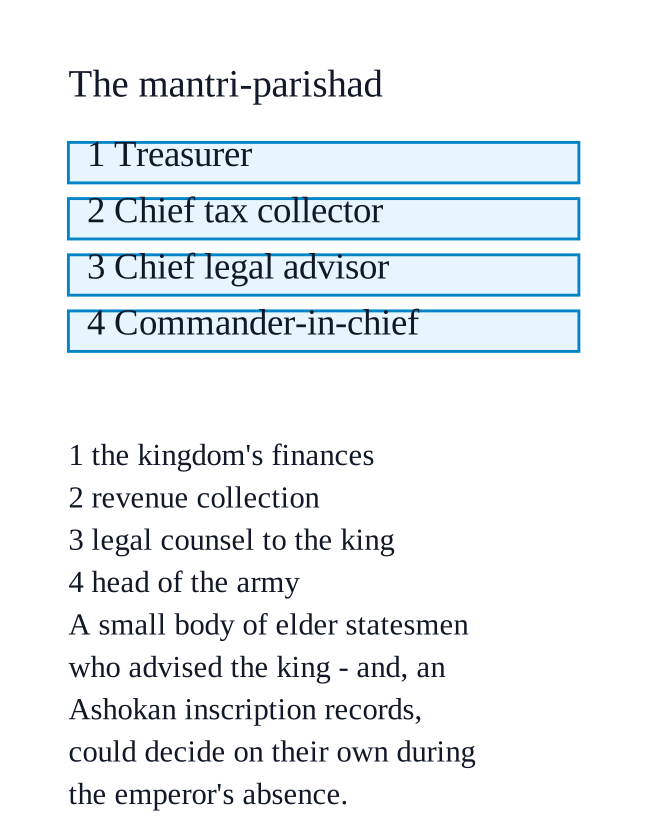
    The Arthaśhāstra is one of the earliest and most systematic treatises on statecraft. It presents a detailed picture of administration, and emphasises the importance of training a king in the art of governance and public administration. The Arthaśhāstra states that “one wheel does not move the carriage”. This statement captures the belief that effective governance requires cooperation and a well-organised administrative machinery. In fact, various literary and epigraphic sources from this period indicate that the king did not rule alone but governed through a multi-layered administrative system. Central to this system was the council of ministers (mantri-pariṣhad), a small body of elder statesmen, whose primary role was to advise and support the king. The council of ministers generally included the treasurer, the chief tax collector, the chief legal advisor, and the commander-in-chief of the army. An Aśhokan inscription refers to decisions taken by the council of ministers during the emperor’s absence, showing that, in exceptional circumstances, the council could take decisions independently in public interest.

    The book prints no answer for this

    NCERT publishes no answers for this textbook, so there is nothing in the book to check this working against. It has also not yet been read through by hand.

    What this box asks you to recallNCERT_Solution_Class9_SocialScience_Ch5_LR_Q5-3
    That a king did not rule alone — early Indian government was a multi-layered machine, not one man.
    The Arthaśhāstra
    One of the earliest and most systematic treatises on statecraft.
    It gives a detailed picture of administration and stresses training a king in governance and public administration.
    Its saying, "one wheel does not move the carriage", means effective governance requires cooperation and a well-organised administrative machinery.
    The council of ministers (mantri-pariṣhad)
    A small body of elder statesmen whose primary role was to advise and support the king.
    It generally included the treasurer, the chief tax collector, the chief legal advisor and the commander-in-chief of the army.
    An Aśhokan inscription records decisions taken by the council during the emperor's absence — so in exceptional circumstances it could decide independently, in public interest.
    Why it matters
    Both literary and epigraphic sources agree on this point, which is strong evidence that advice and delegation were built into early Indian kingship.
  4. Exercise 5.4

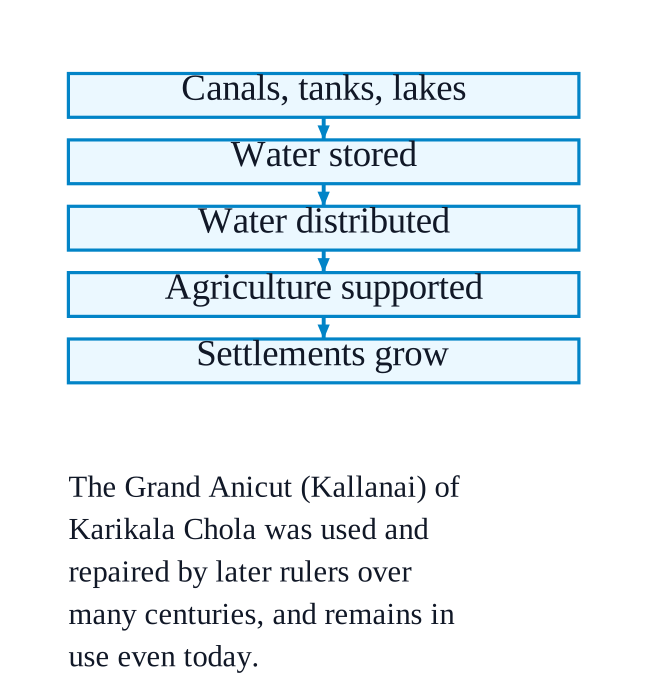
    The Cholas were builders of irrigation systems that included canals, lakes, and tanks with connecting channels. Do you remember reading in your previous grades about the Grand Anicut (Kallanai) built by Karikala Chola? Such irrigation structures helped store and distribute water, supported agriculture, and encouraged the growth of settlements. The Grand Anicut continued to be used and repaired by later rulers and administrations over many centuries, showing the lasting importance of irrigation works undertaken by Cholas. Remarkably, it remains in use even today.

    The book prints no answer for this

    NCERT publishes no answers for this textbook, so there is nothing in the book to check this working against. It has also not yet been read through by hand.

    What this box asks you to recallNCERT_Solution_Class9_SocialScience_Ch5_LR_Q5-4
    The Grand Anicut (Kallanai), built by Karikala Chola, which you read about in earlier grades.
    What the chapter tells you here
    The Cholas were builders of irrigation systems that included canals, lakes, and tanks with connecting channels.
    Such structures stored and distributed water, supported agriculture, and encouraged the growth of settlements.
    The Grand Anicut continued to be used and repaired by later rulers and administrations over many centuries.
    Remarkably, it remains in use even today — the chapter's proof of how lasting these Chola works were.
    Why this sits here in the chapter
    It backs up the section's main point: agriculture was the backbone of the economy, so facilitating irrigation was a major preoccupation of the state.
  5. Exercise 5.5

    In previous grades, we studied the Silappadikāram, which mentions two important routes in the Tamil region that also extended into northern India. The first route linked Kanchipuram to the famous port of Poompuhar (Kaveripattinam), and the second connected Kanchipuram to Kanyakumari.

    The book prints no answer for this

    NCERT publishes no answers for this textbook, so there is nothing in the book to check this working against. It has also not yet been read through by hand.

    What this box asks you to recall
    The two routes in the Tamil region mentioned in the Silappadikāram, which also extended into northern India.
    The two routes
    The first linked Kanchipuram to Poompuhar (Kaveripattinam), a famous port.
    The second connected Kanchipuram to Kanyakumari.
    Why it matters here
    It shows that literary texts, not only maps and inscriptions, are evidence for early trade routes.
    It fits the section's main point: routes connected inland regions with coastal ports, integrating overland and maritime trade into one system.
    Kanchipuram sits where both routes meet, which is why it appears again in the chapter as an early historical city and a centre of learning.