SolveItClass 9 · NCERT

NCERT Solutions · Class 9 Social Science State and Society up to 1000 CE

32 questions · 32 still being checked

Let's Explore 5.1–5.3 (part 3 of 7)

  1. Exercise 5.1

    As you read the chapter, follow the timeline at the bottom of each page. Notice the important events, changes, and connections across time. Think about which event interests you the most and why. By the end of the chapter, share one event you would like to explore further and document: 1. What happened? 2. When did it happen? 3. Why do you think it matters?

    The book prints no answer for this

    NCERT publishes no answers for this textbook, so there is nothing in the book to check this working against. It has also not yet been read through by hand.

    Worked example (yours should be a different event if you like)NCERT_Solution_Class9_SocialScience_Ch5_LE_Q5-1
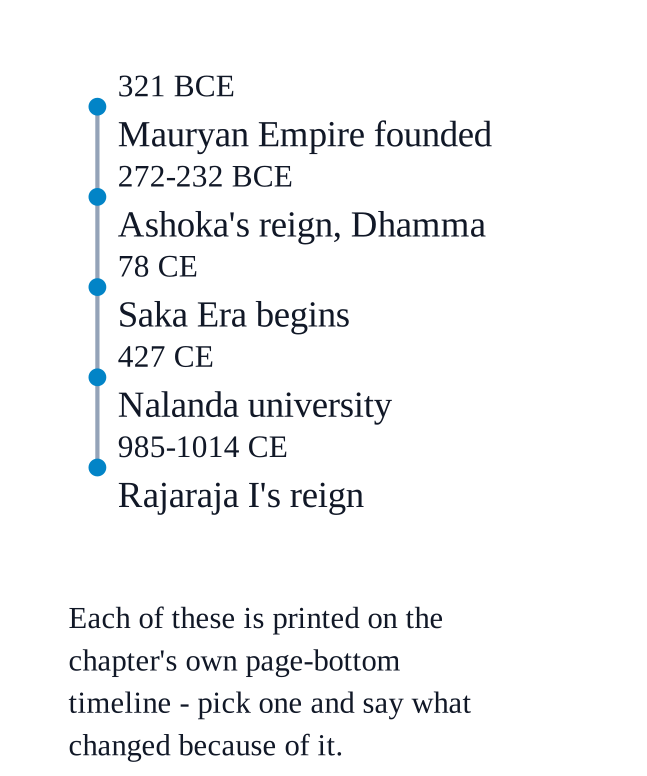
    What happened: Nālandā, one of early India's great centres of higher learning, was established.
    When: the chapter's timeline dates it to $\displaystyle 427$ CE, under 'Cultural and Religious Developments'.
    Why it matters: it shows that while dynasties rose and fell, India's knowledge traditions carried on. The chapter says institutions of higher learning attracted students from both India and other regions, and Fig $\displaystyle 5.10$ places Nālandā among the prominent early centres of learning alongside Takṣhaśhilā, Vallabhī and Vikramśhilā.
    Other events on the chapter timeline you could pick
    $\displaystyle 321$ BCE — foundation of the Mauryan Empire by Chandragupta Maurya.
    $\displaystyle 272$–$\displaystyle 232$ BCE — Aśhoka's reign and the philosophy of Dhamma.
    $\displaystyle 78$ CE — the Saka Era begins.
    $\displaystyle 985$–$\displaystyle 1014$ CE — Rājarāja I's reign and the Brihadeeshwara Temple, Thanjavur.
    What a good answer must contain
    An event that is actually printed on the chapter timeline, with the date exactly as printed.
    One or two sentences of your own saying what changed because of it.
    A reason for choosing it that links to something the chapter says elsewhere — not just "it sounded interesting".
  2. Exercise 5.2

    Read the verse given above and discuss it in groups. As you do so, think like historians—look for clues in the source and use them to understand what life may have been like. While discussing, keep these questions in mind: → What does the source tell us? (evidence) → What can we understand from it? (interpretation) → What might it not tell us? (limits of the source) Now answer the following: 1. What occupations are mentioned in the family described in the verse? What does this indicate about the nature of occupations in Vedic society? 2. How does the above verse challenge the idea that social status and occupation were fixed by birth? 3. What different occupations do you find in contemporary society? After the discussion, compare your group’s responses with those of another group and note the similarities and differences in interpretation. Did all groups interpret the source in the same way? What does this tell us about how historians use evidence to understand the past?

    The book prints no answer for this

    NCERT publishes no answers for this textbook, so there is nothing in the book to check this working against. It has also not yet been read through by hand.

    Thinking like a historian — a worked model
    Evidence: the verse names three occupations inside one family — "I am a poet; my father is a physician, my mother is a grinder of corn" — and says they have various occupations, desiring riches.
    Interpretation: work was varied and could differ from person to person even within a single household.
    Limits: it is one verse by one seer. It does not tell us whether such families were common, nor the family's rank, wealth, region, or how the occupations were chosen.
    1. What occupations are mentioned, and what does that indicate?
    Poet (the speaker), physician (the father) and grinder of corn (the mother).
    Three different occupations in one family, so work was not shared by the whole household.
    This indicates that occupations in Vedic society were flexible and mobile, and that the idea of strict hereditary occupation had not yet become firmly established.
    2. How does the verse challenge the idea that status and occupation were fixed by birth?
    The son does not follow the father's work — so the occupation was clearly not inherited.
    If status came only from birth, all three would share the same work and the same rank.
    The chapter uses this verse as its evidence for that flexibility, and the Buddhist Sutta Nipāta says the same thing directly: "No brāhmaṇa is such by birth. No outcaste is such by birth but only by his deeds."
    The chapter also notes that early Vedic texts do not indicate any fixed social status strictly based on birth — identity came from ethnicity, subgroup, region, village, gotra, language and, especially, occupation.
    3. What different occupations do you find in contemporary society?
    This one is yours to answer from what you see around you.
    Example of the shape: in a single family today you might find a teacher, a nurse, a shopkeeper, a farmer, a driver and a software engineer — and a child may take up work no one in the family has done before. (This is only an example; use the occupations you actually know.)
    Make the point at the end: like the Vedic family in the verse, occupations today are chosen, not inherited.
    Comparing with another group
    Expect differences. Groups often agree on the evidence but disagree on the interpretation.
    That is exactly how historians work: the source is fixed, but it has to be interpreted, and honest readings can differ — which is why historians argue from evidence instead of simply announcing conclusions.
  3. Exercise 5.3

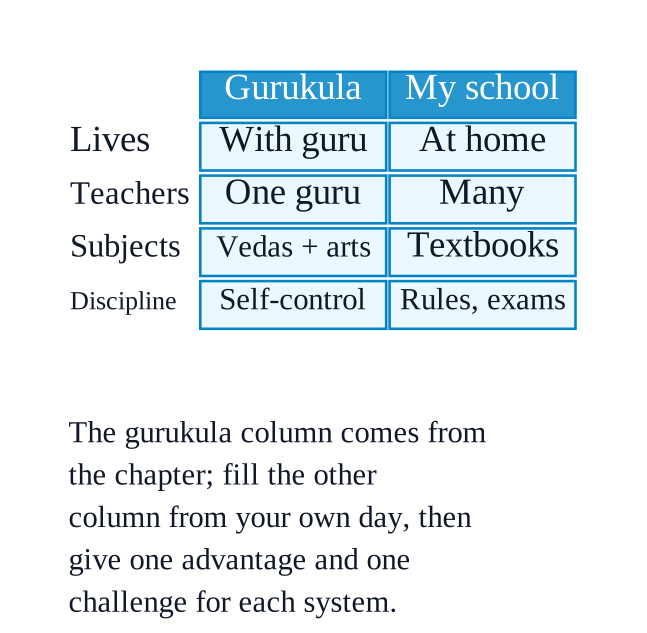
    Compare your school life with the life of a student in a gurukula in early India. Think about aspects such as daily routine, subjects studied, relationship with teachers, discipline, and living arrangements. What advantages and challenges do you think each system of education might have for students?

    The book prints no answer for this

    NCERT publishes no answers for this textbook, so there is nothing in the book to check this working against. It has also not yet been read through by hand.

    A worked example of the comparison (write your own version)NCERT_Solution_Class9_SocialScience_Ch5_LE_Q5-3
    Routine: I live at home and attend school for fixed hours with a timetable and bells; a gurukula student lived with the teacher, and the day mixed study, chores and service.
    Subjects: I study languages, mathematics, science and social science from set textbooks; a gurukula student studied the Vedas together with mathematics, medicine, astronomy, music and archery.
    Teachers: I learn from many subject teachers; a gurukula student learned mainly from one guru who was also his guardian.
    Discipline: mine comes from school rules and exams; his came from self-control, obedience and devotion.
    Living arrangements: I go home each evening; a gurukula student lived in the teacher's home, treated as a member of the teacher's family.
    The gurukula side (all of this is in the chapter)
    Living arrangements: the teacher's home served as the centre of the gurukula, and the student lived there, treated as a member of the teacher's family.
    Daily routine: a disciplined life marked by self-control, obedience and devotion, with yoga, meditation and service to the guru alongside study.
    Subjects: the Vedas, plus grammar, logic, philosophy, ethics, mathematics, science, medicine and astronomy; and training in arts and crafts — music, dance, painting, physical education and martial arts such as archery.
    Teachers: the guru-śhiṣhya paramparā was regarded as sacred; the guru was seen as a guide leading the student from the darkness of ignorance to the light of knowledge, and the bond was close and mutually supportive.
    Aim: education was a complete preparation for life, not just a path to a career, and pupils were trained to live in accordance with dharma.
    Advantages and challenges — an example of the shape
    Gurukula advantages: close personal attention, moral training built into daily life, many skills learned together.
    Gurukula challenges: it reached few students, depended entirely on one teacher, and meant leaving home.
    School advantages: reaches many children, has specialist teachers, laboratories, libraries and sport, and open assessment.
    School challenges: large classes make the teacher–student bond less personal, and moral training can get squeezed out by the syllabus.
    What a good answer must contain
    The gurukula details taken from the chapter, not from imagination.
    Honest, specific points about your own school.
    At least one advantage and one challenge for each system.
    A closing line giving your own view on what schools today could borrow from the gurukula.