Worked example — a poster plan for (c) Trade and guilds in early India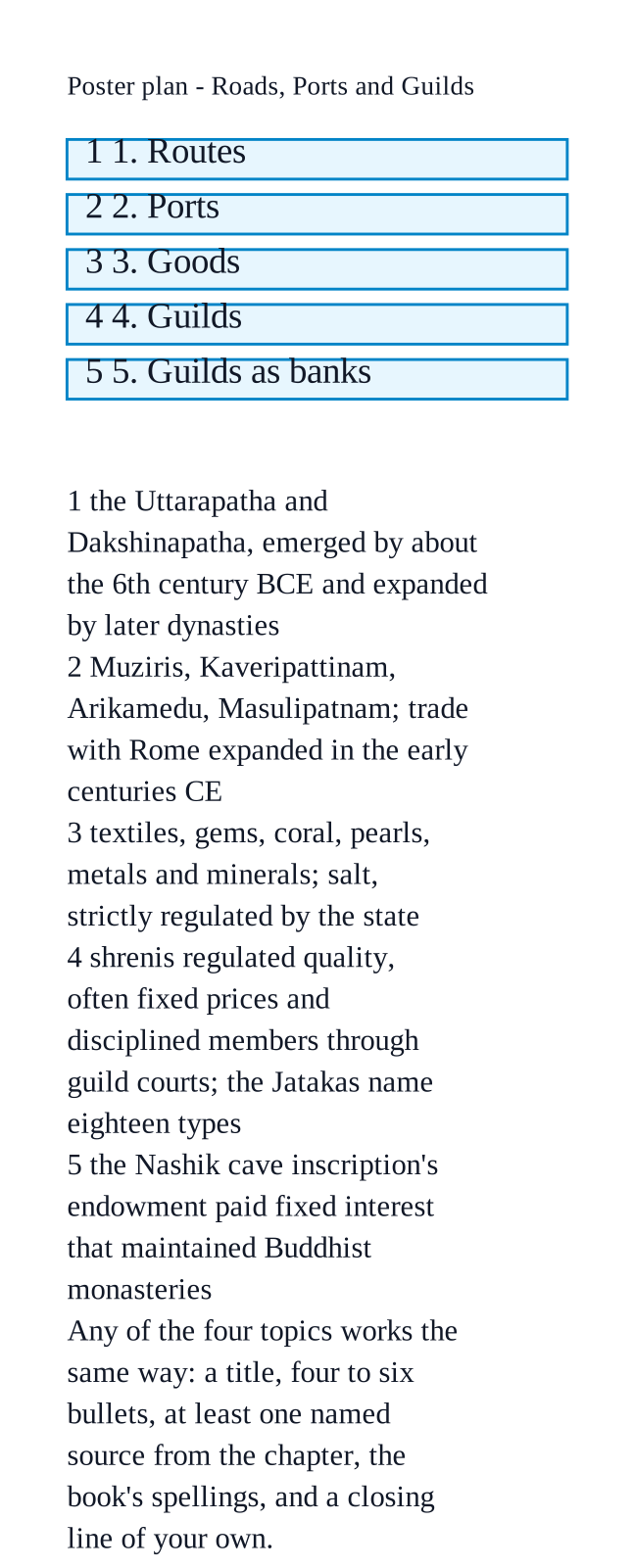
Title: "Roads, Ports and Guilds: How Early India Did Business".
Panel $\displaystyle 1$ — Routes: the Uttarāpatha and Dakṣhiṇāpatha had emerged by about the 6th century BCE and were maintained and expanded by later dynasties.
Panel $\displaystyle 2$ — Ports: Muziris, Kāveripaṭṭinam, Arikameḍu, Masulipaṭnam; by the early centuries CE trade with Rome had expanded significantly.
Panel $\displaystyle 3$ — What was traded: Magadha's textiles, gems, coral, pearls, metals and minerals; salt, strictly regulated by the state.
Panel $\displaystyle 4$ — Guilds (śhreṇīs): associations of one profession or craft; they regulated quality, often fixed prices, and disciplined members through guild courts; the Jātaka literature names eighteen types.
Panel $\displaystyle 5$ — Guilds as banks: quote the Nāśhik cave inscription (2nd century CE) — endowments deposited with guilds paid fixed interest that maintained Buddhist monasteries and caves.
Closing line: your own sentence on why guilds mattered.
a. Life in the Vedic society
Units of society: kula (family) → grāma → viśha under a viśhapati → jana, with the rājā as protector.
Gotra as a patrilineal lineage traced to a Vedic ṛiṣhi, which also regulated marriage.
The four āśhramas — brahmacharya, gṛihastha, vānaprastha, saṁnyāsa — and the ṣhoḍaśha saṁskāras, the sixteen rites of passage.
The four puruṣhārthas — dharma, artha, kāma, mokṣha — with artha to be pursued only as guided by dharma.
Religion: yajñas offered to the sacred fire, deities tied to nature (sun, rain, fire, earth, dawn) with no rigid hierarchy among them; some practices survive in festivals such as Chhath and Makar Sankranti.
b. Early education system (gurukula)
Education was holistic — a complete preparation for life, not just a path to a career.
Inner values: truth, patience, regularity, humility, control of senses, purity of self (sattvaśhuddhi), a sense of the unity of life and nature, reverence for all beings.
Subjects: the Vedas, grammar, logic, philosophy, ethics, mathematics, science, medicine, astronomy; music, dance, painting, physical education and martial arts such as archery; plus yoga and meditation.
The teacher's home was the centre of the gurukula, the student lived as a member of the teacher's family, and the guru-śhiṣhya paramparā was regarded as sacred.
Great centres of learning on Fig $\displaystyle 5.10$ include Takṣhaśhilā, Nālandā, Vallabhī, Vikramśhilā, Ujjayinī and Kānchīpuram; the timeline dates Nālandā to $\displaystyle 427$ CE, Vallabhī to $\displaystyle 480$ CE, and Vikramśhilā to $\displaystyle 783$–$\displaystyle 820$ CE.
c. Trade and guilds in early India
Use the worked example above; add that metallic coins, beginning with silver punch-marked coins, came into circulation as trade grew after the rise of the mahājanapadas.
Add the Sanchi example: the guild of ivory workers from Vidiśhā carved the sculptures on the gateways and railings of the Great Stupa.
d. Role of women in early Indian society
Vedic period: women took part in scholarly learning, in certain contexts performed rituals, joined chariot races and attended the sabhā.
Women sages credited with Ṛigvedic hymns — Apālā, Viśhvavārā, Ghoṣhā, Lopāmudrā; the revered goddesses Uṣha and Aditi.
Manu-smṛiti $\displaystyle 3.56$: "Where women, verily, are honoured, there gods rejoice."
Over time the position of women fluctuated and even declined, though they continued to contribute to household management, agriculture, crafts and religious practice.
Named women: Prabhāvatī Gupta, regent in the Vākāṭaka kingdom, who issued land grants in her own name; the Sangam poetesses Avvaiyar and Vennikuyattiyar; and Sembiyan Mahādevī of the Chola period, who supported temple building.
What a good poster or presentation must contain
A clear title and $\displaystyle 4$–$\displaystyle 6$ short points — bullets, not paragraphs.
At least one named source from the chapter (a text, an inscription, or a dated event).
The book's spellings and diacritics, copied exactly.
A sketch, timeline or hand-drawn map that you make yourself, if it helps the point.
One concluding line in your own words saying why the topic still matters.