SolveItClass 9 · NCERT

NCERT Solutions · Class 9 Social Science State and Society up to 1000 CE

32 questions · 32 still being checked

Questions and activities 5.1–5.10 (part 6 of 7)

  1. Exercise 5.1

    How did political organisation change from the Vedic period to the age of large empires such as the Mauryas and the Guptas? Explain the administrative system of the early Indian states.

    The book prints no answer for this

    NCERT publishes no answers for this textbook, so there is nothing in the book to check this working against. It has also not yet been read through by hand.

    How political organisation changed
    It moved from kin-based clans, to territorial states, to empires.
    Vedic period: the unit was the jana (clan), bound by kinship. The rājā was a clan chief who led in warfare and protected members. Family (kula) formed part of the grāma, several grāmas made a viśha under a viśhapati, and above that stood the jana. Three assemblies — sabhā, samiti and vidhata — shared in decisions.
    c. $\displaystyle 1000$–$\displaystyle 600$ BCE: janas became janapadas — the word means where a people (jana) first set its feet. Identity shifted from kinship to land, and control over land, agricultural production and trade routes grew important.
    c. $\displaystyle 600$ BCE–$\displaystyle 300$ CE: larger mahājanapadas appeared, usually counted as sixteen. Northern India now held both monarchies (rājyas) and republics (gaṇas or saṁghas). Magadha became the strongest, helped by its strategic location, fertile plains and strong rulers.
    Age of empires: Magadha's expansion led to the Mauryan Empire, and later the Guptas; the Satavāhanas ruled the Deccan for nearly $\displaystyle 500$ years, and later still came the Pallavas, Chālukyas, Gurjara-Pratihāras, Pālas, Rāṣhṭrakūṭas and the imperial Cholas.
    The administrative system of the early Indian states
    The state was seen as an organic whole of seven constituents (Saptāṁga) in Kauṭilya's Arthaśhāstra: the king (swāmi), the ministers and high officials (amātya), the territory with its people (janapada), the fortified towns and cities (durga), the treasury (koṣha), the forces of defence and law and order (daṇḍa), and the allies (mitra).
    The king governed through a council of ministers (mantri-pariṣhad) of elder statesmen — treasurer, chief tax collector, chief legal advisor and commander-in-chief.
    Territory was divided into provinces → divisions → districts → villages. In the Satavāhana empire the divisions were āḥāras, each with its amātyas, and villages were led by a headman, the grāmika.
    Pradeśhikas (district governors) handled judicial and administrative work, often deciding after consulting bankers, caravan leaders, artisans and scribes; cities had their own governors for revenue collection and law and order.
    Under the Guptas the mantri headed civil administration; a new sāndhivigrahika (minister of peace and war) was created, and kumārāmātyas served at provincial and local levels. The Damodarpur copper plates show a district office of five: head district officer, chief banker, chief caravan trader, chief artisan and chief of revenue collection.
    Villages governed themselves to a great extent, through assemblies and small committees (variyams) for irrigation, gardens and temple management — the Chola Uttaramerur inscription even records the Kudavolai or 'ballot pot' method of choosing them.
  2. Exercise 5.2

    Describe the role of the king, important officers, and the methods used to govern large territories.

    The book prints no answer for this

    NCERT publishes no answers for this textbook, so there is nothing in the book to check this working against. It has also not yet been read through by hand.

    The role of the kingNCERT_Solution_Class9_SocialScience_Ch5_QA_Q5-2
    Supreme authority rested with the king, but his first task was protection and justice, not power for its own sake.
    He protected subjects from external threats and internal disorder, and administered justice in cases such as abduction, robbery, theft and adultery; serious offences carried severe punishments.
    The Yajurveda coronation oath asked him to judge the strong and the weak impartially and fairly, to protect the country from all calamities, and to do good to the people.
    The Śhānti Parva of the Mahābhārata set out his ethical conduct and responsibilities, and the Arthaśhāstra warned that "Only if a king is himself energetically active, do his officers follow him energetically."
    Kingship was generally hereditary, but there are references to kings being elected or even expelled — royal authority was not always absolute.
    Important officers
    The mantri-pariṣhad, a small council of elder statesmen: the treasurer, the chief tax collector, the chief legal advisor and the commander-in-chief of the army.
    Under the Guptas: the mantri as head of civil administration, plus the commander-in-chief, the general, the chief of the palace guards, the new sāndhivigrahika (minister of peace and war), and kumārāmātyas at provincial and local levels.
    Amātyas headed divisions (the āḥāras of the Satavāhanas); pradeśhikas were district governors with judicial and administrative duties; cities had governors; the grāmika was the village headman.
    District offices could be collegiate — the Damodarpur plates name five members, including the chief banker, the chief caravan trader and the chief artisan.
    Methods used to govern large territories
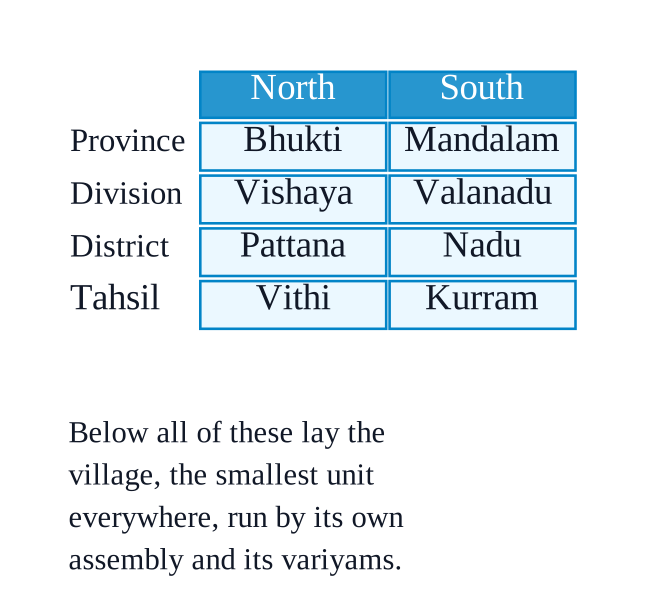
    Layered division of the realm. The rājya was split into provinces (bhuktis in the north, manḍalas/manḍalams in the south), then divisions (viṣhaya or bhoga; koṭṭams or valanāḍu), then districts (adhiṣhṭhāna or paṭṭana; nāḍu), then groups of villages (vithis; paṭṭalā and kūṛram), and finally villages.
    Consulting local notables — bankers, caravan leaders, artisans and scribes — so decisions fitted local conditions.
    Letting villages run themselves through assemblies and variyams; Chola village assemblies handled revenue collection, land management, irrigation, road construction and record maintenance.
    Land grants to bind local groups to the state — the Pallavas' tax-free Brahmadeya villages, and the Chālukyas' agrahārams, some of which (Aihole, Badami) became centres of learning.
    Inscriptions to publish decisions, rules and public works permanently across a wide area.
    Deliberate decentralisation between about $\displaystyle 300$ CE and $\displaystyle 800$ CE, adopted for administrative convenience.
  3. Exercise 5.3

    After studying this chapter, what do you think were the most important features of the state and society in India before 1000\displaystyle 1000 CE?

    The book prints no answer for this

    NCERT publishes no answers for this textbook, so there is nothing in the book to check this working against. It has also not yet been read through by hand.

    The single most striking feature was continuity through change — dynasties rose and fell, but institutions, ideas and traditions carried on.
    1. Monarchy bound by duty, not absolute power
    The king's job was to protect and to judge; he was guided by dharma and advised by a council of ministers.
    The state was thought of as seven parts working together (Saptāṁga), not as one man.
    2. Layered administration with strong self-governing villages
    Provinces, divisions, districts and villages, staffed by governors and district officers.
    Village assemblies and variyams managed irrigation, justice, taxes, land and records, functioning as independent, self-reliant institutions.
    The Uttaramerur inscription records the Kudavolai 'ballot pot' way of choosing them, and required candidates to have "honest earnings" and be "pure" of mind.
    3. A pan-Indian political ideal
    Chakravarti samrāṭ, Jambudvīpa, Bhāratavarṣha, prithivi — rulers from the Cheras to the Cholas imagined authority over the whole subcontinent.
    4. A society organised by function, and mobile at first
    Varṇa began as a functional division; jātis multiplied as new groups and occupations arose.
    There was genuine mobility — rulers came from diverse backgrounds, weavers were also archers and astrologers, brāhmaṇas served as land managers.
    5. Ethics at the centre of law and life
    Dharma (duty and right conduct), ṛita (cosmic order) and samatva (sameness) shaped both government and daily life.
    6. A strong economy and a living knowledge tradition
    Agriculture supported by irrigation works, guilds (śhreṇīs) that were also banks, the Uttarāpatha and Dakṣhiṇāpatha routes, and busy ports.
    Great centres of learning — Takṣhaśhilā, Nālandā, Vallabhī, Vikramśhilā and others — whose traditions outlasted the kingdoms that funded them.
  4. Exercise 5.4

    What do early texts such as the Ṛigveda, Arthaśhāstra, and the Mahābhārata reveal about political and social life?

    The book prints no answer for this

    NCERT publishes no answers for this textbook, so there is nothing in the book to check this working against. It has also not yet been read through by hand.

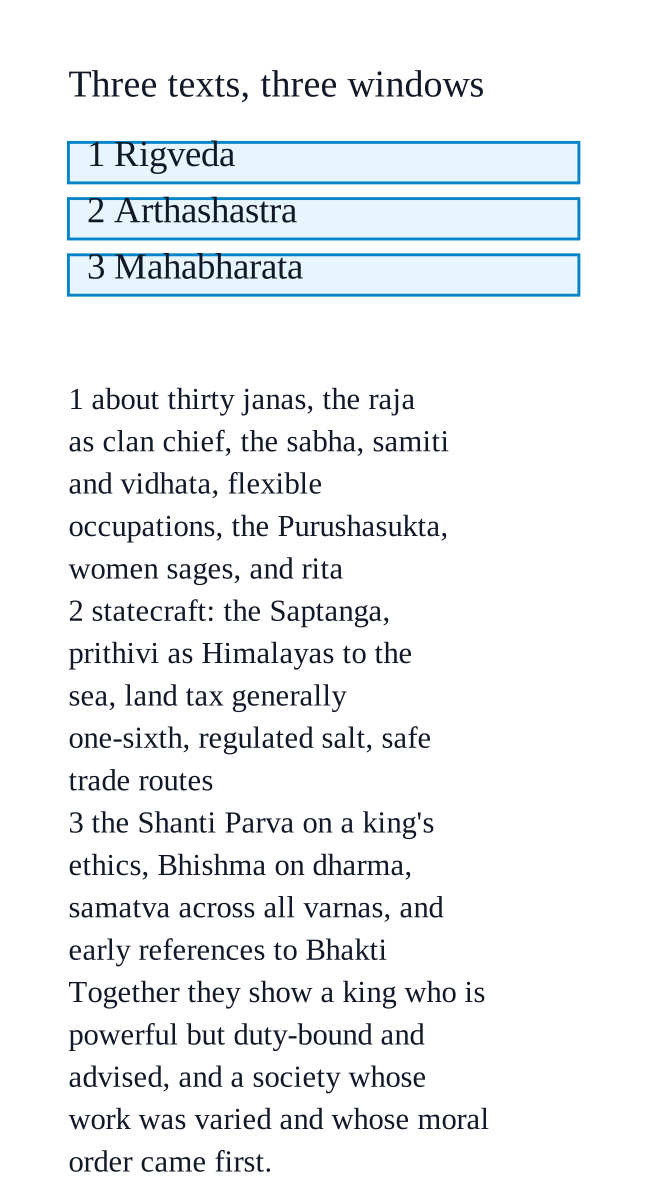
    The ṚigvedaNCERT_Solution_Class9_SocialScience_Ch5_QA_Q5-4
    Shows a kin-based society and an early polity: about thirty janas, five of them the pañchajana, and the Bharata jana named after its ruling family.
    The rājā was a clan chief who led in warfare and protected members — not a territorial king.
    Along with the Atharvaveda, it names three assemblies — sabhā, samiti and vidhata — so decisions were shared.
    Occupations were flexible: verse $\displaystyle 9.112.3$ has a poet, a physician father and a corn-grinding mother in a single family.
    The Puruṣhasūkta, in Book $\displaystyle 10$, carries the earliest reference to the four social categories later understood as varṇa.
    Several hymns are attributed to women sages — Apālā, Viśhvavārā, Ghoṣhā, Lopāmudrā — and goddesses such as Uṣha and Aditi were revered.
    It describes ṛita, the all-pervading cosmic order that upholds harmony in nature and in human society.
    The Arthaśhāstra
    A systematic treatise on statecraft and administration, insisting the king be trained in governance.
    Sets out the Saptāṁga, the seven constituents of a state, which must stay properly integrated.
    "One wheel does not move the carriage" — governance needs cooperation and organised machinery.
    Gives the political geography: prithivi is "the area lying between the Himavat (Himalayas) and the sea", equated with the chakravarti kśhetra.
    On the economy: land classified for revenue, the basic land tax generally one-sixth of the produce, types of village land described in detail, trade named a major activity, salt production strictly regulated, and the state ensuring safe trade routes and protecting consumers from adulteration.
    The Mahābhārata
    Its Śhānti Parva guides rulers on ethical conduct, justice and responsibility to subjects.
    Bhishma's definition of duty: dharma "is that which upholds beings; whatever upholds all beings is dharma".
    Characters from all varṇas uphold samatva, and the epics criticise discrimination, presenting goodness as non-discriminatory.
    The ideal person and ruler is "one who works for the welfare of all beings".
    It contains early references to Bhakti, long before the organised Bhakti tradition.
    Taken together
    On political life: a king who is powerful but duty-bound, advised by ministers and, in early times, checked by assemblies.
    On social life: family and clan at the base, work varied and initially unfixed, and moral order treated as the foundation of society.
  5. Exercise 5.5

    What can we learn from early Indian society about varṇa and the role of women?

    The book prints no answer for this

    NCERT publishes no answers for this textbook, so there is nothing in the book to check this working against. It has also not yet been read through by hand.

    What varṇa teaches usNCERT_Solution_Class9_SocialScience_Ch5_QA_Q5-5
    Varṇa began as a functional division of four — brāhmaṇas, kṣhatriyas, vaiśhyas, śhūdras — and not as a ranking fixed by birth.
    Early Vedic texts do not indicate any fixed social status strictly based on birth; identity came from ethnicity, subgroup, region, village, gotra, language and especially occupation.
    The values behind it placed knowledge highest, then political power, then wealth.
    The Buddhist Sutta Nipāta states it plainly: "No brāhmaṇa is such by birth. No outcaste is such by birth but only by his deeds."
    Practice was looser than theory — śhūdras were also engaged in agriculture, animal husbandry, trade, and arts and crafts.
    There was real mobility: rulers came from diverse backgrounds (the Nandas, Mauryas, Śhuṅgas, Satavāhanas, Vākāṭakas, Guptas and Puṣhyabhūtis); the Mandsaur Stone Inscription ($\displaystyle 473$ CE) records a guild of silk weavers also skilled in archery and astrology; the Karitalai copper plates record brāhmaṇas working as land managers.
    The important lesson: this flexibility gradually got reduced over time — rigidity was a later development, not the original design.
    What the role of women teaches us
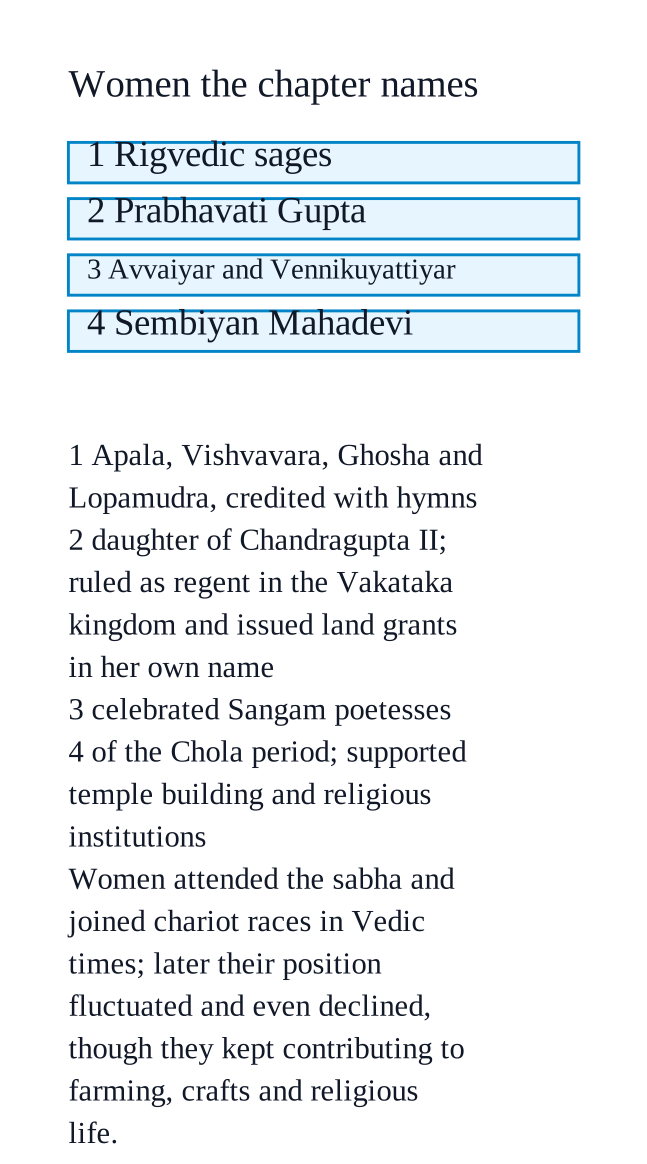
    In the Vedic period women held a high and respectful position — they took part in scholarly learning, in certain contexts performed rituals alongside men, joined chariot races and attended the sabhā.
    Several Ṛigvedic hymns are attributed to women sages — Apālā, Viśhvavārā, Ghoṣhā and Lopāmudrā — and the goddesses Uṣha and Aditi were revered.
    Later texts keep the tradition: Manu-smṛiti $\displaystyle 3.56$ says that where women are honoured the gods rejoice, and where they are not, all sacred rites prove fruitless.
    But the picture is not one straight line: over time the position and roles of women fluctuated, and even declined, as social and political conditions changed.
    Women nevertheless kept contributing — to household management, agriculture, crafts and religious practice.
    Named examples: Prabhāvatī Gupta, daughter of Chandragupta II, ruled as regent in the Vākāṭaka kingdom and issued land grants in her own name; women appear as donors on votive inscriptions from the post-Maurya period; the Sangam poetesses Avvaiyar and Vennikuyattiyar are remembered; and in the Chola period Sembiyan Mahādevī supported temple building and religious institutions.
    Sangam literature also shows women doing the economy's real work — planting, weeding, husking and winnowing paddy, cattle rearing, spinning, fishing, salt production and garland selling.
  6. Exercise 5.6

    Explain how assemblies like sabhā and samiti limited the power of the rājā. Which modern institutions perform similar functions today?

    The book prints no answer for this

    NCERT publishes no answers for this textbook, so there is nothing in the book to check this working against. It has also not yet been read through by hand.

    How the assemblies limited the rājā
    The Vedic rājā was a clan chief, not an absolute monarch — he had to carry the assemblies with him.
    The sabhā was a smaller body, composed of select elites, which primarily served a judicial function — so the king was not the only judge.
    The samiti was a larger assembly focused on policy decisions and political affairs, and it represented the broader population — so major decisions were discussed, not simply ordered.
    The chapter names a third body too, the vidhata, a popular gathering attended by members of the janas and a forum for discussions on warfare and other political matters — so even war was debated.
    Because these bodies existed, royal power was shared and answerable; the chapter adds that although kingship was generally hereditary, there are references to kings being elected or even expelled.
    The chapter also notes that women attended the sabhā, which shows these were real working gatherings.
    Which modern institutions perform similar functions
    Parliament at the Union level and the State Legislatures debate policy and hold the head of government to account — the work the samiti did.
    The courts perform the judicial function of the sabhā.
    The gram sabhā and the panchayat are the closest village-level equivalents, where local people decide local matters.
    Say clearly in your answer that these are only parallels: the sabhā was made of select elites, not of representatives elected by everyone.
  7. Exercise 5.7

    What do the terms varṇa and jāti refer to in early Indian society? How were they different, and what factors may have contributed to the formation of various jātis?

    The book prints no answer for this

    NCERT publishes no answers for this textbook, so there is nothing in the book to check this working against. It has also not yet been read through by hand.

    What varṇa refers toNCERT_Solution_Class9_SocialScience_Ch5_QA_Q5-7
    The fourfold ordering of society: brāhmaṇas, kṣhatriyas, vaiśhyas and śhūdras.
    The earliest reference to these four categories appears in the Puruṣhasūkta, a hymn in Book $\displaystyle 10$ of the Ṛigveda.
    Over time each was linked with particular roles: brāhmaṇas to studying and teaching the Vedas, performing and officiating yajñas, and giving and receiving dāna; rajanya (kṣhatriyas) to warfare, protecting people and administering justice; vaiśhyas to agriculture, pastoralism and trade; śhūdras to assisting the other varṇas — though in practice śhūdras also farmed, kept animals, traded, and worked in arts and crafts.
    The division was a functional one, resting on values that ranked knowledge highest, then political power, then wealth.
    What jāti refers to
    A distinct social structure that emerged later, made up of many smaller groups within society.
    Jātis were endogamous — people were expected to marry within their own group.
    As new social groups and occupations developed, the number of jātis kept growing.
    How they were different
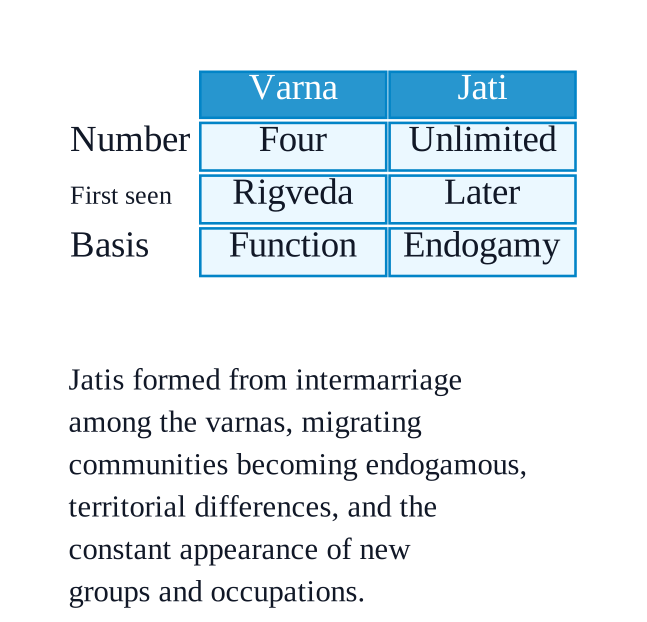
    Number: varṇas were fixed at four; there was no restriction on the number of jātis.
    Age: varṇa is named in the earliest texts; jāti emerged gradually, later.
    Basis: varṇa was a functional division built around occupation and values; jāti grew out of marriage rules, migration and locality.
    Marriage: endogamy was a defining custom of jāti; varṇa as first described did not fix status by birth at all.
    Factors that contributed to the formation of jātis
    Intermarriage among the varṇas.
    Migrating communities becoming endogamous — settling in a new region and marrying only among themselves.
    Territorial differences between one region and another.
    The continuing appearance of new social groups and new occupations, each of which could become a jāti.
  8. Exercise 5.8

    Why do you think education in early India emphasised both knowledge and moral values? How might this have benefited society?

    The book prints no answer for this

    NCERT publishes no answers for this textbook, so there is nothing in the book to check this working against. It has also not yet been read through by hand.

    Why both knowledge and moral values
    Because education aimed at preparing a person for life, not just for a career — the chapter calls it a complete preparation for life.
    Knowledge alone was not thought enough: pupils were trained to live in accordance with dharma, the guiding principle for the individual, the family and society.
    The inner values cultivated were truth, patience, regularity, humility, control of the senses, purity of self (sattvaśhuddhi), a sense of the underlying unity of life, nature and environment, and reverence for all beings.
    Dharma required students to fulfil duties towards parents, teachers and the gods, so learning and conduct were taught as one thing.
    The practical side was wide — the Vedas, grammar, logic, philosophy, ethics, mathematics, science, medicine and astronomy, plus music, dance, painting, physical education and martial arts such as archery, alongside yoga, meditation and service to the guru.
    The guru-śhiṣhya paramparā was regarded as sacred, and the student lived as a member of the teacher's family — so values were absorbed by living them, not just by being told them.
    How this benefited society
    Good character and moral conduct were seen as the foundation of society — so training character was training society itself.
    People taught duty made more trustworthy officials, judges, traders and rulers; the chapter notes the 10th-century Uttaramerur inscription required candidates for village assemblies to have "honest earnings" and be "pure" of mind.
    Skilled and ethical practitioners in medicine, law, astronomy and crafts served the whole community, not only themselves.
    A shared moral vocabulary held large and varied communities together without constant force.
    Knowledge kept being passed on down the generations, which is why, as the chapter says, many knowledge traditions persisted despite the rise and fall of kingdoms.
  9. Exercise 5.9

    Look at the major trade routes of early India (Fig 5.12\displaystyle 5.12). How do you think these routes helped people in the exchange of goods, skills, beliefs, and cultural practices.NCERT_Question_Class9_SocialScience_Ch5_QA_Q5-9

    The book prints no answer for this

    NCERT publishes no answers for this textbook, so there is nothing in the book to check this working against. It has also not yet been read through by hand.

    The routes worked as the subcontinent's nervous system — goods, people and ideas travelled the same roads, so exchange of one meant exchange of all.
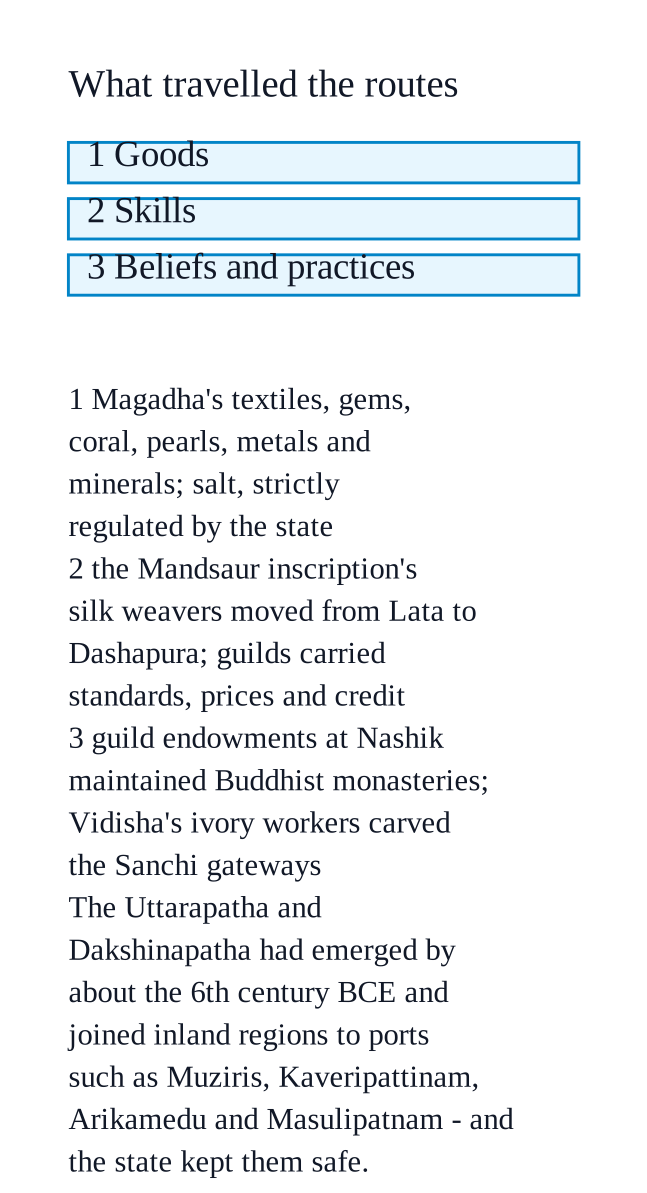
    NCERT_Solution_Class9_SocialScience_Ch5_QA_Q5-9Goods
    By about the 6th century BCE two great land routes, the Uttarāpatha and the Dakṣhiṇāpatha, had emerged, and later dynasties maintained and expanded them.
    The Arthaśhāstra records Magadha trading textiles, gems, coral, pearls, metals and minerals with northern, central and southern India; salt was another important commodity, strictly regulated by the state.
    The routes connected inland regions with coastal ports, joining overland and maritime trade into a single system; ports such as Muziris, Kāveripaṭṭinam, Arikameḍu and Masulipaṭnam grew on this traffic, and by the early centuries CE India's trade with Rome had expanded significantly.
    Skills
    Artisans and traders moved along the routes and carried their crafts with them — the Mandsaur Stone Inscription ($\displaystyle 473$ CE) records a guild of silk weavers migrating from Lata in Gujarat to Dashapura, skilled not only in weaving but in archery and astrology.
    Textile centres such as Mathurā, Kāśhī and Kāmarūpa could supply distant markets because the routes reached them.
    Guilds (śhreṇīs) spread standards of quality and price along the same network, and acted as banks and financiers wherever trade went.
    Beliefs and cultural practices
    The chapter says plainly that these routes facilitated the movement of goods, people, and ideas, connecting inland regions with coastal ports.
    Wealth generated on the routes paid for religious life: the Nāśhik cave inscription records guild endowments whose interest maintained Buddhist monasteries and caves, and the guild of ivory workers from Vidiśhā carved sculptures at the Great Stupa at Sanchi.
    Because the routes were trans-regional, they tied distant parts of the subcontinent into one cultural world — which is why practices, texts and traditions are found far from where they began.
    Why the exchange could keep going
    The state ensured the safety of trade routes, prevented adulteration of goods and protected consumers from unfair practices — without that security, none of this movement would have been possible.
  10. Exercise 5.10

    What might have been the advantages and challenges of ruling a large empire in the absence of modern communication systems?

    The book prints no answer for this

    NCERT publishes no answers for this textbook, so there is nothing in the book to check this working against. It has also not yet been read through by hand.

    AdvantagesNCERT_Solution_Class9_SocialScience_Ch5_QA_Q5-10
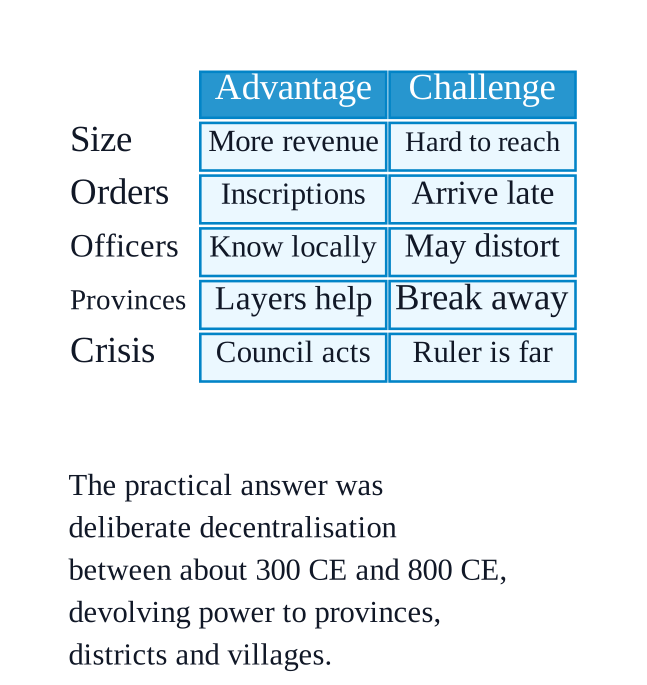
    Scale paid for itself — a large territory meant a large revenue base: the land tax, generally one-sixth of the produce under the Mauryas, plus city revenues and trade.
    Long trade routes such as the Uttarāpatha and Dakṣhiṇāpatha lay inside a single authority, so the state could keep them safe and goods could travel far.
    A layered administration meant most matters never had to reach the capital: provinces, districts and villages settled their own affairs.
    Self-reliant villages with assemblies and variyams ran irrigation, records, roads and local justice without waiting for orders.
    Local officers could decide well because they consulted bankers, caravan leaders, artisans and scribes on the spot.
    Inscriptions let a ruler publish one message across an enormous area and leave it standing permanently — Aśhoka's edicts are the clearest example.
    Big states could fund big works — dams and lakes, temples, and centres of learning.
    Challenges
    News travelled only as fast as a person could — a distant revolt, famine or invasion would be known late, and the reply would arrive later still.
    Officers far from the capital could ignore, delay or distort orders; hence the Arthaśhāstra's warning that officers work energetically only if the king does.
    Emergencies could not wait for the ruler, which is why the council of ministers had to be able to act — an Aśhokan inscription records it taking decisions during the emperor's absence.
    Collecting revenue and enforcing justice uniformly across many regions and languages was very hard.
    Powerful provincial governors could drift towards independence, and holding a valued centre could invite war — the 'tri-partite struggle' for Kannauj between the Gurjara-Pratihāras, Pālas and Rāṣhṭrakūṭas shows the danger.
    The practical answer to all this was decentralisation — between about $\displaystyle 300$ CE and $\displaystyle 800$ CE power was deliberately devolved to provinces, districts and villages for administrative convenience.