Exercise 6.1
◈ Why is it important that the ultimate source of power rests with the people in a democracy? ◈ How does people’s participation through voting strengthen popular sovereignty?
The book prints no answer for this
NCERT publishes no answers for this textbook, so there is nothing in the book to check this working against. It has also not yet been read through by hand.
◈ Why is it important that the ultimate source of power rests with the people?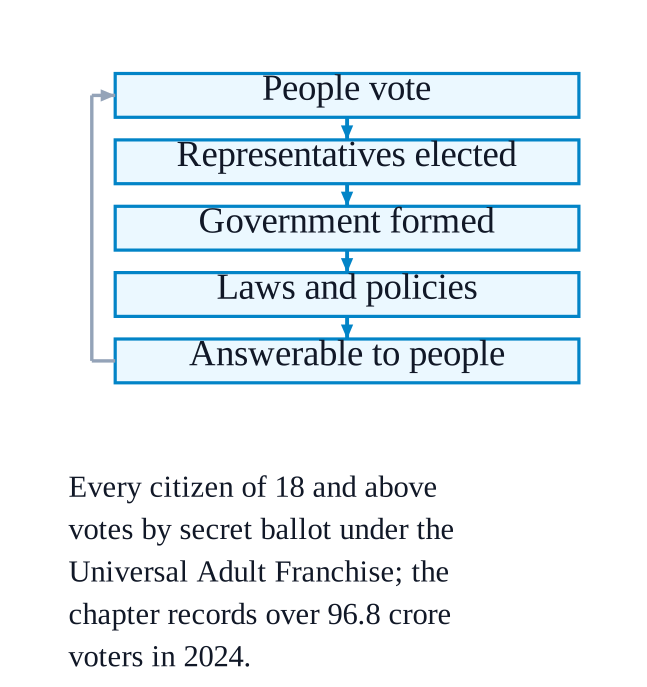
Because that is what popular sovereignty means — the state derives its authority from the people, so the government rules with their consent.
A government that gets its power from the people must answer to them, and can be replaced at the next election.
It stops power from settling permanently with one person or a small group, and keeps rule from being arbitrary.
The laws and policies made by such a government carry the weight of the people's approval.
◈ How does people's participation through voting strengthen popular sovereignty?
Every citizen $\displaystyle 18$ years of age and above has the right to vote by secret ballot — the Universal Adult Franchise — so authority is handed over by the people themselves.
Each vote is equal, so the poorest voter counts exactly as much as the richest.
Because elections come round again, representatives know they must keep the people's trust.
Scale makes the point: the chapter records a voter base of over $\displaystyle 96.8$ crore in $\displaystyle 2024$, the largest participatory exercise anywhere.