Exercise 6.1
We have learnt in previous grades that democracy is a form of government in which the source of power and authority lies with the citizens of the country, who elect their representatives through free and fair elections. Democracy is founded on the principles of freedom, equality, justice, rights and duties, ensuring that citizens have the right to vote, express their opinions, and participate in the decision-making processes.
The book prints no answer for this
NCERT publishes no answers for this textbook, so there is nothing in the book to check this working against. It has also not yet been read through by hand.
Democracy is a form of government in which the source of power and authority lies with the citizens, who elect their representatives through free and fair elections.
It is founded on the principles of freedom, equality, justice, rights and duties.
Citizens have the right to vote, to express their opinions, and to take part in decision-making.
India is the world's largest democracy — the chapter notes a population of over $\displaystyle 140$ crore and a voter base of over $\displaystyle 96.8$ crore (in $\displaystyle 2024$).
Indian democracy is guided by the Constitution of India, adopted on $\displaystyle 26$ November $\displaystyle 1949$ and in force from $\displaystyle 26$ January $\displaystyle 1950$; it guarantees and protects Fundamental Rights and ensures no citizen is discriminated against on the basis of religion, race, caste, sex or place of birth.
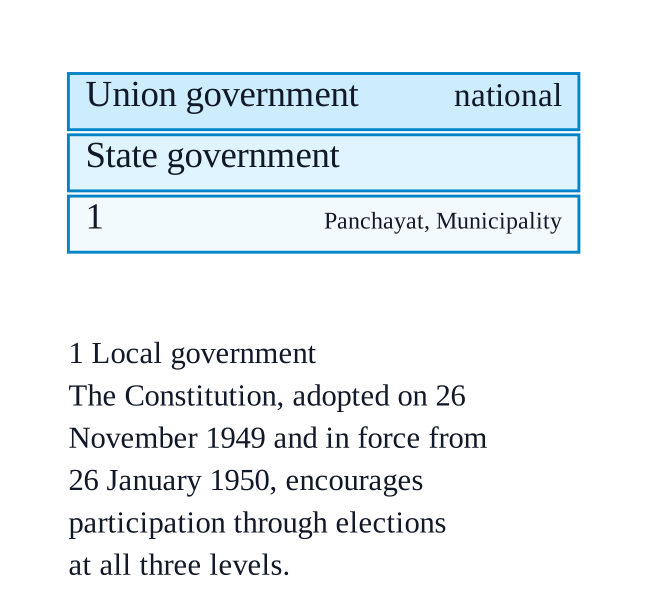
The Constitution also encourages participation through elections at the national, state and local levels.